
From Andon to Akari: The Japanese Lamp
Light, Filtered
From Andon to Akari: The Japanese Lamp
Before the bulb, the Japanese house was lit by a saucer of oil behind paper. This chapter follows that small flame from the andon and the lantern to the Akari, the paper light that Isamu Noguchi drew in Gifu in 1951.
Fact sheet
At a glance
- A flame behind paper. The andon sheltered a saucer of oil with a wick of cotton or pith inside a paper-covered frame of bamboo, wood or metal.
- Four families of light. Wikipedia lists the andon, the bonbori, the chōchin and the tōrō as the traditional lighting equipment of Japan.
- A dim world. Morse wrote in 1886 that before kerosene the means of lighting were of the most meagre description.
- Gifu, 1951. Noguchi visited Gifu in 1951, was asked to modernise the town’s paper lanterns, and designed the Akari.
- Flat to ship. Akari could be collapsed and shipped flat, and were an immediate success in Japan and worldwide.
From a Saucer of Oil to a Sculpture of Paper
The lamp is the object in which the Japanese interior shows its character most plainly. The room is built of paper, wood and straw, all of which burn, and so the flame has to be sheltered, set low and made soft. Every form in this chapter answers that problem in a different way: the box of paper that shelters a saucer of oil, the folding lantern that can be carried through a street, the stone shape that stands in a garden and the paper cylinder that Isamu Noguchi hung in a modern room.
This chapter follows the lamp from the first of those forms to the last. It is a story with a clear thread. Wikipedia describes the Akari as a modern version of traditional Japanese lanterns, and Noguchi himself compared their light to the sun filtered through the paper of shoji. The thread runs from the andon of the Edo period, through the lanterns of Gifu, to a design that is now held in museums on three continents.

Utagawa Kuniyasu, Monochrome woodblock print; ink on paper. The Metropolitan Museum of Art, accession JP1833. H. O. Havemeyer Collection, Bequest of Mrs. H. O. Havemeyer, 1929. Open Access.
Look closer: A woman bends to a tall cylindrical lamp: the andon as a presence in the room, taller than a kneeling person.
The Metropolitan Museum of Art, public domain (Open Access). Source: https://www.metmuseum.org/art/collection/search/56118
The chapter before this one, on Yanagi Sōri, dealt with the object that the Japanese room put underfoot and in the hand. The lamp is its counterpart, the object that the room put over its head. Between them they are the two ends of the household that this almanac keeps returning to: what is held, and what is lit.
Light in the Japanese House Before the Bulb
Edward S. Morse, in Japanese Homes and Their Surroundings of 1886, wrote with feeling about the old light. In his words, before kerosene oil was introduced into Japan the means of illumination were of the most meagre description. He could hardly imagine the difficulty of a student studying the Chinese classics by the feeble light of tiny wicks or by the dim and unsteady flame of a vegetable-wax candle, a light made feebler still when filtered through a paper lantern.
He passed on a story that shows how dark it was. In former times, he writes, devout students of the classics were said to read a single character at a time by the glow of a coal at the end of an incense stick held close to the page. Whether or not the story is true, he recorded it as a tale told in Japan, and it is a reminder of what the paper lamp had to compete with: not a bulb but a spark.
Of all the things that the Japanese took from Western nations and quickly put to use, Morse says, he knew of nothing that had been such a boon to all the people as kerosene oil. The bright light of kerosene, he adds, had lengthened the day for all. It is a view worth setting beside the later affection for the old light. The designers and collectors who now prize the soft glow of a paper lamp are looking back at something that its own users were glad to leave.
The candle had its own craft. Morse describes Japanese candles as made of a vegetable wax, with a wick of a roll of paper, hollow, fitted on a sharp iron spur in the candlestick. When a candle had burned low it was taken off and set on the end of a new candle, so that all of it was used. A better candle, made in the province of Aidzu, was painted in bright colours with flowers and other designs. Candles lit the rooms and the hand-lanterns carried about the streets, and the house lanterns consisted of a square or hexagonal frame covered with paper on the end of a short handle.

Period engraving. Edward S. Morse, Japanese Homes and Their Surroundings (Boston: Ticknor and Company, 1886), figure 205. Wood-engraved illustration, public domain.
Look closer: The iron candlestick Morse called te-shoku, with a disk to catch the wax and a long arm to lift it from the floor.
Edward S. Morse, 1886, public domain, via Project Gutenberg ebook 52868. Source: https://www.gutenberg.org/ebooks/52868
The common iron candlestick, called te-shoku, stood on three legs with a wide disk to stop wax falling on the mats and a ring about the candle to hold it upright. It could be picked up from the floor by its longer arm. A second kind, of brass, rose on a rod from a hemispherical base. The snuffer was a blunt pair of tweezers, though Morse observes that servants often used the hibashi, the tongs, and thrust the burnt wick into the ashes of the hibachi.
The Andon: Paper, Frame, Saucer and Wick
The andon is the principal lamp of the traditional house. Wikipedia describes it as a lamp consisting of paper stretched over a frame of bamboo, wood or metal. The paper protected the flame from the wind. Oil burned in a holder of stone, metal or ceramic, with a wick of cotton or pith, and the lamp was usually open at the top and bottom, with one side that could be lifted to give access. Rapeseed oil was popular. Candles were also used, but their higher price made them less popular, and a cheaper alternative was sardine oil.
Morse describes the working of the lamp in more detail. The Japanese lamp is usually a shallow saucer in which vegetable oil is burned. The wick, of long slender rods of pith, is held down by a small iron ring to which a spur is fixed as a handle. The unburned part of the wick projects beyond the saucer, and as it burns away at one end it is moved along. The saucer rests in an iron disk or ring suspended inside a paper-covered frame.
He gives the commonest form of andon as a square frame of wood covered with paper, open above and below, with one side made as a movable lid that can be raised when the lamp needs tending. The frame is fixed to two uprights that rise from a wooden stand. The stand may hold a drawer with extra wicks and a pair of snuffers. The uprights extend above the lantern and carry a cross-piece by which it is lifted, and another cross-bar just below from which the lamp hangs.

Period engraving. Edward S. Morse, Japanese Homes and Their Surroundings (Boston: Ticknor and Company, 1886), figure 207. Wood-engraved illustration, public domain.
Look closer: An andon whose panels open to a small corner shelf for the saucer of oil.
Edward S. Morse, 1886, public domain, via Project Gutenberg ebook 52868. Source: https://www.gutenberg.org/ebooks/52868
It was not a bright light. Morse says plainly that the light of this night-lamp is feeble and uncertain, and that by it one can barely see one’s way about the room. That is what the designers of the twentieth century inherited. The charm of the old andon is the charm of a dim, warm light that moves slightly with the flame and makes the paper itself the source of the glow. The Akari, as the later sections show, kept the paper and replaced the flame.
Wikipedia adds a few facts of use. The andon became popular in the Edo period, from 1603 to 1867, and early on was handheld, though it could also stand on a stand or hang on a wall. The okiandon, the standing kind, was most common indoors. Many had a vertical box shape with an inner stand for the light, some had a drawer at the bottom to make refilling and lighting easier, and a handle on top made them portable.

1760. Porcelain decorated with enamels (Arita ware, Imari type). The Metropolitan Museum of Art, accession 23.225.148. Gift of Mrs. V. Everit Macy, 1923. Open Access.
Look closer: A porcelain andon of 1760 with a window for the light: the lamp in porcelain, made in the Arita tradition.
The Metropolitan Museum of Art, public domain (Open Access). Source: https://www.metmuseum.org/art/collection/search/62941

Utagawa Yoshikazu, 11th month, 1860. Woodblock print; ink and color on paper. The Metropolitan Museum of Art, accession 2007.49.157. Bequest of William S. Lieberman, 2005. Open Access.
Look closer: A print of 1860 that lists a lamp post among the novelties of Yokohama: the new lights arriving beside the old ones.
The Metropolitan Museum of Art, public domain (Open Access). Source: https://www.metmuseum.org/art/collection/search/73443
Standing, Hanging, Fixed and Bedside Lamps
There was no single andon. Morse says there are many kinds, some very ingenious. One is cylindrical and made of two frames, one within the other, the outer turning in a groove in the stand. Half of each frame is covered with paper, so that turning the outer frame brings the openings together and gives access to the lamp. Another form, which he shows in figure 207, opens in a different way, with a little shelf in one corner to hold the saucer of oil. A third, in figure 208, he says was copied from an old coloured picture-book and consists of an elaborate lacquered stand mounted in metal with a lamp on top.
In the passages and at the head of the stairs, he writes, lamps were often fixed to the wall. In Osaka he saw a curious one whose frame was hung by hinges, with the hinges above, to a board on the wall, so that it rested against the board like a cover and was lifted when the lamp needed attention. In another andon in Osaka he saw a good piece of ironwork made to suspend the lamp.
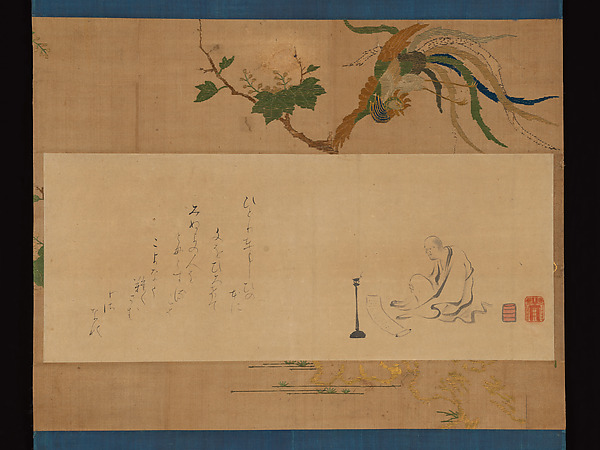
Prince-Abbot Ryōshō, late 17th century. Hanging scroll; ink and color on paper. The Metropolitan Museum of Art, accession 2020.396.22. Mary and Cheney Cowles Collection, Gift of Mary and Cheney Cowles, 2020. Open Access.
Look closer: A seated monk beside a lamp stand, the oldest picture of the subject here: reading by a small flame.
The Metropolitan Museum of Art, public domain (Open Access). Source: https://www.metmuseum.org/art/collection/search/845145
Wikipedia names several further kinds. The Enshū andon, which one explanation attributes to Kobori Enshū, who lived in the late Azuchi-Momoyama and early Edo periods, was tubular, with an opening in place of a drawer. The ariake andon was a bedside lamp. The kakeandon hung under the eaves of a shop, often bearing the merchant’s name, and was a common sight in the towns.
The woodblock prints in the Metropolitan Museum show these lamps in use. In one, a young woman in a patterned robe leans over a tall cylindrical lamp; in another, a hand lantern is carried through snow at night. They are reminders that the lamp was not a fixed object like a chandelier. It was set where it was needed and moved when the work moved, from the reading room to the bedside to the veranda.
The expression hiru andon, a daytime lamp, meant someone or something that seemed to serve no purpose, and Wikipedia notes that in dramatisations of the story of the forty-seven ronin, Ōishi Yoshio is often given that description. A lamp that is not lit is a lamp that does nothing, and the saying reflects how much the household’s routine turned on the flame.

Katsushika Hokusai, Woodblock print (surimono); ink and color on paper. The Metropolitan Museum of Art, accession JP1869. H. O. Havemeyer Collection, Bequest of Mrs. H. O. Havemeyer, 1929. Open Access.
Look closer: A moonlit veranda with a lamp, from a privately printed sheet: the moon as the older lamp of the house.
The Metropolitan Museum of Art, public domain (Open Access). Source: https://www.metmuseum.org/art/collection/search/54434
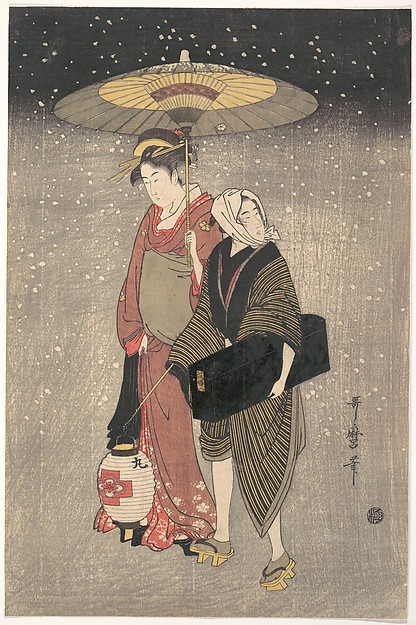
Kitagawa Utamaro, ca. 1797. Woodblock print; ink and color on paper. The Metropolitan Museum of Art, accession JP1665. H. O. Havemeyer Collection, Bequest of Mrs. H. O. Havemeyer, 1929. Open Access.
Look closer: A hand lantern lights the way through a snowy night, the chōchin as a personal light.
The Metropolitan Museum of Art, public domain (Open Access). Source: https://www.metmuseum.org/art/collection/search/55862
Clay Lamps, Candlesticks and Porcelain Lanterns
Lamps made of pottery, Morse remarks, are rarely seen. He shows two from his own collection. One is an old lamp of Oribe ware, with an inclined portion inside to support the wick and a cover notched in front and behind to let the wick pass. The other, made in the province of Iga, has a hole in the wick-tube through which the wick can be moved along, and a handle with a slot so that it can be hung against a wall. He thinks that these two lamps, or at least the last, may have been made for the kami-dana, the shelf that supports the household shrine.
He also shows a pottery candlestick of Owari ware from his collection, with a spike at the top for the candle. Ceramic did not stay a rare material for light, however. The Metropolitan Museum holds several porcelain lamps and lanterns of the late Edo period, made in the Arita tradition. A square lamp of 1760, an andon with a window for the flame, is decorated with enamels, with a standing woman in a long robe. A hanging lamp of 1840 and a lantern of 1850 are pierced with panels or a lattice so that the light would show through the porcelain.
These objects show a long habit of the Japanese interior: the same form is made again in a different material. The paper lantern becomes a porcelain lantern, the stone lantern of the garden becomes a pottery pagoda for a table, and the lantern shape is worn by an incense burner. Each keeps a few signs of the original, such as the pierced panels, the roof with turned-up corners and the ring at the top, and each is a way of bringing the idea of the lantern indoors.

1840. Porcelain decorated with enamels (Arita ware, Imari type). The Metropolitan Museum of Art, accession 23.225.192. Gift of Mrs. V. Everit Macy, 1923. Open Access.
Look closer: A porcelain lamp of 1840 with pierced panels and a pagoda-style roof, a ceramic cousin of the paper lantern.
The Metropolitan Museum of Art, public domain (Open Access). Source: https://www.metmuseum.org/art/collection/search/45943

Genemon, 1850. Porcelain decorated with enamels, and the glaze craquelé (Hizen ware, Kutani type). The Metropolitan Museum of Art, accession 23.225.201. Gift of Mrs. V. Everit Macy, 1923. Open Access.
Look closer: A six-sided porcelain lantern of 1850, its body pierced as a lattice so that the flame shows through.
The Metropolitan Museum of Art, public domain (Open Access). Source: https://www.metmuseum.org/art/collection/search/45944

18th century. White porcelain with mouded designs (Hirado ware). The Metropolitan Museum of Art, accession 29.100.243a, b. H. O. Havemeyer Collection, Bequest of Mrs. H. O. Havemeyer, 1929. Open Access.
Look closer: An incense burner made as a hanging lantern: the lantern form worn by another object.
The Metropolitan Museum of Art, public domain (Open Access). Source: https://www.metmuseum.org/art/collection/search/45958
It is also a reminder of how the lamp could be part of the furnishings of a room as well as a source of light. A well-made lamp in porcelain, stone or lacquer sat in an alcove or on a shelf, and was judged for its form by day as well as by night.

Period engraving. Edward S. Morse, Japanese Homes and Their Surroundings (Boston: Ticknor and Company, 1886), figure 213. Wood-engraved illustration, public domain.
Look closer: A candlestick of Owari pottery from Morse’s own collection, with a spike for the candle and a painted pine.
Edward S. Morse, 1886, public domain, via Project Gutenberg ebook 52868. Source: https://www.gutenberg.org/ebooks/52868
Chōchin and Bonbori: Lanterns That Travel
The chōchin is the lantern that moves. Wikipedia describes it as a relative of the Chinese paper lantern, with a frame of split bamboo wound in a spiral and a covering of paper or silk to protect the flame from the wind. The spiral structure lets it collapse into the basket at the bottom. It is used outdoors, carried or hung outside the house. The earliest record of a chōchin dates to 1085, and one appears in an illustration of 1536.
Today the paper lantern has a second life. Wikipedia notes that in present-day Japan plastic chōchin with electric bulbs are produced as novelties and souvenirs and for festivals and events. The red lantern, it adds, marks an inn or tavern of a particular kind, and in Japanese folklore the chōchin appears as a yōkai, the chōchin-obake.

Period engraving. Edward S. Morse, Japanese Homes and Their Surroundings (Boston: Ticknor and Company, 1886), figure 214. Wood-engraved illustration, public domain.
Look closer: A lantern hung at a gateway on a slender post, which Morse took as a sign of gentle manners.
Edward S. Morse, 1886, public domain, via Project Gutenberg ebook 52868. Source: https://www.gutenberg.org/ebooks/52868
The bonbori is a related lamp. Wikipedia describes it as a kind of Japanese paper lamp used in the open during festivals. It normally has a hexagonal profile and a rather wide, open top, and it can hang from a wire or stand on a pole. The bonbori festival at Tsurugaoka Hachimangū in Kamakura, held annually, is a famous example, in which artists paint on about 400 bonbori set up on the shrine’s grounds.
Morse’s engravings show how a lantern was used at a gate. He describes street-lanterns affixed to short slender posts at the gateway or doorway of a dwelling, usually not over five feet high, and a frail thing to put on a public street. The very frailty and lightness of such objects, exposed with entire safety on busy thoroughfares, are in his words a striking sign of the gentle manners of the Japanese.
Lanterns were also stored. In one of the houses he describes, a shelf in the hall held boxes in which the lanterns were stowed away, and on each box was painted a design matching that of the lantern within, indicating the family name or crest. The lantern was an object of the family’s identity as much as a source of light, and the box was a small piece of that identity put away for the next evening.

Period engraving. Edward S. Morse, Japanese Homes and Their Surroundings (Boston: Ticknor and Company, 1886), figure 224. Wood-engraved illustration, public domain.
Look closer: A shelf of boxes in a hall, each marked with a crest, in which the family’s lanterns were stored.
Edward S. Morse, 1886, public domain, via Project Gutenberg ebook 52868. Source: https://www.gutenberg.org/ebooks/52868
The Household Shrine and Its Flame
One lamp was never allowed to go out. Morse writes that in nearly every house one sees on a shelf called the kami-dana a curious little architectural affair, which on closer look proves to be a model of a Shintō shrine or its principal feature, a circular mirror. On the shelf in front of it are a few lamps, or a single lamp, and trays that may hold food offerings. The shelf is high up on the wall near the ceiling, and in old houses this region, he says, is black with the smoke of the little lamp lit every night, which may have burned there for a century.
The Buddhist household shrines, he continues, are more ornate and rest on the floor, and he was told that most people worship at the shrines of both beliefs. Before Buddhist shrines are placed lamps of brass or hanging lamps, while in front of Shintō shrines candles of vegetable wax are burned. In unglazed hand-made pottery called kawarake, oil is burned, and it is also used for food offerings.
The shrine lamp shows what the domestic lamp was for. It was not only a way of seeing but a way of keeping a household in order with its dead and its gods, lit at a fixed hour each night. The lamp in the main room might give a feeble and uncertain light by which one could barely see the room. The shrine lamp did not need to give more, because its purpose was to be lit.
This is also the setting in which the Akari later found a place. A paper light that stays on in a room, shaped like a quiet column or sphere, has more in common with the shrine lamp than with a reading lamp.
Stone, Bronze and Iron: the Dōrō
The fourth family of Japanese light is the tōrō, or dōrō. Wikipedia explains that the term, once used broadly for any lantern, came to mean a lamp of stone, bronze, iron, wood or another heavy material. These light the grounds of Buddhist temples, Shinto shrines, Japanese gardens and other places that keep tradition in their decor. The earlier use of oil and candles has been replaced in the modern day by electric bulbs.
It names famous bronze examples: a bronze lantern at Hōryū-ji, an eighth-century bronze lantern at Tōdai-ji, listed as a National Treasure, and a bronze lantern at Itsukushima Shrine. Among stone lanterns it shows examples of the Kasuga type at Kasuga-taisha. Wooden lanterns are placed between stone ones at some shrines.
Morse, who saw the lanterns of the 1880s, gives a vivid description. The stone lanterns, he writes, are among the most common yet important accompaniments of garden decoration, and it is rare to see a garden, even of small size, without one or more. They are usually wrought out of soft volcanic rock, and ordinary ones could be bought for a few dollars. They resemble stout stone posts of round, square, hexagonal or octagonal contour, with the upper part hollowed and cut with openings in ornamental shapes. In this cavity a lamp or candle is placed on special occasions.

Period engraving. Edward S. Morse, Japanese Homes and Their Surroundings (Boston: Ticknor and Company, 1886), figure 264. Wood-engraved illustration, public domain.
Look closer: Two stone garden lanterns, the short broad kind with caps shaped like mushrooms.
Edward S. Morse, 1886, public domain, via Project Gutenberg ebook 52868. Source: https://www.gutenberg.org/ebooks/52868

Period engraving. Edward S. Morse, Japanese Homes and Their Surroundings (Boston: Ticknor and Company, 1886), figure 266. Wood-engraved illustration, public domain.
Look closer: Two stone lanterns, one on legs and one on a stacked column.
Edward S. Morse, 1886, public domain, via Project Gutenberg ebook 52868. Source: https://www.gutenberg.org/ebooks/52868

Period engraving. Edward S. Morse, Japanese Homes and Their Surroundings (Boston: Ticknor and Company, 1886), figure 267. Wood-engraved illustration, public domain.
Look closer: An elaborately worked stone lantern on a rocky stump.
Edward S. Morse, 1886, public domain, via Project Gutenberg ebook 52868. Source: https://www.gutenberg.org/ebooks/52868
He names three distinct types: short and broad ones with tops shaped like a mushroom, generally standing on three or four legs; tall slender ones; and a third built of a number of sections piled up to a considerable height, looking like a pagoda. A lantern in the Metropolitan Museum, a pottery pagoda of 1800, makes the same comparison on a table-top scale.
He recounts a legend of the origin of the stone lantern, as told to him. In ancient times, a pond on a certain mountain was frequented by robbers who attacked travellers, and a god called Iruhiko had stone lanterns built to light the roads, stone being more enduring. The first ishi-dōrō is said to have been erected in a temple built by Prince Shōtoku in the second year of Suiko, 594, after being moved from the region of the pond. Morse gives this as a legend, and it is offered here in the same way.
He also sketched a stone lantern on the temple grounds of Miyajima and was informed by the priest that it was over seven hundred years old. Its base was buried, and the whole showed signs of great age in the worn appearance of its parts. Others he sketched came from Tokyo, from Shirako in Musashi and from Utsunomiya, the last an elaborately wrought lantern on a rocky stump.
Gifu, Mino Washi and the Paper Lantern
Gifu is the town of the paper lantern. Wikipedia’s account of Gifu lanterns says that there are records of them from the Keichō and Keian eras, from the late sixteenth to the mid-seventeenth century, when they were goods presented to the Owari Domain, the rulers of the area. The modern shape of the lantern first appeared in the Hōreki era in the mid-eighteenth century, and the coloration became standardised in the Bunsei era in the early nineteenth. On 5 April 1995 Gifu lanterns were designated a traditional craft by the Ministry of International Trade and Industry, and the area received a brandmark for its products in October 2006.
The lanterns are built around a thin frame, layered with pieces of Mino washi. The paper may be plain, showing the flicker of the light, or decorated with a scene or a design. Because many are still made by hand, three skills are used in production, often by different people. Hari is the attaching of paper to the frame, surikomi the addition of designs to the paper, and moriage the application of powder to the wooden parts of the frame that remain exposed.
The paper itself has a history. Wikipedia says that the origin of Mino washi goes back to the Nara period in the eighth century, when high-quality paper was first made in Mino Province, and that some of the original paper is still preserved in the Shōsōin in Nara. In the Heian period officials were sent to the area to establish standards of size and colour. During the Edo period regulations governed its sale and the area flourished as a special production centre. It was designated a Traditional Craft in 1985, and in 2014 the paper was listed as intangible cultural heritage by UNESCO.
The town’s position helped. Starting in the Edo period, the area around Nagara Bridge in Gifu became an important port for merchants travelling up and down the Nagara River, and Mino washi and other goods from upper Mino came ashore there and were sold through wholesalers. Because of the high quality of the paper, it was used in many of the city’s traditional crafts, among them lanterns, umbrellas and fans.
This is the world that the mayor of Gifu was trying to keep alive when he approached Noguchi, and the next section tells that story.
Akari: Noguchi in Gifu, 1951
In 1951 Isamu Noguchi visited Gifu, where, as Wikipedia relates, the mayor approached him and asked him to modernise the lanterns, which were growing obsolete with the rise of electricity. Noguchi redesigned the lamps to use light bulbs instead of candles, and used wire to make the shapes more sculptural. He treated the new lanterns as works of art rather than simple light sources and called them Akari, light sculptures. Akari is the Japanese word for light or illumination.
His words about them are well known. The light of Akari, he said, is like the light of the sun filtered through the paper of shoji. The hardness of electricity is thus transformed through the magic of paper back to the light of our origin, the sun, so that its warmth may continue to fill our rooms at night. Wikipedia adds a remark that, referring to Tanizaki’s In Praise of Shadows, Noguchi mused that all you require to start a home are a room, a tatami and Akari.
They could be collapsed and shipped flat, which made them an immediate success in Japan and abroad. The pieces have been exhibited in galleries, widely collected and held in many public collections, among them the Museum of Modern Art and the Metropolitan Museum in New York, the Musée des Arts Décoratifs in Paris and the Victoria and Albert Museum in London. The designs continue to be handmade in Gifu by the original manufacturer, Ozeki and Company.
Akari are made in Gifu using Mino washi paper, bamboo and metal. The warm patina of the paper and the lamps’ idiosyncratically sculptural shapes make them hard to copy. There are over 200 Akari in different shapes, sizes and colours, from round or rectangular to forms that resemble a banana or a television set. To get the warm glow of high-end lanterns like Akari, some people dye white lanterns with tea.
The Akari is therefore both a continuation and a break. It keeps the materials, the paper and the bamboo, the town and the maker. It changes the source of light, from a flame to a bulb, and the object’s ambition, from a utensil to a sculpture. The same change appears in Yanagi Sōri’s kettle, and in many of the objects in this almanac: a Japanese form, remade in a new light.
For the sculptor’s own account, with the garden and the studio, see the chapter on Isamu Noguchi. This chapter keeps to the lamp.
Owners, Collectors and Collaborations
Akari have been popular since their appearance. Wikipedia quotes The Strategist describing them as a shorthand for taste but not flashiness. Among their admirers it names the painter Georgia O’Keeffe, who had an Akari pendant lamp in her New Mexico home, and the filmmaker Mira Nair, who said in a 2002 New York Times profile that she owned seven. A 2021 article in The Strategist profiled 41 Akari owners with photographs of the lamps in their homes, and the owners praised the lamps’ coziness and simplicity.
Generations of architects and designers have drawn on them, and Wikipedia calls them the archetype of a silent dialogue between Japanese tradition and modernity. More recent collaborations with designers such as Barber Osgerby and Sebastian Conran have paid homage to the originals and have been shown at the London Design Festival, at Maison et Objet in Paris and at the Noguchi Museum itself.
Vintage examples of the light sculptures are, as Wikipedia notes, treated as collector’s items. This house does not value or authenticate such pieces in its chapters, and a buyer should rely on the maker’s own records and a specialist for any individual lamp.
Lanterns in Other Countries
Japan is not alone in having made the lantern a ritual object. Wikipedia’s general account of the lantern notes that in many Asian festivals lanterns play a part. During the Ghost Festival, lotus-shaped lanterns are set afloat on rivers and seas to guide the lost souls of forgotten ancestors to the afterlife. At the Lantern Festival in China, many lanterns are displayed on the fifteenth day of the first lunar month, and during other Chinese festivities kongming lanterns, sky lanterns, rise into the air.
The lantern is also a European device. The enclosure of a lantern, Wikipedia says, was primarily used to prevent a burning candle or wick being extinguished by wind or rain, and to reduce the risk of fire. That is the same job done by the paper of the andon and the chōchin, but in Japan the enclosure was made translucent, so that it spread the light as well as sheltering it.
Morse compared the pricket candlestick, a spike on which the candle is fixed, with a form that had gone out of use in England a few centuries earlier and was still retained in Japan. He also set the fragile street-lantern at a Japanese gate against the crowds of his own country and wondered how long such a delicate lamp would survive there. Both remarks are of their time, but they show an observer noticing that a lamp is also a statement about the street it stands in.
Light and Lamps by Date
Dates are those given in the sources named at the end of the chapter, and several are approximate.
| Date | What happened | Source |
|---|---|---|
| 8th century | High-quality paper first made in Mino Province; a bronze lantern of this century survives at Tōdai-ji | Mino washi and Traditional lighting equipment of Japan, Wikipedia |
| 594 | The first ishi-dōrō is said in legend to have been erected in a temple of Prince Shōtoku | Morse, 1886 |
| 1085 | Earliest record of a chōchin | Traditional lighting equipment of Japan, Wikipedia |
| 1536 | A chōchin appears in an illustration | Traditional lighting equipment of Japan, Wikipedia |
| Late 16th to mid-17th century | Gifu lanterns recorded as goods presented to the Owari Domain | Gifu lanterns, Wikipedia |
| 1603 to 1867 | The Edo period, in which the andon became popular | Traditional lighting equipment of Japan, Wikipedia |
| Mid-18th century | The modern shape of the Gifu lantern appears | Gifu lanterns, Wikipedia |
| 1760 | Porcelain andon of the Arita tradition now in the Metropolitan Museum | Metropolitan Museum Open Access |
| Early 19th century | Gifu lantern coloration standardised | Gifu lanterns, Wikipedia |
| 1886 | Morse publishes Japanese Homes and Their Surroundings, with its account of kerosene and the old lamps | Morse, 1886 |
| 1951 | Noguchi visits Gifu and begins the Akari | Akari and Gifu lanterns, Wikipedia |
| 1985 | Mino washi designated a Traditional Craft | Mino washi, Wikipedia |
| 1995 | Gifu lanterns designated a traditional craft | Gifu lanterns, Wikipedia |
| 2006 | Gifu lanterns receive a brandmark | Gifu lanterns, Wikipedia |
| 2014 | Mino washi listed as intangible cultural heritage by UNESCO | Mino washi, Wikipedia |
Sites to Visit
Hours, fees and viewing arrangements change; check each institution’s own site before travelling.
| Place | What there is | Source |
|---|---|---|
| Gifu, Gifu Prefecture | The town of the Gifu lantern and of Ozeki and Company, maker of the Akari | Gifu lanterns and Akari, Wikipedia |
| Tōdai-ji, Nara | An eighth-century bronze lantern, a National Treasure | Traditional lighting equipment of Japan, Wikipedia |
| Hōryū-ji, Nara Prefecture | A bronze lantern | Traditional lighting equipment of Japan, Wikipedia |
| Itsukushima Shrine, Miyajima | A bronze lantern, and the grounds where Morse drew an old stone lantern | Traditional lighting equipment of Japan, Wikipedia, and Morse |
| Kasuga-taisha, Nara | Stone lanterns of the Kasuga type | Traditional lighting equipment of Japan, Wikipedia |
| Tsurugaoka Hachimangū, Kamakura | The annual bonbori festival, with about 400 lamps painted by artists | Traditional lighting equipment of Japan, Wikipedia |
| The Noguchi Museum, Long Island City, New York | Akari and exhibitions of designer collaborations | Akari, Wikipedia |
| The Metropolitan Museum of Art, New York | Porcelain lamps and lanterns, woodblock prints of lamps and Akari | Metropolitan Museum Open Access and Akari, Wikipedia |
Stories of the Flame and the Maker
The blue andon. Wikipedia relates that in the Hyakumonogatari Kaidankai, the game of one hundred ghost stories, candles in the room were often placed in andon of blue paper to make the room eerie. When the last story was told, a spirit was said to appear, which Toriyama Sekien drew in his Konjaku Hyakki Shūi as the Aoandon, a woman with a blue complexion and two horns on her brow. The name means blue andon.
The mayor of Gifu. The Akari began with a request. The mayor of Gifu asked a visiting sculptor to modernise the town’s lanterns, which were growing obsolete with electricity. What he got was a series of sculptures that still come from Gifu today.
The student and the incense. A tale Morse recorded, that devout students once read the classics one character at a time by the glow of a coal at the end of an incense stick, has stayed in his book as a small parable of what a good lamp is worth.
The shopkeeper’s lantern. Wikipedia mentions that the kakeandon under the eaves of a shop often bore the merchant’s name. A lamp hung outside was a sign as well as a light.
Fun Facts for the Curious
Each of these comes from the sources named at the end of the chapter.
- Akari means light in Japanese, and there are over 200 Akari in different shapes, sizes and colours.
- Akari can be collapsed and shipped flat.
- Some people dye white lanterns with tea to imitate the warm glow of an Akari.
- The earliest record of a chōchin dates to 1085.
- Rapeseed oil was a popular fuel for the andon; sardine oil was cheaper.
- Morse recorded that Japanese candles were made of vegetable wax with a wick of a roll of paper.
- A Japanese candle stub could be set on a new candle so that all of it burned.
- The Bonbori festival at Tsurugaoka Hachimangū has about 400 painted lamps.
- Mino washi was listed as UNESCO intangible cultural heritage in 2014.
- A hiru andon, a daytime lamp, is someone or something that seems to serve no purpose.
Modern Facts: What Is Still Made
Gifu lanterns are still made by hand, and the Akari continue to be made in Gifu by Ozeki and Company, the original manufacturer. Mino washi is still produced in the same prefecture and holds the status of a Traditional Craft, which it has had since 1985. The plastic chōchin with an electric bulb has become a familiar sight at festivals and events.
The stone, bronze and iron lanterns of the temples have kept their place, with bulbs where they once held oil. The festival lamps, such as the bonbori of Kamakura, are lit each year. The old andon is now mostly a museum object or a decorative piece, though its form and the idea of a paper-shaded light survive in a very wide range of modern lamps.
The Akari itself has become a classic. It has also become an example of how a craft community can be kept alive by design: a request from a mayor, a visit by a sculptor, and more than seventy years of handmade production in the same town.
Glossary of Lamps and Lanterns
A short vocabulary of the lamps in this chapter.
| Term | Meaning |
|---|---|
| Akari | Light; Noguchi’s paper light sculptures of Gifu |
| Andon | A lamp of paper stretched over a frame, sheltering a flame or wick |
| Okiandon | A standing andon, most common indoors |
| Enshū andon | A tubular andon, attributed by one explanation to Kobori Enshū |
| Ariake andon | A bedside lamp |
| Kakeandon | A hanging andon under the eaves of a shop |
| Hiru andon | Daytime lamp; someone or something that serves no purpose |
| Bonbori | A hexagonal paper lamp used in the open at festivals |
| Chōchin | A lantern with a spiral frame of split bamboo, collapsible |
| Tōrō or dōrō | A lantern of stone, bronze, iron or wood |
| Ishi-dōrō | A stone lantern |
| Te-shoku | The iron candlestick on three legs described by Morse |
| Kami-dana | The shelf for the household Shintō shrine |
| Washi | Japanese paper |
| Mino washi | Washi of Mino Province, the paper of Gifu lanterns |
| Hari, surikomi, moriage | The three skills of Gifu lantern making |
A Collector’s Eye for Lamps
This house does not value or authenticate individual pieces in its chapters, and the points below are a way of reading the sources.
Look at the paper. A lantern’s paper is the part that wears first and is most often replaced. Ask whether it is original, and what kind of paper it is. The Mino washi of Gifu is well documented, and a maker’s record can show whether it was used.
Look at the frame. Wikipedia describes the Gifu lantern as built around a thin frame, and the Akari as made of bamboo and metal. A frame that has been repaired, or rewired for a modern bulb, is a normal state for a lamp of this age, but the repair should be known.
Look at the maker. Because the Akari have been made in Gifu by the same company for decades, and because imitations exist, the manufacturer’s own records and marks matter more than the shape. Ozeki and Company is the original manufacturer.
Look at the electrics. Any lamp that has been wired should be checked by a competent person before use. This applies equally to an Akari, an old porcelain lamp and a converted andon.
Light on the Shelf
The house holds no Akari at present, and this chapter does not value or authenticate lamps. For furniture and household objects of a related kind, see the temple furniture on the shelf, or write to the concierge desk with a question.
Answered plainly
What is an andon?
A traditional Japanese lamp of paper stretched over a frame of bamboo, wood or metal, sheltering a flame or a wick burning in oil. It became popular in the Edo period.
What fuel did an andon use?
Oil burned in a holder of stone, metal or ceramic with a wick of cotton or pith. Rapeseed oil was popular, candles were dearer, and sardine oil was a cheaper alternative.
What is a chōchin?
A paper or silk lantern with a spiral frame of split bamboo that collapses, used outdoors. The earliest record dates to 1085.
What is a bonbori?
A hexagonal paper lamp used in the open at festivals, such as the bonbori festival at Tsurugaoka Hachimangū in Kamakura.
What is a tōrō or dōrō?
A lantern of stone, bronze, iron, wood or another heavy material, found at temples, shrines and gardens.
What are Akari?
Paper lanterns designed by Isamu Noguchi from 1951, made of washi paper and bamboo in Gifu and modelled on traditional Japanese lanterns.
Who makes the Akari?
Ozeki and Company of Gifu, the original manufacturer, which continues to make them by hand.
What does Akari mean?
Light, or illumination, in Japanese.
Why Gifu?
Gifu was a town that specialised in traditional paper lanterns. Its mayor asked Noguchi to modernise them in 1951.
What is Mino washi?
The washi of Mino Province in Gifu Prefecture, designated a Traditional Craft in 1985 and listed as UNESCO intangible cultural heritage in 2014.
How bright was an andon?
Not very. Morse wrote in 1886 that the light of a night-lamp was feeble and uncertain and that one could barely see one’s way about the room by it.
Can this house value a lamp?
No. This house does not value or authenticate individual pieces.
Where next
Sources and image credits
- Traditional lighting equipment of Japan, Wikipedia
- Akari (lamp), Wikipedia
- Gifu lanterns, Wikipedia
- Mino washi, Wikipedia
- Aoandon, Wikipedia
- Lantern, Wikipedia
- The Metropolitan Museum of Art Open Access collection (porcelain lamps and lanterns, prints and a scroll)
- Edward S. Morse, Japanese Homes and Their Surroundings, 1886, Project Gutenberg ebook 52868
Last reviewed 29 October 2026. Pictures, where shown, are public-domain or open-access and credited beneath each one.
Looking for a lamp or a piece of Japanese design with its history intact? The concierge desk replies within one to three business days.
Private concierge
Looking for something in particular?
Describe the piece or the project you have in mind. A senior advisor in Tokyo reads every case file personally and replies within two business days, with fees set out in writing before any work begins.