
Yanagi Sōri and the Modern Everyday Object
A Son’s Inheritance
Yanagi Sōri and the Modern Everyday Object
He was the son of the man who taught Japan to love anonymous pots, and he spent his life designing objects that did not need a name. His Butterfly Stool is in museums on three continents.
Fact sheet
At a glance
- Inheritor of mingei. His father Yanagi Sōetsu founded the folk crafts movement and the Japan Folk Crafts Museum. The son turned the idea toward factory production.
- Taught by a Frenchwoman. He translated for Charlotte Perriand in Tokyo in the early 1940s, and she introduced him to product design.
- A stool like a butterfly. The Butterfly Stool is made of two moulded pieces, and has been compared to a butterfly’s open wings, a shrine gate and a samurai helmet.
- Made by hand first. He made first versions over and over by hand before a design went to production.
- A designer of public things. His work reached furniture, three-wheeled vehicles, a torch, cauldrons and pedestrian overpasses.
The Everyday Object, Designed on Purpose
Every Japanese interior in this almanac is filled with objects that someone made, and most of the makers are unknown. The chapter before this one dealt with a sculptor who redesigned a paper lantern. This chapter follows a designer who spent six decades making the ordinary things of a house: a stool, a kettle, a torch. Yanagi Sōri is, in the words of Wikipedia, both a representative of the wholly Japanese modern designer and a full-blown modernist who merged simplicity and practicality with elements of traditional Japanese crafts.
That description leaves out the most interesting part, which is that he was the son of the man who gave the idea of anonymous craft its name. Yanagi Sōetsu founded the mingei, or folk craft, movement, and the Japan Folk Crafts Museum, and argued that utilitarian things made by ordinary people were beautiful because they were ordinary. Sōri did not copy his father. He did the reverse. Where Sōetsu looked back to unknown craftsmen, Sōri looked forward to a designer who could make a well-formed object in thousands.

Period engraving. Edward S. Morse, Japanese Homes and Their Surroundings (Boston: Ticknor and Company, 1886), figure 172. Wood-engraved illustration, public domain.
Look closer: A bamboo rack of household kitchen tools drawn by Morse in 1886: everyday things hung where the hand expects them.
Edward S. Morse, 1886, public domain, via Project Gutenberg ebook 52868. Source: https://www.gutenberg.org/ebooks/52868
The two ideas are closer than they seem. Both start from the belief that a thing used every day deserves to be made well, that function is the first measure of beauty, and that a form worth keeping shows no sign of effort. The difference is in how the object is made. The Interior and Design Almanac is concerned with that difference, and Sōri Yanagi is the place where it is most visible.
A Father, a Museum and an Idea
Sōri Yanagi was born in Tokyo in 1915, the son of Yanagi Sōetsu. Sōetsu was born in 1889 and died in 1961; Wikipedia calls him an art critic, philosopher and founder of the mingei movement in Japan in the late 1920s and 1930s. He was not an artist or craftsman himself. His interest in craft began with a visit to Korea in 1916, out of curiosity about Korean crafts, and led to the founding of the Korean Folk Crafts Museum in 1924 and to the coining of the word mingei by Yanagi and the potters Hamada Shōji and Kawai Kanjirō. In 1926 the Folk Art Movement was formally declared, and in 1936 the Japan Folk Crafts Museum was established.
The philosophical pillar of mingei is the hand-crafted art of ordinary people. Wikipedia lists the criteria that Sōetsu gave for a mingei object: it is made by anonymous craftspeople, produced by hand in quantity, inexpensive, used by the masses, functional in daily life, and representative of the region in which it was made. Utilitarian objects made by common people were, in Sōetsu’s view, beyond beauty and ugliness. His book The Unknown Craftsman examines the Japanese way of seeing beauty in everyday crafts, and has been influential since its English publication in 1972.
The son grew up in that house. He entered the Tokyo Art School, now the Tokyo University of the Arts, in 1934, where he studied art and architecture. It is worth stopping at the order of his studies: painting first, then buildings, then objects. Wikipedia says that his interests later moved from painting to buildings to design and objects, and that this path was set in motion by one meeting, which is the subject of the next section.
The father’s influence on others is also part of the story. Wikipedia lists the potter Bernard Leach, the sculptor Isamu Noguchi and the architect Bruno Taut among those he influenced. The chapters of the Tansu, Mingei and Furniture Almanac on the Folk Crafts Museum and its makers tell the father’s side of the story. This chapter takes up the son’s.
Le Corbusier, Charlotte Perriand and an Interpreter
Wikipedia says that Yanagi was influenced by Le Corbusier and by Charlotte Perriand, whom he translated for when she was in Tokyo in the early 1940s. Perriand, it adds, introduced him to product design. The meeting was a fortunate accident of war. In 1940, when Germany occupied Paris, Perriand left France for Japan as an official advisor for industrial design to the Ministry for Trade and Industry. She advised the government on raising the standards of design in Japanese industry so as to develop products for the West. She was forced to leave in 1942 as an undesirable alien, and was then trapped by the naval blockade and spent the rest of the war in Vietnam.
Perriand’s own time in Japan left a mark on her. Wikipedia notes that during her exile she studied woodwork and weaving and gained much influence from Eastern design, and that The Book of Tea, which she read then, had a major impact on her work and was referenced throughout the rest of her career.
Le Corbusier is the other name on the list. The great architect, born in Switzerland and a French citizen from 1930, designed buildings in Europe, Japan, India and the Americas over a career of five decades, and is also known for furniture such as the LC4 chaise longue. For a young Tokyo designer, Le Corbusier and Perriand together represented a way of thinking in which the house, the furniture and the cup were designed as parts of one system. That is also how the Japanese room works, as the first chapter of this almanac shows, and it may be why the meeting was so productive.
What he learned from them, Wikipedia suggests, was a method. Yanagi believed that true beauty is not made but is born naturally. When he created a new product he made the first versions over and over by hand, looking for forms that took shape from both new and old ideas. A prototype in his hands was a conversation, not a drawing.
The Butterfly Stool
The Butterfly Stool, announced in 1956, is Yanagi’s best-known piece of furniture. It won a gold prize at the eleventh Milan Triennial. Its form is two identical moulded pieces joined at a central bar, and Wikipedia says that this two-piece form has been compared to a butterfly’s open wings. It adds that the shape can alternatively be seen as the gateway of a Shinto shrine or as an antique samurai helmet.
Wikipedia is careful to call it a form that is both modern and timeless, and the three readings suggest why. A butterfly is a natural image, the gate of a shrine is an architectural one, and a helmet is an object made to be worn. All three are in the Metropolitan Museum’s open-access collection in some form: a screen of the early seventeenth century that shows the torii of the Gion Shrine, and two helmets, one of the sixteenth century with a gold-lacquered bowl and a red flame, and one of the late seventeenth or early eighteenth century with a ribbed bowl and lacquered neck guards. None of them is a source for the stool. They show why the comparison was made at all.
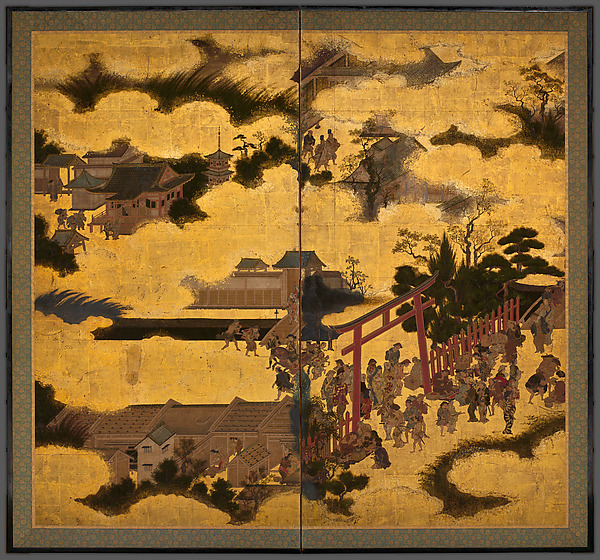
early 17th century. Sliding doors (fusama) remounted as a two-panel folding screen; ink, color, and gold on paper. The Metropolitan Museum of Art, accession 60.164. Gift of A. I. Sherr, 1960. Open Access.
Look closer: A screen of the early seventeenth century with the torii of the Gion Shrine, the shrine gate that Wikipedia offers as another reading of the Butterfly Stool.
The Metropolitan Museum of Art, public domain (Open Access). Source: https://www.metmuseum.org/art/collection/search/45095

16th century. Iron, lacquer. The Metropolitan Museum of Art, accession 36.25.81a–c. Bequest of George C. Stone, 1935. Open Access.
Look closer: A helmet of the sixteenth century in the zukin shape. Wikipedia notes that the Butterfly Stool can also be read as an antique samurai helmet.
The Metropolitan Museum of Art, public domain (Open Access). Source: https://www.metmuseum.org/art/collection/search/24014

late 17th–early 18th century. Iron, lacquer, copper, gold, silk, copper-gold alloy (shakudō). The Metropolitan Museum of Art, accession 2018.833.10. Gift of Etsuko O. Morris and John H. Morris Jr., 2018. Open Access.
Look closer: A ribbed helmet of the late seventeenth to early eighteenth century, one of the forms behind the comparison with Yanagi’s stool.
The Metropolitan Museum of Art, public domain (Open Access). Source: https://www.metmuseum.org/art/collection/search/27585
The stool is in major collections. Wikipedia names the Metropolitan Museum and the Museum of Modern Art in New York, the Rubell Museum and the Victoria and Albert Museum in London. It is a case of a design whose success depends on its using little: two pieces, one joint, no applied ornament, and a form that reads at a glance.
He had made the Elephant Stool two years earlier, in 1954. Wikipedia lists it, with the Butterfly Stool and a stainless-steel kettle of the 1960s, among his key designs.
A Kettle of Stainless Steel
A kettle sits at the other end of the household from a stool. It is the object nearest the fire, the one most often held, and the one that has most obviously been formed by use. Japan has an old kettle tradition. Wikipedia describes the tetsubin as a cast-iron kettle with a pouring spout, a lid and a handle crossing over the top, used for boiling and pouring hot water, which is traditionally heated over charcoal. It relates that the historical origin of the tetsubin is not certain, and that one authoritative Japanese source says it developed from the tedorigama, a spouted and handled water kettle already used in chanoyu in the era of Sen no Rikyū. During the 19th century, as infused tea became more popular, tetsubin came to be seen mainly as status symbols and were often elaborately decorated.
Yanagi’s stainless-steel kettle of the 1960s is a quiet reply to that history. It is listed among his key designs, and Wikipedia gives no further detail, so the description here is of its place in the tradition and not of the object. The older vessels in the Metropolitan Museum show what he was working against and with: a plain cylindrical cast-iron kama of the mid-seventeenth century, a round cast-iron kettle of the sixteenth century with a ring on its lid, and an eighteenth-century iron kettle on its brazier in a tea display. They are heavy, dark and exact in outline. A kettle of stainless steel keeps the logic of the pouring spout, the lid and the handle that crosses the top, and changes the material.
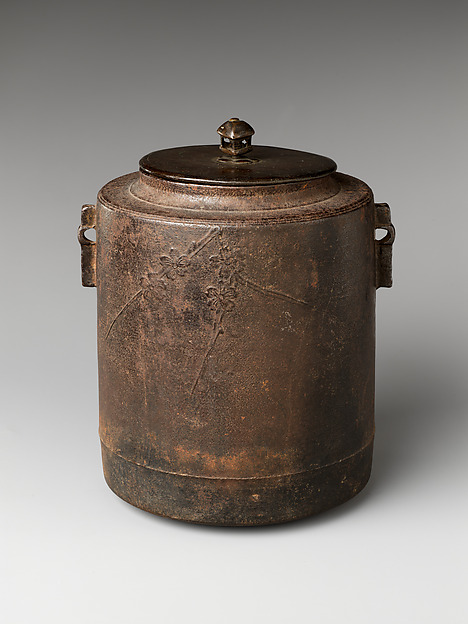
Ōnishi Gorōzaemon, mid-17th century. Cast iron and bronze. The Metropolitan Museum of Art, accession 2024.553.6a, b. Gift of Peggy and Richard M. Danziger, 2024. Open Access.
Look closer: A cast-iron tea kettle of the mid-seventeenth century, plain in outline and heavy in the hand: the older world of metal vessels that Yanagi’s steel kettle answered.
The Metropolitan Museum of Art, public domain (Open Access). Source: https://www.metmuseum.org/art/collection/search/913853
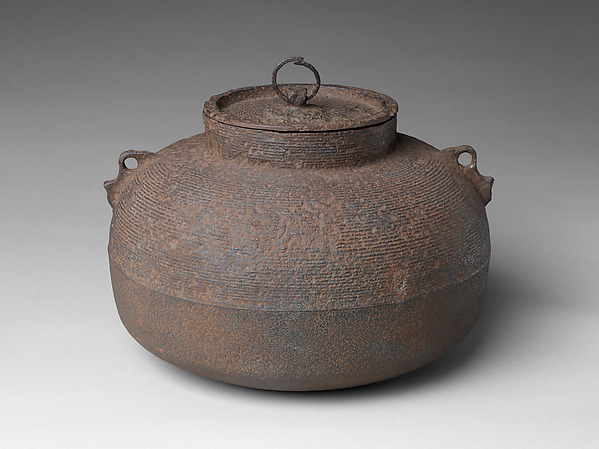
16th century. Cast iron. The Metropolitan Museum of Art, accession 2024.553.7a–c. Gift of Peggy and Richard M. Danziger, 2024. Open Access.
Look closer: A sixteenth-century cast-iron kettle with a rounded body and a ring on the lid.
The Metropolitan Museum of Art, public domain (Open Access). Source: https://www.metmuseum.org/art/collection/search/913854
The change is more than cosmetic. Cast iron is poured into a mould by a founder, and a stainless-steel vessel is formed from sheet. A kettle that is made from sheet can be made in volume, cleaned easily and used without ceremony. It also becomes cheap enough to be an everyday object in the sense that Yanagi Sōetsu meant: made in quantity, used by the masses, functional in daily life. In that sense a stainless-steel kettle designed by the founder’s son is, oddly, closer to the mingei criteria than many antique tea kettles.

18th century. Iron. The Metropolitan Museum of Art, accession 25.215.32. Fletcher Fund, 1925. Open Access.
Look closer: An eighteenth-century iron kettle on its brazier, shown with the small utensils of a tea display.
The Metropolitan Museum of Art, public domain (Open Access). Source: https://www.metmuseum.org/art/collection/search/39566
A household also holds smaller things, and the Metropolitan Museum has examples that give a sense of how they were made. A round cane mat for resting a kettle, a basket of bamboo and rattan for peonies, a tall lattice basket with three small feet and a basket whose rattan loops are left as a design all show the Japanese household object as a piece of material intelligence, in which the structure is the ornament.

ca. 1775. Cane. The Metropolitan Museum of Art, accession 25.215.39. Fletcher Fund, 1925. Open Access.
Look closer: A round mat of woven cane for resting a kettle: a household object in which the weave is both structure and ornament.
The Metropolitan Museum of Art, public domain (Open Access). Source: https://www.metmuseum.org/art/collection/search/56437
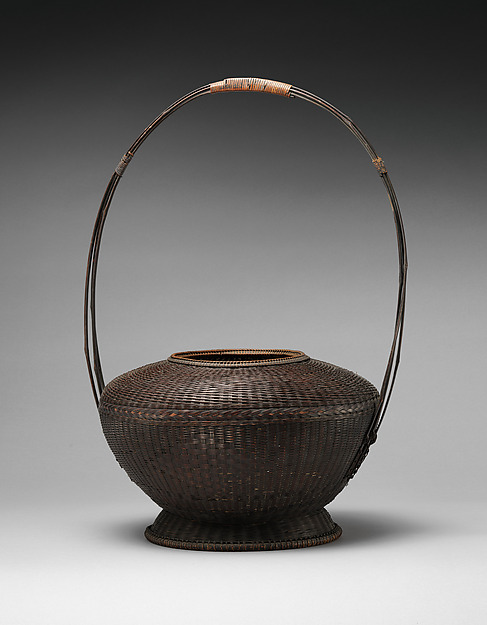
second half 19th century. Bamboo and rattan. The Metropolitan Museum of Art, accession 91.1.2070. Edward C. Moore Collection, Bequest of Edward C. Moore, 1891. Open Access.
Look closer: A flower basket of bamboo and rattan from the second half of the nineteenth century, with a tall arched handle.
The Metropolitan Museum of Art, public domain (Open Access). Source: https://www.metmuseum.org/art/collection/search/62170

19th century. Bamboo. The Metropolitan Museum of Art, accession 91.1.2082. Edward C. Moore Collection, Bequest of Edward C. Moore, 1891. Open Access.
Look closer: A tall nineteenth-century bamboo basket with a lattice body and a woven handle.
The Metropolitan Museum of Art, public domain (Open Access). Source: https://www.metmuseum.org/art/collection/search/62182
A Torch, Cauldrons and Overpasses
After the Second World War Yanagi designed a wide range of products. Wikipedia lists furniture, three-wheeled vehicles, Olympic cauldrons and pedestrian overpasses. The list is short and the range is wide, and it shows that for Yanagi design was a way of thinking applicable to anything from a stool to a bridge. In 1972 he designed the official torch for the Winter Olympics in Sapporo.
It is tempting to treat these large public objects as a separate chapter in his career. They are better read as the same work at a different scale. A torch is carried in the hand and a stool is sat upon. A kettle is lifted by its handle. Each has a human gesture built into it, and each is a form that has to read at a distance as well as in the hand. Yanagi’s method, making the first versions repeatedly by hand until the form settled, applies to all of them.
Public objects also change who the user is. A kettle is chosen by one household; an overpass is used by a city. A designer who works for the public has to find forms that nobody needs to explain, and that is another way of describing what Sōetsu called objects beyond beauty and ugliness.
Kenmochi, Watanabe and the Good Design Mark
Yanagi worked in a small community of postwar Japanese designers. In 1958 he assisted in founding the Japan Interior Architects/Designers’ Association, which he led together with Isamu Kenmochi and Riki Watanabe. Kenmochi, born in Tokyo in 1912 and a graduate of the Tokyo College of Industrial Arts, was a founding member of the Japan Industrial Designers Association in 1952. He is also the link back to the previous chapter, since Wikipedia says that he met Isamu Noguchi in the summer of 1950, on Noguchi’s first trip to Japan after the war, and that the two together developed a number of furniture designs, pioneering a Japanese Modern style that integrated the material culture of Japanese furniture with modernist styles.
Kenmochi’s lounge chair of 1958, commissioned by the Yamakawa Rattan Company, entered the design collection of the Museum of Modern Art in 1964 and won the G-Mark Prize. The G-Mark, the Good Design Award, is sponsored by the Japan Institute of Design Promotion and is the only comprehensive evaluation and recommendation system of design in Japan; its selection system was established in 1957. It gave the new profession a public measure.
These names place Yanagi in a pattern. Noguchi, an American with a Japanese father, worked with a Japanese designer in 1950; Perriand, a Frenchwoman, advised a Japanese ministry in 1940; Le Corbusier built in Japan; Yanagi translated and learned from them. The tradition that came out was not a simple export of foreign ideas or a simple preservation of old ones. It was a conversation, conducted in several languages, about what a modern object in a Japanese room should be.
Craft and Design in Other Countries
The relation between craft and industrial design is not peculiar to Japan. Wikipedia’s entry for Perriand calls her one of the great figures of twentieth-century design, and her own work turned, after her Asian years, toward wood, weaving and the use of natural materials. In Britain, Bernard Leach’s studio pottery drew on Yanagi Sōetsu’s ideas.
What marks the Japanese case is that the line between the workshop and the factory was never drawn as sharply. Mingei theory put the beauty of the object in its use and its anonymity, not in its being a work of art. A designer could therefore take up the same values in a new material without feeling that he had left them behind. Yanagi Sōri’s stainless-steel kettle and moulded stool are not a betrayal of his father’s tradition. They are what that tradition looks like when it meets the twentieth century.
Life and Work by Date
Dates are those given in the Wikipedia articles named in the sources.
| Date | What happened | Source |
|---|---|---|
| 1889 | Yanagi Sōetsu is born | Yanagi Sōetsu, Wikipedia |
| 1915 | Yanagi Sōri is born in Tokyo | Sori Yanagi, Wikipedia |
| 1916 | Sōetsu visits Korea for the first time | Yanagi Sōetsu, Wikipedia |
| 1926 | The Folk Art Movement is formally declared | Yanagi Sōetsu, Wikipedia |
| 1934 | Sōri enters the Tokyo Art School | Sori Yanagi, Wikipedia |
| 1936 | The Japan Folk Crafts Museum is established | Yanagi Sōetsu, Wikipedia |
| 1940 | Charlotte Perriand sails for Japan as advisor to the Ministry for Trade and Industry | Charlotte Perriand, Wikipedia |
| Early 1940s | Sōri translates for Perriand in Tokyo | Sori Yanagi, Wikipedia |
| 1950 | Kenmochi meets Isamu Noguchi | Isamu Kenmochi, Wikipedia |
| 1954 | Elephant Stool | Sori Yanagi, Wikipedia |
| 1956 | The Butterfly Stool is announced | Sori Yanagi, Wikipedia |
| 1957 | The Good Design selection system is established | Good Design Award, Wikipedia |
| 1958 | Founding of the Japan Interior Architects/Designers’ Association | Sori Yanagi, Wikipedia |
| 1960s | Stainless-steel kettle | Sori Yanagi, Wikipedia |
| 1972 | Official torch for the Winter Olympics in Sapporo | Sori Yanagi, Wikipedia |
| 2008 | Honorary Royal Designer for Industry, United Kingdom | Sori Yanagi, Wikipedia |
| 2011 | Sōri Yanagi dies at the age of ninety-six | Sori Yanagi, Wikipedia |
Sites to Visit
Hours, fees and viewing arrangements change; check each institution’s own site before travelling.
| Place | What there is | Source |
|---|---|---|
| Japan Folk Crafts Museum, Komaba, Tokyo | The museum founded by Yanagi Sōetsu in 1936 | Yanagi Sōetsu, Wikipedia |
| The Metropolitan Museum of Art, New York | Holds the Butterfly Stool, among other collections | Sori Yanagi, Wikipedia |
| The Museum of Modern Art, New York | Holds the Butterfly Stool and Kenmochi’s lounge chair | Sori Yanagi and Isamu Kenmochi, Wikipedia |
| Victoria and Albert Museum, London | Holds the Butterfly Stool | Sori Yanagi, Wikipedia |
| Rubell Museum | Holds the Butterfly Stool | Sori Yanagi, Wikipedia |
| The Noguchi Museum, Long Island City, New York | Akari lamps and Noguchi’s furniture, close to the thread of this chapter | See the Noguchi chapter of this almanac |
Stories of the Stool and the Maker
The interpreter. A young Tokyo student interpreted for a French designer who had fled war, and in doing so moved from painting to buildings to objects. That is how Wikipedia accounts for the turning of his career.
The gate and the helmet. Where a Western eye sees a butterfly, a Japanese eye can see a shrine gate. A third reading, an old samurai helmet, makes the stool a piece of armour for the sitter.
The first versions. Yanagi made the early versions of a product over and over by hand, looking for forms that came from both new and old ideas.
A family in craft. Wikipedia notes that Yanagi Sōetsu’s great-grandnephew Shinya Yanagi is a weaver, the third generation of the Yanagi family of weavers, so the name has continued in craft as well as in design.
Fun Facts for the Curious
Each of these comes from the sources named at the end of the chapter.
- The Butterfly Stool has been compared to butterfly wings, a Shinto shrine gate and a samurai helmet.
- Yanagi translated for Charlotte Perriand when she was in Tokyo in the early 1940s.
- Perriand read The Book of Tea during her exile in Vietnam and referred to it for the rest of her career.
- The Butterfly Stool is in the Metropolitan Museum, the Museum of Modern Art, the Rubell Museum and the Victoria and Albert Museum.
- Yanagi designed the torch for the 1972 Winter Olympics in Sapporo.
- Kenmochi and Noguchi met in the summer of 1950 and designed furniture together.
- The G-Mark selection system dates from 1957.
- Sōetsu’s book The Unknown Craftsman was first published in English in 1972.
- The tetsubin is traditionally heated over charcoal.
Modern Facts: Collections and Honours
The Butterfly Stool remains the design most closely tied to Yanagi’s name, and the museums that hold it are named in the sources. His honours include the title of Honorary Royal Designer for Industry, awarded in the United Kingdom in 2008. He died in 2011 at the age of ninety-six.
The Japanese tradition he belonged to is also continuing. The Good Design Award is given each year by the Japan Institute of Design Promotion. The mingei idea his father stated is now taught as a chapter of Japanese craft history, and the Japan Folk Crafts Museum is open to the public.
Glossary of the Designer’s Terms
A short vocabulary for the stool, the kettle and the movement behind them.
| Term | Meaning |
|---|---|
| Mingei | Folk craft; the movement founded by Yanagi Sōetsu |
| Nihon Mingeikan | The Japan Folk Crafts Museum in Tokyo |
| Butterfly Stool | Yanagi’s two-piece stool, announced in 1956 |
| Elephant Stool | A stool of 1954 listed among his key designs |
| Tetsubin | A cast-iron kettle with a spout, lid and overhead handle |
| Kama | An iron kettle used in the tea ceremony |
| Chanoyu | The Japanese tea ceremony |
| Torii | The gate of a Shinto shrine |
| Kabuto | A samurai helmet |
| G-Mark | The mark of the Good Design Award, from 1957 |
| Industrial design | Design of objects for production in quantity |
| Royal Designer for Industry | A British honour given to designers; Yanagi was an honorary holder from 2008 |
A Collector’s Eye for Designed Things
This house does not value or authenticate individual pieces in its chapters, and the points below are a way of reading the sources.
Look at the joint. A form such as the Butterfly Stool depends on the connection between its two parts. A good example shows a joint that is simple, tight and square, with no gap and no clumsy addition.
Look at the material. Wikipedia describes Yanagi’s kettle as stainless steel and his stool as a two-piece form. A designed object of this kind is made in series, and a collector will want to know which maker produced it and in what period.
Look at the lineage. Because Yanagi’s designs have been produced for decades and copied, the maker and the period matter more than the shape. A museum or the maker’s own archive is the right place to ask.
Look at the use. The object was meant to be used every day. Signs of wear on a stool or a kettle are part of its history, and it is worth asking whether they are signs of use or of damage.
Design on the Shelf
The house holds no pieces by Yanagi Sōri at present, and this chapter does not value or authenticate designed objects. For furniture and household objects of a related kind, see the temple furniture on the shelf, or write to the concierge desk with a question.
Answered plainly
Who was Sōri Yanagi?
A Japanese industrial designer, 1915 to 2011, who merged simplicity and practicality with elements of traditional Japanese crafts. He was the son of Yanagi Sōetsu, founder of the mingei movement.
What is the Butterfly Stool?
A two-piece moulded stool announced in 1956 that won a gold prize at the eleventh Milan Triennial and is held in museum collections including the Metropolitan Museum and the Museum of Modern Art.
Why is it called the Butterfly Stool?
Its two-piece form has been compared to a butterfly’s open wings. It has also been read as the gate of a Shinto shrine or an antique samurai helmet.
Who influenced Yanagi?
Le Corbusier and Charlotte Perriand, for whom he translated when she was in Tokyo in the early 1940s.
What else did he design?
The Elephant Stool of 1954, a stainless-steel kettle of the 1960s, three-wheeled vehicles, Olympic cauldrons, pedestrian overpasses and the 1972 Sapporo Olympic torch.
What is mingei?
The Japanese folk craft movement founded by Yanagi Sōetsu, which holds that utilitarian objects made by ordinary people can be beautiful.
What is the connection with Isamu Noguchi?
Noguchi met the designer Isamu Kenmochi in 1950, and Kenmochi and Yanagi Sōri led the Japan Interior Architects/Designers’ Association together with Riki Watanabe.
What is the G-Mark?
The mark of the Good Design Award, sponsored by the Japan Institute of Design Promotion; its selection system was established in 1957.
What is a tetsubin?
A cast-iron kettle with a spout, a lid and a handle over the top, traditionally heated over charcoal.
What honour did Yanagi receive in 2008?
He became an Honorary Royal Designer for Industry in the United Kingdom.
Where can I see his work?
The Butterfly Stool is held by the Metropolitan Museum and the Museum of Modern Art in New York, the Rubell Museum and the Victoria and Albert Museum in London.
Can this house value a designed piece?
No. This house does not value or authenticate individual pieces.
Where next
Sources and image credits
- Sori Yanagi, Wikipedia
- Yanagi Sōetsu, Wikipedia
- Charlotte Perriand, Wikipedia
- Isamu Kenmochi, Wikipedia
- Good Design Award (Japan), Wikipedia
- Tetsubin, Wikipedia
- The Metropolitan Museum of Art Open Access collection (kettles, baskets, helmets and a screen)
- Edward S. Morse, Japanese Homes and Their Surroundings, 1886, Project Gutenberg ebook 52868
Last reviewed 28 October 2026. Pictures, where shown, are public-domain or open-access and credited beneath each one.
Looking for a piece of Japanese design with its history intact? The concierge desk replies within one to three business days.
Private concierge
Looking for something in particular?
Describe the piece or the project you have in mind. A senior advisor in Tokyo reads every case file personally and replies within two business days, with fees set out in writing before any work begins.