
Isamu Noguchi: Between Two Worlds
Sculptor, Designer, Gardener
Isamu Noguchi: Between Two Worlds
He was born in Los Angeles to a Japanese poet and an American writer, and he spent his life carrying forms across the Pacific. His paper lanterns from Gifu are the best known of them.
Fact sheet
At a glance
- Two countries, one eye. He grew up between Los Angeles, Japan and Indiana, and his work moves between American modernism and Japanese material and space.
- A sculptor who designed. He called the Radio Nurse his only strictly industrial design, yet his table for Herman Miller is still in production.
- The lanterns of Gifu. In 1951 the mayor of Gifu asked him to modernise paper lanterns that electricity was making obsolete. He gave them light bulbs and wire ribs.
- Landscape as sculpture. His sunken gardens, playgrounds and plazas treated the ground itself as a sculptural material.
- A museum of his own. In 1985 he opened the first museum of its kind established by a living artist in America, in a former photogravure plant in Queens.
A Sculptor Who Would Not Stay in One Country
Isamu Noguchi is hard to place, and that is the point. Wikipedia calls him an American artist, furniture designer and landscape architect whose career spanned six decades from the 1920s. He made portrait busts, abstract stone sculptures, stage sets for Martha Graham, playgrounds, fountains, furniture and lamps. His work is shown at the Noguchi Museum in New York and in many other museums, and a number of his furniture designs and lamps are still made and sold.

Shibata Zeshin 柴田是真, circa 1860. Woodblock print (nishiki-e); ink and color on paper. The Metropolitan Museum of Art, accession JP2743. The Howard Mansfield Collection, Purchase, Rogers Fund, 1936. Open Access.
Look closer: A woman reaches up to light a paper lantern hung for the Obon festival: the household lantern that Noguchi’s Akari would reinvent.
The Metropolitan Museum of Art, public domain (Open Access). Source: https://www.metmuseum.org/art/collection/search/45265
What links the work is a way of seeing that he carried between two places. He was born in Los Angeles, the son of a Japanese poet and an American writer, and was taken to Japan as a small child. He returned to the United States as a teenager and came back to Japan as a young man to study clay and gardens. In 1951 he came back again and, at the request of a mayor, redesigned the paper lantern. The Akari lamps that resulted turn up in houses on every continent, and they are the form in which most people meet his name.
This chapter follows that path. It is the second in the Interior and Design Almanac and it follows the Japanese room, because Noguchi wrote that all a home needed to begin were a room, a tatami and an Akari. The chapters that follow take up the lamp itself, the designer Yanagi Sōri, the glass of Edo and the lacquer of the table. Here the subject is the man who stood between the room and the world outside it.
Los Angeles, Yokohama and Indiana
Isamu Noguchi was born in Los Angeles in 1904, the son of Yone Noguchi, a Japanese poet who was acclaimed in the United States, and Léonie Gilmour, an American writer who edited much of Yone’s work. Yone ended his relationship with Gilmour that year and left for Japan, where he planned to marry The Washington Post reporter Ethel Armes. The engagement fell through when Armes learned of Léonie and her newborn son.
In 1906 Yone invited Léonie to come to Tokyo with their son. She at first refused, but anti-Japanese sentiment in the United States after the Russo-Japanese War eventually convinced her. They sailed from San Francisco in March 1907 and arrived at Yokohama, where the boy was finally given the name Isamu, which means courage. Yone had by then married a Japanese woman, and he was mostly absent from his son’s childhood. Léonie and Isamu moved several times through Japan.
In 1912, in Chigasaki, Léonie had a house built for herself, Isamu and his half-sister Ailes Gilmour, who would become a pioneer of American modern dance. She had the eight-year-old Isamu oversee the project. Wikipedia says that she put him in charge of the garden and apprenticed him to a local carpenter. It is hard not to see a first lesson in the later work in that account: a child set to look after a plot of ground and to learn from a man who cut wood.

Period engraving. Edward S. Morse, Japanese Homes and Their Surroundings (Boston: Ticknor and Company, 1886), figure 48. Wood-engraved illustration, public domain.
Look closer: An old house in Kyoto seen from the garden, with stepping stones laid in the yard.
Edward S. Morse, 1886, public domain, via Project Gutenberg ebook 52868. Source: https://www.gutenberg.org/ebooks/52868
In December 1917 they moved again, to an English-speaking community in Yokohama. In 1918 Noguchi was sent back to the United States for schooling in Rolling Prairie, Indiana, and then boarded in La Porte with a Swedenborgian pastor. He graduated from La Porte High School in 1922. In those years he used the name Sam Gilmour.

Period engraving. Edward S. Morse, Japanese Homes and Their Surroundings (Boston: Ticknor and Company, 1886), figure 206. Wood-engraved illustration, public domain.
Look closer: A paper-pane lamp on a stand, as drawn by Morse in 1886: the form of light that electric bulbs were about to replace.
Edward S. Morse, 1886, public domain, via Project Gutenberg ebook 52868. Source: https://www.gutenberg.org/ebooks/52868

Period engraving. Edward S. Morse, Japanese Homes and Their Surroundings (Boston: Ticknor and Company, 1886), figure 209. Wood-engraved illustration, public domain.
Look closer: A wall lamp: a paper-covered box fixed to a wall, drawn by Morse.
Edward S. Morse, 1886, public domain, via Project Gutenberg ebook 52868. Source: https://www.gutenberg.org/ebooks/52868
Borglum, Brâncuși and a Name Taken
After high school Noguchi told his guardian, Dr. Edward Rumely, that he wanted to be an artist. Rumely would have preferred a doctor, but he sent him to Connecticut as an apprentice to his friend Gutzon Borglum, who was then working on the group Wars of America for Newark, New Jersey. Noguchi was given little training as a sculptor. He arranged horses, modelled for the figure of General Sherman, and picked up some casting skills from Borglum’s Italian assistants. At the end of the summer Borglum told him that he would never be a sculptor.
He reconsidered Rumely’s suggestion and enrolled in February 1922 as a premedical student at Columbia University. He met the bacteriologist Hideyo Noguchi, who urged him to think again about art, and the Japanese dancer Michio Itō, whose celebrity later helped him find acquaintances in the art world. In 1924, on his mother’s advice, he took night classes at the Leonardo da Vinci Art School. Its head, Onorio Ruotolo, was impressed, and three months later Noguchi held his first exhibition of plaster and terracotta work. He left Columbia, changed his name from Gilmour to Noguchi, and took a studio of his own.
Portrait busts paid the rent. In late 1926 he applied for a Guggenheim Fellowship, proposing to study stone and wood cutting and the human figure in Paris for a year and then to travel in Asia. He was awarded the grant although he was three years short of the age requirement.
He arrived in Paris in April 1927 and met the American writer Robert McAlmon, who took him to the studio of Constantin Brâncuși. Neither man could talk to the other, as Noguchi barely spoke French and Brâncuși no English, but Noguchi became his assistant for seven months. He learned stone, a medium he had not worked in before, and he later said that one of Brâncuși’s greatest teachings was to appreciate the value of the moment.
He came back to New York in February 1929 and at Romany Marie’s café in Greenwich Village met Buckminster Fuller, with whom he worked on several projects, including the modelling of the Dymaxion car. His abstract sculptures from Paris did not sell, so he returned to portrait busts, which sold well enough to pay for the Asian journey the Guggenheim had been meant to fund.
Beijing, Kyoto and the Clay Figures
Noguchi left for Paris in April 1930 and two months later received his visa to ride the Trans-Siberian Railway. He had meant to visit Japan first, but he learned that his father did not want his son to visit under the family name, and he went to Beijing instead. There he studied brush painting with Qi Baishi and stayed six months before sailing for Japan. Japanese newspapers had already reported his supposed reunion with Yone, and although he denied that this was why he had come, the two did meet in Tokyo.
He went on to Kyoto and studied pottery with Uno Jinmatsu. In Kyoto he noted the Zen gardens and the haniwa, the clay funerary figures of the Kofun period. Wikipedia says these inspired his terracotta The Queen. The haniwa are among the oldest sculptures made in Japan, and the Metropolitan Museum holds several of them in public-domain images: a figure of a female shrine attendant with a wide flat hat, a warrior in a crested helmet and banded armour, a horse’s head with its harness in relief, and a house in the form of a ribbed cylinder. They are quiet, simple in mass, and made to stand in the earth.

6th century. Earthenware with traces of color. The Metropolitan Museum of Art, accession 2015.300.255. Mary Griggs Burke Collection, Gift of the Mary and Jackson Burke Foundation, 2015. Open Access.
Look closer: A haniwa of the sixth century with slit eyes and mouth. Noguchi saw haniwa in Kyoto in the early 1930s, and Wikipedia ties them to his terracotta The Queen.
The Metropolitan Museum of Art, public domain (Open Access). Source: https://www.metmuseum.org/art/collection/search/53156

6th century. Earthenware with painted, incised, and applied decoration. The Metropolitan Museum of Art, accession 1978.412.1706. The Michael C. Rockefeller Memorial Collection, Gift of Mrs. John D. Rockefeller III, 1958. Open Access.
Look closer: A sixth-century haniwa warrior, made of clay and set in the earth: the kind of figure that drew Noguchi back to Japan.
The Metropolitan Museum of Art, public domain (Open Access). Source: https://www.metmuseum.org/art/collection/search/45545

6th century. Earthenware. The Metropolitan Museum of Art, accession 69.249. Gift of Mrs. J. Townsend Russell, 1969. Open Access.
Look closer: A haniwa horse’s head, simple in mass and exact in the detail of its harness.
The Metropolitan Museum of Art, public domain (Open Access). Source: https://www.metmuseum.org/art/collection/search/44442
There is a lesson in the pairing of Zen gardens and haniwa. One is a landscape arranged for contemplation; the other is a set of figures set in the ground to guard a tomb. Both treat earth, stone and clay as the material of an art that is meant to be placed, and neither is meant to be carried home. That attitude shapes Noguchi’s later gardens, plazas and playgrounds.

3rd–7th century. Earthenware. The Metropolitan Museum of Art, accession 17.229.24. Rogers Fund, 1917. Open Access.
Look closer: A haniwa model house of the Kofun period, a reminder that clay was the oldest Japanese medium for shaping space.
The Metropolitan Museum of Art, public domain (Open Access). Source: https://www.metmuseum.org/art/collection/search/45843
He returned to New York during the Great Depression and found few clients for his portrait busts. He hoped to sell the sculptures and brush paintings he had made in Asia, and although very few sold, he regarded the one-man exhibition that began in February 1932 and toured Chicago, the West Coast and Honolulu as his most successful.

Period engraving. Edward S. Morse, Japanese Homes and Their Surroundings (Boston: Ticknor and Company, 1886), figure 239. Wood-engraved illustration, public domain.
Look closer: A stone water basin, the chōdzu-bachi, drawn by Morse; the Japanese garden gave Noguchi a vocabulary of stone.
Edward S. Morse, 1886, public domain, via Project Gutenberg ebook 52868. Source: https://www.gutenberg.org/ebooks/52868

5th–7th century. Earthenware. The Metropolitan Museum of Art, accession 17.228.3. Rogers Fund, 1917. Open Access.
Look closer: A haniwa head of the fifth to seventh century, with slits for eyes and mouth and a flat headdress tied at the side.
The Metropolitan Museum of Art, public domain (Open Access). Source: https://www.metmuseum.org/art/collection/search/47272

2nd–3rd century. Haniwa pottery. The Metropolitan Museum of Art, accession 1986.496. Gift of Mr. and Mrs. J. Gordon Douglas III, 1986. Open Access.
Look closer: A boar’s head on a clay column, shaped in a few firm strokes.
The Metropolitan Museum of Art, public domain (Open Access). Source: https://www.metmuseum.org/art/collection/search/62462
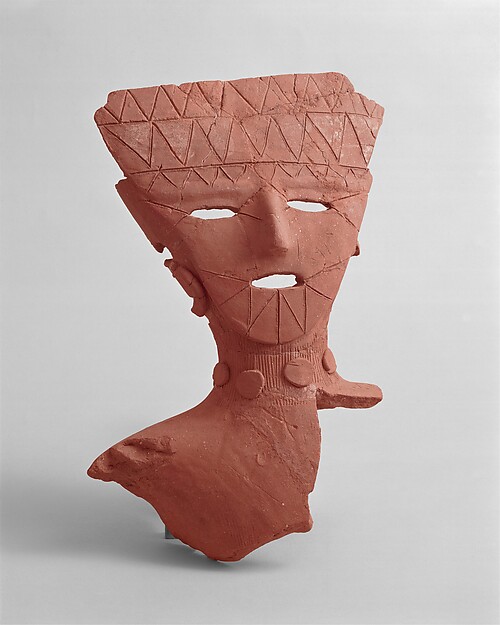
5th–early 6th century. Earthenware with painted, incised, and applied decoration. The Metropolitan Museum of Art, accession 1975.268.413. The Harry G. C. Packard Collection of Asian Art, Gift of Harry G. C. Packard, and Purchase, Fletcher, Rogers, Harris Brisbane Dick, and Louis V. Bell Funds, Joseph Pulitzer Bequest, and The Annenberg Fund Inc. Gift, 1975. Open Access.
Look closer: A red clay haniwa head with an incised band of triangles above the face.
The Metropolitan Museum of Art, public domain (Open Access). Source: https://www.metmuseum.org/art/collection/search/44832
The Radio Nurse, the News Relief and the Camp at Poston
In the 1930s Noguchi began submitting designs for public spaces to the Public Works of Art Program. A monument to Benjamin Franklin and a pyramid-shaped earthwork called Monument to the American Plow went unrealised, and his playground design Play Mountain was personally rejected by Parks Commissioner Robert Moses. In 1935 he produced the set for Frontier, the first of many he would design for Martha Graham. In Mexico City in 1936 he made his first public work, History as Seen from Mexico in 1936, a relief mural twenty metres long for the Abelardo Rodriguez market.
On his return to New York in 1937 he designed the Zenith Radio Nurse, the original baby monitor, now held in many museum collections. It was his first major design commission, and he called it his only strictly industrial design. In 1939 he made a fountain of automobile parts for the Ford Motor Company at the New York World’s Fair, which critics and Noguchi alike thought poorly of. His next sculpture, News, a nine-ton stainless-steel bas-relief unveiled over the entrance of the Associated Press building at Rockefeller Center in April 1940, was widely praised.
After the attack on Pearl Harbor, anti-Japanese feeling in the United States intensified. Noguchi formed Nisei Writers and Artists for Democracy and, with other leaders, wrote to officials to try to halt the internment of Japanese Americans, without effect. In May 1942 he travelled to the internment camp at Poston, Arizona, becoming its only voluntary internee. He hoped to design parks and recreation areas there, and made plans for baseball fields, swimming pools and a cemetery, but found that the War Relocation Authority had no intention of carrying them out. He applied for release in June, was labelled a suspicious person, and left on a month-long furlough in November that he did not end. The Federal Bureau of Investigation investigated him for espionage until the American Civil Liberties Union intervened.
Back in New York, he took a studio in Greenwich Village. In the 1940s his sculpture drew on Surrealism and included mixed-media constructions, landscape reliefs, self-illuminating reliefs he called lunars, and a series of biomorphic figures made of interlocking slabs. The best known of them, Kouros, was shown in September 1946.
The Table for Herman Miller
In 1947 Noguchi began a working relationship with Herman Miller of Zeeland, Michigan. Wikipedia says that it resulted in several designs that have become symbols of the modernist style, among them the Noguchi table, which remains in production. He also designed furniture and lamps for Knoll. Another coffee table of 1944 is listed among his notable works as an iconic item of mid-century modern furniture.
These were designs for factories and showrooms, made in volume instead of as single works, and they sit alongside the sculpture in his catalogue. The museum he founded shows his furniture designs beside his stone, his stage designs and his drawings, and treats them as one body of work.
He was also at work in the theatre. He designed the sets for Martha Graham’s Appalachian Spring, and for John Cage and Merce Cunningham’s production of The Seasons. Near the end of his time in New York he took commissions for public spaces, including the ceilings of the Time-Life headquarters. In March 1949 he had his first one-person show in New York since 1935, at the Charles Egan Gallery.
The Mayor’s Request
After the suicide of his friend the painter Arshile Gorky in 1948 and the end of a romance, Noguchi applied for a Bollingen Fellowship to travel the world and study public space as research for a book on the environment of leisure. The project was only completed fifteen years after his death. During his stay in Japan after the war he was photographed in Nagoya by Kansuke Yamamoto, and the portrait was published in a newspaper in July 1950.
In 1951 he visited Gifu, a town known for making traditional paper lanterns. The mayor of Gifu approached him and asked him to help modernise the lanterns, which were growing obsolete with the spread of electricity. Wikipedia says that Noguchi did so by redesigning the lamps to use light bulbs instead of candles, and by using wire to make their shapes more sculptural.
The lanterns he knew were household objects with a long history. A woodblock print in the Metropolitan Museum shows a woman reaching up to light a lantern hung for the Obon festival; another shows a woman holding a round paper hand lantern as she stands beside a seated friend. In Morse’s book of 1886 the paper-covered lamp appears on a stand, on a wall and in the hall. These lamps all gave a low light and were all made of paper over a frame. Noguchi kept the paper and the frame and changed the light.

Kitao Shigemasa, ca. 1790. Woodblock print; ink and color on paper. The Metropolitan Museum of Art, accession JP2655. The Howard Mansfield Collection, Purchase, Rogers Fund, 1936. Open Access.
Look closer: A woman holds a round paper hand lantern beside a seated friend: a lantern carried and used, long before it became a sculpture.
The Metropolitan Museum of Art, public domain (Open Access). Source: https://www.metmuseum.org/art/collection/search/56834
Shibata Zeshin 柴田是真, circa 1860. Woodblock print (nishiki-e); ink and color on paper. The Metropolitan Museum of Art, accession JP2743. The Howard Mansfield Collection, Purchase, Rogers Fund, 1936. Open Access.
Look closer: A woman reaches up to light a paper lantern hung for the Obon festival: the household lantern that Noguchi’s Akari would reinvent.
The Metropolitan Museum of Art, public domain (Open Access). Source: https://www.metmuseum.org/art/collection/search/45265

Period engraving. Edward S. Morse, Japanese Homes and Their Surroundings (Boston: Ticknor and Company, 1886), figure 208. Wood-engraved illustration, public domain.
Look closer: A lamp on a lacquered stand, drawn by Morse; the Akari replaced forms like this with a single paper shade.
Edward S. Morse, 1886, public domain, via Project Gutenberg ebook 52868. Source: https://www.gutenberg.org/ebooks/52868

Period engraving. Edward S. Morse, Japanese Homes and Their Surroundings (Boston: Ticknor and Company, 1886), figure 211. Wood-engraved illustration, public domain.
Look closer: A pottery oil lamp with a handle, drawn by Morse; clay lamps were rarely seen, he noted.
Edward S. Morse, 1886, public domain, via Project Gutenberg ebook 52868. Source: https://www.gutenberg.org/ebooks/52868

Period engraving. Edward S. Morse, Japanese Homes and Their Surroundings (Boston: Ticknor and Company, 1886), figure 212. Wood-engraved illustration, public domain.
Look closer: A pottery lamp with a spout and handle, on a stem above a catching dish.
Edward S. Morse, 1886, public domain, via Project Gutenberg ebook 52868. Source: https://www.gutenberg.org/ebooks/52868
Akari: The Lantern as Sculpture
The word akari means light in the sense of illumination. The lamps are made in Gifu from Mino washi paper, bamboo and metal. Wikipedia says that there are over two hundred Akari in different shapes, sizes and colours, from round or rectangular to forms resembling a banana or a television set. They were designed to collapse and could be shipped flat, which helped make them an immediate success in Japan and abroad.
Noguchi regarded the lanterns as works of art, not simple light sources. He called them Akari light sculptures, and compared the light they give off to the sun filtered through the paper of shōji. With a reference to Tanizaki’s essay In Praise of Shadows he remarked that all one needed to start a home was a room, a tatami and an Akari. The first chapter of this almanac shows how closely the lamp fits the room: the shōji of the Japanese house also diffuse light through paper over a lattice.

Period engraving. Edward S. Morse, Japanese Homes and Their Surroundings (Boston: Ticknor and Company, 1886), figure 210. Wood-engraved illustration, public domain.
Look closer: A shallow dish lamp hung from a twisted rope, the simplest form of household light.
Edward S. Morse, 1886, public domain, via Project Gutenberg ebook 52868. Source: https://www.gutenberg.org/ebooks/52868
The lamps are still handmade in Gifu by the original manufacturer, Ozeki and Company. Wikipedia notes that the warm patina of the paper and the lamps’ idiosyncratically sculptural shapes make them difficult to replicate, and that some people dye white lanterns with tea to imitate the glow. Examples are held in public collections that include the Museum of Modern Art and the Metropolitan Museum in New York, the Musée des Arts Décoratifs in Paris, and the Victoria and Albert Museum in London. Barber Osgerby and Sebastian Conran are among the designers who have made collaborations that pay homage to the originals.
Their reception has been warm. The painter Georgia O’Keeffe had an Akari pendant lamp in her New Mexico home, and the filmmaker Mira Nair said in 2002 that she owned seven. A magazine described the lamps as shorthand for taste but not flashiness. Owners praise their coziness and simplicity.
Gardens, Playgrounds and the Last Park
In his later years Noguchi installed large-scale work in many of the world’s major cities. He was married from 1952 to 1957 to the actress and singer Yoshiko Yamaguchi, and from 1959 to 1988 he was in a long friendship with the talent agent and art patron Priscilla Morgan. In 1955 he designed the sets and costumes for a controversial production of King Lear starring John Gielgud. He was elected to the American Academy of Arts and Letters in 1962 and the American Academy of Arts and Sciences in 1971.
His landscapes include the decorative railings for a bridge in the Peace Park at Hiroshima, from 1951 and 1952; the gardens at the UNESCO headquarters in Paris, from 1956 to 1958; the sunken garden for the Beinecke Rare Book and Manuscript Library at Yale; the sunken garden for the Chase Manhattan Bank Plaza in New York; the gardens for the IBM headquarters in Armonk; and the Billy Rose Sculpture Garden at the Israel Museum in Jerusalem. He designed playgrounds, including Children’s Land at Kodomo no Kuni in Yokohama and Playscapes in Piedmont Park in Atlanta, and fountains, including the Expo ’70 fountains in Osaka and the Dodge Fountain in Detroit, made with Shoji Sadao.
His last project was Moerenuma Park in Sapporo. He designed it in 1988, shortly before his death, and it was completed by Shoji Sadao and Architects 5. In 1982 he received the Edward MacDowell Medal, in 1987 the National Medal of Arts, and in 1988 Japan’s Order of the Sacred Treasure. He died on 30 December 1988 at the age of eighty-four.
A Museum That Opened in His Lifetime
The Noguchi Museum, chartered as the Isamu Noguchi Foundation and Garden Museum, is at 32-37 Vernon Boulevard in Long Island City, Queens. It was designed and created by Noguchi and opened on a limited basis to the public in 1985. Its purpose was to preserve and display his sculptures, architectural models, stage designs, drawings and furniture designs. Wikipedia says that it was the first museum established by a living artist in America.
To house it Noguchi bought, in 1974, a photogravure plant and a gas station across the street from the New York studio where he had worked and lived since 1961. The two-storey museum and its sculpture garden cover about 24,000 square feet. A sixty-foot tree of heaven, seventy-five years old, stood in the garden until 2008, when it was found to be dying; the garden was designed around it, a former aide said, and the museum had its wood made into benches and sculptures.
The museum was renovated, reopened in 2004, and now has twelve galleries. Its education programmes include Art for Families and Art for Tots. The museum is the best place to see how Noguchi’s ideas run from sculpture to furniture to lamp, since the Akari stand in the same rooms as the stone.
Noguchi Among Makers of East and West
Noguchi belongs to a generation that moved ideas between countries, and he was not alone in doing so. Michio Itō, the Japanese dancer who helped him find acquaintances in New York, and Yone Noguchi, his father, were both Japanese figures in American arts and letters. In Britain the potter Bernard Leach carried Japanese ideas to St Ives, a story told in the Tansu, Mingei and Furniture Almanac. In Japan the designer Yanagi Sōri, a later chapter’s subject, worked on related questions of form and use from Tokyo.
The Akari were made in Gifu, the town that had made lanterns for generations, and they are still made there by the original manufacturer. That continuity of place and maker is part of why Wikipedia describes the lamps as an archetype for a silent dialogue between Japanese tradition and modernity.
The Life by Date
Dates are those given in the Wikipedia articles on Noguchi, the Noguchi Museum and Akari.
| Date | What happened | Source |
|---|---|---|
| 1904 | Born in Los Angeles to Yone Noguchi and Léonie Gilmour | Isamu Noguchi, Wikipedia |
| 1907 | Arrives in Yokohama with his mother and is named Isamu | Isamu Noguchi, Wikipedia |
| 1918 to 1922 | Schooled in Indiana; graduates from La Porte High School | Isamu Noguchi, Wikipedia |
| 1924 | First exhibition, of plaster and terracotta works | Isamu Noguchi, Wikipedia |
| 1927 | Assistant to Constantin Brâncuși in Paris for seven months | Isamu Noguchi, Wikipedia |
| 1930 to 1932 | Studies brush painting in Beijing and pottery in Kyoto; shows his Asian work from February 1932 | Isamu Noguchi, Wikipedia |
| 1937 | Designs the Zenith Radio Nurse | Isamu Noguchi, Wikipedia |
| 1940 | News is unveiled at Rockefeller Center | Isamu Noguchi, Wikipedia |
| 1942 | Enters the Poston internment camp as a voluntary internee | Isamu Noguchi, Wikipedia |
| 1947 | Begins to work with Herman Miller | Isamu Noguchi, Wikipedia |
| 1951 | Visits Gifu and begins the Akari | Akari, Wikipedia |
| 1952 to 1957 | Marriage to Yoshiko Yamaguchi | Isamu Noguchi, Wikipedia |
| 1974 | Buys the photogravure plant that becomes the museum | Noguchi Museum, Wikipedia |
| 1985 | The museum opens to the public on a limited basis | Noguchi Museum, Wikipedia |
| 1986 | Represents the United States at the Venice Biennale | Isamu Noguchi, Wikipedia |
| 1988 | Dies in New York; Moerenuma Park is designed | Isamu Noguchi, Wikipedia |
Sites to Visit
Hours, fees and viewing arrangements change; check each institution’s own site before travelling.
| Place | What there is | Source |
|---|---|---|
| The Noguchi Museum, Long Island City, New York | Noguchi’s museum and sculpture garden, with twelve galleries | Noguchi Museum, Wikipedia |
| Moerenuma Park, Sapporo | His last project, completed after his death by Shoji Sadao and Architects 5 | Isamu Noguchi, Wikipedia |
| Honolulu Museum of Art | Martha Graham, Tsuneko-san, Untitled Red and other works | Isamu Noguchi, Wikipedia |
| Crystal Bridges Museum of American Art, Arkansas | Lunar Landscape and Octetra | Isamu Noguchi, Wikipedia |
| Peace Park, Hiroshima | Decorative railings for a bridge, designed 1951 to 1952 | Isamu Noguchi, Wikipedia |
| UNESCO headquarters, Paris | Gardens designed 1956 to 1958 | Isamu Noguchi, Wikipedia |
| Rockefeller Center, New York | The stainless-steel relief News, over the entrance at 50 Rockefeller Plaza | Isamu Noguchi, Wikipedia |
Stories of the Lantern and the Man
The name given late. When his mother took him to Japan in 1907 the boy had not yet been named; Wikipedia says that he was finally given the name Isamu, courage, on their arrival at Yokohama.
The garden and the carpenter. At Chigasaki the young Isamu was set to oversee the building of the house, and was then put in charge of the garden and apprenticed to a carpenter.
The conversation without words. Brâncuși spoke no English and Noguchi barely any French, yet the two worked side by side in the studio for seven months.
The only volunteer. At Poston he found himself distrusted from both sides, taken for an agent of the camp administration by the internees and for a troublesome interloper by the camp administrators.
A mayor’s favour. When the mayor of Gifu asked him to modernise the town’s lanterns in 1951, the commission was a rescue of a local industry as much as a design brief.
Fun Facts for the Curious
Each of these comes from the sources named at the end of the chapter.
- Noguchi’s stone-cutting began in Paris with Brâncuși; he had been told by Borglum that he would never be a sculptor.
- He worked on the Dymaxion car with Buckminster Fuller.
- He had a brief affair with Frida Kahlo in Mexico, and they remained friends until her death.
- The Radio Nurse, his only strictly industrial design by his own account, is held in many museum collections.
- The Noguchi Museum was the first established in America by a living artist.
- A stamp honouring him was issued by the United States Postal Service in 2004.
- There are more than two hundred Akari designs.
- Georgia O’Keeffe, the painter, had an Akari pendant in her New Mexico home.
- Akari are collapsible and ship flat.
Modern Facts: Exhibitions and Reissues
Exhibitions of his work continue. The Clark Art Institute in Massachusetts showed Isamu Noguchi: Landscapes of Time in 2025. The Noguchi Museum announced Noguchi’s New York for February to September 2026, and the High Museum of Art in Atlanta announced a design retrospective, I am not a designer, with nearly two hundred objects, for April to August 2026.
The catalogue raisonné of his work, begun in 1979, is now published online only, as an ever-modifiable work in progress. His Akari are still made by hand in Gifu, and the Noguchi table is still made. A vintage Akari is a collector’s item, and Wikipedia reports that vintage examples sell for thousands of dollars. This house does not value or authenticate individual pieces.
Glossary of Noguchi’s Terms
A short vocabulary for the lamps and the man.
| Term | Meaning |
|---|---|
| Akari | Light, illumination; the name of Noguchi’s paper lanterns |
| Washi | Japanese paper; Akari use Mino washi from Gifu |
| Gifu | The town in central Japan where Akari are made |
| Ozeki and Company | The Gifu manufacturer of the Akari |
| Haniwa | Clay figures of the Kofun period set on tombs |
| Shōji | Sliding screens of paper on lattice, whose light Noguchi likened to that of Akari |
| Radio Nurse | The Zenith baby monitor of 1937 |
| Bollingen Fellowship | The fellowship he applied for to study public space around the world |
| Moerenuma Park | The park in Sapporo he designed in 1988 |
| Kouros | His interlocking slab sculpture shown in 1946 |
| Lunars | His self-illuminating reliefs of the 1940s |
| Dymaxion | Buckminster Fuller’s car, which Noguchi helped to model |
A Collector’s Eye for Light
This house does not value or authenticate individual pieces in its chapters, and the points below are a way of reading the sources.
Know the maker. The Akari are made in Gifu by the original manufacturer, and Wikipedia says the paper’s warm patina and the lamps’ sculptural shapes make them difficult to replicate. Lanterns in the same spirit are made by others, and the difference is worth learning.
Know the range. Wikipedia reports more than two hundred designs, so a shape that is unfamiliar is not on that account a copy. The Noguchi Museum is the place to compare forms.
Look at the materials. Wikipedia names Mino washi, bamboo and metal as the materials of the Akari. A shade of some other material is worth a question, and the museum is the better place to put it.
Look at the light. The point of the form is the soft, even glow, the sun filtered through shōji. A lamp that does not give it has missed its purpose.
Light on the Shelf
The house holds no Akari at present, and this chapter does not value or authenticate lamps. For furniture and household objects of a related kind, see the temple furniture on the shelf, or write to the concierge desk with a question.
Answered plainly
Who was Isamu Noguchi?
An American sculptor, furniture designer and landscape architect, 1904 to 1988, born in Los Angeles to a Japanese poet father and an American writer mother, who spent part of his childhood in Japan.
What are Akari lamps?
Paper lanterns designed by Isamu Noguchi from 1951, made in Gifu from Mino washi paper, bamboo and metal, with a light bulb inside.
Why did Noguchi design the Akari?
The mayor of Gifu asked him in 1951 to help modernise the town’s traditional paper lanterns, which were becoming obsolete with electricity.
Who makes Akari today?
The original manufacturer, Ozeki and Company, still makes the designs by hand in Gifu.
How many Akari designs are there?
More than two hundred, in different shapes, sizes and colours.
What did Noguchi say about Akari and the home?
He mused that all a person needs to start a home are a room, a tatami and an Akari.
What was the Radio Nurse?
A baby monitor designed for Zenith in 1937, which Noguchi called his only strictly industrial design.
Which furniture did he design for Herman Miller?
Among others, the Noguchi table, which remains in production.
What is the Noguchi Museum?
The museum and sculpture garden in Long Island City, New York, that Noguchi created; it opened on a limited basis in 1985.
Where did he study in Japan?
In Kyoto he studied pottery with Uno Jinmatsu and noted the Zen gardens and haniwa.
What was his last project?
Moerenuma Park in Sapporo, designed in 1988 and completed after his death by Shoji Sadao and Architects 5.
Can this house value an Akari?
No. This house does not value or authenticate individual pieces; the Noguchi Museum is the right place for comparison.
Where next
Sources and image credits
- Isamu Noguchi, Wikipedia
- Noguchi Museum, Wikipedia
- Akari (lamp), Wikipedia
- Haniwa objects, The Metropolitan Museum of Art Open Access
- Edward S. Morse, Japanese Homes and Their Surroundings, 1886, Project Gutenberg ebook 52868 (period wood-engraved illustrations)
Last reviewed 28 October 2026. Pictures, where shown, are public-domain or open-access and credited beneath each one.
Looking for a lamp or a piece of Japanese design with its history intact? The concierge desk replies within one to three business days.
Private concierge
Looking for something in particular?
Describe the piece or the project you have in mind. A senior advisor in Tokyo reads every case file personally and replies within two business days, with fees set out in writing before any work begins.