
Six Eras of the Japanese Camera | Japonista
Almanac · The Long View
Six Eras of the Japanese Camera
日本のカメラの時代
Japan’s camera industry changed its character about every fifteen years. This chapter divides its history into six eras, names the cameras that mark each, and says honestly where the supposed firsts of the period are claimed rather than proved.
Fact sheet
At a glance
- 1933 to 1947. Study: Japanese makers learn from German cameras.
- 1948 to 1958. Rangefinders: Nikon and Canon become export names.
- 1952 to 1975. Reflex: the SLR becomes the standard camera.
- 1976 to 1984. Automation: electronics reach the amateur camera.
- 1985 to 1999. Autofocus: the system camera becomes electronic.
- 2000 onwards. Digital: film becomes a choice, not a default.
Why Six Eras and Not Sixty Dates
A timeline is a way of telling the truth about a past too large to hold, and it tells that truth by leaving things out. The six eras of this chapter are our choice of what to leave out. They suppose that Japan’s camera industry has changed its character roughly every fifteen years, and that the changes can be named by what each era made ordinary: the copy, the export rangefinder, the reflex, the automatic, the autofocus, the digital file. Within each, one or two cameras serve as witnesses.
The thesis is that these eras are not periods of invention but periods of ordinariness. Invention is rare and disputed; much of this almanac is concerned to say that the firsts claimed for the AE-1, the C35 AF, the Maxxum 7000 and the F4 cannot be proved or are qualified. What is not disputed is that in each era something that had been a rarity became a household object, and that Japanese makers were the ones who made it cheap. That is the story the six eras tell.
A note on honesty. Every date below is taken from one of the maker chapters of this almanac, each of which cites the Wikipedia article or other source for its dates; we have added no date that is not in them. Where the sources disagree we give the range.
The Shape of the Story
A timeline can be read as a list of dates or as a pattern. The pattern here is a repeating one: a period of copying and study, a period of invention at the highest level, and then a period in which the invention became ordinary and cheap. The graphic marks the milestones; the six eras below say what each period was.
Eleven dated milestones from the Kwanon prototype to the end of Contax and Konica Minolta cameras. Dates follow the chapters; where sources differ, the range is shown.
Look closer: Notice the gap of twelve years between the first Japanese SLR and the camera that put an exposure meter behind the lens: invention was fast, refinement was faster.
Diagram by Japonista. Original drawing, no source image.
The dates in this chapter come from the maker chapters of this almanac, which give their sources. Where those sources disagree the range is shown, and the table at the end lists the points on which the reference works do not settle a question.
Study: Learning from Germany
The first era is one of imitation, honestly described. Canon’s own museum says that Gorō Yoshida took apart a Leica Model II to study it before founding the Precision Optical Instruments Laboratory in 1933, and Wikipedia describes the 1934 Kwanon prototype as a copy of the Leica design. The Hansa Canon of 1936, Canon’s first production model, carried a 50 mm f/3.5 Nikkor lens made by Nippon Kōgaku. The Nikkor brand was introduced in 1932 and the Minolta name adopted for cameras in 1931, so the optical and the camera businesses were growing together.

1936 Hansa Canon with Nikkor 50mm f/3.5
Morio, CC BY-SA 4.0, via Wikimedia Commons.

The war shifted production. Nippon Kōgaku made binoculars, bomb sights and periscopes, and Asahi Optical was disbanded by the occupying powers in 1948 and re-formed. What survived was a body of optical and mechanical skill that peacetime could use.

Rama, CC BY-SA 2.0, via Wikimedia Commons.

| Date | Event | Chapter |
|---|---|---|
| 1933 | Precision Optical Instruments Laboratory founded | Canon |
| 1936 | Hansa Canon, with a Nikkor lens | Canon |
| 1937 | Minoltaflex twin-lens reflex | Minolta |
Rangefinders: Export and Reputation
The Nikon I of 1948 joined the Contax bayonet shape to Leica-style focusing and a Leica-style cloth shutter. The S series followed from 1951, and the SP in 1957 is regarded as its summit. Canon’s rangefinders ran from the 1930s to the 1960s. The Korean War episode, in which photographers including David Douglas Duncan adopted Nikkor lenses, is the story most often told of this period; its details are anecdotal, though its outline is confirmed in Wikipedia and in Nikon’s own emphasis on cold-weather durability.

Nikon SP chrome with exposure meter and NIKKOR-S 1:1,4 f=5cm;own work
Dnalor 01, CC BY-SA 3.0 at, via Wikimedia Commons.

The era closes with a change of weather. The Asahiflex of 1952 and the Asahi Pentax of 1957 showed that Japanese makers could build the reflex camera, and the rangefinder’s long reign began to end.

Canon 7 with 50mm f/1.4
Hiyotada, CC BY-SA 3.0, via Wikimedia Commons.

Reflex: The SLR Becomes the Standard
The reflex era began with the Asahiflex of 1952 and the Miranda T of 1955, the first Japanese pentaprism SLR. In 1959 Nikon introduced the F, Canon the Canonflex and Yashica the Pentamatic. The through-the-lens meter followed: Pentax showed a prototype at photokina in 1960 and launched the Spotmatic in 1964, and Minolta’s SR-T 101 of 1966 used contrast-light-compensation metering.

Chrome Nikon F camera with eye-level finder and Nikkor-O 35/2,0
Runner1616, CC BY-SA 3.0, via Wikimedia Commons.

By 1971 Canon had introduced the F-1 and the FD lens range, Nikon the F2; in 1972 Olympus launched the compact OM-1, and in 1975 Pentax created the K mount. The mounts that came out of this era, in particular Nikon’s F and Pentax’s K, lasted for decades.
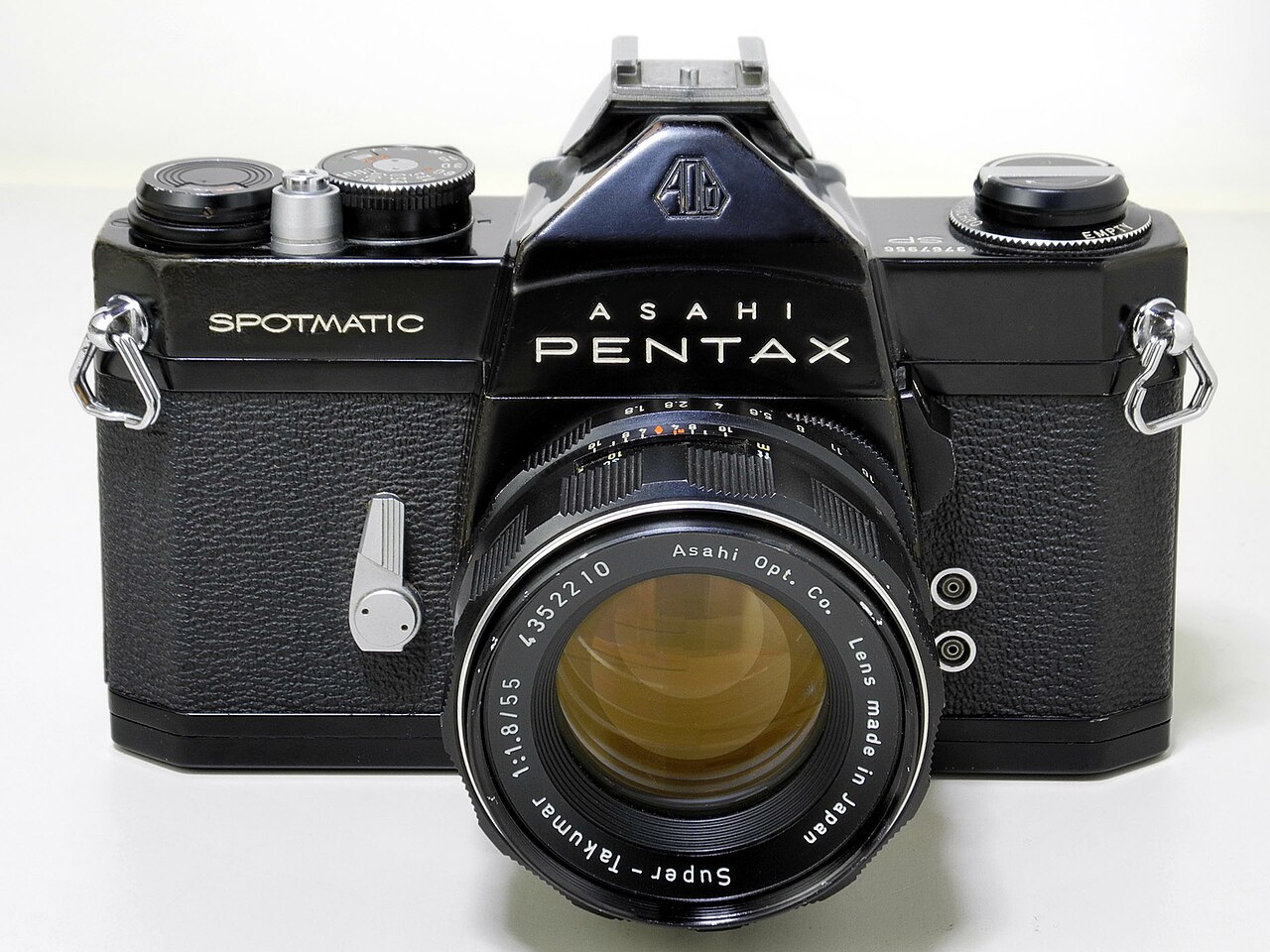
Hiyotada, CC BY-SA 3.0, via Wikimedia Commons.


Fitted with Zuiko Auto Zoom 50-90mm f3.5.
John Nuttall from Hampshire, United Kingdom, CC BY 2.0, via Wikimedia Commons.

Automation: Electronics for the Amateur
The Canon AE-1 of 1976 is the emblem of this era: an electronically controlled, shutter-priority camera that sold in very large numbers. The claim that it was the first microprocessor camera is, as the Canon chapter explains, disputed. The Pentax K1000 of 1976 was the same decade’s argument for simplicity. The Konica C35 AF was released in November 1977, and Wikipedia calls it the first mass-produced autofocus camera, a claim attached to three citations that we have not examined.

Black Canon AE-1 (1976) SLR camera from the front
en:User:Cburnett, CC BY-SA 3.0, via Wikimedia Commons.

The compact reached its height with Maitani’s XA of 1979, and the high-end compact with the Contax T of 1984. In 1980 Nikon introduced the F3, styled by Giorgetto Giugiaro; in 1983 Kyocera acquired Yashica, and with it the Contax name.

Olympus manual reflex camera
Daft racer, CC BY-SA 3.0, via Wikimedia Commons.


Ra Boe, CC BY-SA 3.0, via Wikimedia Commons.

Autofocus: The Electronic System
In February 1985 Minolta introduced the Maxxum 7000 with autofocus inside the body and a new A mount that made its older lenses obsolete. Canon followed in 1987 with the EOS 650 and a fully electronic EF mount that abandoned the FD system. Nikon’s F4 of 1988 was called by the company the first professional autofocus SLR, a company claim, and the Contax T2, in 1990 or 1991, brought a Zeiss lens and a titanium body to a pocket camera. The Olympus mju-II, sold as the Stylus Epic in some regions, arrived in 1997.

MIKI Yoshihito, CC BY 2.0, via Wikimedia Commons.

This was also the era of the legal case. A court ordered Minolta in 1991 to pay Honeywell $127.6 million for infringement of autofocus patents, though the report on which the figure rests is not about the case itself.

Frank Murmann, CC BY-SA 3.0, via Wikimedia Commons.

Digital: Film Becomes a Choice
Digital cameras moved from the margins in the 1990s to the centre in the 2000s. Nikon’s D1 of 1999 was built on a film body; Canon’s EOS D30 of 2000 was its first in-house digital SLR. In 2004 Nikon introduced the F6, the last film flagship; in January 2006 it announced that it would discontinue most film cameras. In 2005 Kyocera ended Contax and Yashica cameras, and in 2006 Konica Minolta left the camera business.

CONTAX T2 titanium body autofocus camera
User:Gisling, CC BY-SA 3.0, via Wikimedia Commons.

The mirrorless era came in 2008 with the Micro Four Thirds Lumix G1, in 2012 with the OM-D, and in 2018 with Canon’s RF mount and Nikon’s Z. The camera business of Olympus was sold, the new owner taking it in January 2021. And in 2024 Pentax introduced a new half-frame film camera, the Pentax 17. Wikipedia’s article on point-and-shoot cameras reports renewed, nostalgia-driven interest in older compact cameras by 2023, and a significant rise in fixed-lens camera sales in 2025; we cannot say how long that will last.

Zebrio from Tokyo, Japan, CC BY-SA 2.0, via Wikimedia Commons.


Ashley Pomeroy, CC BY-SA 3.0, via Wikimedia Commons.

Forty Dates in Order
The table lists forty dated events from the maker chapters, in order. It is the skeleton on which the six eras hang, and it is the reference to use when checking a camera’s age.

I have long wanted one of these. I finally got one. Unfortunately, the electronics do not work. Some day, when I get the time and nerve, I will tear into it and
James Case from Philadelphia, Mississippi, U.S.A., CC BY 2.0, via Wikimedia Commons.

| Date | Event | Chapter |
|---|---|---|
| 1917 | Nippon Kōgaku formed by the merger of three optical makers (Nikon) | Nikon |
| 1919 | Takachiho Seisakusho founded (Olympus); Asahi Kogaku Goshi Kaisha founded (Pentax) | Olympus, Pentax |
| 1928 | Kazuo Tashima founds the camera shop that becomes Minolta | Minolta |
| 1931 | Minolta name adopted for cameras | Minolta |
| 1932 | Nikkor lens brand introduced | Nikon |
| 1933 | Precision Optical Instruments Laboratory founded (Canon) | Canon |
| 1936 | Hansa Canon; Semi-Olympus I with the first Zuiko lens | Canon, Olympus |
| 1937 | Minoltaflex twin-lens reflex | Minolta |
| 1946 | The Nikon name first appears | Nikon |
| 1947 | Minolta-35 rangefinder | Minolta |
| 1948 | Nikon I; Asahi Optical allowed to re-form | Nikon, Pentax |
| 1949 | Yashima Seiki founded in Nagano | Yashica |
| 1952 | Asahiflex, the first Japanese 35 mm SLR (per Wikipedia) | Pentax |
| 1955 | Miranda T, first Japanese pentaprism SLR (per Wikipedia) | Rangefinders and SLRs |
| 1957 | Asahi Pentax; Pentax trademark acquired; Yashica-Mat; Nikon SP | Pentax, Yashica, Nikon |
| 1958 | Minolta SR-2; Yashica Company formed | Minolta, Yashica |
| 1959 | Nikon F; Canonflex; Yashica Pentamatic; Olympus Pen | Nikon, Canon, Yashica, Olympus |
| 1961 | Canon 7 with 50 mm f/0.95 lens | Canon |
| 1963 | Olympus Pen F | Olympus |
| 1964 | Pentax Spotmatic | Pentax |
| 1965 | Yashica Electro 35 (December 1965 or 1966) | Yashica |
| 1966 | Minolta SR-T 101 | Minolta |
| 1967 | Olympus Trip 35 | Compacts |
| 1971 | Canon F-1 and the FD mount | Canon |
| 1972 | Olympus OM-1 (as M-1 at photokina); Nikon F2 | Olympus, Nikon |
| 1974 | Contax RTS at photokina | Yashica |
| 1975 | Pentax K mount | Pentax |
| 1976 | Canon AE-1; Pentax K1000 | Canon, Pentax |
| 1977 | Konica C35 AF; Minolta XD | Compacts, Minolta |
| 1979 | Olympus XA | Olympus |
| 1980 | Nikon F3 styled by Giugiaro | Nikon |
| 1983 | Kyocera acquires Yashica; Nikon F3AF | Yashica, Nikon |
| 1984 | Contax T | Yashica |
| 1985 | Minolta Maxxum 7000 | Minolta |
| 1987 | Canon EOS 650 and EF mount | Canon |
| 1988 | Nikon F4 | Nikon |
| 1990 or 1991 | Contax T2 | Yashica |
| 1997 | Olympus mju-II / Stylus Epic | Compacts |
| 1999 | Nikon D1 | Nikon |
| 2000 | Canon EOS D30; Nikon S3 reissue | Canon, Nikon |
| 2003 or 2004 | Konica and Minolta merge | Minolta |
| 2005 | Kyocera ends Contax and Yashica cameras; Nikon SP reproduction | Yashica, Nikon |
| 2006 | Nikon announces it will stop most film cameras; Konica Minolta exits cameras | Nikon, Minolta |
| 2008 | Micro Four Thirds Lumix G1 | Olympus |
| 2011 | Ricoh acquires Pentax Imaging | Pentax |
| 2018 | Nikon Z mount and Canon RF mount | Nikon, Canon |
| 2021 | OM Digital Solutions takes over Olympus cameras | Olympus |
| 2024 | Pentax 17 half-frame film camera | Pentax |
Three Stories That Cross the Eras
The suppliers. The same names recur across eras: Nikkor lenses on Canon’s first cameras; a Zeiss-designed mount that became Pentax’s K mount; Zeiss lens designs on Yashica-built Contax bodies; Leica’s name on Minolta’s CL and, in essentials, its R3. The Japanese industry was never one of isolated companies, and its history is as much a history of exchange as of rivalry.

-- Canon F-1 Camera (S/N 252xxx) 1971-1976-- Eye-level finder-- CANON LENS FD 55mm 1:1.2 S.S.C. ASPHERICAL (S/N 68xxx) (radioactive)Body weight = 827g (with
s58y, CC BY 2.0, via Wikimedia Commons.

The defeat that kept a camera alive. Several mounts survived because their makers refused to follow the market. Pentax and Nikon kept their K and F bayonets when autofocus arrived, while Minolta and Canon replaced theirs, and Wikipedia calls the F and K the only two SLR mounts not abandoned. The stubbornness that looked old-fashioned in 1985 looks, forty years later, like the reason that lenses from 1959 still fit.
The comeback. Nikon’s S3 reissue of 2000 and SP reproduction of 2005, the Zfc of 2021 dressed as an FM2, the OM-D of 2012 styled on the OM-1, and the Pentax 17 of 2024 are the same story told from different directions: the industry has begun to sell its own past. Wikipedia reports nostalgia-driven interest in older compacts from 2023, and a trade writer reports that the Contax T2 rose from a couple of hundred dollars to nearly $2,500. A past that sells is a past that is kept, and a past that is kept is, in the end, a history.
The comeback also changes how the earlier eras are read. A Hansa Canon, an F or a Spotmatic is no longer only a surviving object; it is a sample of a supply chain that may or may not continue, since the film it needs, the batteries it needs and the technicians who can mend it are all scarcer than they were. The eras described here are therefore not closed. Each is still being lived, by someone, in the present tense.
The Seventh Era, Perhaps
It is tempting to add a seventh era to the six: the era of the revival. The evidence for it is real but thin. Pentax introduced a new film camera in 2024, the first to carry its name in more than two decades; Lucky Film relaunched a black-and-white stock; Fujifilm restarted C200 and C400 production, according to a design magazine; Kodak hired 300 people to increase film output; and younger buyers, a trade writer reports, are visiting film stores more often. Against this stand the facts that Kodak has raised its prices, Fujifilm has discontinued some stocks, Kodak has stopped selling motion-picture film outside the industry, and a five-roll pack of Portra 400 that cost about $54 in 2018 cost about $109 when in stock at the time of the report.
We therefore decline to name a seventh era. An era is what has become ordinary, and film is not ordinary. It is, for the first time since the 1880s, a choice, and a choice is a different thing from an era. The six eras end where the choice begins.
What Was Happening Beyond Japan
A national history is easiest to follow against the one beside it. Wikipedia’s rangefinder article dates the first marketed rangefinder camera to the Kodak 3A Autographic Special of 1916, and the Leica I of 1925 to the popularising of the small-format miniature. In 1932 the Leica II and the Zeiss Contax I were major successes. The Kine Exakta of 1936 was the first integrated 35 mm SLR, Jenő Dulovits patented the first eye-level SLR finder in Hungary in 1943, and the Rectaflex A.1000 of 1948 was the first commercial SLR with a roof pentaprism. The East German Contax S followed in 1949. When the Asahiflex arrived in 1952 it was therefore not the invention of the reflex, but the first of the Japanese kind.
The digital turn has its own foreign beats. The Epson R-D1 of 2004 was, according to Wikipedia, the first digital rangefinder camera, and Leica’s first, the M8, followed in 2006. Those dates matter because they show that the Japanese camera industry did not lose its past in the digital age; it was copied back into the new technology by its own makers, by Epson, which is Japanese, and by Leica, which is German.
A Collector’s Eye on Each Era
Study (1933 to 1947). The objects of this era are few and mostly in museums. The thing to know is the Nikkor on the Hansa Canon, which is the best physical evidence of how closely the early makers worked together. A buyer who is offered one should expect the description to carry documents.

Vitaly baranov, CC BY-SA 3.0, via Wikimedia Commons.

Rangefinders (1948 to 1958). The Nikon S series and the Canon bodies of the period are the heart of the collecting field. The Nikon chapter notes that Contax lenses fit the Nikon rangefinder physically but do not focus accurately on it, so a mixed outfit needs checking.
Reflex (1952 to 1975). The most plentiful era of the survivors, and the one in which the bench guide is most useful. The Pentax Spotmatic, the Minolta SR-T 101 and the Nikon F are the models most often met, and the mount decides which lenses can be shared.
Automation (1976 to 1984). The AE-1, K1000 and OM-1 are common, and their prices are tied to their reputations. Battery and electronics faults are the risk, as the bench guide explains.
Autofocus (1985 to 1999). The Maxxum 7000, the EOS 650 and the F4 are cheap by the standards of the earlier eras, and their mounts, with the exception of Nikon’s F, are the ones the later makers abandoned or reinvented. The compacts of the same years, among them the Contax T2, are the opposite case, priced by fashion.
Digital onwards (2000 onwards). The film camera is now a choice, and the new film cameras, the Pentax 17 above all, are the first in decades that a buyer can purchase new.
Three Beats That Repeat
Within each era the same three beats recur. First comes the study: an unfamiliar technology, German in the first era, American or European in others, is taken apart and learned. Then comes the leap: a Japanese maker adds something the originals lacked, whether the Nikon F’s system, the Pentax K mount, the Olympus OM’s small body or the Minolta A mount’s autofocus. Last comes the commonplace: the leap becomes ordinary and cheap, and the next era begins. The pattern is the argument of the chapter, and it explains why the dates cluster.

Joost J. Bakker from IJmuiden, CC BY 2.0, via Wikimedia Commons.

The pattern also explains why the claims of firsts are so numerous and so poorly proved. A first belongs to the leap, and the leap is never as clean as the advertisement. The commonplace is the real achievement, and it is the one that the makers did not need to claim.
A Small Timeline Glossary
Era. A period named for what became ordinary in it.
photokina. The Cologne trade fair at which several landmark cameras, among them the Contax RTS and the Olympus M-1, were shown.
Reissue. A camera made again by its original maker, as in the Nikon S3 of 2000.
Reproduction. A rebuilt version, such as the Nikon SP of 2005.
Mirrorless. A camera without a reflex mirror; the Lumix G1 of 2008 was the first Micro Four Thirds.
Half-frame. A format of 18 by 24 mm; the Olympus Pen of 1959 and the Pentax 17 of 2024.
Claimed and Proved: The Firsts
Because every maker likes to be first, this table sorts the superlatives of the period by the quality of the evidence we found.
| Claim | Evidence | Our wording |
|---|---|---|
| Kwanon as Japan’s first 35 mm focal-plane camera | Wikipedia; prototype never sold | Prototype; a copy of the Leica design |
| Asahiflex as the first Japanese 35 mm SLR | Wikipedia, twice | Stated as Wikipedia states it |
| Miranda T as the first Japanese pentaprism SLR | Wikipedia SLR article | Stated as Wikipedia states it |
| AE-1 as the first microprocessor camera | Two differently worded claims, one 1977 source | Disputed |
| Konica C35 AF as the first mass-produced autofocus camera | Wikipedia, three citations not examined | Reported, not verified |
| Maxxum 7000 as the first autofocus SLR | Earlier AF SLRs exist; narrower claim stands | Narrow wording only |
| Nikon F4 as the first professional autofocus SLR | Company claim | Attributed to the company |
| Contax T2 introduced in 1990 or 1991 | Sources differ | Both years given |
Eras in objects

1936 Hansa Canon with Nikkor 50mm f/3.5
Look closer: The earliest object in this chapter; the lens is a Nikkor.
Morio, CC BY-SA 4.0, via Wikimedia Commons.


A Nikon F on display at the Nikon Museum in Shinagawa, Tokyo.
Look closer: The camera that made the reflex era a professional one.
K6ka, CC BY-SA 4.0, via Wikimedia Commons.

The Camera Shelf
The house keeps a small shelf of Japanese cameras, and keeps it honest: at the time of writing it holds Contax T2 compacts with Carl Zeiss lenses, each photographed and described with its condition set out. If a body or lens you want is not there, the concierge desk can look for it in Japan.
Answered plainly
What were the main eras of Japanese camera history?
Six: study, the rangefinder export years, the reflex era, automation, autofocus and the digital turn.
When did Japan make its first SLR?
The Asahiflex of 1952, according to Wikipedia, the first Japanese 35 mm SLR.
Which Japanese camera first had through-the-lens metering?
The Pentax Spotmatic was launched in 1964 after a 1960 prototype; we make no claim that it was the first anywhere.
When did the autofocus SLR arrive?
The Nikon F3AF in 1983 and the Pentax ME F preceded the Maxxum 7000 of 1985, which combined integrated autofocus with motorised film advance.
When did film cameras end?
They did not. Nikon announced in 2006 that it would discontinue most of them, but Pentax introduced a new film camera in 2024.
Why are the dates sometimes given as two years?
Because the reference works disagree and we do not choose between them.
How many eras of Japanese camera history are there?
Six in this almanac: study, the rangefinder export years, the reflex, automation, autofocus and the digital turn. We decline to name a seventh.
When did Japanese cameras start?
The dates of the first prototypes are 1933 or 1934 for Canon’s Kwanon, with Nikon, Olympus, Pentax and Minolta each beginning in optics before cameras.
What was the first Japanese camera sold worldwide?
The record does not support a single answer. The Nikon S series and the Canon rangefinders of the 1950s were the first to make Japanese cameras known abroad.
When did film cameras stop being made in Japan?
They did not stop altogether. Nikon announced in 2006 that it would stop most film cameras but keep the F6 and FM10, and Pentax introduced a new film camera in 2024.
Is film photography really coming back?
There are signs: new film cameras and relaunched stocks. There are also rising film prices, and trade writers disagree about how long the revival will last.
Where next
Sources and image credits
- Canon Inc., Wikipedia
- Nikon, Wikipedia
- Olympus Corporation, Wikipedia
- Pentax, Wikipedia
- Minolta, Wikipedia
- Yashica, Wikipedia
- Single-lens reflex camera, Wikipedia
- Konica C35 AF, Wikipedia
- Point-and-shoot camera, Wikipedia
- Canon Camera Museum
- 2025 could be a make-or-break year for film photography (Digital Camera World)
- New Pentax 17 35mm camera heralds the return of film (Wallpaper*)
- Image: Hansa Canon front-right 2016 Canon Plaza S, Morio (CC BY-SA 4.0)
- Image: Leotax img 1855, Rama (CC BY-SA 2.0)
- Image: Nikon SP chrome with exposure meter and NIKKOR-S 1,4 f=5cm, Dnalor 01 (CC BY-SA 3.0 at)
- Image: Canon7 50mm, Hiyotada (CC BY-SA 3.0)
- Image: Nikon F Eye Level, Runner1616 (CC BY-SA 3.0)
- Image: Pentax SP, Hiyotada (CC BY-SA 3.0)
- Image: Olympus - Pen F, John Nuttall from Hampshire, United Kingdom (CC BY 2.0)
- Image: Canon AE-1 front, en:User:Cburnett (CC BY-SA 3.0)
- Image: Olympus OM-1 chrome, Daft racer (CC BY-SA 3.0)
- Image: Pentax K1000 by-RaBoe-001, Ra Boe (CC BY-SA 3.0)
- Image: Minolta Maxxum 7000 Alpha Mount, MIKI Yoshihito (CC BY 2.0)
- Image: Minolta 9000, Frank Murmann (CC BY-SA 3.0)
- Image: CONTAX T2, User:Gisling (CC BY-SA 3.0)
- Image: 0313 Ricoh GR1, Zebrio from Tokyo, Japan (CC BY-SA 2.0)
- Image: Olympus XA 5316, Ashley Pomeroy (CC BY-SA 3.0)
- Image: Yashica Electro 35 GSN, James Case from Philadelphia, Mississippi, U.S.A. (CC BY 2.0)
- Image: Canon F-1, s58y (CC BY 2.0)
- Image: Pentax ME Super, Vitaly baranov (CC BY-SA 3.0)
- Image: Olympus Trip 35, Joost J. Bakker from IJmuiden (CC BY 2.0)
- Image: A Hansa Canon of 1936, Morio (CC BY-SA 4.0)
- Image: A Nikon F, K6ka (CC BY-SA 4.0)
Last reviewed 28 October 2026. Pictures are public-domain or openly licensed and credited beneath each one; diagrams are drawn by Japonista.
Looking for a camera from a particular era? The concierge desk replies within one to three business days.
Return to the Japanese Camera Almanac · Make a private request
Private concierge
Looking for something in particular?
Describe the piece or the project you have in mind. A senior advisor in Tokyo reads every case file personally and replies within two business days, with fees set out in writing before any work begins.