
Nikon: From Nippon Kogaku to the F Mount | Japonista
Camera Almanac · The Lens Maker
Nikon: From Nippon Kogaku to the F Mount
ニコン
Nikon began as a maker of glass, and the cameras came later. This chapter follows the house from the first rangefinder of 1948 to the F of 1959, whose lens mount has outlived most of the companies that once competed with it, and says plainly where the stories told about it rest on thin evidence.
Fact sheet
At a glance
- Lenses first. The Nikkor name dates from 1932, sixteen years before the first Nikon camera.
- A borrowed mount. The 1948 Nikon I joined the bayonet shape of the Contax to the focusing of the Leica, by Nikon’s own account.
- The F. Interchangeable finders and screens, a bayonet mount and a system of lenses made one body a tool for decades.
- Film to Z. The F mount of 1959 was still being used on a 2020 flagship; the Z mount arrived in 2018.
Why Nikon Is a History of What Was Kept
Most camera histories celebrate the first of something. The Nikon story is better told as a history of what was kept. The F mount of 1959 is still the mount on which Nikon builds lenses; Wikipedia counts more than four hundred compatible Nikkor lenses and calls it the largest interchangeable flange-mount system in history. A company that began as a merger of three optical makers in 1917 and sold its first camera under its own name in 1948 had, by the end of the century, the least interrupted lens catalogue in photography.
That continuity is a choice, and it was not free. Canon abandoned its FD mount in 1987 and began again with the electronic EF; a generation of professionals, as Wikipedia’s Nikon article puts it, moved to Canon through the 1990s. Nikon kept the old bayonet, accepted the compromises that came with it, and made the old lenses work on new bodies. Whether that was wise is arguable, and this chapter does not argue it. It records what happened, and what it means to a person who now holds an old Nikkor and wonders whether it will fit.
The rest of this chapter is arranged as a reader might use it: first the stories, which are what make the objects interesting; then the numbers and curiosities; then the long professional line from the F2 to the F6; then the lens line letter by letter; then the reissues, which are the nearest the camera world comes to a reprint; then the modern chapter, in which Nikon is both a camera maker and something much larger.
A Lens Maker Turns to Cameras
Nikon is a good case for the proposition that Japan’s camera industry grew out of optics rather than photography. Wikipedia’s article records that Nippon Kōgaku Kōgyō, Japan Optical Industries, was formed in 1917 when three optical manufacturers merged, that the Nikkor lens brand was introduced in 1932, and that the name Nikon dates from 1946, at first intended only for the small-camera line. During the war the company made military optics: binoculars, lenses, bomb sights and periscopes.
The first camera followed within three years of the war’s end. Nikon’s own history says that development of the Nikon I began in 1945 and that the camera was released in March 1948. It was a rangefinder, and Nikon is frank about its parentage. The lens mount, the company says, combined the bayonet shape of the Contax with a Leica-style focusing mechanism and the same flange distance as the Contax, so that Nikon’s 5 cm lens could be focused at infinity on either maker’s body. The shutter was a focal-plane type with a cloth curtain running horizontally, borrowed from Leica, which Nikon chose over the Contax’s vertical metal curtain for steadier performance.

Photo showing the Nikon S-mount on the Nikon SP camera. This lens mount was used in the Nikon interchangeable-lens range finder cameras and was a copy of the pr
Look closer: The S mount is a bayonet of Contax pattern; look for the three-slot ring and the small tab that couples the lens to the rangefinder.
Sshenoy Sudhir Shenoy, CC BY 3.0, via Wikimedia Commons.

One detail marks the earliest cameras out. The Nikon I made a frame of 24 by 32 mm, a shape Nikon calls its own “Nikon format”, shortened from the usual 36 mm to sit closer to the proportions of printing paper. The result confused photofinishers, because the film was cut mid-frame. The Nikon M of October 1949 widened the frame to 24 by 34 mm, and the Nikon S, at the end of 1950, added flash synchronisation. Nikon’s account does not trace the frame sizes of the later models, and neither shall we; it is enough to know that the first two bodies carry frames the later cameras abandoned, which is one reason collectors treat the Nikon I and the Nikon M as objects apart.
The Rangefinder Years
The story most often told about the S series involves a war. In 1950 the Life photographer David Douglas Duncan, covering Korea, is said to have used Nikkor lenses on Leica bodies after meeting Nippon Kōgaku’s president in Tokyo; colleagues followed, and the New York Times reported Nikon’s rise among photojournalists in December 1950. That is the account given by an enthusiast’s blog, which cites no documents and contradicts itself on small points such as which lens and which Leica body were used. Wikipedia’s article on the company states the outline more cautiously: Duncan used Nikon-optic Leica bodies in the Korean War, and the company’s profile rose. We treat the story as true in outline, important as a contributing cause, and not the whole explanation.

Nikon SP chrome with exposure meter and NIKKOR-S 1:1,4 f=5cm;own work
Look closer: Find the long window to the left of the lens: it is the wide finder that made the SP the grandest of the S cameras.
Dnalor 01, CC BY-SA 3.0 at, via Wikimedia Commons.

Nikon’s own account of the S-series emphasises something less romantic: cold. The company says smooth shutter movement and improved lubrication, developed with advice from aircraft laboratories and tested in a meteorological laboratory, a fish-market freezer and refrigeration plants, let the camera work in colder places than its rivals. Professionals, it says, valued that durability with Nikkor lenses. The page names no photographer.
The line then matured quickly. Wikipedia dates the Nikon S to 1951, the S2 to 1954, the professional SP to 1957, the S3 to 1958, and the lower-priced S4 to 1959; the Rangefinder Camera article describes the S series as running from 1951 to 1962. The SP is the one most admired: it carried a wide viewfinder with frames for several focal lengths. Two limited reissues have complicated the used market since: the S3 in 2000 and the SP in 2005, both clearly marked, as the house’s earlier Journal guide to Japanese rangefinders explains.

1957 Nikon SP with the 1957 BC-5 flash unit.
Look closer: Flash in 1957 meant a large separate unit on the camera’s accessory shoe; the sync contacts Nikon added to the S in 1950 are why it works.
Morio, CC BY-SA 4.0, via Wikimedia Commons.

The F and the Mount That Stayed
Wikipedia gives April 1959 for the Nikon F, and the camera’s importance lies less in any one invention than in the system around it. Its article describes interchangeable prisms and focusing screens, and it tells a candid story about originality: the source it cites for the camera’s history says the F “did not embody any technological breakthroughs”, even as other commentary calls it revolutionary for combining so many features in one body. Both can be true. Nikon’s achievement was reliability and completeness, the sense that a working photographer could buy into one family of lenses, finders and drives and keep it.

Chrome Nikon F camera with eye-level finder and Nikkor-O 35/2,0
Look closer: The plain prism is the simplest of the F’s finders; the engraving on the front of the prism and the mount ring are where collectors look for variants.
Runner1616, CC BY-SA 3.0, via Wikimedia Commons.

The system grew in stages. The article dates the first independent-photocell Photomic finder to 1962 and the 60 per cent centre-weighted through-the-lens FTn to 1968. Nikon’s successor, the F2, was released in September 1971 according to Wikipedia, with production ending in 1980; the F3 followed in March 1980, styled by Giorgetto Giugiaro, and stayed in production, depending on the account, until between 2000 and 2002. Wikipedia’s F article gives 862,600 as the total number of Nikon F bodies, citing a history published at Sendai; it also gives October 1973 as the end of production while elsewhere saying the F was “succeeded in 1972”, so the end date is one we mark as uncertain.

A cut-away view of a Nikon F SLR camera and 50mm f/2 lens, at the Nikon Museum in Tokyo
Look closer: In a cutaway, trace the path from the lens to the mirror and up into the prism; that is the same journey drawn in our diagram of the SLR.
4300streetcar, CC BY 4.0, via Wikimedia Commons.

The mount is the quieter triumph. The F mount was first introduced on the Nikon F in 1959, with a flange focal distance of 46.5 mm, and Wikipedia records that Nikon still uses variations of it on the 2020 D6, a span of more than 67 years. Over that time the mount absorbed automatic maximum-aperture indexing in 1977, known as Ai, and AF-S in 1996. A caution belongs here: Wikipedia notes that non-Ai lenses can mechanically damage later bodies unless modified, which is why a bargain lens of the 1960s should be checked against the body you intend to fit it to.

A Nikon F on display at the Nikon Museum in Shinagawa, Tokyo.
Look closer: The F’s square, plain lines were thought durable rather than beautiful; its later fame made them beautiful.
K6ka, CC BY-SA 4.0, via Wikimedia Commons.

From the F2 to the Z
The decades after the F are a story of electronics. The F3AF of 1983 brought autofocus to the F line with special lenses; the F4 of 1988 is described by the company as the first professional autofocus SLR, a claim we mark as the company’s own. Canon’s EOS system, introduced in 1987, drew many professionals away from Nikon in the following decade, according to Wikipedia. The F5 arrived in 1996 and the F6 in 2004. In January 2006 Nikon announced that it would discontinue most film cameras and large-format lenses.
Digital came by way of the film body. Wikipedia dates the D1 to 15 June 1999, built on a film-camera chassis with Kodak’s help, and the full-frame D3 to August 2007. The Z mount and the Z6 and Z7 followed in 2018.
| Model | Year | What to know | Basis |
|---|---|---|---|
| Nikon I | 1948 | 24 × 32 mm frame; Contax-pattern bayonet with Leica-style focusing | Nikon history |
| Nikon M | 1949 | 24 × 34 mm frame | Nikon history |
| Nikon S | 1951 | Flash sync contacts, added at the end of 1950 by Nikon’s account | Wikipedia; Nikon history |
| Nikon SP | 1957 | Wide multi-frame finder | Wikipedia |
| Nikon F | 1959 | System SLR, interchangeable finders | Wikipedia |
| Nikon F2 | 1971 | Photomic finders; motor drives | Wikipedia |
| Nikon F3 | 1980 | Giugiaro styling; electronic shutter | Wikipedia |
| Nikon F6 | 2004 | Last film flagship | Wikipedia |
Six Stories from the Nikon Record
A lens maker learns its name. The Nikkor brand was introduced in 1932, according to Wikipedia, as a Western rendering of Nikkō, an abbreviation of the company’s original name. Nikkō also means sunlight and is the name of a famous hot-spring town. The word Nikon appeared first in 1946, spelled Nikkon, for the small-camera line, and lost a letter on the way. The company was renamed Nikon Corporation only in 1988, after its cameras, which is to say that for seventy-one years the best-known name in the business was a product name and not the company’s.
The Zeiss complaint. In the early 1950s Carl Zeiss objected that Nikon sounded too like its own Ikon brand. The same article records that from 1963 to 1968 the Nikon F was labelled Nikkor in Germany to avoid the dispute. These German-market cameras are now collectors’ items. The detail matters to this almanac because it turns a rumour we once flagged as uncited into a documented fact, and we have moved it from our list of doubtful stories to our list of supported ones.
The correspondent and the lenses. The Korean War story has a name attached. Wikipedia says that the photojournalist David Douglas Duncan covered the war in 1950 and 1951 using Nikon lenses fitted to his Leica rangefinders, and that he had been introduced to the lenses by Jun Miki. What the lens proved, in the retelling, was that a Japanese optic could survive a winter campaign. The outline is firm; the numbers of lenses and the exact conditions are anecdote, and we say so.
The bullet. Wikipedia’s article on the Nikon F reports that Don McCullin’s Nikon F stopped a bullet, which may have saved his life. We repeat it as Wikipedia’s report and add only the obvious caution that a camera that stops a bullet is a camera that has been somewhere it should not have been. The F’s nickname, the hockey puck, comes from the same article and refers to its durability.
The Moon, and the cover of a record. An F with an FTn Photomic prism and a motor drive was used on Apollo 15 in 1971 and was, according to the Nikon F article, the first 35 mm SLR in lunar orbit; modified Fs flew aboard Skylab in the early 1970s. In another register, Wikipedia’s article on the Nikon SP notes that Bob Neuwirth is seen carrying an SP in Daniel Kramer’s portrait of Bob Dylan used for the cover of Highway 61 Revisited in 1965. A camera that went to orbit and a camera on a record sleeve: the Nikon reputation sits between the laboratory and the street.
The factory on film. Wikipedia records that Akira Kurosawa’s wartime film The Most Beautiful filmed its scenes of an optical factory at the Nippon Kōgaku works at Totsuka, Yokohama. It is a small fact with a large implication: before Nikon was a household name, its own workplace was already a setting that a film-maker thought worth recording.
Numbers and Curiosities
The facts below are each attributed to the Wikipedia article named; none comes from the maker’s publicity. Where a figure looks inconsistent, we say so.
- The F cost US$186 with a 50 mm f/2 lens at its launch in April 1959, and $233 for the body with a standard prism in November 1963, with $90 more for the f/2 lens or $155 for the f/1.4 (Nikon F article).
- The F was produced in 862,600 bodies before the F2 replaced it in 1972, and production ended in October 1973 (Nikon F article). Both dates are given in the article; they are consistent if production of remaining stock continued after the F2 arrived.
- The F in the name stands for re-F-lex, because many Asian languages lack the R sound (Nikon F article, a claim we have not checked against a second source).
- The F’s shutter was a titanium-foil focal-plane design, and the SP’s shutter curtain was changed from rubberized silk to titanium in 1959 to match (Nikon F and Nikon SP articles).
- The SP’s viewfinder assembly, with 28 internal elements, took about ten times as long to assemble as the FM3A’s (Nikon SP article).
- The SP had no hot-shoe; flash was connected by a PC socket synchronised at 1/60 second. Its S-mount is a modified Contax bayonet, and Contax lenses fit physically but do not focus accurately on the SP’s rangefinder (Nikon SP article).
- A 2000 mm f/11 Reflex-Nikkor weighs 17.5 kg, about 39 pounds (F-mount article).
- Nikon’s raw file format is called NEF, for Nikon Electronic File, and the DSCN prefix on its file names stands for Digital Still Camera – Nikon (Nikon article).
- The Wikipedia article lists screen and song appearances, among them The French Connection, in which a drug dealer gives his girlfriend an F, the television series Dexter, whose lead uses a Nikon, and Paul Simon’s 1973 song Kodachrome, which mentions Nikon cameras.
From the F2 to the F6: The Professional Camera
The F is the founding body; the cameras that followed form the longest line in professional photography. The F2 arrived in 1972. The F3 was introduced in March 1980 and, according to Wikipedia, was styled by the Italian designer Giorgetto Giugiaro, the first of many F-series cameras he styled. It introduced the red stripe on the handgrip that became a Nikon signature. Its shutter was electronically controlled by a quartz timer and a metal blade, with a mechanical backup at 1/60 second. Production ran from 1980 to about 2001, and the article records more than 751,000 made through September 1992, although new bodies stayed on sale for years afterwards. The F3 is described there as the longest-running professional Nikon SLR; it remained in production after the F4 of 1988 and the F5 of 1996 had arrived.
The F3 had variants worth knowing. The F3HP, High Point, had a viewfinder from which the full image could be seen from 2.5 cm away, helpful to people who wear spectacles. The titanium F3/T appeared in 1982. The F3AF of 1983 was Nikon’s first autofocus camera, with motors in two special lenses; Wikipedia calls it slow and bulky. The F3H, built for high-speed work with the MD-4H drive at up to 13 frames a second, was used at the 1998 Nagano Olympics; Nikon’s own figure was about a hundred bodies, but serial numbers suggest more.
The F4 of 1988 is described by Wikipedia as the world’s first professional autofocus SLR with a built-in motor drive, which is a company claim as well as a Wikipedia statement, and we treat it as such. The F5 followed in 1996 and the F6 in 2004. In January 2006 Nikon announced that it would stop making most film cameras, keeping only the F6 and the FM10 in production. Wikipedia notes that both still appeared in Nikon’s film line-up in 2019, and that the company has committed to servicing film cameras for ten years after production ends.
Alongside the professional line, Nikon built the cameras that people actually carried. The Nikkormat F series arrived in 1965, the Nikon FM in 1977, the FE in 1978 and the FM2 in 1982. The FM2 had a mechanical shutter to 1/4000 second, a vertical-travel metal shutter with titanium blades at first and aluminium from 1989, and a meter that needed batteries although the camera could otherwise run mechanically without them. The FM2/T of 1993, with titanium plates, was listed at $1,120 and discontinued in 1997. The FM2 stayed in limited production until 2001, and its successor, the FM3A, was also made in limited numbers in 2001. Wikipedia reports an operating range of minus 40 to plus 50 degrees Celsius for the FM2, a claim with no source given.
| Camera | Year | What it is remembered for |
|---|---|---|
| Nikon F | April 1959 | The first Nikon SLR; interchangeable prisms; the F mount |
| Nikon F2 | 1972 | Replaced the F after 862,600 F bodies |
| Nikon F3 | March 1980 | Giugiaro styling, red grip stripe, electronic shutter, produced to about 2001 |
| Nikon FM2 | 1982 | Mechanical shutter to 1/4000; in limited production until 2001 |
| Nikon F3AF | 1983 | Nikon’s first autofocus camera, with motors in the lens |
| Nikon F4 | 1988 | Company-claimed first professional autofocus SLR with built-in drive |
| Nikon F5 | 1996 | Successor to the F4 |
| Nikon F6 | 2004 | The last film flagship; in the line-up in 2019 |
The Mount Through Its Suffixes
The F mount is a three-lug bayonet with a 44 mm throat and a flange distance of 46.5 mm, according to Wikipedia’s F-mount article, and its history is a history of letters. The first lenses, from 1959, were the Auto Nikkor type, with a prong on the aperture ring to couple to a meter. The Photomic T prism of 1965 used a through-the-lens meter that required the maximum aperture to be set by hand. The year 1971 brought the C marking for multicoating and replaced the Nippon Kogaku engraving with the word Nikon. In 1974 the K-type lenses appeared with rubber focus grips.
The system then took its decisive step. In 1977 the AI, automatic maximum-aperture indexing, system added a ridge on the aperture ring that coupled to the body. The article warns that non-Ai lenses can damage later bodies unless modified. The Series E lens line, simpler and lighter, appeared in 1979 with the Nikon EM; AI-S followed in 1981 with standardised aperture control. Autofocus lenses came in stages: AF-N and AF-I and AF-D in 1990 and 1992, then AF-S, with its silent ultrasonic motor, in 1996, and AF-P with a stepper motor in 2015 on the F mount. A caution applies here as well: the article records that AF-P lenses will not focus on cameras from before about 2013.

Runner1616, CC BY-SA 3.0, via Wikimedia Commons.

Wikipedia counts more than 400 compatible Nikkor lenses and more than 67 years of production, and calls the F mount one of only two SLR mounts, the other being the Pentax K, that were not abandoned when autofocus arrived. The successor Z mount, introduced in August 2018 with the Z7 and Z6, has an adapter, the FTZ and its second version the FTZ II, through which many F-mount lenses work on Z cameras. Old manual lenses can gain meter support on consumer bodies with a small replacement chip, sold under the name Dandelion. And the name Noct, once given to a very fast manual Nikkor, was revived for the Z-mount 58 mm f/0.95 S Noct.
When Nikon Reprinted a Camera
Most manufacturers revive a name. Nikon did something rarer: it rebuilt two rangefinders. According to Wikipedia’s SP article, the company released an S3 reissue in 2000. In 2001 it began work on an SP reproduction, and its engineers bought two used SPs to take apart and study. Orders for the SP Limited Edition were open to Japanese customers only, from 14 January to 30 June 2005; first deliveries came in March. Exactly 2,500 cameras were made, painted black and supplied with a reproduction of the W-Nikkor 3.5 cm f/1.8 lens bearing a matching serial number. The price was 690,000 yen before tax, about US$6,228 at the time.

Herbert Ortner, CC BY 4.0, via Wikimedia Commons.

The reproduction was not a copy. The article says the new lens formula omitted the lanthanum glass used in the original. And many of the cameras were never used: the same article notes that by 2025 many limited editions remained boxed, so that complete kits with their original packaging could still be bought in Japan. For a collector this raises the question our myths chapter asks. A reissue is not a fake, and an unused one is not an old camera; its value, if it has one, lies in its documentation. The house prices nothing here. It notes only that a dealer who calls a 2005 camera a 1957 camera has made a serious error.
Nikon Now: Mirrorless, Film Memory and a Much Larger Company
Nikon’s digital history is quickly told. It sold its first mirrorless cameras, the Nikon 1 series with a one-inch sensor, in 2011 and discontinued them in 2018. In August 2018 it introduced the Z mount and the full-frame Z7 and Z6, followed in 2019 by the DX-format Z50, in 2020 by the Z6II and Z7II, and in 2021 by the Zfc, styled to evoke the FM2, and by the flagship Z9 with a 45.7 megapixel sensor and no mechanical shutter. The Zfc is the clearest sign that the company understands its own memory: it is a modern camera dressed as an old one.
The corporate picture is larger and less comfortable. Nikon is also a maker of semiconductor lithography equipment, where its share fell from about 34 per cent in 1999 to about 20 per cent in 2013 as ASML rose; in 2019 a patent settlement with ASML and Carl Zeiss brought it about $170 million. It acquired RED Digital Cinema in April 2024, moved its headquarters to Nishi-Ōi, Shinagawa, in July 2024, and in October 2025 saw EssilorLuxottica become its largest shareholder by voting rights. Wikipedia reports a loss for the year ended 31 March 2026 against revenue of ¥677.2 billion, driven in part by impairments in its digital manufacturing business. A reader choosing a camera need not read the balance sheet, but the facts explain why Nikon is careful about its film cameras: they are a memory, not a market.
That memory is alive. Wikipedia lists the F6 and FM10 in the 2019 line-up; Nikon’s ten-year servicing commitment applies to them. In the wider market, a camera trade writer reports that Kodak has raised prices and Fujifilm has discontinued some stocks, and another that a five-roll pack of Kodak Portra 400, about $54 in 2018, cost about $109 when in stock at the time of writing. These are not Nikon facts, but they are the facts a person buying a Nikon film body will meet at the shop. See the bench guide for what to inspect, and the glossary for the vocabulary.
The F2: The Last Mechanical Professional
Wikipedia records that Nippon Kogaku released the F2 in September 1971 and built it until 1980, that it replaced the F, and that it was the last all-mechanical professional Nikon SLR. Photojournalists used it widely in the later part of the Vietnam War, the article says, without naming any. It added a top speed of 1/2000 second, a swing-open back, a back holding 250 exposures, a larger mirror, a release set nearer the front of the body and a detachable motor drive. The body needs no batteries; only the metering heads do.

Photopath at flickr, CC BY-SA 2.0, via Wikimedia Commons.

The heads are the F2’s special story. The DP-1 of 1971 had a centre-the-needle galvanometer display with 60/40 centre-weighted CdS metering; the DP-2 of 1973 used LEDs for over- and under-exposure and had better low-light sensitivity; the DP-3 of 1976 was the first silicon-photodiode meter on a Nikon SLR. The DE-1 was a meterless prism that was unpopular at the time and is now, the article says, the most expensive on the used market, a paradox it leaves unexplained. Motor drives, the MD-1 of 1971 and MD-2 of 1973, provided automatic advance and power rewind, and the MD-3 was lighter and cheaper without power rewind.

Runner1616, CC BY-SA 3.0, via Wikimedia Commons.

The variants include the F2AS, the most advanced standard Photomic; the F2T and the black F2 Titan, built with titanium parts from 1978 to 1980; the F2H of 1978, a high-speed body with a pellicle mirror, a 1/1000 top speed and its own motor drive, of which about 400 were made; and an F2 Data body of about 5,000 imprinting time and date. The article reports about 816,000 F2 bodies in all, and list prices of $660 for an F2 Photomic with a 50 mm f/1.4 lens in 1972, $961 for the F2S in 1976 and $1,278 for the chrome F2AS in 1978, with used bodies today at about $200 to $400. The article also gives a small piece of workshop lore, the “Nikon Shuffle”, the procedure for indexing rabbit-ear lenses to the meter. It flags as uncited several statements, among them the claims of the largest lens selection in the world, a 1978 system value of $110,000, and NASA’s favouring of the Type P screen, and it contradicts itself on weight and drive speed; we repeat none of them as fact.

Runner1616, CC BY-SA 3.0, via Wikimedia Commons.


Frankwit01, CC BY 3.0, via Wikimedia Commons.


Runner1616, CC BY-SA 3.0, via Wikimedia Commons.

The F3: Giugiaro and the Quartz Shutter
The F3, introduced in March 1980 and made until about 2001, was Nikon’s third professional SLR and offered manual and aperture-priority exposure. It was the first F-series body styled by Giorgetto Giugiaro, and it introduced the red stripe on the handgrip that became a recurring Nikon signature. Its shutter was electronically controlled, a horizontal-travel metal curtain replacing the F2’s mechanical one, with a quartz timer that made aperture-priority speeds stepless: the actual speed may fall between the marked settings. A mechanical backup lever fires the shutter at 1/60 second if the battery fails, and the metering is a silicon photodiode, centre-weighted at 80 per cent.

Photopath at flickr, CC BY-SA 2.0, via Wikimedia Commons.

It was the first Nikon with an internal LCD for shutter information, and the article notes that LCDs lose contrast and can fail with age while the manual dials keep the camera working. The HP, or high eyepoint, finder lets the whole image be seen from further away, which suits spectacle wearers, at the cost of a smaller image. The article says flash synchronisation was limited to 1/80 second, which pushed press photographers toward other bodies until the F4 addressed it.
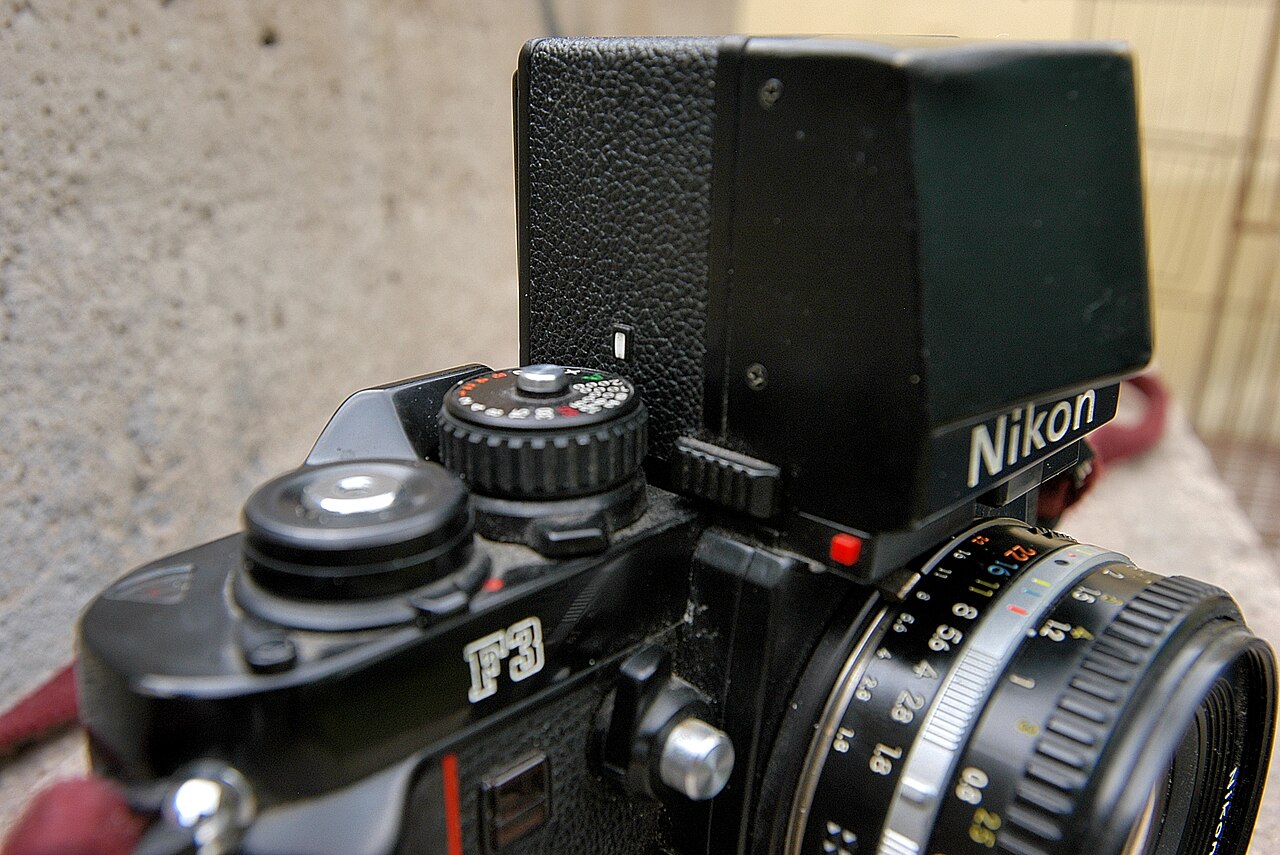
Martintoy, CC BY 3.0, via Wikimedia Commons.

The F3 has more variants than any other Nikon F-series body, according to the article: the F3/T in titanium, about 20 grams lighter, with a champagne finish from 1982 to about 1985; the F3P press model of 1983 with extra sealing; the Japan-only F3 Limited of 1994 in a wooden box; the F3H high-speed model with a fixed pellicle mirror and up to 13 frames a second; and the rare autofocus F3AF of 1983 with two lenses that carried their own focus motors. The article reports over 751,000 F3 bodies made through September 1992 and calls it Nikon’s longest-running professional SLR; it contradicts itself on the end of production, giving 2001, and “2000 or 2002”, and on the F3H, where Nikon’s official count of about 100 is at odds with serial numbers in the high 800s. The F3 also served as the body for the Kodak DCS-100, an early digital SLR system.

Dan Lindsay (User:Edgy01), CC BY 3.0, via Wikimedia Commons.


Nikonmania, CC BY-SA 4.0, via Wikimedia Commons.

The FM2: The Mechanical Camera That Stayed
While the F series went electronic, a second line stayed stubbornly mechanical. Wikipedia says Nippon Kogaku made the FM2 in Japan from 1982 to 2001, a 35 mm SLR for serious amateurs and semi-professionals that succeeded the FM of 1977 and was followed by the FM3A in 2001. Its shutter is a mechanically timed, vertical-travel, metal-bladed focal-plane shutter with a top speed of 1/4000 second and, originally, a flash synchronisation of 1/200 second. The FM2n of 1984 raised the synchronisation to 1/250 second by taking the titanium-bladed shutter from the FE2; later FM2n bodies switched to aluminium blades in 1989, and honeycombed blades identify an early example. The shutter works without a battery; only the 60/40 centre-weighted meter, with LED indicators, needs one.

JorgeGT at en.wikipedia, Public domain, via Wikimedia Commons.

The body is a copper-aluminium-silicon alloy, the article says, with hardened metal gears on ball bearings and a mirror mechanism borrowed from the F2, and the camera accepts AI and AI-S lenses. It launched at $364 in chrome, rose to $525 by 1988 and $745 by 1995, and, the article notes, such cameras often sold thirty to forty per cent below list. The FM2/T of 1993 had titanium top and bottom plates and was discontinued in 1997. The article says that the FM2 sold well though makers were moving toward smaller automated bodies in the decade from 1975 to 1985, because it served photographers who wanted a rugged mechanical camera, and that many professionals keep one as a backup; its statement that the FM2 was the most rugged mechanical 35 mm camera of all time is flagged as uncited, and so is its operating range of minus 40 to plus 50 degrees.

Runner1616, CC BY-SA 3.0, via Wikimedia Commons.


Édouard Hue (User:EdouardHue), CC BY-SA 3.0, via Wikimedia Commons.


BastienM, CC BY-SA 3.0, via Wikimedia Commons.

The F4 and the Electronic Professional
The F4, introduced in 1988, was a 35 mm autofocus SLR for professionals. Wikipedia describes it as the first professional Nikon with a practical autofocus system, a wording it flags as uncited, and credits Giugiaro with the design, also without a source. Focus is TTL phase-detection with one zone, exposure modes are program, shutter priority, aperture priority and manual, and metering is five-segment matrix, with dedicated analogue dials for speed, aperture, metering pattern and compensation. It accepts F-mount lenses, including those of the F3AF in autofocus mode; G-type lenses work only in program and shutter-priority modes because they have no aperture ring.

Imm808, CC BY 3.0, via Wikimedia Commons.

It is fully electronic and uses a bottom-mounted battery pack: the MB-20 on the F4 of 1988 gives four frames a second from four AA cells, the MB-21 on the F4S of 1988 gives 5.7 frames from six cells with a vertical release, and the MB-23 on the F4E of 1991 is the largest. The article notes that all bodies bear the same F4 nameplate and that F4S and F4E refer to packs, a labelling inconsistency in its own infobox. The F4 was the first F-series camera without a manual advance lever. It was succeeded by the F5 in 1996, all F4 models were discontinued in May 1997, and the F3 outlasted it. A modified F4 with a monochrome CCD back of 1,024 by 1,024 pixels, the Nikon NASA F4 Electronic Still Camera, flew on the Space Shuttle from 1991, which the article calls one of the first and rarest fully digital cameras, a claim marked as uncited.

NASA, Public domain, via Wikimedia Commons.


Michael Neebul, CC BY-SA 3.0, via Wikimedia Commons.


Narwhal Hwangus from Newton, United States, CC BY 2.0, via Wikimedia Commons.

The D1 and the Digital Door
The Nikon D1 was introduced on 15 June 1999 at $5,500 for the body, Wikipedia says, against more than $30,000 for the Kodak DCS 460. Its CCD measures 23.7 by 15.6 mm, the DX format with a 1.5 times field-of-view crop, and its output is 2,000 by 1,312 pixels, about 2.7 megapixels; a later Nikon interview, the article says, put the real count at about 10.8 million photosites combined into the final pixels, a conflict it leaves open. It took the F mount, so every lens in this chapter’s lineage fitted it. Development began in 1996, with Nikon aiming at professional digital cameras at a few thousand dollars, and some sensor makers at first refused to build the sensor, doubting the volume. Bjørn Rørslett called the D1 the end of the beginning.
The D1 was discontinued on 5 February 2001 and replaced by the D1H, with the same sensor and five frames a second, and the D1X with 5.3 effective megapixels. The F mount survived into the digital age and into the mirrorless one: the Z mount of 2018, and the Zfc of 2021 dressed as an FM2, are the later chapters of the same house. The article does not mention them, nor the end of most film production in 2006; those are attributed in this almanac to the sources named in the eras chapter.
Five Bodies Compared
The table sets the five bodies of this chapter side by side, using only the figures the Wikipedia articles give. Where an article contradicts itself, the cell says so. The comparison shows a pattern worth stating: each professional body added electronics and subtracted the need for the photographer to hold the camera’s state in his head, until the F4 asked him to trust a battery pack, and the FM2 existed to offer the opposite choice.
The collector’s reading of the table is plain. The F2 is the last professional Nikon that works with no battery at all, apart from its meter; the F3 needs a battery for anything but 1/60 second; the F4 needs a battery pack for everything; and the FM2 returns to a shutter that needs no battery but a meter that does. A buyer who plans to use the camera in a place where batteries are hard to find should read that as a decision between eras, and the bench guide explains how to check each.
One further caution belongs beside the table. The production figures it gives are the totals that the Wikipedia articles report, and they count bodies of every finish and finder together; they cannot tell a collector how many of a particular variant survive. A figure of roughly 816,000 for the F2 says that the camera was common, not that every version of it is, and the scarcer finders and the late reissues are the places where an informed buyer can still find a surprise.
| Body | Introduced | Shutter and power | Production note |
|---|---|---|---|
| F | 1959 | Mechanical; meter in the prism head | The system camera of the reflex era |
| F2 | September 1971 | Mechanical, to 1/2000; meter heads need batteries | Made to 1980; about 816,000 bodies |
| F3 | March 1980 | Electronic, stepless in aperture priority; mechanical 1/60 backup | Made to about 2001; over 751,000 to September 1992 |
| FM2 | 1982 | Mechanical, to 1/4000; only the meter needs a battery | Made to 2001; FM2n from 1984 |
| F4 | 1988 | Electronic; battery pack required; autofocus | Discontinued May 1997; F5 followed in 1996 |
A Small Nikon Glossary
Bayonet. The type of mount used by the F, in which tabs on the lens seat in recesses and lock with a partial turn.
Ai. Automatic maximum-aperture indexing, introduced in 1977; non-Ai lenses can damage later bodies unless modified.
AI-S. A refinement of 1981 with standardised aperture control.
Photomic. The name of the Nikon F’s metering prisms, the first delivered in 1962 with an independent photocell, the FTn of 1968 adding 60 per cent centre-weighted through-the-lens metering.
Nikkor. The lens brand, dated by Wikipedia to 1932; in Germany from 1963 to 1968 it was also the name on the F itself.
Noct. The name of a very fast Nikkor line, revived for the Z-mount 58 mm f/0.95.
S-mount. The modified Contax bayonet of the rangefinders from the Nikon I to the SP.
FTZ. The adapter that lets F-mount lenses work on Z-mount cameras.
Dandelion. A replacement chip that gives meter support to some manual lenses on consumer bodies.
What a Collector Checks
Condition language should be taken from the camera, not the catalogue. On an S-series body, work the shutter at every speed and listen for hesitation at the slow end; look at the cloth curtain for pinholes by holding the open back to the light with the shutter on B; and check that the two images in the rangefinder patch align at infinity and at close range. The bench guide in this almanac sets out the whole routine.
Three points are particular to Nikon. First, refinishing: black-painted S-series bodies exist in factory form but are rarer than chrome, and a repainted body is not the same object, as our myths chapter explains. Second, reissues: the 2000 S3 and 2005 SP are marked as such and are valued separately from the originals. Third, lenses: older Nikkors can need the Ai modification described above, and the lenses chapter explains the yellowing that some mid-century glass shows.
Nikons in Pictures

Nikon F professional SLR camera with early NIKKOR-S Auto 1:1,4 f=5,8cm;own work
Look closer: A 5.8 cm lens, not 5 cm, marks an early standard lens for the F; focal lengths in centimetres are an older Nikkor habit.
Dnalor 01, CC BY-SA 3.0, via Wikimedia Commons.


Nikon F Cameras in both common colours. Both are equipped with Photomic FTN finders. the black Camera sports the name "Nikkor" instead of "Nikon". This is an ea
Look closer: Chrome and black: the black bodies are rarer and are the ones most often refinished.
Minya S, CC BY-SA 4.0, via Wikimedia Commons.


Different types of 35-mm film cartridges. 1 -- Nikon SP, Nikon F (Contax-type) labirintine cassette inside sleeve; 2 -- Nikon cassette body; 3 -- labirintine ca
Look closer: Pictured: cassettes of different eras; the reusable types shown here matter if you intend to load a vintage body with its original loading method.
Runner1616, CC BY-SA 3.0, via Wikimedia Commons.

The Camera Shelf
The house keeps a small shelf of Japanese cameras, and keeps it honest: at the time of writing it holds Contax T2 compacts with Carl Zeiss lenses, each photographed and described with its condition set out. If a body or lens you want is not there, the concierge desk can look for it in Japan.
Answered plainly
When was the first Nikon camera released?
Nikon’s own history says the Nikon I was released in March 1948, after development that began in 1945.
Why does the Nikon I have an unusual frame size?
It made a frame 24 by 32 mm, which Nikon calls its “Nikon format”, shortened from 36 mm to suit printing paper. The Nikon M widened it to 24 by 34 mm, and the S returned to the standard frame.
Did the Korean War make Nikon?
It helped. David Douglas Duncan and other Life photographers used Nikkor lenses in 1950 and the company’s profile rose. The detailed accounts are mostly anecdotal, and Nikon’s own page credits cold-weather durability.
When was the Nikon F introduced?
Wikipedia gives April 1959.
Is the F mount still in use?
Wikipedia says Nikon continues to use variations of it, citing the 2020 D6, and that it has been in production for over 67 years. The Z mount arrived in 2018.
Can any old Nikkor go on any Nikon body?
No. Wikipedia notes that non-Ai lenses can cause mechanical damage to later bodies unless they are modified to the Ai specification.
Why was the Nikon F called the Nikkor F in Germany?
Wikipedia reports that Carl Zeiss objected in the early 1950s that Nikon sounded too like its Ikon brand, and that from 1963 to 1968 the F was labelled Nikkor in Germany. These cameras are now collectors’ items.
Who designed the Nikon F3?
Wikipedia credits the Italian designer Giorgetto Giugiaro with styling it, the first of many F-series cameras he styled. It introduced the red grip stripe.
Does Nikon still make film cameras?
In January 2006 Nikon announced that it would stop making most of them, keeping the F6 and the FM10; Wikipedia says both were still in the line-up in 2019. Check the maker for the current position.
Can I use old Nikon lenses on a Z camera?
Many can, through the FTZ or FTZ II adapter, according to Wikipedia. Non-Ai lenses can damage later F bodies, so check before fitting them.
What is the difference between Ai and non-Ai?
Ai, introduced in 1977, adds a ridge on the aperture ring that couples to the body’s meter. A non-Ai lens lacks it and can damage later bodies unless it has been modified.
How many Nikon SP reproductions were made?
Wikipedia reports 2,500 numbered black cameras in 2005, each with a matching-serial reproduction W-Nikkor 3.5 cm f/1.8 lens, sold in Japan for 690,000 yen before tax.
Did a Nikon go to the Moon?
Wikipedia reports that a Nikon F with an FTn Photomic prism and a motor drive was used on Apollo 15 in 1971 and was the first 35 mm SLR in lunar orbit.
What does the F in Nikon F stand for?
Wikipedia says it stands for re-F-lex, because many Asian languages lack the R sound; we have not checked this against a second source.
Where next
Sources and image credits
- Nikon, Wikipedia
- Nikon F, Wikipedia
- Nikon F-mount, Wikipedia
- Nikon F2, Wikipedia
- Nikon F3, Wikipedia
- Rangefinder camera, Wikipedia
- Nikon Imaging, Vol. 9: Nikon S, M and I
- Leica Celebrates the Man Responsible for the Rise of Nikon (enthusiast blog, anecdotal)
- Nikon D1, Wikipedia
- Nikon F4, Wikipedia
- Nikon FM2, Wikipedia
- Nikon SP, Wikipedia
- Is the price of 35mm film killing the film photography revival? (Digital Camera World)
- Image: The S-series bayonet, seen on a Nikon SP, Sshenoy Sudhir Shenoy (CC BY 3.0)
- Image: Nikon SP with exposure meter and 5 cm f/1.4 Nikkor-S, Dnalor 01 (CC BY-SA 3.0 at)
- Image: The SP of 1957 with a BC-5 flash unit, Morio (CC BY-SA 4.0)
- Image: A chrome Nikon F with eye-level finder and Nikkor-O 35 mm f/2, Runner1616 (CC BY-SA 3.0)
- Image: Cutaway of a Nikon F and 50 mm f/2 lens, Nikon Museum, Tokyo, 4300streetcar (CC BY 4.0)
- Image: A Nikon F at the Nikon Museum, Shinagawa, K6ka (CC BY-SA 4.0)
- Image: Nikon AIvsNON, Runner1616 (CC BY-SA 3.0)
- Image: Nikon S3 year 2000 edition, Herbert Ortner (CC BY 4.0)
- Image: Nikon F2, Photopath at flickr (CC BY-SA 2.0)
- Image: Nikon F vs F2, Runner1616 (CC BY-SA 3.0)
- Image: Nikon F2 DE1, Runner1616 (CC BY-SA 3.0)
- Image: F2-titan-7, Frankwit01 (CC BY 3.0)
- Image: F2 Photomic, Runner1616 (CC BY-SA 3.0)
- Image: Nikon F3, Photopath at flickr (CC BY-SA 2.0)
- Image: Nikon F3 DA2, Martintoy (CC BY 3.0)
- Image: NikonF3T, Dan Lindsay (User:Edgy01) (CC BY 3.0)
- Image: Nikon F3HP SLR Nikkor 28mm F2.8 AI-s, Nikonmania (CC BY-SA 4.0)
- Image: Nikon FM2, JorgeGT at en.wikipedia (Public domain)
- Image: NIKON FM2n NIKKOR Q, Runner1616 (CC BY-SA 3.0)
- Image: Nikon FM2-T, Édouard Hue (User:EdouardHue) (CC BY-SA 3.0)
- Image: Nikon FM2 - arrière ouvert, BastienM (CC BY-SA 3.0)
- Image: Nikon f4, Imm808 (CC BY 3.0)
- Image: Nikon F4 ESC NASA, NASA (Public domain)
- Image: Nikon F4S, Michael Neebul (CC BY-SA 3.0)
- Image: Nikon F4 with Battery Pack MB-21 (F4S), Narwhal Hwangus from Newton, United States (CC BY 2.0)
- Image: An early Nikon F with a 5.8 cm f/1.4 Nikkor-S Auto, Dnalor 01 (CC BY-SA 3.0)
- Image: Nikon F in the two common finishes, with Photomic FTn finders, Minya S (CC BY-SA 4.0)
- Image: Types of 35 mm film cassette, Runner1616 (CC BY-SA 3.0)
Last reviewed 28 October 2026. Pictures are public-domain or openly licensed and credited beneath each one; diagrams are drawn by Japonista.
Looking for a particular body, finder or Nikkor? The concierge desk replies within one to three business days.
Return to the Japanese Camera Almanac · Make a private request
Private concierge
Looking for something in particular?
Describe the piece or the project you have in mind. A senior advisor in Tokyo reads every case file personally and replies within two business days, with fees set out in writing before any work begins.