
Pentax: Asahiflex to the K Mount | Japonista
Camera Almanac · The Prism Makers
Pentax: Asahiflex to the K Mount
ペンタックス
Pentax is the camera house that made the single-lens reflex ordinary. This chapter follows Asahi Optical from a lens-polishing workshop in 1919 to the Spotmatic and the K mount, and shows how a thread and a bayonet, each given generously to other makers, carried one company’s lenses across the world.
Fact sheet
At a glance
- First Japanese SLR. The Asahiflex of 1952 is described by Wikipedia as the first Japanese 35 mm SLR.
- A borrowed name. Asahi acquired the name Pentax in 1957; it had been a trademark of the East German Zeiss Ikon.
- Meter in the lens. The Spotmatic of 1964 metered through the lens; Pentax had shown it at photokina in 1960.
- A long-lived bayonet. The K mount, created in 1975, was designed with the same flange distance as M42 so that screw lenses could be adapted.
Why Pentax Is the Camera Maker of the Plain Good Thing
Pentax made fewer grand claims than its rivals, and sold more ordinary pleasure. The Asahiflex of 1952 was the first Japanese 35 mm SLR; the Spotmatic of 1964 put through-the-lens metering within reach of ordinary buyers; the K1000 of 1976 stripped the idea back to a metal box that worked without a battery and cost less than almost anything with a famous name on it. For half a century students were told to start with a Pentax, and a great many obeyed.
That reputation has a mechanism. Pentax built its cameras on a limited number of strong chassis, and kept its mounts unusually long. The M42 screw thread of the Spotmatic was borrowed from Zeiss and Praktica and used for more than a decade; the K bayonet of 1975 is, according to Wikipedia’s article on the Nikon F mount, one of only two SLR mounts that were not abandoned when autofocus arrived, the other being Nikon’s. The chapter that follows records how that policy worked, and what it cost: the company that made the plain good camera was bought, merged, sold and reborn.
Dates in this chapter are drawn from the Wikipedia articles on Pentax, the K1000 and the Spotmatic, supplemented by a design-magazine report on the Pentax 17. Where an article does not give a fact we say that it does not.
From Spectacle Lenses to an SLR
Wikipedia gives the origin plainly. Asahi Optical was founded in Tokyo in 1919 by Kumao Kajiwara as a lens-polishing workshop that at first made spectacle lenses. It took the name Asahi Optical Company in 1938 and was re-formed in 1948 after the occupying powers disbanded it at the end of the war. The name Pentax came later: Wikipedia says Asahi acquired it in 1957, and that it had originally been a trademark of Zeiss Ikon of East Germany, without saying how the transfer was arranged.
The first camera of consequence was the Asahiflex of 1952. Wikipedia’s article calls it the first Japanese 35 mm SLR, credits the designers Nobuyuki Yoshida and Ryohei Suzuki, and notes that the Asahiflex I had a non-interchangeable waist-level finder, with an optical viewfinder alongside for eye-level use. Its mirror was lifted before the exposure and returned only after the film was wound and the shutter recocked, a detail that explains why photographers of the time lost sight of their subject at the critical moment. The article also remarks that company information attributes the camera to the pre-war Reflex-Korelle, which conflicts with the Praktiflex origin given in its main text; we note the conflict and take no side.
The next steps are well recorded. The Asahiflex IIB of 1954 added an instant-return mirror, and the article calls it a world first; the article on the single-lens reflex gives other early claimants for the instant-return mirror, among them a Hungarian camera of 1948, so we do not repeat the superlative. That article dates the first Japanese pentaprism SLR, the Miranda T, to 1955, and credits the Asahi Pentax of 1957 with combining a fixed pentaprism and a thumb wind lever.
The Spotmatic and the Thread
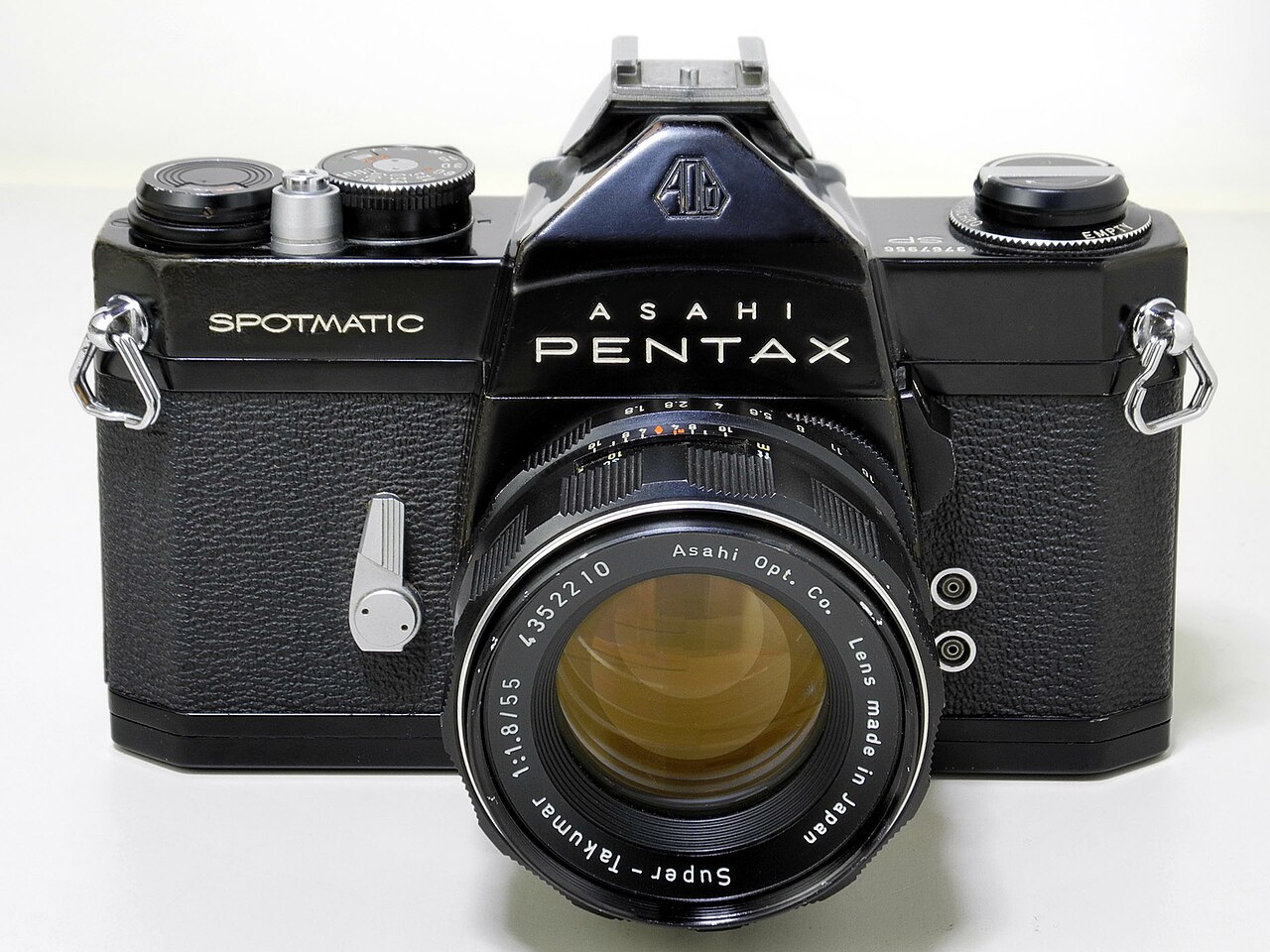
Pentax showed a prototype of its through-the-lens metering camera at photokina in 1960, and Wikipedia records the Spotmatic’s launch in 1964, with production to 1976. A lever stopped the lens down and switched on the meter, which read the image the lens formed on the focusing screen; the metering was centre-weighted, though the camera’s name suggests otherwise, and the article says the original spot-metering design was changed. The meter is an indication of how quickly the Japanese industry had moved from copying to engineering.

mikeossur / Michael Russo, CC BY 2.0, via Wikimedia Commons.

Every Spotmatic used the M42 screw mount, a thread of 42 mm and one millimetre pitch with a flange focal distance of 45.46 mm, shared with Praktica and Zenit cameras. A vast range of lenses fits it. Honeywell imported Pentax cameras into the United States, and Wikipedia records that those officially imported were labelled Honeywell Pentax.
Hiyotada, CC BY-SA 3.0, via Wikimedia Commons.

The Takumar lenses made for the mount bring a note of caution. Hobby writers report that some Takumars, the Super-Takumar 50 mm f/1.4 among them, contain thorium oxide in the glass, which raised its refractive index and which, over time, turns the glass yellow. The lenses chapter takes the matter in detail; here it is enough to say that the evidence for the radiation risk comes from informal sources, that those sources judge the risk very low, and that anyone concerned should consult a radiation-safety authority.
The K Mount and the K1000
In 1975 Pentax created the K mount, a bayonet. Wikipedia says its flange focal distance, 45.46 mm, is the same as M42’s, and that Pentax supplied adapters so that screw-mount lenses could be used on K bodies and still focus correctly. The mount has since been used by all Pentax 35 mm and digital SLRs, and the article describes successive variants, KA, KAF, KAF2 and KAF3, which added electrical contacts and autofocus. Other makers, among them Ricoh, Chinon, Vivitar and the Soviet Zenit makers, also used it.

Andy Fogg (Flickr user ndrwfgg), CC BY 2.0, via Wikimedia Commons.

The K1000, sold from 1976 to 1997, is the K mount’s emblem. Wikipedia describes a horizontal-travel focal-plane shutter and a mechanical design that can work without batteries, and says it eventually sold over three million units, citing a film-photography article. The same article says the camera was recommended or required for art and photography students; that claim has no citation, so we offer it only as a widely repeated reputation. A K1000 is a good camera on which to learn precisely because it asks the photographer to set everything by hand.

Finn Pauls, CC BY-SA 3.0, via Wikimedia Commons.

Medium format received a similar treatment. Wikipedia records the Pentax 6x7 sub-brand from 1969 to 1990 and its renaming as the Pentax 67 from 1990 to 1999.
Hoya, Ricoh and a Half-Frame Return
Ownership changed repeatedly after 2000. Wikipedia records that the company took the name Pentax Corporation in 2002, that it partnered with Samsung on DSLR technology in 2005, that Hoya completed a tender offer in 2007 and merged Pentax into itself in 2008, and that in 2011 Hoya sold the camera business to Ricoh, which formed Pentax Ricoh Imaging, renamed Ricoh Imaging Company in 2013. Samsung left the camera market in 2017.

Bubba73 (Jud McCranie), CC BY-SA 4.0, via Wikimedia Commons.

In 2024 Pentax launched the Pentax 17, a half-frame film camera, which Wikipedia notes. The decision to make a new film camera in the 2020s says something about how the market has moved; the chapter on Olympus, which made the first half-frame camera in Japan, explains what the format is.
| Model | Year | What to know | Basis |
|---|---|---|---|
| Asahiflex | 1952 | First Japanese 35 mm SLR; waist-level finder | Wikipedia |
| Asahi Pentax | 1957 | Fixed pentaprism and thumb wind lever | Wikipedia |
| Spotmatic | 1964 | Through-the-lens metering; M42 mount | Wikipedia |
| Pentax 6x7 | 1969 | Medium-format SLR | Wikipedia |
| K mount | 1975 | Bayonet; flange 45.46 mm | Wikipedia |
| K1000 | 1976 | Mechanical SLR; over three million sold | Wikipedia |
| Pentax 17 | 2024 | Half-frame film camera | Wikipedia |
Five Stories from the Pentax Record
Rising Sun. Wikipedia records that Kumao Kajiwara founded the company in November 1919 in Toshima, Tokyo, as Asahi Kogaku Goshi Kaisha, beginning with spectacle lenses, and that Asahi means rising sun. The company became Asahi Optical in 1938 and made camera and cine lenses as well. After the war it was, like many Japanese firms, disbanded by the occupying powers, and in 1948 it was allowed to re-form.

Today I got some old 35mm gear from one of the better college professors in Texas . This included:2x Pentax K1000 35mm SLR's2x Pentax 50mm f/2Pentax 50mm f/1
Terry Presley from Lubbock, United States, CC BY 2.0, via Wikimedia Commons.

A name from two cameras. In 1957 Asahi Optical acquired the Pentax trademark, which had originally been registered by VEB Zeiss Ikon. Wikipedia says the name combines pentaprism and Contax. It is a pleasing irony that the name of Japan’s most successful plain camera began as a mark of the East German makers of the Contax, and that the Contax name itself would later be revived in Japan, as the Yashica and Contax chapter relates.

Bilby, CC BY 3.0, via Wikimedia Commons.

A name that stayed when its meaning changed. The Spotmatic was designed for spot metering. Wikipedia says that shortly before production Asahi switched from spot to centre-weighted average metering, and that the name stayed because the change came too late to rename the camera. A prototype had been shown at photokina in 1960; the camera was launched in 1964 and made in its family until 1976. The article describes its through-the-lens metering as one of the first in an SLR, and does not claim that it was the first.
The Honeywell years. From the 1950s to the mid-1970s Pentax equipment was sold in the United States through Honeywell, first as Heiland Pentax and later as Honeywell Pentax. The Spotmatic IIa of 1971 was sold only in the United States, for use with Honeywell Strobonar flashes. A collector who finds a Honeywell Pentax has found a camera made in Japan for an American market, and the name on the prism is the clue.
Three million students. The K1000, introduced in 1976 and made until 1997, sold more than three million, according to Wikipedia. It was made by removing features from the KM: the self-timer, the depth-of-field preview, the film reminder dial and the flash socket. The article reports that art and photography courses for many years recommended or required it because its manual controls teach exposure. Asahi, it adds, described the K1000 at launch as the cheapest big-brand 35 mm SLR on the market.
The Spotmatic Family in Order
The Spotmatic used stop-down metering: the camera focused with the lens wide open, and a lever on the side stopped the lens down and switched on the meter, whose reading appeared as a needle in the finder. This limited performance in dim light, as Wikipedia notes. The camera used the M42 screw mount, developed after the war by Zeiss and Praktica; Asahi’s lenses were Takumars, and later multi-coated versions were Super Multi Coated Takumars.

Pablo M Coronel, CC BY-SA 3.0, via Wikimedia Commons.

The family grew quickly. The Pentax SL of 1968 was identical but without a built-in meter. In 1971 came the SP500 and the SP II, the latter improving metering to a maximum of ASA 3200, adding a hot shoe and introducing SMC lenses. In the same year the Electro-Spotmatic appeared in Japan, described by Wikipedia as the first aperture-priority, electronic, automatic SLR; it went international in 1972. The Spotmatic F of 1973 could meter without stopping the lens down, and the SP1000 of 1974 had a top speed of 1/1000. The Spotmatic chassis formed the basis of the bayonet-mount K2, KX, KM and K1000. Notable users listed by the article are Ira Cohen, Ringo Starr and Carol Jerrems.

Groogle, CC BY-SA 4.0, via Wikimedia Commons.


FlanellKamerasFilm, CC0, via Wikimedia Commons.

| Model | Year | Note |
|---|---|---|
| Spotmatic | 1964 | Stop-down TTL metering; M42 mount |
| Pentax SL | 1968 | Spotmatic without a meter |
| SP500 and SP II | 1971 | SP II improved metering, hot shoe, SMC lenses |
| Electro-Spotmatic | 1971 (Japan); 1972 abroad | Aperture-priority, electronic |
| Spotmatic F | 1973 | Meters without stopping down |
| SP1000 | 1974 | Top speed 1/1000; no self-timer |
The K1000: A Camera Reduced to Its Argument
The K1000 is almost entirely metal and fully mechanical. It works without batteries, which are needed only for the light meter, a built-in CdS cell with a centre-the-needle display. The meter has no on-off switch, so the lens cap should stay on to save the battery. Shutter speeds run from one second to 1/1000 with bulb and a flash synchronisation of 1/60. The 1000 in the name refers to the fastest speed, following the earlier SP1000.

The classic.
E Magnuson, CC BY 2.0, via Wikimedia Commons.

The price tells the story. At launch the body with an SMC Pentax 55 mm f/2 lens listed at $299.50 in the United States. In 1983 a K1000 with a 50 mm f/2 lens listed at $220; in 1988 the body listed at $210 and in 1993 at $263; in 1994 it rose to $315 and stayed there. Production moved from Japan to Hong Kong in 1978 and to China in 1990, when plastic replaced some metal parts and bodies weighed 525 g. It ended in 1997, because the older design and parts, particularly the precision meter galvanometers, had become too costly to source. The ZX-M, also called MZ-M, replaced it in 1998.

Pentax k1000 con 50mm f4 macro
Sebastcardone, CC BY-SA 3.0, via Wikimedia Commons.

Wikipedia adds an observation that every shopper should hear: good used K1000s often sell for more than the better-equipped K-series cameras, which are less common and less remembered. It is a reminder that a camera’s price is not its capability. For a first film SLR the K1000 remains a defensible choice; for a camera with more features, its siblings are often better value.

Ra Boe, CC BY-SA 3.0, via Wikimedia Commons.

From Asahi to Ricoh
The corporate history is a story of slow absorption. The company was renamed Pentax Corporation in 2002. In 2005 it partnered with Samsung on digital SLR technology. By 2006 its domestic digital-camera market share had fallen to 4 per cent, and in December merger talks with Hoya began. On 11 April 2007 the planned stock swap was called off and the president, Fumio Urano, resigned; on 6 August 2007 Hoya completed a tender offer for 90.59 per cent; and on 31 March 2008 Pentax merged into Hoya, with manufacturing moved to Cebu in the Philippines and to Hanoi.
On 1 July 2011 Hoya announced the sale of the camera business to Ricoh, reportedly for about ten billion yen, and on 1 October 2011 Ricoh acquired Pentax Imaging, renamed Pentax Ricoh Imaging. Since 1 August 2013 it has been Ricoh Imaging Company. Samsung left the camera market in 2017. Throughout, the Pentax name remained on the cameras, and the K mount remained on the lenses.
The Pentax 17 and the Half-Frame Return
On 17 June 2024 Pentax introduced the Pentax 17, a half-frame film camera priced at $500, the first Pentax-branded film camera in more than two decades. A design magazine reported on 24 June 2024 that it was priced at £499.99 in the United Kingdom, takes a standard 35 mm cartridge and yields about 72 shots a roll, has a built-in flash, no autofocus, six shooting modes and a partly metal body, and that the team consulted retired employees because some components were out of production. The magazine also reports that half-frame reduces apparent grain density by roughly half; we pass this on as its claim, not as a measurement.

Vitaly baranov, CC BY-SA 3.0, via Wikimedia Commons.

A camera trade writer, assessing the film revival, notes that the Pentax 17 lacks the full manual control dedicated photographers wanted, and reports that the market for film is now driven by Millennials and Gen Z. The same writer reports that Kodak has raised prices and that Fujifilm has discontinued some stocks. The first new Pentax film camera in twenty years arrives, in short, at a moment when the cost of the film is the main obstacle. The old cameras, meanwhile, are a different proposition: a K1000 needs nothing but film and a patient owner.

Michael Gatchell, CC BY 2.0, via Wikimedia Commons.

Curiosities from the Pentax Record
The facts below come from the Wikipedia articles on Pentax and its cameras.
- The Pentax 6×7 medium-format camera was sold from 1969 to 1990, and as the Pentax 67 from 1990 to 1999.
- A Chinese-assembled K1000 weighs 525 g.
- The K1000 SE of 1977–78 added a split-image rangefinder and a Black Diamond leatherette covering in its first run.
- The SP500 had a top speed of 1/500 and an unmarked stop at 1/1000, and no self-timer.
- Pentax had about 6,000 employees in 2004.
- Hoya’s tender offer for Pentax in 2007 left it with 90.59 per cent of the company.
- The Pentax 17 is described as the first film camera to carry the Pentax name in over two decades.
The K1000 in Detail
Wikipedia says the K1000 was introduced in 1976 by Asahi Optical and built until 1997, when rising costs and the end of supply for parts such as its precision analogue light-meter galvanometers made continued production unviable. The article gives sales of over three million units and says the camera was succeeded in 1998 by the Pentax ZX-M, also called the MZ-M. A production run of twenty-one years, for a camera whose design was already plain in 1976, is among the longest of any SLR in this almanac.

Pentax K1000 Body
Michael Gatchell from Stockholm, Sweden, CC BY 2.0, via Wikimedia Commons.

The K1000 was derived from the K series, with the self-timer, depth-of-field preview, film reminder dial and FP flash socket removed to save cost, and the article describes it, in one place, as a Spotmatic F with a K mount and, in another, as the KM minus several features. Its name follows the SP1000 and SP500 in recording the top shutter speed, 1/1000 second. Its relatives were the K2, KM and KX of 1975 and the professional K2 DMD of 1976. The body is almost entirely metal, with brass top and bottom plates until plastic substitutions came; the article gives 620 grams for the original body and about 525 grams for units assembled in China with plastic parts.

A Pentax K1000 SE with a 50mm f/2 lens
Bubba73 (Jud McCranie), CC BY-SA 4.0, via Wikimedia Commons.

Its shutter is a horizontal-travel, rubberised-silk focal-plane shutter running from one second to 1/1000 second and Bulb, with flash synchronisation at 1/60 second through a hot shoe and a PC socket, and no flash dedication. The controls are mechanical; the battery serves only the viewfinder meter, a CdS cell with a needle-centring display. There is no meter switch, so the article advises fitting the lens cap to avoid draining the battery, and critics note that the meter responds slowly and the finder shows little. The K1000 SE had a split-image rangefinder and microprism screen.

jacme31, CC BY-SA 2.0, via Wikimedia Commons.

The camera usually came with the budget SMC Pentax 50 mm f/2 lens, though the article’s price section cites a 55 mm f/2 at launch, a discrepancy it does not explain. It reports a launch list price of $299.50 with the 55 mm lens and later list prices of about $220 in 1983, $210 for the body in 1988, $263 in 1993 and $315 in 1994; it adds that SLRs usually sold thirty to forty per cent below list. It also says the camera was long recommended to photography students because manual controls teach exposure, and that good used examples now sell for more than their better-equipped siblings; both statements are flagged as uncited. As the bench guide says, the meter of an old K1000 is worth testing before anything else.

Ra Boe, CC BY-SA 3.0, via Wikimedia Commons.

The 645 and the Medium-Format Line
Pentax’s medium-format line is the other half of its reputation. The Pentax 645, introduced in 1984 with a line of lenses, nominally takes 6 by 4.5 centimetre images on 120, 220 and 70 mm film, with an actual image of 56 by 41.5 mm; it has a built-in motor drive at 1.5 frames a second, centre-weighted metering, a top-plate liquid-crystal display and manual focus, and its film loads in holders that cannot be removed until the roll is exposed. The 645N of 1997 added autofocus, matrix metering, film-edge data imprinting and a two-frames-a-second drive; the 645NII of 2001 added mirror lock-up and ten user-programmable functions.
The digital turn produced the 645D of 2010, a medium-format DSLR with a 40-megapixel Kodak CCD measuring 44 by 33 mm in a fixed, weather-sealed back, and the 645Z of 2014 with a 51.4-megapixel CMOS sensor, a tilting screen and two memory-card slots. The article says the 645Z sold out after its launch, with 1,500 orders by June 2014 against a supply of about 400 cameras a month, and puts its price at $10,000 against $30,000 for rival medium-format cameras, while a reference headline in its own citations speaks of a one-million-yen camera; we repeat the dollar figure as the article’s and flag the discrepancy. The lens mount has a flange distance of 70.87 mm, and the lens families run from A (manual) through FA (autofocus) to DFA (digital), with Pentax 67 lenses usable by adapter. The Pentax 645 shows how the firm that made the K1000 simple also made the large format accessible.
A Small Pentax Glossary
Asahiflex. The 1952 camera described by Wikipedia as the first Japanese 35 mm SLR.
Takumar. Asahi’s lens brand; the Super Multi Coated Takumar is the multicoated version.
SMC. Super Multi-Coating, introduced to the Pentax line with the SP II in 1971.
M42. The screw mount of the Spotmatic and, before it, the Praktica.
K mount. The bayonet created in 1975; one of two SLR mounts not abandoned with autofocus.
Stop-down metering. A metering method in which the lens is closed to the working aperture before the reading.
Honeywell Pentax. The name under which Pentax cameras were sold in the United States from the 1950s to the mid-1970s.
Half-frame. A format of 18 by 24 mm; the Pentax 17 of 2024 uses it.
What a Collector Checks
Pentax bodies are generally sturdy, and faults tend to be age rather than design. On a Spotmatic, check the stop-down lever and the meter; the cell may be dim or unresponsive, and the mercury battery the camera was designed for is no longer sold. On any body of the period, replace the foam seals and check the shutter at every speed. On a K1000, which has few electronic parts, test the meter needle against a known exposure and confirm that the mirror returns cleanly.
With the lenses, work in good light. Inspect for haze and fungus, and look at the colour of the glass against a white card: a pronounced yellow in a Takumar is the sign discussed above. The bench guide sets out the procedure and the glossary defines the terms.
The Camera Shelf
The house keeps a small shelf of Japanese cameras, and keeps it honest: at the time of writing it holds Contax T2 compacts with Carl Zeiss lenses, each photographed and described with its condition set out. If a body or lens you want is not there, the concierge desk can look for it in Japan.
Answered plainly
What was the first Japanese SLR?
Wikipedia calls the Asahiflex of 1952 the first Japanese 35 mm SLR. The SLR article names the Miranda T of 1955 as the first Japanese pentaprism SLR.
Where does the name Pentax come from?
Wikipedia says Asahi acquired it in 1957 and that it had originally been a trademark of Zeiss Ikon of East Germany.
What is the M42 mount?
A screw mount with a 42 mm thread and a flange focal distance of 45.46 mm, used by Pentax, Praktica and Zenit cameras.
Can M42 lenses be used on K-mount cameras?
Yes: the K mount shares the same flange distance and Pentax supplied adapters, according to Wikipedia.
How many K1000 cameras were sold?
Wikipedia says over three million, citing a film-photography article.
Is a yellowed Takumar dangerous?
Informal sources say the risk is very low, but they are not authorities. Anyone concerned should consult a radiation-safety authority.
What does the name Pentax mean?
Wikipedia says it combines pentaprism and Contax. Asahi Optical acquired the trademark in 1957; it had been registered by VEB Zeiss Ikon.
Why is the Spotmatic called a spot meter if it is not one?
Asahi designed it for spot metering and switched to centre-weighted average metering shortly before production, too late to rename it, according to Wikipedia.
How long was the Pentax K1000 made?
From 1976 to 1997, about 21 years, and it sold more than three million, according to Wikipedia.
Does the K1000 need a battery?
Only for the light meter. The shutter is mechanical.
Who owns Pentax now?
Ricoh Imaging, since Ricoh acquired Pentax Imaging in October 2011 from Hoya.
What is the Pentax 17?
A half-frame film camera introduced on 17 June 2024 at $500, the first Pentax-branded film camera in more than twenty years.
Where next
Sources and image credits
- Pentax, Wikipedia
- Asahiflex, Wikipedia
- Pentax Spotmatic, Wikipedia
- Pentax K-mount, Wikipedia
- Pentax K1000, Wikipedia
- Single-lens reflex camera, Wikipedia
- Don’t Sleep with Yellow Lenses, Darlin’ (35mmc, hobby blog)
- Pentax 645, Wikipedia
- New Pentax 17 35mm camera heralds the return of film (Wallpaper*)
- 2025 could be a make-or-break year for film photography (Digital Camera World)
- Image: Pentax spotmatic stripped, mikeossur / Michael Russo (CC BY 2.0)
- Image: Pentax SP, Hiyotada (CC BY-SA 3.0)
- Image: Pentax MX, Andy Fogg (Flickr user ndrwfgg) (CC BY 2.0)
- Image: Pentax MX body, Finn Pauls (CC BY-SA 3.0)
- Image: Asahi Pentax logo, Bubba73 (Jud McCranie) (CC BY-SA 4.0)
- Image: Pentax K1000, Terry Presley from Lubbock, United States (CC BY 2.0)
- Image: Pentax MX (black) with film, Bilby (CC BY 3.0)
- Image: Pentax Spotmatic and lenses, Pablo M Coronel (CC BY-SA 3.0)
- Image: Spotmatic-4, Groogle (CC BY-SA 4.0)
- Image: Pentax Spotmatic analog camera with Carl Zeiss Tessar lens, FlanellKamerasFilm (CC0)
- Image: Pentax-K1000, E Magnuson (CC BY 2.0)
- Image: Pentax k1000, Sebastcardone (CC BY-SA 3.0)
- Image: Pentax K1000 by-RaBoe-001, Ra Boe (CC BY-SA 3.0)
- Image: Pentax ME Super, Vitaly baranov (CC BY-SA 3.0)
- Image: Pentax ME Super body, Michael Gatchell (CC BY 2.0)
- Image: Pentax K1000 Body, Michael Gatchell from Stockholm, Sweden (CC BY 2.0)
- Image: Pentax K1000 SE, Bubba73 (Jud McCranie) (CC BY-SA 4.0)
- Image: Pentax K1000 135 film SLR camera, jacme31 (CC BY-SA 2.0)
- Image: Pentax K1000 by-RaBoe-005, Ra Boe (CC BY-SA 3.0)
Last reviewed 28 October 2026. Pictures are public-domain or openly licensed and credited beneath each one; diagrams are drawn by Japonista.
Looking for a Spotmatic, a K-mount body or a particular Takumar? The concierge desk replies within one to three business days.
Return to the Japanese Camera Almanac · Make a private request
Private concierge
Looking for something in particular?
Describe the piece or the project you have in mind. A senior advisor in Tokyo reads every case file personally and replies within two business days, with fees set out in writing before any work begins.