
Hosso, Kegon and Ritsu: The Nara Schools That Stayed
Doctrine · Discipline
Hosso, Kegon and Ritsu: The Nara Schools That Stayed
The six schools of Nara were less sects than study groups, and most of them faded when the capital moved. Three did not. Hosso still keeps Kofuku-ji and Yakushi-ji, Kegon, begun at the site of Todai-ji, is still practised, and Ritsu was reborn in the thirteenth century under a monk who ordained outcasts. The sections below add the six schools and what became of the other three, the Great Buddha and the temple that Kegon built, a scorched sutra and the torch festival of Todai-ji, the shrine beside Kofuku-ji, a magic kettle and a golden lion, the stories and fun facts, a glossary, and a collector's eye for Nara-school work.
Fact sheet
Three schools in brief
- Hosso, mind only. It teaches eight consciousnesses and holds that some beings cannot become buddhas, an idea that Tendai later made marginal.1
- Kegon, everything joined. Its images are interpenetration and Indra's net, drawn from the Chinese Huayan tradition of Fazang.4
- Ritsu, the rule. It rests on the Vinaya, and its great revival began in 1236 when Eison and three companions ordained themselves.58
Hosso and the Pilgrim's Teaching
First lookHosso is the Japanese form of Yogacara, the teaching that only consciousness is real. It describes eight consciousnesses, with the alaya, or store, consciousness as the root that carries karmic seeds, and it kept the doctrine of the five natures, which holds that some beings cannot become buddhas.1 Its Chinese founder in the practical sense was Xuanzang, who lived from 602 to 664, travelled to India, studied at Nalanda under Silabhadra and returned with 657 texts; his Cheng Weishi Lun is the school's core treatise, and his disciple Kuiji is counted its second ancestor.1

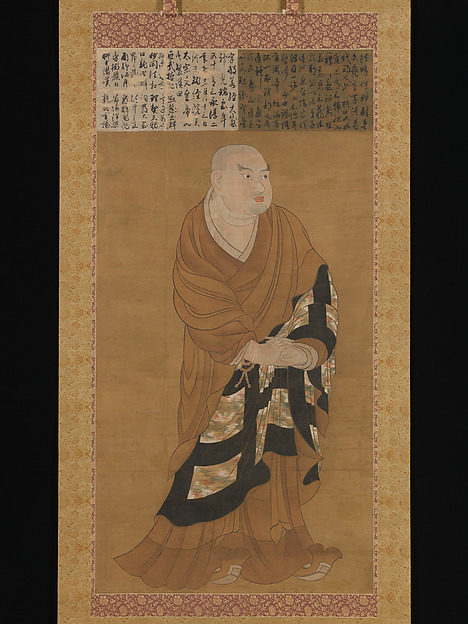
Japan · Kamakura period (1185–1333) · 14th century · Hanging scroll; ink and color on silk
Look closer: A fourteenth-century hanging scroll by Kasuga Motomitsu: Xuanzang, called Genjo in Japan, with an attendant, in ink and colour on silk. The Met dates it to the Kamakura period. It is the Chinese pilgrim at the root of the school, painted in Japan.
The Metropolitan Museum of Art, New York, H. O. Havemeyer Collection, Gift of Horace Havemeyer, 1929, accession 29.160.29. Public domain, Met Open Access. Museum record
Hosso reached Japan by two roads. Dosho, who lived from 629 to 700, studied under Xuanzang from 653 to 660 and was based at Gango-ji; Wikipedia calls this the Southern Temple tradition. A second line, running through Chiho, Chiran and Chiyu, who visited Korea and China about 703, and later through Gien and Genbo, became the Northern Temple tradition centred at Kofuku-ji and followed the Silla scholar Wonchuk.1 The two traditions argued for centuries over whether Kuiji's reading or the Silla commentaries were the orthodox one.1
Japan · Kamakura period (1185–1333) · 14th century · Hanging scroll; ink and color on silk
Look closer: A fourteenth-century Kamakura-period hanging scroll in ink and colour on silk, titled Jion Daishi (Guiji) by the Met. Jion Daishi is the honorific by which Hosso remembers Kuiji, Xuanzang's disciple; the Met's title spells his name Guiji.
The Metropolitan Museum of Art, New York, Rogers Fund, 1950, accession 50.137. Public domain, Met Open Access. Museum record
The quarrel that made Hosso famous was with its rivals. Tokuitsu, a Hosso scholar, exchanged letters of debate with Saicho and Kukai. Saicho criticised Hosso for refusing the one-vehicle teaching of the Lotus Sutra; Kukai was more conciliatory.1 In the long run Tendai's universalism prevailed and the icchantika position became marginal, though Jokei, who lived from 1155 to 1213, argued that even the most deluded beings could attain enlightenment.1
Kofuku-ji and Yakushi-ji
The connoisseur's eyeKofuku-ji began in 669 at Yamashina, in what is now Kyoto, founded by Kagami-no-Okimi, wife of Fujiwara no Kamatari, who prayed for her husband's recovery. It moved to Fujiwara-kyo in 672 and to its present place in Heijo-kyo, today's Nara, in 710; Kamatari's son Fujiwara no Fuhito named it after the Vimalakirti Sutra.2 It was the Fujiwara family's tutelary temple, and it kept its influence through the family's ties to the court, especially through Empress Komyo.2 Today it is the national headquarters of the East Asian Yogacara school.2

Japan · Muromachi period (1392–1573) · 16th century · Hanging scroll; ink, color, and gold leaf on silk
Look closer: The Met's Hosso Mandala is a sixteenth-century Muromachi hanging scroll in ink, colour and gold leaf on silk, a gift of Eileen Hsu in 1991. The catalogue title is all we have to go on, and we say no more about its contents than the museum's title does.
The Metropolitan Museum of Art, New York, Gift of Eileen Hsu, 1991, accession 1991.384. Public domain, Met Open Access. Museum record
The five-storey pagoda is the building most visitors photograph. Empress Komyo ordered it in 730, and the national list of buildings dates the present structure to 1426.2 The East Golden Hall is a National Treasure, the Central Golden Hall was rebuilt in 2018, and the three-storey pagoda dates from 1185.2 Civil wars and fires damaged the temple many times and it was rebuilt each time, but some major buildings were never restored.2 Among its National Treasures is the dry-lacquer figure of Ashura, one of the Devas of the Eight Classes.2
Yakushi-ji was commissioned by Emperor Tenmu in 680 as an offering for the recovery of the consort who later became Empress Jito, and Tenmu died before it was finished, around 698.3 Its first site was Fujiwara-kyo. The temple is long believed to have moved to its present place in 718, but excavations in the 1990s raised the possibility that two Yakushi-ji stood at once, and the Fujiwara-kyo temple is called Moto, or original, Yakushi-ji.3 The East Pagoda, completed in 730, is the only surviving eighth-century structure there. It is about 34 metres tall and has three storeys that look like six because of intermediate roofs; it was taken apart in 1898 to 1900 and again in 2012, with repairs continuing to 2018.3
The Yakushi Triad is a wooden group and one of Japan's most famous images, an early example of Tang-style work; scholars debate whether it was made for the Fujiwara-kyo temple or for the early Nara one.3 Most of the buildings were destroyed in 973 and the main hall burned in 1528; the main hall was rebuilt in 1976, the west tower in 1981, the central gate in 1984 and the east and west gates in 1995.3 Yakushi-ji, with Kofuku-ji, remains in the Hosso sect.1
Kegon and the Sutra of Everything
The connoisseur's eyeKegon is the Japanese form of the Chinese Huayan school, whose scripture is the Avatamsaka, or Flower Ornament, Sutra. Its signature ideas are interpenetration and the image of Indra's net, and its foundational figure is Fazang, often thought of as the real founder of the Chinese school.4 In Japan the school began in 736, when Roben, who lived from 689 to 773 and was originally a Yogacara monk, invited the Korean monk Shinjo, also written Shinsho, to lecture on the sutra at Kinshosen Temple, the origin of later Todai-ji.4
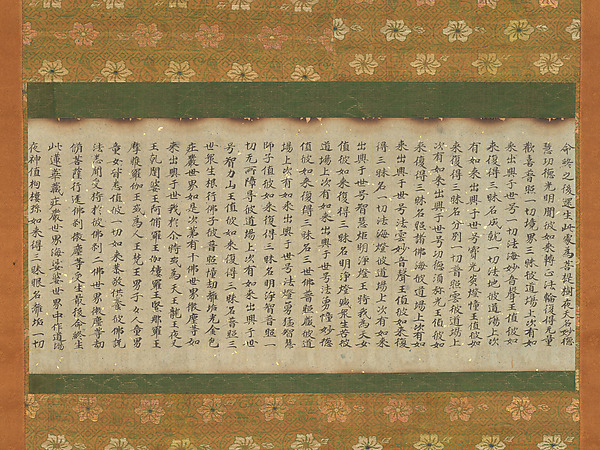
Japan · Heian period (794–1185) · 12th century · Section of handscroll mounted as a hanging scroll; ink on pale indigo-dyed paper decorated with flakes of gold leaf
Look closer: A twelfth-century Heian-period section of the Flower Ornament Sutra, called the Senpukuji Burned Sutra, in ink on pale indigo-dyed paper decorated with flakes of gold leaf, mounted as a hanging scroll. The Met's own title carries the name Kegon-kyo, so the sutra of this school is the object itself.
The Metropolitan Museum of Art, New York, Mary and Cheney Cowles Collection, Gift of Mary and Cheney Cowles, 2024, accession 2024.412.1. Public domain, Met Open Access. Museum record
When Todai-ji was finished, Roben became head of the new school with the support of Emperor Shomu, and Kegon was counted among the Six Sects of Nanto.4 His disciple Jitchu administered the temple and raised its prestige with imported rituals.4 The school later absorbed Shingon practice, with which it kept a cordial relationship.4
Kegon was revived twice in the centuries after Nara. Gyonen, who lived from 1240 to 1321, did it in the late Kamakura era, and in the Tokugawa period Hotan, who lived from 1657 to 1738, and his disciple Fujaku, who lived from 1707 to 1781, led a scholarly revival.4 The practice continues today, including at a few temples overseas.4
Myoe, the Monk Who Kept a Dream Diary
The connoisseur's eyeMyoe, who lived from 1173 to 1232, was abbot and founder of Kozan-ji and the most celebrated Kegon figure after Nara. He combined Kegon with Tendai and Shingon lineages, wrote more than fifty works, and promoted the mantra of light as a practice open to lay and monastic followers, linking it also to rebirth in Amitabha's Pure Land.4

Japan · Kamakura period (1185–1333) · 1225 · Hanging scroll; ink on paper
Look closer: A section of Myoe's Dream Diary, dated 1225, a Kamakura-period hanging scroll in ink on paper, 33.7 by 54.9 centimetres of image. The Met notes that the date is unusually complete for a fragment.
The Metropolitan Museum of Art, New York, Gift of Sylvan Barnet and William Burto, in honor of Saretta and Howard Barnet, 2014, accession 2014.719.4. Public domain, Met Open Access. Museum record
The Met holds two scrolls from his own hand. One is a section of his Dream Diary, the Yume no ki, dated 1225. The entry concerns a ceremony planned at Kozan-ji to dedicate three tutelary shrines, one to a deity associated with the Himalayas, one to the Great Illuminating Deity of Kasuga Shrine in Nara and one to a female protector; a typhoon forced it to be postponed, and Myoe then records two dreams in which he met people whom he took to be incarnations of the three.9 The Met's catalogue entry does not discuss the Kegon context, and we add none.
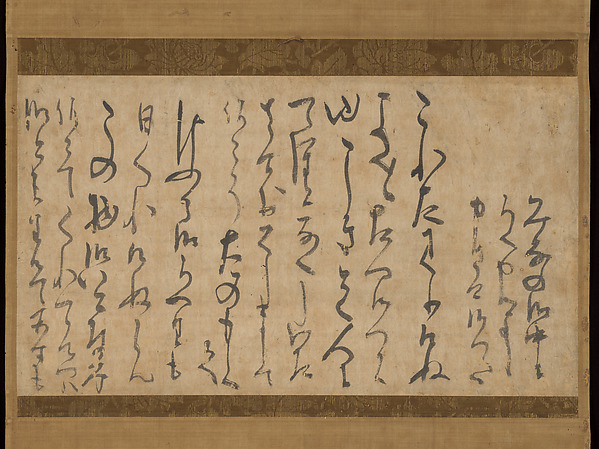
Japan · Kamakura period (1185–1333) · early 13th century, probably 1220s · Hanging scroll; ink on paper
Look closer: A letter by Myoe Kohen in kana characters, early thirteenth century, probably the 1220s: a hanging scroll in ink on paper, from the Mary and Cheney Cowles Collection.
The Metropolitan Museum of Art, New York, Mary and Cheney Cowles Collection, Gift of Mary and Cheney Cowles, 2020, accession 2020.396.2. Public domain, Met Open Access. Museum record
The other is a letter in kana characters of the early thirteenth century, probably the 1220s, a Kamakura-period hanging scroll in ink on paper.10 Both came to the Met as gifts, the diary leaf in 2014 and the letter in 2020, and the museum records that the diary section is not on view.
Ritsu, from Ganjin to Eison
The connoisseur's eyeRitsu is the school of the Vinaya, the monastic discipline, using the Dharmaguptaka texts. It was formally established in Tang China by Daoxuan, founder of the Nanshan Vinaya school.8 Its Japanese story begins with the blind Chinese monk Jianzhen, called Ganjin in Japan, who brought the Four-Part Vinaya to Japan in 753 after several failed voyages.8 He set up an ordination platform at Todai-ji, where he ordained, among others, Emperor Shomu and Empress Koken, and later founded Toshodai-ji.8

Japan · Muromachi period (1392–1573) · 15th century · Hanging scroll; ink and color on silk
Look closer: A fifteenth-century Muromachi-period hanging scroll in ink and colour on silk, titled Portrait of Jianzhen (Ganjin) by the Met. The portrait tradition for Ganjin is long: the founder of the school is remembered as the teacher who crossed the sea blind.
The Metropolitan Museum of Art, New York, H. O. Havemeyer Collection, Bequest of Mrs. H. O. Havemeyer, 1929, accession 29.100.518. Public domain, Met Open Access. Museum record
Toshodai-ji dates from 759 and remains the head temple of the school.78 Its Golden Hall is a National Treasure and is considered an archetype of the classical style; the lecture hall, treasure house and sutra storehouse are also National Treasures from the Nara period, and the bell tower was rebuilt in 1240.7 The temple is part of the same World Heritage site as Kofuku-ji and Yakushi-ji.7
By the Heian period ordination had fragmented. Saicho set up a separate ordination platform at Enryaku-ji, and Kukai favoured a different Vinaya while still ordaining at Todai-ji.8 The school declined further under Zen dominance in the Muromachi period, was revived in the Edo period by several monks, and in the Meiji era most of its temples were absorbed into Shingon, except Toshodai-ji; it regained independent recognition in 1900.8
Eison and the Tea Bowl
The connoisseur's eyeEison, who lived from 1201 to 1290 and received the posthumous title Koshō Bosatsu in 1300, founded the Shingon Risshu, a Shingon school centred on the Vinaya.5 He vowed in 1235 to restore the discipline and in 1236, lacking precept masters, he and three companions ordained themselves at Todai-ji; in 1238 he took over Saidai-ji and began restoring it.5 The self-ordination of 1236 was carried out by Kakujo, Yugon, Ensei and Eison, free of state control.8
Saidai-ji had been founded in 765, when the retired Empress Koken, re-enthroned as Empress Shotoku, ordered gilt bronze statues of the Four Heavenly Kings to pray for an end to the Fujiwara no Nakamaro rebellion.6 Eison restored it over about fifty years and made it a centre of social welfare for the poor and sick, enshrining the Shaka Nyorai honzon in 1249.6 He conferred the precepts on laypeople, prisoners and outcasts, and aided women and people with leprosy; his disciple Ninsho carried the movement into eastern Japan with the same emphasis on charity.5
Eison was also a priest of the state. He performed protective esoteric rites during the Mongol invasions, including rituals invoking Aizen Myoo in 1281, and was invited by Hojo Tokiyori to Kamakura about 1260 to 1262, where he ordained many people and lectured on the Vinaya.5 The Eison article links him to the origin of the Saidai-ji tea rite, in which he served tea from a giant bowl after Japan's deliverance from the invasions; we repeat the link as that article states it and add nothing to it.5 Not everyone approved. Nichiren named Eison a traitor to the Vinaya for accepting privileges that supported his charity.5
Saidai-ji became the head temple of the Shingon Risshu after Eison took over, and the sect became independent from Shingon in June 1895.6 Fire took the temple in December 1499 and the East Pagoda in 1502; the Main Hall was rebuilt in 1808, and the precincts became a National Historic Site in 1965.6
| Figure | Dates | Why he matters here |
|---|---|---|
| Xuanzang | 602 to 664 | Pilgrim and translator whose Cheng Weishi Lun is the core of Hosso1 |
| Dosho | 629 to 700 | Studied with Xuanzang and brought Hosso to Gango-ji1 |
| Roben | 689 to 773 | First head of the Kegon school at Todai-ji4 |
| Jianzhen | arrived 753 | Brought the Vinaya and founded Toshodai-ji in 75978 |
| Myoe | 1173 to 1232 | Founder of Kozan-ji and reviver of Kegon4 |
| Eison | 1201 to 1290 | Restored Saidai-ji and the Vinaya5 |
The Six Schools of Nanto
First lookTo see why three schools stayed, start with the six. Wikipedia calls them the Six Southern Schools of Nara, the Nanto Rokushu, the principal academic traditions of the Nara period, which ran from 710 to 794; the name records that their temples lay to the south of Heian-kyo, the later capital.11 The article says the monks were primarily scholastic, studying and interpreting Buddhist texts, and that the state supported and regulated them, using Buddhist and Confucian doctrine to strengthen its own authority.11
The schools came from China and Korea and arrived in different decades. The table sets out what the article reports for each. Three of the six are still active, according to the page; it does not say whether the others survive as institutions.11
| School | Basis | Introduced, per the article | Status |
|---|---|---|---|
| Sanron | Madhyamaka: emptiness and the Middle Way | By the Korean monk Hyegwan in 625 | Not stated11 |
| Jojitsu | The Satyasiddhi treatise, in the manner of abhidharma analysis | No date given; often regarded as a branch of Sanron | Not stated11 |
| Hosso | Yogacara: consciousness only | From China by Dosho and others in 653 | Continues11 |
| Kegon | Huayan and the Flower Ornament Sutra | Established 736 | Continues11 |
| Kusha | The Abhidharma-kosha, the Dharma analysis school | No date given; largely absorbed into Hosso in the eighth century | Absorbed11 |
| Ritsu | The Vinaya of the Dharmaguptaka | Brought by Jianzhen in 753 | Continues11 |
The article gives a reason for the end of the experiment: Emperor Kanmu moved the capital to Heian-kyo in 794, partly, it says, to reduce the political power of Nara Buddhism, and the successor movements it names are Tendai under Saicho and Shingon under Kukai.11 The reason is the article's own statement and the page cites no evidence for it, so we offer it as a view and not as a finding.
Todai-ji, the Temple Kegon Built
The connoisseur's eyeThe head temple of the Kegon school is Todai-ji, and its story is the story of one emperor's vow. Wikipedia names Emperor Shomu as founder, records his edict of 741 for temples in the provinces and his commission of the Great Buddha in 743, and describes the temple as the Japanese headquarters of the Kegon school.13 It was opened in 752.13 For the founding itself the article is untidy: its box gives only the early eighth century, its text says the temple was founded in 738, and its timeline names Kinshosen-ji, the forerunner where Roben had the sutra lectured in 736, as dating from 728.134

Japan · Heian period (794–1185) · 1120 · Detached page from a book mounted as a hanging scroll; ink on mica paper
Look closer: A detached page of calligraphy in ink on mica paper, dated 1120, from the Illustrations and Explanations of the Three Jewels, a Buddhist illustrated work known as the Todaiji Fragment, with the calligraphy attributed to Minamoto no Toshiyori, who lived from 1055 to 1129. Look at the sheen of the mica on the paper. The Met's entry gives no account of what this page says about Todai-ji, and we add none.22
The Metropolitan Museum of Art, New York, Gift of Florence and Herbert Irving, 2015, accession 2015.500.9.6. Public domain, Met Open Access. Museum record
The Great Buddha, Birushana, is the Kegon cosmic Buddha made visible. Work began at Shigaraki in 743, resumed at Nara in 745, and the statue was completed in 751; the eye-opening ceremony took place in 752, with about ten thousand monks and four thousand dancers present.13 The article gives the original height as 16 metres and the present listed height as 14.98 metres, and puts the weight at about 500 tonnes; the statue was repaired after damage in 1692.13

Japan · Nara period (710–794) · dated 756 · Silk tabby
Look closer: A fragment of plain-weave silk dated 756, the year of the empress's gift to the Great Buddha described in the chapter on objects from across Asia. The Met's title calls it a Shosoin fragment and lists the name Kochi-no-Tanushi against it; the record does not say what that person did or describe any link to Todai-ji, and we do not add one.21
The Metropolitan Museum of Art, New York, Seymour Fund, 1965, accession 65.213.1. Public domain, Met Open Access. Museum record
The hall that holds it is a later building. The present Great Buddha Hall was completed in 1709, measures 57 metres long, 50 wide and 49 high, and has seven bays where its predecessor had eleven, so it is about thirty per cent smaller than the original; until 1998 it was the largest wooden building in the world.13 A hole in one supporting pillar is said to match the size of one of the Buddha's nostrils, and by legend anyone who crawls through it will be enlightened in the next life.13
Two pieces in the Met's collection carry Todai-ji or the Shosoin in their titles. They are held in New York and are shown on this page for what the museum's records say they are, and for nothing more.
The Sutra That Survived a Fire
The deep endThe Met's Nigatsudo Burned Sutra is a fragment of the Flower Ornament Sutra, the scripture at the heart of Kegon. The museum's entry says it comes from a set of sixty handscrolls donated to Todai-ji in 744; the scrolls were damaged by fire in 1667 in the Nigatsudo Hall of the temple, and the surviving pieces are called the Nigatsudo Burned Sutras.19 The Met adds that the scorched edges are valued because they seem to capture the Buddhist idea that everything is impermanent, and that these fragments are among the earliest surviving Buddhist texts copied with precious materials; its own medium line reads silver pigment on indigo-dyed paper.19
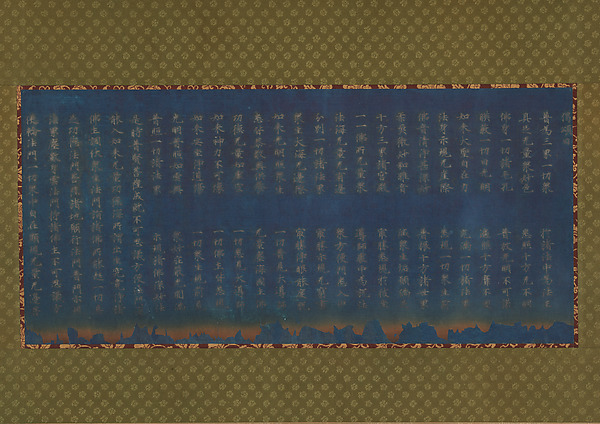
Japan · Nara period (710–794) · ca. 744 · Hanging scroll; silver pigment on indigo-dyed paper
Look closer: Look first at the lines of silver script on the indigo paper, then at the edges. The scrolls were burned in 1667, so the damage you see is the damage the Met's entry describes, not wear from age. A hanging scroll of about 25 by 54 centimetres of image, dated to about 744 and listed in the Nara period.19
The Metropolitan Museum of Art, New York, Purchase, Mrs. Jackson Burke Gift, 1978, accession 1981.75. Public domain, Met Open Access. Museum record
The hall named in the title is the home of a festival. Wikipedia's article on Shuni-e says the ceremony at Todai-ji was started by Jitchu, a Kegon monk, as a devotion and confession to the bodhisattva Kannon, and that it has continued every year since 752.12 It runs from the first of March to the morning of the fifteenth.12 Eleven monks, called rengyoshu, hold six repentance services a day, from late evening to the dusk service.12
Each night ten believers, eleven on the twelfth, carry pine torches up to eight metres long and weighing up to eighty kilograms along the balcony of the Nigatsudo, showering the crowd with sparks, which is believed to protect against evil.12 Around two in the morning after the last fire night, monks draw water by torchlight from the Wakasa Well; legend says it springs only once a year, and the water, offered to Kannon and to the public, is believed to cure ailments.12 This is the rite called Omizutori, the water-drawing, and it gives the whole festival its popular name.12
Kasuga, the Shrine Beside Kofuku-ji
The connoisseur's eyeKofuku-ji was the tutelary temple of the Fujiwara family,2 and the Kasuga shrine in Nara, which stands near it, is the subject of several mandalas in the Met. The early fourteenth-century Kasuga Shrine Mandala shown here is a hanging scroll in ink, colour and gold on silk, and the Met's entry describes the shrine mandala as a genre that joins the idea of a Buddhist mandala to older Japanese painting.20 It shows the shrine at the foot of Mount Mikasa from a bird's-eye view, an invitation to what the museum calls a virtual pilgrimage in which the viewer wins the favour of the Kasuga deities.20

Japan · Kamakura period (1185–1333) · early 14th century · Hanging scroll; ink, color, and gold on silk
Look closer: Read the scroll from the top: the five forms along the upper edge are the Buddhist forms of the five Kasuga deities, as the Met's entry lists them. The Met describes the rest as a bird's-eye view of the shrine at the foot of Mount Mikasa, a tall hanging scroll meant to be walked through with the eye.20
The Metropolitan Museum of Art, New York, Mary Griggs Burke Collection, Gift of the Mary and Jackson Burke Foundation, 2015, accession 2015.300.12. Public domain, Met Open Access. Museum record
Along the top the Met identifies, from right to left, the Buddhist forms of the five deities: an Eleven-headed Kannon, the Kannon of the Unfailing Noose, the Medicine Buddha Yakushi, the bodhisattva Jizo and a second Eleven-headed Kannon.20 That row is the plainest lesson in the union of gods and Buddhas in the whole chapter: each of the shrine's deities is shown in a Buddhist form. The Met's entry does not mention Kofuku-ji or the Fujiwara, so the link between the shrine and the Hosso temple is not drawn by the museum and we do not draw it for them.20
The shrine also appears in the life of Myoe, the Kegon reviver. Wikipedia's article on Myoe says the Kasuga deity twice urged him through an oracle to stay in Japan when he planned to go to India, in 1203 and again in 1205.14 The page cites no source for the oracle, and we give it as a story the article tells, not as an established event.
A Magic Kettle and a Golden Lion
The connoisseur's eyeThe Hosso story begins with a walk. Wikipedia gives Xuanzang's years as 602 to 664 and says he brought back about 657 Sanskrit texts when he reached Chang'an in 645, sixteen years after leaving Chinese territory.17 The page reports a disagreement about the start: most sources give 629, but a version in the Guang hongming ji, together with Japanese and Korean texts, gives 627, and a detail in one biography about a meeting with a khan who died in 628 would favour the earlier date.17 The article treats 629 as the most common date and leaves the question open.17
His Japanese pupil is Dosho. Wikipedia's article on Dosho dates his life to 629 to 700, says he went to China in 653 and studied the consciousness-only teaching under Xuanzang, and says he became a priest at Gango-ji in Nara after he returned and is said to have founded Japan's first meditation hall there; the page gives no return date.16 It also tells a legend. Xuanzang gave Dosho a kettle that could brew healing medicines, and when a storm at sea threatened Dosho's ship he gave the kettle to the sea god and the storm calmed.16 The article cites scholars for the legend, and it remains a legend.
Kegon has its own travellers and a teacher with a famous image. Fazang, who lived from 643 to 712, is seen by some scholars as the de facto founder of the Huayan school, and Wikipedia says his relationship with Empress Wu helped spread the teaching.18 His Essay on the Golden Lion uses a statue of a lion to explain how the underlying principle relates to the many things we see: the gold is the single pattern, and the lion is our illusion of separate objects.18 He also used the image of Indra's net, in which every jewel reflects all the others.18 His friend Uisang, who lived from 625 to 702, took Huayan home to Korea, while his Korean pupil Simsang, called Shinjo in Japan, taught Roben, the first head of the Kegon school at Todai-ji.18
Water, Fire and a Very Large Bowl
The deep endThe Nara schools are lived in public all year. In March the torches of the Todai-ji water-drawing burn for two weeks, and the sparks from the torches fall on the crowd below the Nigatsudo balcony, which is said to protect against evil.12 At Kofuku-ji the Central Golden Hall, rebuilt in 2018, stands again beside the five-storey pagoda, as the first section of this chapter describes.2 At Yakushi-ji the East Pagoda, completed in 730, was taken apart again in 2012 and repaired, with work continuing to 2018.3
Saidai-ji keeps the most playful of the traditions. A tour-company page describes the Ochamori, or tea gathering, as said to originate with Eison, who served tea that had been offered to the Hachiman shrine to local people, at a time when tea was a drink of the aristocracy and ordinary people had no tea bowls and used whatever pots or pans they had.15 Today the page says the tea is served in very large bowls, around fifty centimetres across, and that the bowl is so heavy that helpers lift it to your mouth, with each guest taking a turn.15 The page gives no date, season or price, and describes the origin as a legend; we do the same, and add that the Eison article links him to the origin of the rite.155
The date for the Saidai-ji foundation also needs a note. Wikipedia says the retired Empress Koken requested the statues of the Four Heavenly Kings in September 764 to pray for the end of the Fujiwara no Nakamaro rebellion, and that they were completed in 765, the year of the temple's founding.6 The statues now in the Shiodo are later replacements; only the demons beneath their feet date from the founding.6 The original complex had twin five-storey pagodas and two main halls, the Miroku hall with 77 statues and the Yakushi hall with 21, and the present main hall was rebuilt in 1808.6
One relic story deserves a careful sentence. Wikipedia's article on Xuanzang says that part of his remains were taken from Nanjing by Imperial Japanese Army soldiers in 1942 and are now enshrined at Yakushi-ji in Nara, and that in 1956 Japan returned some relics to Taiwan.17 The article also records a skull relic at a memorial hall at Nalanda in India and a claim to part of the skull at a monastery in Chengdu. The claims conflict, and the page does not choose among them.
Stories and Fun Facts
First lookSeveral small stories sit inside the larger history, and each is a good way into it. They are given as the sources give them, and no more.
The kettle that bought a calm sea. Dosho was given a kettle that brewed medicines, and he gave it to the sea god in a storm.16
The ear and the razor. Wikipedia says Myoe cut off an ear in his youth and again before a Buddha image at Kozan-ji, and that the bloodstain is supposedly still visible. The page cites no source for either account.14
Two deaths for one monk. The same Myoe article gives 11 February 1232 in its heading and 19 January 1232 in its text, and says he kept a dream journal for over forty years.14
The pillar with a nostril. A hole in a pillar of the Great Buddha Hall is said to match one of the statue's nostrils, and legend promises enlightenment in the next life to anyone who passes through.13
The lion that explained everything. Fazang used a golden lion to teach that the gold is the principle and the lion is the appearance.18
The well that flows once a year. Legend says the Wakasa Well springs forth only at the Omizutori.12
The sutra that kept its scorch. The Met treats the burn marks on the Nigatsudo sutra as part of its meaning, an image of impermanence.19
The Buddha who got smaller. The Great Buddha was 16 metres when it was made, according to Wikipedia, and is 14.98 metres today.13
The bowl that needs two helpers. The Saidai-ji tea is drunk from a bowl about fifty centimetres wide.15
The skull that is in several places. Wikipedia lists a memorial hall at Nalanda, a monastery at Chengdu and, for part of his remains, Yakushi-ji.17
Dates to remember: 653, Dosho studies under Xuanzang; 736, Kegon lectures begin; 752, the Great Buddha is opened; 753, Jianzhen arrives; 1236, Eison's self-ordination.1641385
Numbers to remember: six schools, three survivors, about 657 texts brought back by Xuanzang, eleven rengyoshu monks, sixty scrolls in the burned sutra set.11171219
A Glossary of the Nara Schools
The connoisseur's eyeTerms used in this chapter, with the language each belongs to.
| Term | Language | Meaning |
|---|---|---|
| Nanto Rokushu | Japanese | The Six Southern Schools of Nara, the academic traditions of 710 to 79411 |
| Hosso | Japanese | The consciousness-only school, from Yogacara1 |
| Kegon | Japanese | The Flower Ornament school, from Chinese Huayan4 |
| Ritsu | Japanese | The school of the monastic rule, the Vinaya8 |
| Sanron | Japanese | The Madhyamaka school of the Middle Way, brought in 62511 |
| Birushana | Japanese | The cosmic Buddha of Kegon, the Great Buddha of Todai-ji13 |
| Rengyoshu | Japanese | The eleven monks who perform the Todai-ji repentance rite12 |
| Omizutori | Japanese | The water-drawing at the end of the Shuni-e12 |
| Shuni-e | Japanese | A spring rite of repentance held at Todai-ji from 1 to 15 March12 |
| Indra's net | English | The image of a net of jewels each reflecting all the others18 |
| Miya mandara | Japanese | A shrine mandala, a painting of a shrine as a sacred map20 |
| Ochamori | Japanese | The Saidai-ji tea gathering from very large bowls15 |
A Collector's Eye on Nara Work
The connoisseur's eyeWork made in the Nara period itself is rare, and the Met's holdings show how much of what survives is later. The portraits of Xuanzang, Guiji and Jianzhen that illustrate this chapter are works of the Kamakura and Muromachi periods, painted centuries after their subjects, and the sutras are fragments from a temple set.1819 A collector meeting one of these subjects is often meeting a later image of an early founder, and that is not a weakness: the portrait tradition is part of how the schools remembered themselves.
Three questions help. The first is which school the subject belongs to, because a portrait of Xuanzang points to Hosso, one of Jianzhen to Ritsu, and a section of the Flower Ornament Sutra to Kegon. The second is whether the object names its temple or its hand; an inscription or a seal on a scroll is evidence, while a founder's name on a mount is tradition. The third is what the record leaves out, and here the Met is a good teacher: its entries state the credit line, the date and the medium, and where they say nothing about an origin, the Todaiji Fragment, for example, we say nothing either.22
In the house, the shelf of Buddhist statues and sacred art holds Shaka, triads and seated Buddhas, and the Asian antiques shelf takes in pieces that cross the sea. We describe a piece by style and leave the date and the temple to the evidence. The Japanese terms to search for are Shaka Nyorai, Birushana and Kegon; the English terms are Great Buddha, Flower Ornament Sutra and sutra scroll.
Objects of the Nara Schools
The house catalogues the figures these schools placed on their altars, the seated Buddhas, the triads and the Shaka images, under their own names. The strip below fills from the live shelf on the day you read this, and shows nothing if a tag is empty.
Nara-school work is early and rare. Most of what reaches us is later, and our own record says so plainly on each piece.
Pieces in the house now
- Buddhist Statues and Sacred ArtShaka, triads and seated Buddhas
Filter by what you have just read
Answered plainly
What happened to the six schools of Nara?
Most faded or merged after the capital moved. Hosso, Kegon and Ritsu survived, and Hosso and Ritsu still hold head temples at Kofuku-ji, Yakushi-ji and Toshodai-ji.178
What does Hosso teach?
That only consciousness is real, with eight consciousnesses and the store consciousness as root; it also held that some beings cannot become buddhas.1
Who founded Kegon in Japan?
Roben, who invited Shinjo to lecture on the Flower Ornament Sutra in 736 and became the first head of the school at Todai-ji.4
Why is Eison remembered?
Because he revived the Vinaya in 1236 by self-ordination, restored Saidai-ji from 1238, and extended the precepts to outcasts, prisoners and the poor.56
Is the Saidai-ji tea bowl tied to the Mongol invasions?
The Eison article links him to the origin of the rite; we repeat the link as it is stated and do not treat it as a dated fact.5
Can I see these schools' temples?
Yes. Kofuku-ji, Yakushi-ji and Toshodai-ji are part of the World Heritage site Historic Monuments of Ancient Nara.237
Which of the six Nara schools survive today?
Hosso, Kegon and Ritsu, according to Wikipedia. Sanron and Jojitsu are not described as institutions today, and Kusha was largely absorbed into Hosso in the eighth century.11
What is the Omizutori at Todai-ji?
The water-drawing that ends the Shuni-e, a repentance rite that has continued every year since 752. It runs from 1 to 15 March, with pine torches carried on the Nigatsudo balcony and water drawn from the Wakasa Well around two in the morning.12
How big is the Great Buddha of Todai-ji?
Wikipedia gives the present height as 14.98 metres, the original as 16 metres and the weight as about 500 tonnes. The hall is 57 metres long, 50 wide and 49 high, completed in 1709.13
What is the Nigatsudo Burned Sutra?
A fragment of the Flower Ornament Sutra from a set of sixty handscrolls donated to Todai-ji in 744, scorched in the Nigatsudo fire of 1667. The Met holds a hanging scroll of it in silver pigment on indigo-dyed paper.19
Who was Myoe?
A Kegon monk who lived from 1173 to 1232, abbot of Kozan-ji and keeper of a dream diary for over forty years. Wikipedia gives two different dates for his death, 11 February and 19 January 1232.14
Is part of Xuanzang enshrined in Nara?
Wikipedia says that part of his remains are enshrined at Yakushi-ji, taken from Nanjing in 1942. It also notes rival claims in China and India, so the question is not settled.17
What is Indra's net?
A Kegon and Huayan image used by Fazang: a net of jewels in which each reflects all the others, standing for the interpenetration of things.18
Is the Saidai-ji tea gathering really from Eison?
It is said to originate with him. A tour-company page describes the bowls as around fifty centimetres wide and gives the origin as a legend, and the Eison article links him to the rite.155
Why is the Kasuga shrine shown with Buddhist figures?
Because the shrine mandala joins the idea of a Buddhist mandala to older Japanese painting. The Met's scroll lists the Buddhist forms of the five Kasuga deities along its upper edge.20
Where next
Sources and image credits
- Wikipedia, Hosso Transmission, doctrine, the Tokuitsu debate.
- Wikipedia, Kofuku-ji Founding, moves, pagoda, treasures.
- Wikipedia, Yakushi-ji Founding, East Pagoda, the two-temple question.
- Wikipedia, Kegon 736 lectures, Roben, Myoe, revivals.
- Wikipedia, Eison 1235 vow, 1236 self-ordination, Saidai-ji.
- Wikipedia, Saidai-ji 765 founding, Eison's restoration, independence in 1895.
- Wikipedia, Toshodai-ji Founding in 759 and the surviving buildings.
- Wikipedia, Ritsu school Vinaya, Jianzhen, Kamakura revival, Meiji.
- The Metropolitan Museum of Art, Section of the Dream Diary (Yume no ki) Catalogue entry for the 1225 diary section.
- The Metropolitan Museum of Art, Letter in Kana Characters Catalogue record for Myoe's letter.
- Wikipedia, Nanto Rokushu The six schools, their introductions, the 794 capital move and the survivors; read 29 October 2026.
- Wikipedia, Shuni-e Jitchu, 752, the March dates, the torches and the water-drawing; read 29 October 2026.
- Wikipedia, Todai-ji Foundation, the Great Buddha, the hall and the nostril pillar; read 29 October 2026.
- Wikipedia, Myoe Life dates, the dream journal, the ear story and the Kasuga oracle; read 29 October 2026.
- Japan Deluxe Tours, Ochamori Tea Ceremony The Saidai-ji tea gathering, stated as a legend of Eison; read 29 October 2026.
- Wikipedia, Dosho Study under Xuanzang, Gango-ji and the kettle legend; read 29 October 2026.
- Wikipedia, Xuanzang Dates, the 627 or 629 departure, the 657 texts and the relic claims; read 29 October 2026.
- Wikipedia, Fazang The Golden Lion, Indra's net, Uisang and the Japanese transmission; read 29 October 2026.
- The Metropolitan Museum of Art, Nigatsudo Burned Sutra Catalogue entry: the 744 set, the 1667 fire and the impermanence reading.
- The Metropolitan Museum of Art, Kasuga Shrine Mandala (Kasuga miya mandara) Catalogue entry: the shrine mandala genre and the five deities.
- The Metropolitan Museum of Art, Shosoin fragment Catalogue record: silk tabby, dated 756.
- The Metropolitan Museum of Art, Page from the Illustrations and Explanations of the Three Jewels, the Todaiji Fragment Catalogue entry: dated 1120, ink on mica paper.
Last reviewed 28 October 2026. Dates in this chapter follow the cited pages; where the sources disagree, the chapter says so. Every picture is public-domain or openly licensed, and its credit and licence stand beneath it.
If a Nara-school image or scroll has called to you, the concierge desk can search Japan for it.
Private concierge
Looking for something in particular?
Describe the piece or the project you have in mind. A senior advisor in Tokyo reads every case file personally and replies within two business days, with fees set out in writing before any work begins.