Rare Vintage, Antiques and Art Collector / Curator / Personal Shopper From Japan
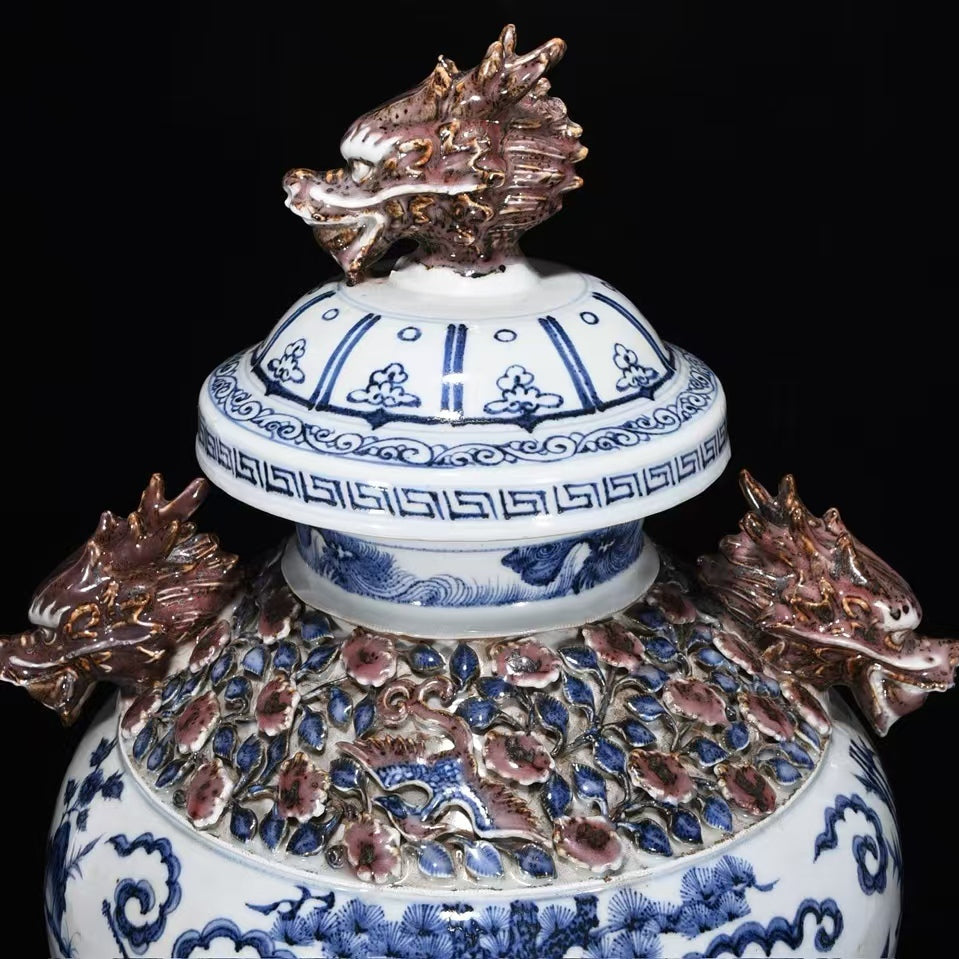
Yuan Dynasty–Style Blue & White Dragon Jar — Applied Dragon Handles & Lid — Monumental 40 cm Classical Revival Vessel
Yuan Dynasty–Style Blue & White Dragon Jar — Applied Dragon Handles & Lid — Monumental 40 cm Classical Revival Vessel
Couldn't load pickup availability
Have a reasonable price in mind? Submit your best offer and our concierge will review it personally.
Qing Dynasty Revival Paired Dragon & Floral Porcelain Vases
This matched pair of Chinese porcelain vases exemplifies Qing dynasty revival decorative art, combining vibrant famille rose enamels with auspicious dragon iconography. Produced as a unified pair, the vessels were designed for symmetry, visual authority, and formal display rather than utilitarian use.
Each vase features a radiant yellow enamel ground historically associated with imperial presence, overlaid with dense floral scrollwork and a central dragon medallion symbolizing power, protection, and prosperity. Elephant‑mask handles at the shoulders reinforce classical Chinese decorative symbolism tied to strength and guardianship.
Mounted on elaborate gilt bronze stands, the vases are elevated into sculptural display objects suitable for altars, cabinets, or architectural interiors. Their paired configuration enhances balance and collector desirability.
Although Chinese in origin, works of this nature were actively collected and preserved in Japan during the late Meiji and Showa periods. This example reflects that cross‑cultural appreciation and survives with light age‑appropriate wear consistent with decorative display.
These paired dragon vases should not be read merely as decorative porcelains, but as material statements of late-imperial continuity, authority, and ritualized symmetry. In Qing visual culture, paired forms were not aesthetic redundancies; they were philosophical instruments. Balance (和), order (序), and mirrored authority were encoded into the object itself. When vases were produced as a pair, they were intended to occupy space together—flanking thresholds, altars, or axial interiors—creating a visual gate through which power, blessing, and legitimacy symbolically passed.
The dragon iconography here operates on multiple registers simultaneously. At its most immediate level, the dragon is imperial: a creature without equal, governing rain, fertility, and cosmic mandate. At a deeper level, the dragon’s coiling movement around the vessel body transforms the vase into a vertical cosmogram—earth at the foot, ascension through the body, and celestial command near the shoulder and rim. This vertical narrative is not incidental; it mirrors Qing cosmology itself, where hierarchy was spatial, moral, and metaphysical.
Equally important is the chromatic strategy. The yellow ground historically signals proximity to imperial taste and court-sanctioned palettes, even when produced outside the inner court kilns. Yellow functions not merely as color, but as coded privilege—instantly legible to Qing viewers as an elite register. The enamels applied over this ground show controlled saturation and confident linework, suggesting a workshop operating with skilled division of labor rather than amateur hand.
The bronze-mounted bases and fittings further complicate the reading. Such mounts were often later additions, commissioned to elevate ceramic works into more permanent display objects suitable for elite interiors. Their presence signals that these vases were not treated as transient utensils, but as heirloom objects—worth reinforcing, preserving, and visually anchoring. This hybridization of ceramic and metal speaks to a collecting culture already thinking in generational terms.
From a collector’s standpoint, the value here is not only visual impact but conceptual completeness. Surviving as a matched pair dramatically increases both rarity and historical coherence. Pairs were far more likely to be separated over time due to inheritance divisions, sales, or damage. The continued unity of the set suggests careful stewardship rather than casual circulation.
In a modern context, these vases function exceptionally well as architectural anchors—suitable for symmetrical placement in grand interiors, gallery-like stair landings, or curated retail and hospitality environments. They command space without relying on excess scale alone; instead, they project authority through proportion, repetition, and symbolic density.
This is not merely an object pair to be owned, but a visual thesis on Qing taste, hierarchy, and the long afterlife of imperial symbolism beyond the court itself.
Specifications
- Origin: China (Qing dynasty revival period)
- Material: Porcelain with famille rose enamels
- Decoration: Dragon medallions, floral motifs, elephant‑mask handles
- Height: approx. 29 cm each
- Width: approx. 12 cm each
- Mounts: Gilt bronze stands
- Configuration: Matched pair
Collector’s Resonance
Designed for collectors of Chinese decorative arts, Qing revival porcelain, and East Asian interior architecture. Particularly suitable for paired placement in formal spaces requiring symbolic balance and visual authority.
Authenticity & Stewardship
Evaluated under the Japonista Authentication Framework™:
- Material, carving, and surface-study comparison
- Iconographic and stylistic verification
- Condition and stability review (surface integrity)
- Construction assessment and handling-risk evaluation
Guaranteed 100% Authentic. Covered by the Japonista Lifetime Authenticity Warranty™.
A Note on Stewardship and Collecting
At Japonista, we approach Buddhist statues, sacred images, and ritual objects not merely as collectibles, but as cultural and spiritual artifacts deserving of respect, understanding, and careful presentation. Every piece we offer is thoughtfully examined, researched, and curated with sensitivity to its origin, meaning, and historical role.
Our role is not only to offer access to rare and meaningful objects, but to serve as responsible custodians—connecting the right works with collectors who value depth, intention, and authenticity.
Inquiries, Availability, and Private Consideration
Some of the cultural and heritage works may allow room for discussion, while others are held firmly due to rarity, condition, or cultural importance. All inquiries are reviewed personally and discreetly, and we welcome thoughtful questions or expressions of interest.
If you are exploring a particular theme, deity, lineage, or period—or seeking guidance in building a focused collection—our concierge team is always available to assist with quiet expertise and care.
Concierge Support & Collector Guidance
Japonista Concierge™ provides personalized assistance for collectors seeking deeper understanding, thoughtful acquisition, or long-term curation strategies. Whether your interest is devotional, scholarly, or aesthetic, we are here to help guide your journey with clarity and respect.
For select high-value or historically significant works, private reservation or structured payment arrangements may be available on a case-by-case basis. Please reach out to discuss eligibility and discreet options.
Before Proceeding
We kindly encourage collectors to review our shop policies and house guidelines, available through the links in our website footer, which outline shipping, handling, and conditions specific to vintage, sacred, and collectible works.
A Closing Note
Thank you for exploring Japonista’s collection of Oriental Cultural Heritage and arts. We are honored to share these meaningful works and to help place them where they may continue to be appreciated, studied, and respected.
If you have questions or wish to explore related works, please feel free to contact Japonista Concierge™ at any time.