Rare Vintage, Antiques and Art Collector / Curator / Personal Shopper From Japan
YAMANE EVISU Vintage Kintaro Koi Dragon Japan Map Embroidered Denim Jacket Amekaji Sukajan Style Tour Coat M-L
YAMANE EVISU Vintage Kintaro Koi Dragon Japan Map Embroidered Denim Jacket Amekaji Sukajan Style Tour Coat M-L
Couldn't load pickup availability
Have a reasonable price in mind? Submit your best offer and our concierge will review it personally.
Japanese Indigo Denim Souvenir Jacket with Kintarō Hero, Climbing Carp, Dragon, City Map Embroidery, and Full Pictorial Sleeves
COLLECTOR’S OVERVIEW
An exceptional YAMANE embroidered denim jacket from the wider EVISU and Japanese Amekaji tradition, transforming the narrative language of the sukajan into a substantial collared indigo tour jacket.
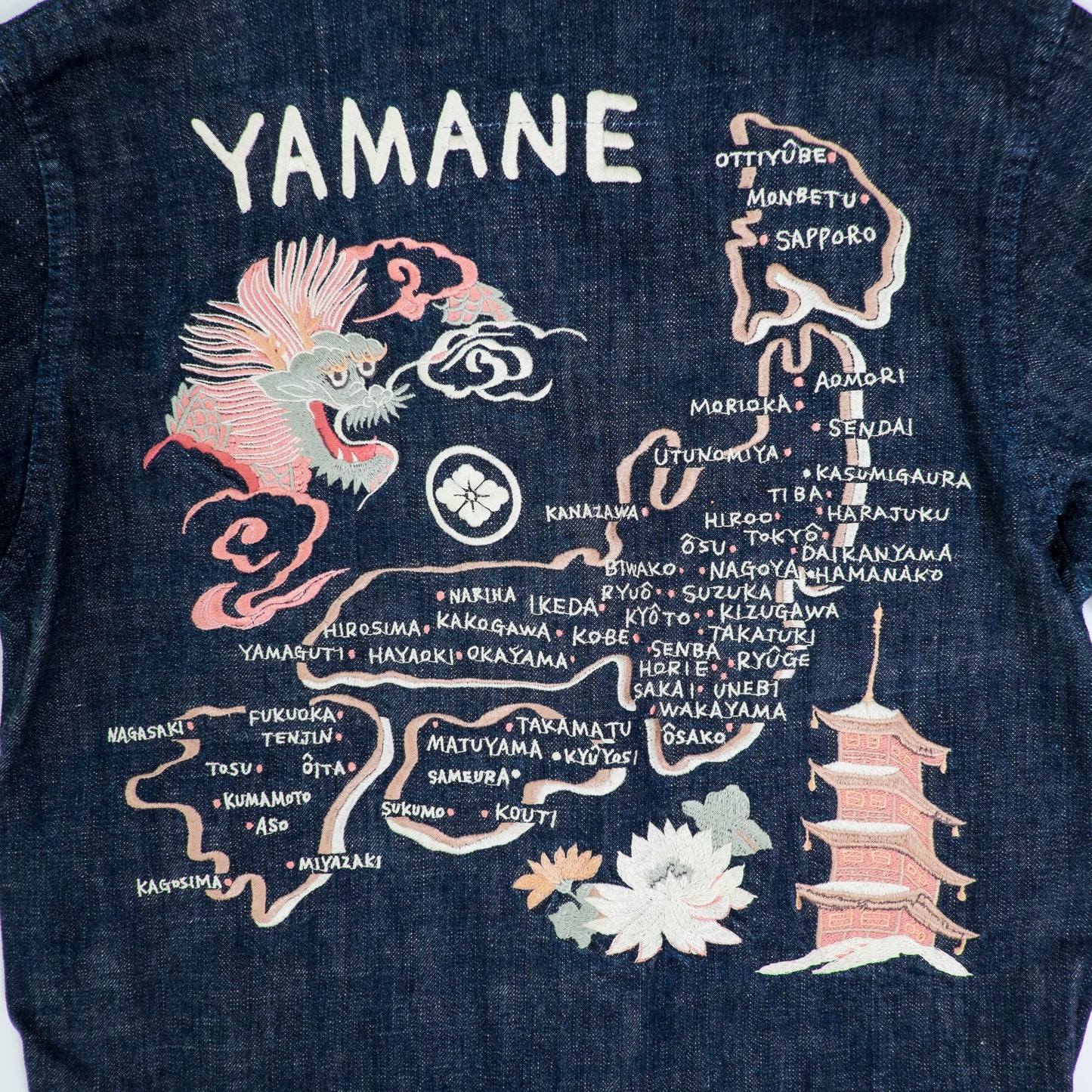
The composition unfolds across nearly the entire garment. A large embroidered map of Japan dominates the back, marked with regional and city names extending from Hokkaidō through Honshū, Shikoku, and Kyūshū. Above it, the name YAMANE is embroidered in large ivory lettering. A pale dragon emerges beside the map through curling clouds, accompanied by a circular floral crest and scattered chrysanthemum-like blossoms.
Both sleeves carry mirrored vertical scenes. The legendary child hero Kintarō stands powerfully upon a rocky height, while a large carp surges upward through foaming turquoise water below. The arrangement connects two celebrated images of strength: Kintarō, the superhuman child destined to become the warrior Sakata no Kintoki, and the ascending carp, whose struggle against the current symbolizes courage, advancement, and transformation.
The front continues the visual program with a dragon and crest embroidered on the left chest, large Kintarō-and-carp sleeve panels, a pointed denim collar, covered front closure, patch chest pocket, and lower hand pocket construction. Deep indigo denim provides a strong, workwear-derived foundation for embroidery in coral, turquoise, ivory, gray, mustard, pink, sage, brown, and pale gold.
This is not a conventional satin bomber. It is a more unusual sukajan-inspired denim tour jacket, combining Japanese souvenir imagery with the sturdy architecture of an Amekaji work jacket. The result sits between denim culture, folklore art, embroidered streetwear, souvenir mapping, and wearable Japanese material culture.
IDENTIFICATION
Object Type
Vintage Japanese embroidered denim jacket.
Style Classification
Amekaji denim tour jacket with sukajan-inspired pictorial embroidery.
Brand
YAMANE.
The woven interior label and large embroidered back name identify the garment with YAMANE, closely associated with the EVISU-centered Japanese denim and heritage-fashion tradition.
Origin
Japan.
Tagged Size
Free Size, indicated approximately M-L.
Approximate Western Fit
Generally closest to a contemporary Western S-M or a trim M-L fit, depending on body proportions, desired ease, sleeve preference, and the thickness of garments worn underneath.
Primary Textile
Dark indigo denim with a visible woven grain and subtle slub-like surface character.
Principal Motifs
Kintarō child hero, climbing carp, waterfall, dragon, clouds, Japan map, city and regional names, circular floral crest, chrysanthemums, rocky landscape, and tour-jacket typography.
Construction
Collared denim jacket with set-in sleeves, covered center-front fastening, visible lower metal snap, patch chest pocket, lower hand-pocket construction, button or snap cuffs, straight denim hem, interior branded label, and extensive multicolor embroidery across the chest, back, and both sleeves.
YAMANE AND THE JAPANESE DENIM TRADITION
Japanese Amekaji
Amekaji, shortened from “American casual,” describes Japan’s highly developed interpretation of American workwear, military clothing, college sportswear, motorcycle apparel, denim, and mid-century casual fashion.
Japanese designers did not merely reproduce American garments. They studied their fabrics, stitching, silhouettes, hardware, aging patterns, and cultural associations, then reworked them through Japanese craftsmanship and visual storytelling.
This jacket belongs to that cross-cultural lineage.
Its pointed collar, indigo denim, work-jacket construction, chest pocket, sturdy cuffs, and straight hem come from utilitarian Western clothing. Its dragon, Kintarō, koi, embroidered map, cloud forms, crest, and full pictorial sleeves belong to Japanese decorative and souvenir-jacket culture.
YAMANE Identity
The YAMANE name appears prominently across the upper back and on the interior woven label.
Rather than relying upon a small discreet signature, the brand becomes part of the composition itself. The ivory lettering crowns the map of Japan, giving the jacket the character of a personalized travel garment, regional tour piece, and Japanese denim statement object.
Beyond the Conventional Sukajan
Traditional sukajan commonly use lightweight rayon-like satin, elastic ribbed trim, raglan sleeves, and reversible bomber construction.
This garment translates the same storytelling impulse into denim.
The embroidery is distributed over a collared work-jacket silhouette rather than a satin bomber. The result feels heavier, more architectural, and more firmly connected with Japanese denim collecting.
It may be styled as:
An embroidered denim jacket.
A Japanese tour jacket.
A sukajan-inspired souvenir coat.
An Amekaji statement piece.
An EVISU and YAMANE collectible.
A folklore-based wearable artwork.
THE INDIGO DENIM GROUND
Deep Blue-Black Color
The jacket is constructed from dark indigo denim that appears blue-black, navy, charcoal-indigo, or lightly speckled blue according to lighting.
The fabric retains a strong, saturated ground while showing the natural vertical and diagonal grain associated with woven denim.
This deep color is essential to the design. It allows ivory lettering, coral skin tones, turquoise water, pale dragon scales, gray rock, mustard foliage, and soft pink cloud forms to remain highly visible without appearing overly bright.
Denim Texture
Unlike smooth satin, denim does not reflect light in broad liquid highlights.
Its surface absorbs and breaks illumination through the weave, creating a more rugged background for the embroidery. The dimensional threadwork stands slightly above the denim and reads almost like appliqué or tattoo imagery transferred onto workwear.
Structural Character
The denim gives the garment a firmer outline than a lightweight souvenir bomber.
The collar holds its shape.
The shoulder line remains defined.
The cuffs and hem create a clean work-jacket finish.
The large embroidered sleeves retain a strong pictorial surface when worn or displayed.
Aging Potential
Indigo denim develops character through wear.
High-contact areas such as the collar, cuffs, placket, seams, pocket openings, elbows, and hem may gradually soften or lighten, creating a personal wear pattern around the established embroidery.
The jacket therefore combines two forms of visual history: the fixed narrative of the stitched motifs and the evolving record created by the wearer.
THE JAPAN MAP
Central Back Composition
A large stylized outline of Japan occupies the central back.
The islands are bordered in warm pink, peach, and pale coral thread, while the interior remains primarily dark indigo, allowing the denim itself to become the geographical field.
Numerous locations are marked in hand-rendered ivory lettering with small coral dots and route-like placement.
Visible names extend across the archipelago and include areas such as Sapporo, Morioka, Utsunomiya, Kanazawa, Nagoya, Kyoto, Kobe, Hiroshima, Fukuoka, Kumamoto, Miyazaki, Matsuyama, and other regional points.
Tour-Jacket Language
Maps have long appeared on souvenir jackets as records of travel, military stations, ports, routes, and personal experience.
Here, the traditional satin map-jacket concept is translated into Japanese denim. The text has a deliberately hand-drawn, irregular character rather than the precision of formal cartography.
This gives the back the appearance of an embroidered travel diary.
Hokkaidō to Kyūshū
The vertical movement of the map follows Japan from the northern island of Hokkaidō down through the long central body of Honshū and into the island regions of Shikoku and Kyūshū.
The geography creates a natural compositional spine beneath the YAMANE name.
Place and Identity
The map does more than locate the garment geographically.
It turns the entire country into a brand and cultural landscape. City names, regional routes, dragon imagery, and the crest suggest movement through Japan while preserving a distinctly Japanese visual identity.
Denim as Landscape
Much of the map interior is left unfilled.
The indigo cloth becomes sea, land, night sky, and negative space simultaneously. This restraint keeps the heavily embroidered sleeves from competing with an overly dense central panel.
YAMANE BACK LETTERING
Monumental Brand Signature
The word YAMANE is embroidered in large ivory capitals across the shoulder blades.
The lettering is slightly irregular and hand-drawn in appearance, complementing the freehand style of the city names below.
Placement
Positioned above the dragon and Japan map, the name functions almost like the title of the entire composition.
It is immediately legible from a distance and gives the jacket a distinctive branded identity without requiring a separate rear patch.
Ivory Against Indigo
The cream-white thread provides maximum contrast against the dark denim.
Its restrained color also connects with the map lettering, floral crest, dragon details, and pale foam in the sleeve waterfalls.
THE DRAGON
Back Dragon
A pale dragon emerges to the left of the Japan map.
Its head is rendered in ivory, muted coral, pale gray, and dusty pink, with a long muzzle, open mouth, whiskers, horns, flowing mane, and cloud-like movement.
The body curls downward into pink and coral scrolls rather than being shown as a complete naturalistic creature.
Chest Dragon
A smaller corresponding dragon appears on the left chest.
It is positioned beside the circular crest, creating a concentrated emblem that previews the imagery found across the back.
Ryū Symbolism
The Japanese dragon, or ryū, is associated with water, rainfall, rivers, seas, wisdom, protection, authority, transformation, and elemental force.
Unlike many European dragons, East Asian dragons are strongly linked with water and the life-giving movement of weather.
This connection is especially meaningful beside the koi and waterfall imagery running down the sleeves.
Dragon and Carp Relationship
A celebrated East Asian legend tells of a carp that succeeds in climbing the Dragon Gate and is transformed into a dragon.
The carp represents perseverance before transformation.
The dragon represents the power achieved after the trial.
By including both creatures within one jacket, the embroidery creates a symbolic progression from struggle to elevation.
Clouds and Breath
Ivory and pale pink cloud forms extend from the dragon’s mouth and body.
These curling lines give the creature movement while preserving open indigo space around it.
The dragon appears less as a solid animal and more as an apparition formed from cloud, water, and breath.
THE CIRCULAR CREST
Floral Mon-Like Emblem
A circular ivory emblem appears beside the dragon on both the chest and back.
Its interior contains a simplified four-petal floral device.
The motif resembles the visual grammar of a Japanese mon, or family crest, without requiring attribution to a specific historic lineage.
Graphic Function
The crest introduces a compact geometric form between the fluid dragon and irregular map.
Its circle creates visual order and provides a repeated identifying mark across the garment.
Symbolic Reading
Circular crests often suggest continuity, unity, inheritance, identity, and belonging.
The floral center softens the emblem and connects it with the scattered blossoms near the lower back.
KINTARŌ
Mirrored Sleeve Heroes
A large Kintarō-inspired figure occupies the upper portion of each sleeve.
The child hero is shown with a powerful rounded body, dark windswept hair, coral-red skin, determined eyes, and a dynamic crouching stance upon a rocky ledge.
He wears a pale yellow chest garment, a green neck detail, and a purple, black, ivory, and pink checkered lower garment.
The mirrored figures turn inward toward the body, creating a balanced pair when the jacket is viewed from either front or back.
Kintarō in Japanese Folklore
Kintarō, the “Golden Boy,” is one of Japan’s most enduring child heroes.
Raised in the mountains and celebrated for extraordinary strength, he is often depicted wrestling animals, carrying an axe, confronting wild creatures, or demonstrating power far beyond his age.
He later becomes associated with Sakata no Kintoki, a famed warrior retainer of Minamoto no Yorimitsu.
Childhood Strength
Kintarō represents strength in its earliest and most direct form.
He is powerful before becoming formalized as a warrior.
His courage arises from instinct, vitality, closeness to nature, and freedom from fear.
The Mountain Setting
The embroidered ledge beneath each figure is rendered in layered gray, taupe, brown, white, and mustard thread.
Its angular forms establish a mountain or cliff environment, connecting the child hero with the wilderness central to his legend.
Kintarō and the Carp
Kintarō is frequently shown in Japanese art wrestling, carrying, riding, or confronting a giant carp.
The pairing became particularly popular in ukiyo-e, festival imagery, tattoo designs, and boys’ decorative culture because both figures symbolize vitality and determined strength.
On this jacket, Kintarō appears above the carp’s ascent, visually presiding over the struggle below.
THE CLIMBING CARP
Monumental Sleeve Koi
A large carp occupies the lower portion of each sleeve.
The fish is rendered in taupe, gray, ivory, pale blue, turquoise, sage, and muted gold.
Individual scales are outlined across the body, while the fins and tail spread outward through the surrounding current.
Waterfall Composition
Bright turquoise and pale-blue vertical bands descend behind the fish.
Foaming white and aqua waves gather around its body, creating the impression of a carp forcing its way upward through powerful water.
The water is especially vivid against the dark denim and forms one of the jacket’s strongest color contrasts.
Koi no Takinobori
The image is consistent with koi no takinobori, the carp climbing a waterfall.
This motif represents perseverance against difficulty, advancement through effort, courage, ambition, and eventual transformation.
The fish does not drift with the current.
It moves against it.
Dragon Gate Legend
The carp’s ascent evokes the Dragon Gate story, in which the successful fish is transformed into a dragon after overcoming the waterfall.
The dragon embroidered on the chest and back may therefore be read as the destination of the sleeve narrative.
At the cuff, the carp begins its struggle.
Above it, Kintarō embodies strength.
Across the body, the dragon represents achieved transformation.
Koi and Masculine Festival Culture
Carp imagery is closely associated with vitality, resilience, and hopes for children to grow strong.
It appears prominently in boys’ festival traditions, tattoo art, textiles, banners, and decorative objects.
The presence of Kintarō intensifies this language of youthful courage and future achievement.
THE FULL-SLEEVE NARRATIVE
Vertical Storytelling
The sleeves are not decorated with isolated patches.
Each arm carries a complete vertical composition.
At the upper arm, Kintarō crouches upon rock.
Below him, the cliff descends into a rushing waterfall.
At the forearm, the carp surges upward through foam.
This arrangement creates a readable narrative from cuff to shoulder.
Mirrored Construction
The scenes are repeated across both sleeves, giving the jacket visual symmetry while allowing each arm to function independently as an embroidered panel.
When the wearer’s arms hang naturally, the koi and Kintarō imagery frames the body and extends the jacket’s story beyond the central torso.
Embroidery Density
Large areas of the sleeves are covered with thread.
Kintarō’s body, clothing, rock, waterfall, koi scales, fins, foam, and surrounding details are built through closely layered stitches.
The result has substantial tactile depth and long-distance visibility.
Motion in Wear
As the elbows bend and the arms move, the waterfall and carp compositions change shape.
The embroidery therefore gains animation through the body, particularly around the foaming water and flexed pose of Kintarō.
FRONT DESIGN
Pointed Denim Collar
The jacket uses a broad pointed collar rather than a ribbed bomber neckline.
This gives it a workwear and trucker-jacket character, clearly distinguishing the garment from a conventional satin sukajan.
The collar frames the interior YAMANE label and maintains a structured shape when worn open.
Asymmetrical Chest
The left chest carries the embroidered dragon and circular crest.
The opposite side includes a rectangular patch pocket, providing a utilitarian counterweight to the pictorial embroidery.
This asymmetry is characteristic of Japanese designer workwear, where function and decoration are intentionally allowed to coexist rather than being mechanically mirrored.
Covered Front Closure
The center front is finished with a broad denim placket that conceals much of the fastening system.
A round metal snap or button is visible near the lower hem.
The covered construction keeps the front visually clean and allows the sleeve embroidery and chest emblem to dominate.
Lower Pocket
A diagonal lower pocket opening is visible on the front.
Its restrained denim construction preserves the work-jacket character without interrupting the embroidered sleeve field.
Straight Hem
The jacket finishes with a straight denim waistband rather than elastic ribbing.
This produces a cleaner vertical body line and makes the garment easier to layer over shirts, knitwear, T-shirts, or light sweatshirts.
Denim Cuffs
The sleeves terminate in structured denim cuffs.
These provide a strong endpoint beneath the heavily embroidered carp and waterfall motifs.
EMBROIDERY EXECUTION
Multicolor Thread Palette
The embroidery uses an unusually broad but controlled range of colors:
Ivory.
Cream.
Coral.
Salmon pink.
Dusty rose.
Turquoise.
Pale blue.
Sage green.
Mustard.
Taupe.
Brown.
Gray.
Black.
Muted gold.
The palette is softened rather than neon, helping the pictorial imagery harmonize with the dark indigo ground.
Kintarō Shading
Kintarō’s face and body are constructed from several coral, salmon, pink, and cream tones.
The thread direction follows the rounded anatomy of the arms, legs, cheeks, and torso, giving the figure greater volume.
Koi Scales
The carp bodies use repeated curved scale outlines.
Pale thread defines each scale against a darker taupe-gray body, while muted gold fins create contrast around the fish.
Water Texture
Turquoise, aqua, pale blue, cream, and white stitches overlap to create falling water and exploding foam.
The sharp color contrast gives the waterfall a luminous quality against the denim.
Map Typography
The place names are embroidered in intentionally irregular ivory lettering.
This hand-drawn appearance supports the travel-journal character of the back.
Dense and Open Areas
The sleeves contain dense pictorial embroidery.
The map uses more open linework and lettering.
This contrast keeps the garment visually balanced and prevents the back from becoming as heavily filled as the arms.
Natural Textile Movement
The denim may show gentle puckering or dimensional movement around larger embroidered fields.
This is characteristic of extensive machine embroidery applied to woven fabric and contributes to the jacket’s tactile, handmade-looking presence.
PERIOD AND STYLE ASSESSMENT
Likely Era
The jacket appears consistent with Japanese YAMANE and Amekaji production from the 2000s to early 2010s.
Its dark denim, full pictorial sleeve embroidery, map-based back, large brand lettering, heritage-workwear silhouette, and combination of folklore with souvenir imagery align strongly with Heisei-era Japanese designer streetwear.
Y2K Japanese Fashion
During the Y2K and post-Y2K period, Japanese labels frequently enlarged traditional motifs and applied them to denim, leather, varsity jackets, sweatshirts, jeans, and military-derived garments.
This jacket reflects that moment through its maximal sleeve embroidery, travel-map back, folklore hero, climbing carp, dragon, and sturdy work-jacket body.
Archive Streetwear Character
The piece holds particular relevance for collectors of:
EVISU and YAMANE clothing.
Japanese denim.
Amekaji fashion.
Embroidered tour jackets.
Kintarō imagery.
Koi and dragon symbolism.
Y2K Japanese streetwear.
Tattoo-inspired textiles.
Souvenir mapping.
Japanese folklore fashion.
CONDITION
Overall Condition
Vintage pre-owned condition with natural denim creasing, mild seam wear, subtle indigo variation, softened high-contact edges, and age-appropriate textile character.
The jacket retains a strong dark indigo appearance, and the principal embroidered compositions remain visually complete and highly legible.
Denim Body
The denim shows gentle surface movement and natural variation through the weave.
Subtle softening and lighter tonal development are visible around seams, collar edges, cuffs, placket, pockets, and hem.
These changes remain consistent with normal wear and contribute to the garment’s vintage denim character.
Back Embroidery
The YAMANE lettering, Japan map, dragon, crest, city names, route lines, and floral details remain clearly readable.
The ivory and coral threads continue to contrast strongly against the indigo ground.
Sleeve Embroidery
The mirrored Kintarō figures, rocks, waterfalls, koi, fins, scales, and foaming currents remain vibrant and well articulated.
The turquoise water, coral figures, gray fish, and pale foam retain strong color separation.
Minor thread fuzzing, isolated raised fibers, subtle edge wear, or small embroidery irregularities may be present within the extensive stitched fields.
Collar and Cuffs
The pointed collar and structured denim cuffs remain present and cohesive.
Gentle softening and light edge wear are consistent with previous use.
Pockets and Placket
The visible chest pocket, lower pocket opening, covered front placket, and lower metal fastening remain integrated into the garment.
Structural Presentation
The shoulder seams, sleeves, side panels, back yoke, collar, cuffs, hem, pockets, and principal embroidery fields appear structurally sound.
No major missing panel, catastrophic tear, or extensive embroidery loss is evident in the presented garment.
Vintage Character
This jacket is not presented as factory-new.
Natural fading, seam rubbing, creasing, thread movement, denim softening, and small signs of prior wear form part of its authentic visual history.
SIZING AND FIT
Tagged Size
Free Size, indicated approximately M-L.
Approximate Western Conversion
Generally comparable to a contemporary Western S-M or a close-fitting M-L, depending on chest width, shoulder breadth, arm length, preferred layering, and desired silhouette.
Fit Character
The jacket follows a Japanese designer workwear profile with:
A structured pointed collar.
Defined shoulders.
A relatively straight body.
Full embroidered sleeves.
Firm denim cuffs.
A non-elastic straight hem.
A layered front placket.
Layering
The denim body makes the jacket suitable for wear over a T-shirt, collared shirt, lightweight knit, or thin sweatshirt, depending on individual proportions.
A closer fit emphasizes the graphic sleeves and sharp work-jacket structure.
A more relaxed fit allows the map and embroidery to remain fully extended across the back.
Unisex Wear
The garment is suitable for masculine, feminine, and gender-neutral wardrobes.
Fit should be selected according to body measurements and preferred styling rather than gendered sizing assumptions.
COLLECTOR DESIRABILITY
YAMANE Branding
The visible interior label and monumental embroidered back name give the jacket a clearly identifiable collector identity.
EVISU-Associated Denim Culture
The garment belongs to the Japanese denim world closely associated with EVISU and YAMANE, making it attractive to buyers who collect Amekaji, Osaka denim, and elaborately decorated heritage clothing.
Full Japan Map
The embroidered map and city typography connect the jacket directly with souvenir-tour traditions.
Kintarō Sleeve Panels
Kintarō is a less common jacket subject than tigers, eagles, or dragons and gives the garment distinctive folklore value.
Koi Waterfall Imagery
The climbing carp introduces one of the strongest Japanese symbols of perseverance and advancement.
Dragon Completion
The dragon on the body completes the carp’s symbolic transformation and creates narrative unity between the sleeves and torso.
Full Pictorial Sleeves
The sleeves function as two substantial textile artworks rather than secondary decorative areas.
Denim Construction
The collared denim silhouette distinguishes the jacket from conventional satin sukajan and broadens its appeal among denim collectors.
Wearable Color Palette
Despite the dense embroidery, the softened coral, turquoise, gray, ivory, and gold palette remains compatible with everyday indigo styling.
Display Value
The back may be displayed as a Japan-map textile panel, while the sleeves contribute sculptural embroidered imagery when arranged outward on a broad hanger.
DISPLAY, STYLING, AND CULTURAL VALUE
Classic Amekaji Styling
Pair with raw or faded jeans, chinos, military trousers, engineer boots, moc-toe boots, canvas sneakers, or a simple white T-shirt.
A double-denim combination can be particularly effective when the lower denim differs slightly in wash or texture.
Japanese Streetwear
Wear with wide-leg trousers, cargo pants, cropped denim, sneakers, or minimalist black layers.
The heavily embroidered sleeves create the primary statement, allowing the rest of the outfit to remain restrained.
Heritage Workwear
The pointed collar, chest pocket, dark indigo body, and structured cuffs work naturally with flannel, chambray, work boots, and vintage-inspired utility clothing.
Tattoo-Art Styling
The Kintarō, koi, dragon, clouds, and map imagery connect strongly with Japanese tattoo composition.
Black trousers, silver accessories, boots, and simple underlayers emphasize the pictorial threadwork without competing with it.
Rockabilly and Biker Styling
The jacket may be worn with cuffed denim, black trousers, engineer boots, open-collar shirts, or plain fitted tees.
Its workwear structure provides a more substantial alternative to a lightweight satin souvenir bomber.
Gender-Neutral Styling
The straight denim body and folklore imagery work comfortably across masculine, feminine, and gender-neutral wardrobes.
The garment can be worn fitted, layered, open, or buttoned depending on the desired balance between workwear and statement fashion.
Editorial and Stagewear
The embroidery reads clearly under photography and stage lighting.
Turquoise water and coral Kintarō figures create strong sleeve movement, while the back map remains recognizable from a distance.
The jacket is especially suitable for fashion editorials, music styling, display installations, performance wardrobes, and Japanese streetwear archives.
Wearable Journey
The jacket’s imagery creates a journey through both geography and symbolism.
The back travels across Japan.
The sleeves move upward through the waterfall.
Kintarō represents strength during the ascent.
The koi represents persistence.
The dragon represents transformation achieved.
CARE AND PRESERVATION
Professional Cleaning
Professional cleaning by a specialist experienced with indigo denim, dense embroidery, vintage Japanese clothing, and metal hardware is recommended.
Avoid ordinary machine washing unless a textile specialist confirms that the embroidery, indigo, internal construction, and hardware can tolerate it safely.
Indigo Care
Indigo may transfer through friction, moisture, or contact with pale textiles.
Avoid prolonged contact with white upholstery, light bags, pale clothing, and absorbent surfaces, particularly when the jacket is damp.
Embroidery Care
Do not scrub, brush aggressively, or iron directly over Kintarō, the koi, waterfall, map lettering, dragon, crest, clouds, or floral details.
Direct pressure may flatten the threads or distort finely stitched outlines.
Spot Treatment
Avoid aggressive household stain removers, bleach, alcohol, and concentrated detergent.
Uncontrolled spot cleaning may alter the indigo, create rings, or affect embroidery color.
Drying
Do not tumble dry.
If professionally wet-cleaned, the jacket should be reshaped and dried away from direct sunlight and strong heat.
Pressing
Use low heat only from the reverse side with a protective pressing cloth, avoiding direct pressure over embroidered areas and metal hardware.
Storage
Store on a broad, supportive hanger that preserves the shoulder line and carries the weight of the full sleeve embroidery.
A breathable garment cover is preferable to sealed plastic.
Keep away from direct sunlight, excess humidity, smoke, perfume, dust, and prolonged compression.
Handling
Do not lift or carry the garment by the collar, pocket, or embroidered sleeve panels.
Support the shoulders and body evenly.
Display
For extended display, keep the jacket away from strong daylight to reduce unequal fading between the exposed denim, embroidery, and folded areas.
SHIPPING, OFFERS, AND FINAL-SALE POLICIES
Shipping
Worldwide tracked shipping is available from Japan, generally through Japan Post EMS or another suitable tracked international service.
The jacket will be carefully folded with protective material placed between the embroidered sleeves, Japan-map back, dragon, crest, pockets, collar, placket, cuffs, and metal hardware.
Tracking information is normally provided approximately 3–5 business days after dispatch.
Delivery times vary according to destination, customs processing, postal conditions, and the international service available at the time of shipment.
Protective Packaging
Special care will be taken to reduce friction across the Kintarō figures, carp scales, turquoise waterfall, map lettering, dragon embroidery, collar, and denim surface.
Gentle transit folds may remain upon arrival and should be allowed to relax naturally rather than treated with direct high heat.
Additional Photographs
Additional photographs may be available upon request.
Detailed views can be useful for examining the embroidery, label, map lettering, collar, cuffs, pockets, placket, metal hardware, denim grain, and fit proportions.
Offers
Reasonable offers may be considered on selected items.
Because of the YAMANE identity, EVISU-associated collector appeal, full pictorial sleeves, Japan-map back, Kintarō subject, and substantial embroidery, price flexibility may be limited. Serious and respectful proposals are nevertheless welcome and considered individually.
Product Representation
Every effort has been made to represent the jacket accurately through the photographs and description.
Indigo denim changes according to lighting, camera exposure, viewing angle, and screen calibration.
The body may appear dark navy, blue-black, charcoal-indigo, or slightly lighter blue according to the environment in which it is viewed.
Vintage Condition
This is a pre-owned vintage or vintage-era garment and is not presented as factory-new.
Natural fading, denim softening, creasing, seam wear, thread irregularity, embroidery movement, and age-related textile character may be present.
Final Sale
The jacket is sold in its present condition as photographed and described.
All sales are final. No returns, claims, cancellations, or exchanges are accepted for accurately disclosed vintage wear, approximate sizing, denim variation, indigo transfer, fading, creasing, embroidery character, textile patina, or other age-related characteristics, subject to applicable Etsy rules and consumer law.
Please review all photographs, condition information, sizing guidance, care instructions, and policies carefully before completing your purchase.
#YAMANE #EVISU #VintageYamane #EvisuJacket #JapaneseDenim #KintaroJacket #KoiJacket #DragonJacket #JapanMapJacket #EmbroideredDenim #Amekaji #JapaneseStreetwear #VintageJapaneseFashion #DenimTourJacket #SukajanStyle #SouvenirJacket #KoiNoTakinobori #JapaneseFolklore #JapaneseEmbroidery #Y2KJapaneseFashion #OsakaDenim #ArchiveStreetwear #WearableArt #IndigoJacket #CollectorJacket #TattooArtFashion #UnisexVintage #JapanVintage #StatementDenim #HeritageStreetwear
yamane jacket, evisu denim, kintaro jacket, japan map jacket, embroidered denim, koi jacket, dragon jacket, amekaji jacket, japanese streetwear, vintage denim coat, souvenir jacket, y2k japan fashion, wearable art coat
MATERIAL TAGS
indigo denim, embroidered textile, multicolor thread, metal hardware, woven label