


WWII USAAF D-1 Type Variant Sheepskin Jacket, No Side Pockets, Talon Zip, Korean War UN Blood Chit, Size 40
WWII USAAF D-1 Type Variant Sheepskin Jacket, No Side Pockets, Talon Zip, Korean War UN Blood Chit, Size 40
- Dispatch
- Prepared and sent from Tokyo within 7–14 days, often sooner, or as arranged
- Arrival
- United States · usually 4–7 days after dispatch, insured and tracked
- Import
Duties and customs · View the estimate
A guide for this piece: about $185, based on the 10% US charge on the declared value of goods made in Japan.
The final figure is set by US Customs and depends on where the piece was made and the kind of object it is. Many antiques over a century old carry no ordinary duty; most jewellery and leather goods add a single-digit rate.
With EMS, any charge is collected by your postal service on delivery. For pieces of significant value we can often arrange duties prepaid before dispatch.
How the estimate is reached · Ask for a figure on this piece
- Sizing
- Measured flat by hand, pit to pit and length, in centimetres · Find your size · Ask before you buy
- Replies
- Within one Tokyo business day · Ask the curator team
- Guarantee
- Authenticity guaranteed · How we grade
Couldn't load pickup availability
All sales are final. Please read our refund policy before purchase.
Considered offers only. The Desk replies personally to figures made in good faith; those set far below the asking price receive no reply.
Examined in Tokyo, one price, insured to your door. How buying from Japonista works · Join the Circle, free
A Second World War Army Air Forces sheepskin of D-1 pattern, cut without side pockets and reinforced at the yoke, which went on to a second war: a Korean War United Nations blood chit is sewn across its back.
The Type D-1, Built for Ground Crews
The bomber war of 1942 to 1945 was fought as much on frozen hardstands as in the air. Mechanics, armourers and crew chiefs in England, Alaska and the Aleutians worked through the night on aircraft parked in the open, often in temperatures far below freezing, and the Army Air Forces gave them their own shearling garment: the Type D-1 ground-crew jacket. It was a hip-length sheepskin with the wool turned inward, a painted outer surface, horsehide-taped seams and a Talon zip, designed to be warm without the bulk of the aircrew B-3.
Aircrew soon noticed. The D-1 was lighter and less cumbersome than the B-3, and it could be worn over an A-2, so pilots and gunners adopted it informally, particularly for the long wait before take-off and the cold transition to altitude. That crossover between hangar and cockpit is part of why the D-1 has become one of the most sought-after WWII sheepskin flight jackets among collectors, and why makers such as Aero Leather, The Real McCoy's and Buzz Rickson's continue to reproduce it.
A D-1 Type Variant
Standard D-1s vary in their details from contract to contract, and published descriptions differ on such points as pockets. This jacket departs further than most. It has no side pockets at all, the shoulder yoke is panelled in a smoother, harder leather that reads as horsehide reinforcement, and the angled yoke seams front and back give it a silhouette somewhere between the D-1 and the B-3. A chin strap sits at the collar and a leather tab at the hem.
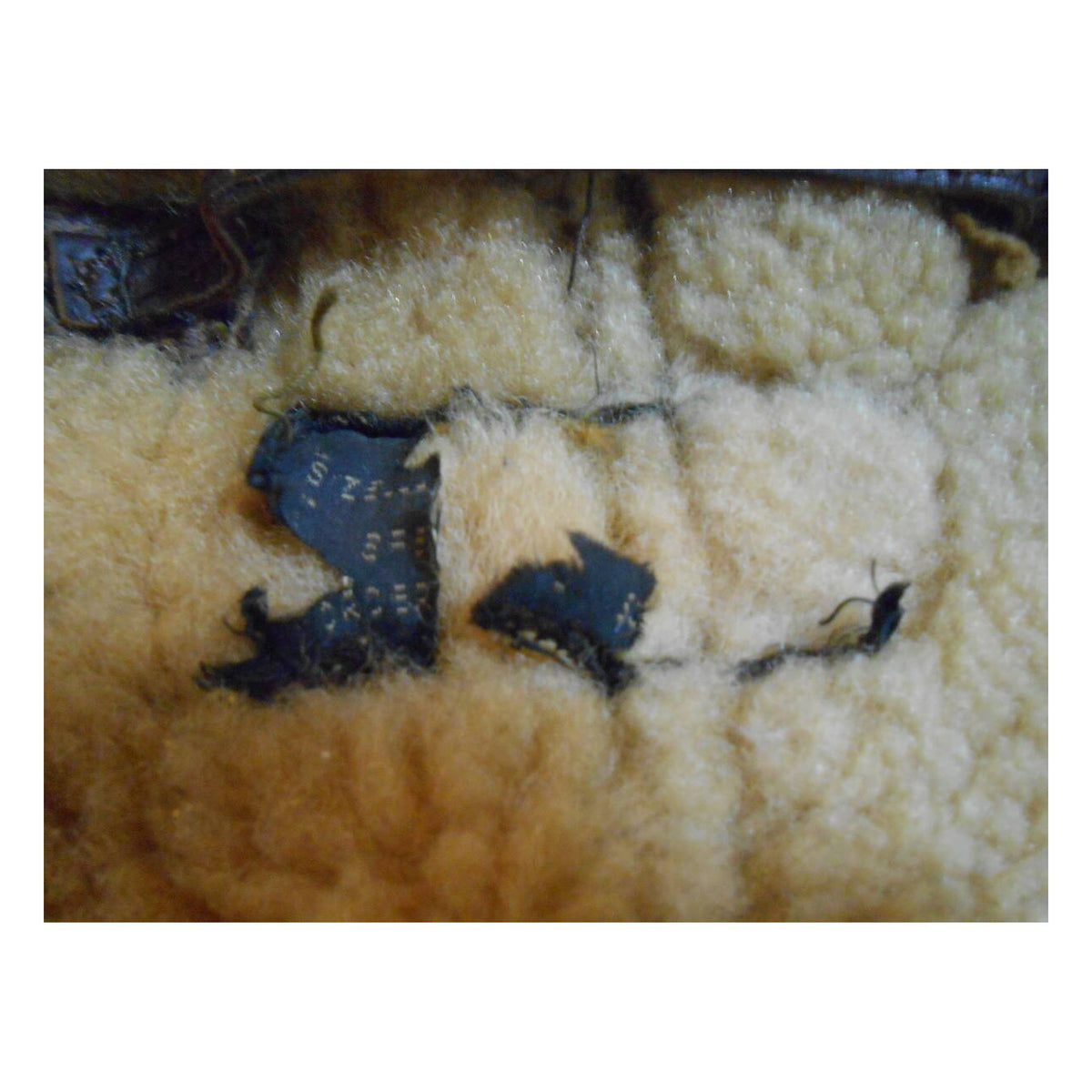
The previous owner described it as a D-1 prototype. We have found no published record of a prototype with these features, and the black woven label inside has largely disintegrated, leaving only scattered letters; maker, specification and contract cannot be read. Black labels of this kind are consistent with wartime Army Air Forces issue, but on their own they do not confirm the type. We therefore present it as a D-1 type variant of Second World War pattern, and invite any collector with a matching example or documentation to compare notes.
Variants of this kind are not surprising in wartime production. Dozens of contractors made sheepskin clothing for the Army Air Forces, materials were substituted as supplies allowed, and garments were modified in the field and by depots. A jacket that falls between the D-1 and the B-3 may reflect a particular contract, a depot alteration or a maker's own interpretation; without the label, we cannot say which.
Shearling in the Air War
Sheepskin was the original answer to the cold of unpressurised flight. The B-3 bomber jacket, the B-6 and the A-3 trousers kept crews of B-17s and B-24s alive at altitudes where the air fell to forty degrees below zero, and the painted surface of these garments, usually a seal or chocolate brown lacquer over the suede side, was meant to shed wind and moisture. That paint is also the first thing to age. With decades of flexing it crazes, flakes and lifts, and on many surviving sheepskins it has become a map of the jacket's working life.
By 1944 cloth jackets such as the B-10 and B-15 were taking over in the air, yet the shearling ground-crew and flight jackets remained in stores in enormous numbers when the war ended, and they would be called on again sooner than anyone expected.
Korea, 1950 to 1953
When war broke out in Korea in June 1950, the newly independent US Air Force and its United Nations partners were sent into some of the harshest winters any modern air arm had faced. Second World War clothing was widely reissued, and older sheepskins went back into service alongside newer patterns. Many of the men who flew and serviced aircraft over Korea were themselves veterans of the earlier war. We cannot document who wore this jacket, but its construction and its chit together tell the story of a WWII-pattern sheepskin carried into a second conflict.
Blood Chits, Messages to Strangers
A blood chit is a printed appeal carried by aircrew in case they came down among civilians who could not speak their language. The tradition reaches back to the American Volunteer Group in China, and in Korea it took the form of cloth panels printed with flags and a short message, frequently sewn straight onto the back of a flight jacket. Versions vary; some carry dragons and longer texts, and dealers note that some were printed locally in Korea or Japan.
The chit on this jacket shows the 48-star flag of the United States, correct for 1950 to 1953, together with the flags of the United Nations and the Republic of Korea, above Korean text in mixed hangul and hanja reading, in effect, 'This person is UN forces; let us all aid him'. It matches the documented English wording of the Korean War chit, 'This bearer is UN forces, let us aid them'. The panel shows age, pin holes and stitch marks consistent with long attachment. It has not been forensically examined, and reproduction Korean chits do exist, so we describe it as period-correct in appearance rather than certified.
Why Japan Collects Sheepskin
Japan's collectors have studied American flight clothing more closely than almost anyone, and the country was itself the rear base of the Korean War, the place where aircraft were repaired, crews rested and, quite possibly, chits like this one were printed. A WWII Army Air Forces shearling jacket that carries a Korean War blood chit therefore speaks to two chapters of history in which Japan was directly involved, which gives it a particular weight here.
There is also the matter of scale. Sheepskin jackets are bulky and heavy, and far fewer were kept by veterans than leather A-2s; many were worn out in service or discarded as the paint failed. A wartime-pattern example that survived two wars, with its chit still attached, is a small piece of history that would be difficult to assemble again.
The Piece
The jacket is a dark-brown painted sheepskin with a dense wool interior, a centre Talon zip that works smoothly, a chin strap at the collar and a hem tab. There are no side pockets. The shoulder yoke is panelled in a harder, smoother leather, and the yoke seams are angled front and back, the details that set this example apart from a typical D-1.
This is a working garment with a long life behind it. The painted surface has crazed and flaked extensively, the lower front shows several stitched and glued repairs, and the receiving side of the collar strap is missing. Worn, those repaired areas may open again; we see it first as a collector's study piece, with its blood chit as the focal point.
It fits roughly like a modern US 40 over a light knit, a Japanese L. For anyone who already owns an A-2 or a B-3 and wants a sheepskin that tells a two-war story, this is an honest, characterful example.
Details
- Type: Sheepskin (shearling) jacket, US Army Air Forces D-1 type variant
- Maker: Unknown; black woven label largely destroyed
- Contract / label: Black wartime-style label, illegible
- Era: Second World War pattern; Korean War blood chit, 1950 to 1953
- Leather / shell: Painted sheepskin, smoother leather reinforcement at the shoulder yoke
- Hardware: Talon zip; collar chin strap (receiver side missing)
- Lining & knits: Natural shearling wool interior; no knits
- Decoration: Korean War cloth blood chit with US 48-star, UN and Republic of Korea flags and Korean text
- Tagged size: Label illegible; fits about US 40 / Japanese L
- Measurements: Shoulder 52 cm · Chest (pit to pit) 59 cm · Sleeve 60 cm · Length 61 cm
Condition
- Extensive crazing and flaking of the painted surface
- Several stitched and glued repairs at the lower front
- Left (receiving) side of the collar strap missing
- Label largely destroyed; type not confirmed by label
- Blood chit aged, with pin and stitch holes; not forensically verified
- Talon zip works smoothly
Condition grade BC on the Japanese scale; see Japanese condition ranks, explained.
Authenticity & Care
The label, contract and size tags, leather, stitching, zip and hardware, paint and insignia are examined together and documented in Japan before dispatch; anything that cannot be confirmed is stated plainly in the description. Every piece carries the Japonista authenticity guarantee. Keep cool, dry and away from direct light, and avoid conditioning the painted surface without professional advice, as it may lift further.
Delivery from Japan
Packed by hand in Japan and shipped insured and tracked by EMS or an equivalent express service. Import duties and taxes, where applicable, are payable on arrival. Every sale is final; please ask anything before you buy, and see our published policy.
Every figure above is taken by hand with the garment laid flat, in centimetres. Lay a shirt or jacket you already love beside them and allow a centimetre or two of margin, the quiet safeguard on a final sale. Our size guide to tops and jackets turns pit-to-pit figures into US, UK, EU and Japanese sizes, and for anything it leaves open the curator team replies within one Tokyo business day.
Considered offers are welcome through Send an Offer, and each one is reviewed personally. Pieces over $1,000 may be reserved over several payments with Layaway Privilege™.
Continue browsing: Military Flight Jacket & Nose Art · Designer Leather Jackets · Japan Luxury Archive
Two conflicts, one garment
Searching for a documented Korean War flying jacket, or a D-1 with a named crewman? Our Hunting Salon™ locates a specific reference across Japan’s private collector circles, then inspects, documents and delivers it to you. Begin a Hunting Salon™ request →
Collectors also search: WWII D-1 sheepskin jacket · USAAF D-1 ground crew jacket · original D-1 shearling jacket · WWII sheepskin flight jacket Talon · Korean War blood chit jacket · UN blood chit flight jacket · Army Air Forces shearling jacket · vintage sheepskin bomber jacket 1940s · WWII D-1 jacket with Korean War blood chit · D-1 jacket no pockets variant Talon zip


Chosen for you