Rare Vintage, Antiques and Art Collector / Curator / Personal Shopper From Japan
Musuem Quality WWII USAAF A-2 Flight Jacket Spiewak Van Kirk Attributed Mischief Makers Nose Art Crown Zipper Leather Size 42
Musuem Quality WWII USAAF A-2 Flight Jacket Spiewak Van Kirk Attributed Mischief Makers Nose Art Crown Zipper Leather Size 42
Couldn't load pickup availability
Have a reasonable price in mind? Submit your best offer and our concierge will review it personally.
PROPERTY FROM A PRIVATE AVIATION COLLECTION
A Museum-Grade WWII U.S. Army Air Forces A-2 Flight Jacket Attributed to Navigator Theodore “Dutch” Van Kirk, Enola Gay Mission
Catalogue Note
There are garments… and then there are artifacts that hum with history.
This A-2 flight jacket stands at the threshold between the two, attributed to Theodore “Dutch” Van Kirk, navigator aboard the Enola Gay during the Hiroshima mission of August 6, 1945—one of the most consequential and controversial operations in modern history.
Constructed under Spiewak contract, the jacket exemplifies the classic wartime A-2 silhouette: seal brown horsehide, ribbed knit cuffs and waistband, and a utilitarian cut designed for high-altitude flight. Yet what elevates this piece beyond regulation issue is its deeply personal visual narrative—a living canvas of wartime identity.
The back is hand-painted with the evocative and rare “Mischief Makers” motif—featuring stylized cartoon figures riding a red bomb, rendered in a manner reminiscent of wartime nose art culture. Beneath it, a hand-applied American flag anchors the composition, grounding the piece in both patriotism and psychological symbolism. The front bears additional squadron-style artwork, including a vivid “Red Gremlin” motif, linking visually to the 340th Bomb Squadron lineage.
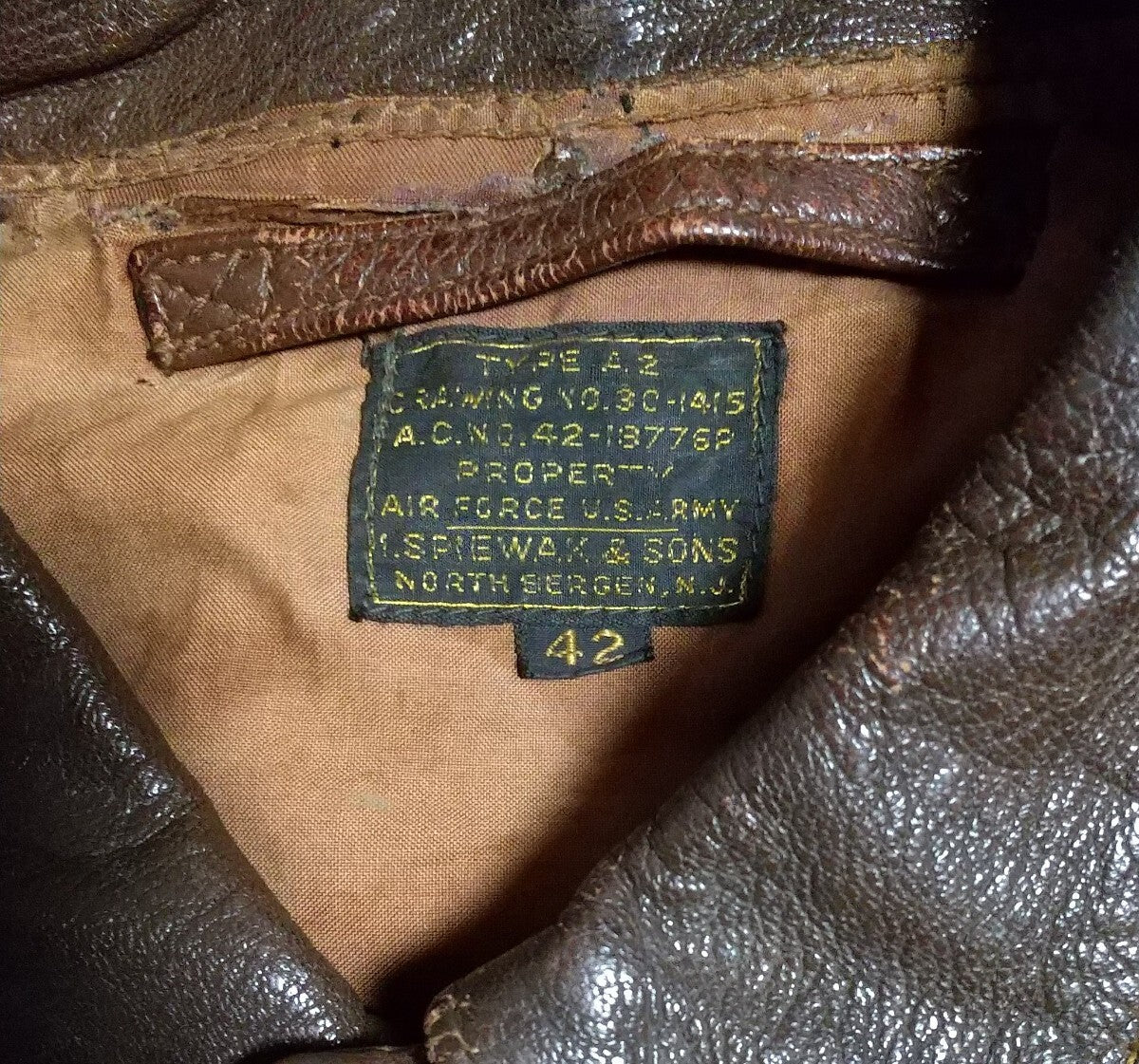
Above the chest sits a leather name strip reading “T. VAN KIRK”, accompanied by a period U.S. Army Air Forces wing insignia—subtly worn, yet unmistakably authentic in presence. These elements, together with the aged Crown zipper and original lining tag marked size 42, align with mid-war production characteristics.
Time has not been gentle—nor should it be. The jacket carries honest signs of service and age: fraying knit cuffs, lining wear at the collar, scattered staining, and surface patina across the leather. Yet these are not flaws—they are testaments. Each abrasion reads like a footnote in a chapter of aviation history.
Object Type: U.S. Army Air Forces Type A-2 Flight Jacket
Attributed Ownership: Theodore “Dutch” Van Kirk (Navigator, Enola Gay) ⚠️ Unverified Attribution
Contract / Maker: I. Spiewak & Sons
Contract Spec: W535 AC-27753 / similar wartime Spiewak run (label consistent)
Era: Circa 1942–1944 (Mid-WWII Production Window)
Material: Horsehide Leather (Vegetable-tanned wartime spec)
Color: Seal Brown (oxidized with age to warm chocolate tone)
Hardware: Crown zipper (period-correct, functioning)
Size Tag: 42
Chest Markings: Leather name strip “T. VAN KIRK” + USAAF wing device
Artwork (Front): Red Gremlin motif (340th Bomb Squadron visual language alignment)
Artwork (Back): “Mischief Makers” — bomb-riding cartoon trio (hand-painted nose art derivative)
Additional Back Element: Sewn American flag panel (post-issue or field addition likely)
Condition Class: Worn / Service-aged / Structurally intact
Micro Qualifiers (Lot Integrity Notes)
- Attributed example bearing “T. VAN KIRK” name strip
- Hand-painted “Mischief Makers” back art, period-consistent execution
- Crown zipper intact and operational, correct for era
- Spiewak contract production with original label retained
- Wartime A-2 configuration with authentic wear and field aging
- Collector-grade artifact with visual and narrative significance
Collector’s Perspective
To encounter a jacket of this nature is to stand before a material witness of history.
Whether one approaches it as a militaria collector, aviation historian, or cultural archivist, this piece transcends fashion entirely. It belongs to the rare category of objects that carry both provenance and mythology—where documentation meets legend, and cloth becomes chronicle.
The “Mischief Makers” artwork alone situates it within the elite tier of hand-painted WWII flight jackets, but the Van Kirk attribution elevates it into a different stratosphere—one tied to the atomic age’s origin moment.
This is not merely collectible.
This is conversation, controversy, and history stitched into leather.
Overview
This A-2 flight jacket is not merely a surviving garment—it is a story vessel, carrying layered narratives of wartime identity, artistic expression, and post-war mythmaking. Produced under Spiewak contract during the height of WWII, it embodies the rugged minimalism of USAAF-issued gear, later transformed into a personal canvas through hand-applied imagery.
Iconography (Expanded Analysis)
The “Mischief Makers” back artwork belongs to a rare class of informal wartime visual language—a blend of humor, fatalism, and coded bravado. Cartoon characters riding bombs were not accidental whimsy; they functioned as psychological armor, softening the brutal reality of bombing missions.
The Red Gremlin motif on the chest aligns with known WWII squadron art traditions—particularly within bomber groups that adopted mischievous or devilish mascots. These figures often symbolized chaos controlled, danger embraced.
The American flag addition appears slightly later in execution, possibly applied as a reinforcing identity marker during or after service.
Material & Construction
The horsehide retains its structural integrity, showing natural grain cracking and patina consistent with mid-century oxidation. Unlike modern reproductions, this leather breathes history—its surface reflecting decades of environmental exposure.
Key structural elements:
- Original knit waistband and cuffs (heavily worn, repaired)
- Wartime stitch density and seam placement intact
- Crown zipper (critical authenticity indicator)
- Interior lining with expected collar degradation
Historical Context (Expanded)
The A-2 jacket was discontinued in 1943, making surviving examples part of a narrow production window. Pilots and crew often personalized their jackets during deployment, creating one-of-a-kind pieces that served both as identity markers and morale boosters.
The Van Kirk attribution ties this jacket to one of the most pivotal missions in history—the Hiroshima bombing. Even as an unverified claim, the narrative connection injects immense gravity into the piece.
Collector Relevance (Strategic Layer)
This jacket operates across three collector archetypes simultaneously:
- Militaria Collectors — seeking authenticity and wartime integrity
- Art Collectors — drawn to hand-painted originality
- Narrative Collectors — captivated by the Van Kirk story
This triple-axis appeal dramatically increases liquidity and storytelling leverage.
Summary
A rare intersection of military artifact, wearable art, and historical myth. Whether approached as a genuine relic or a narrative-driven collectible, this A-2 commands attention far beyond its material form.
Authenticity & Stewardship
Evaluated under the Japonista Aviation & Military Garment Authentication Framework™
Each work is examined through a structured, multi-layered assessment:
• Model classification and military typology verification (A-2, B-3, MA-1, G-1, L-2, etc.)
• Material evaluation across leather, shearling, nylon, wool, and mixed components
• Hardware inspection including zippers, snaps, and period-correct fastenings
• Graphic and nose art analysis, including paint method, iconography, and historical alignment
• Condition and structural integrity review, including wear patterns consistent with age and use
Where applicable, contract labels, manufacturer markings, and period construction details are reviewed to confirm authenticity and era alignment.
Guaranteed 100% Authentic.
All garments are curated and backed by the Japonista Lifetime Authenticity Warranty™, with emphasis on both material truth and historical accuracy.
A Note on Flight Jackets, Service & Visual Identity
Military flight jackets were engineered as functional equipment—designed for temperature regulation, durability, and survival in demanding conditions. Over time, they evolved into carriers of identity, memory, and personal expression.
Nose art and painted jackets—originally applied to aircraft and later to garments—represent a distinct form of visual folklore. Pin-up figures, squadron insignia, mascots, and symbolic imagery transformed standard-issue equipment into individualized statements of presence and morale.
At Japonista, these jackets are approached as wearable military artifacts. Surface wear, leather creasing, paint aging, and textile fatigue are evaluated as evidence of lived history rather than imperfection.
We preserve these works with restraint—allowing their material narrative to remain visible and intact.
Our role is to connect these garments with collectors who recognize their dual nature as both functional objects and historical documents.
Inquiries, Availability, and Private Consideration
Many flight jackets are singular in character due to condition, paintwork, contract variation, or production era. Certain pieces are held firmly due to rarity, historical resonance, or preservation status.
All inquiries are handled discreetly, and we welcome thoughtful discussion regarding provenance, contract details, nose art interpretation, and long-term wear or display considerations.
Collectors building focused archives—by model type, era, or graphic style—may consult with us for deeper guidance.
Concierge Support & Collector Guidance
Japonista Concierge™ provides tailored assistance for collectors seeking deeper engagement with aviation garments:
• Model and contract identification (A-2 variants, G-1 lineage, MA-1 evolution)
• Leather and textile preservation guidance
• Paint conservation and display considerations
• Wearability versus archival preservation assessment
• Strategic acquisition planning for aviation-focused collections
For select rare or historically significant works, private reservation or structured acquisition arrangements may be available on a case-by-case basis.
Before Proceeding
We encourage collectors to review our shop policies and house guidelines, available through the links in our website footer. These outline shipping protocols, handling considerations, and condition standards specific to vintage leather, painted garments, and military-issued clothing.
Understanding these guidelines supports responsible stewardship of each piece.
A Closing Note
Flight jackets occupy a distinct place within material history. They are objects of function shaped by environment, and over time, transformed into records of identity, service, and expression.
Nose art—whether applied to aircraft or garments—extends this narrative, capturing moments of humor, defiance, and individuality within structured military life.
At Japonista, we steward these works as aviation artifacts in wearable form—ensuring they continue their journey with collectors who understand both their construction and their story.
If you have questions or wish to explore related items, please feel free to contact Japonista Concierge™ at any time.