Rare Vintage, Antiques and Art Collector / Curator / Personal Shopper From Japan
WWII German Luftwaffe Leather Flight Jacket Private Purchase Aviator Coat Kid Leather Vintage
WWII German Luftwaffe Leather Flight Jacket Private Purchase Aviator Coat Kid Leather Vintage
Couldn't load pickup availability
Have a reasonable price in mind? Submit your best offer and our concierge will review it personally.
A GERMAN WARTIME LEATHER AVIATION JACKET OF LUFTWAFFE ASSOCIATION, CIRCA SECOND WORLD WAR
Private-purchase or privately tailored example in fine dark leather with double-breasted front, mixed lining construction, and strong period character
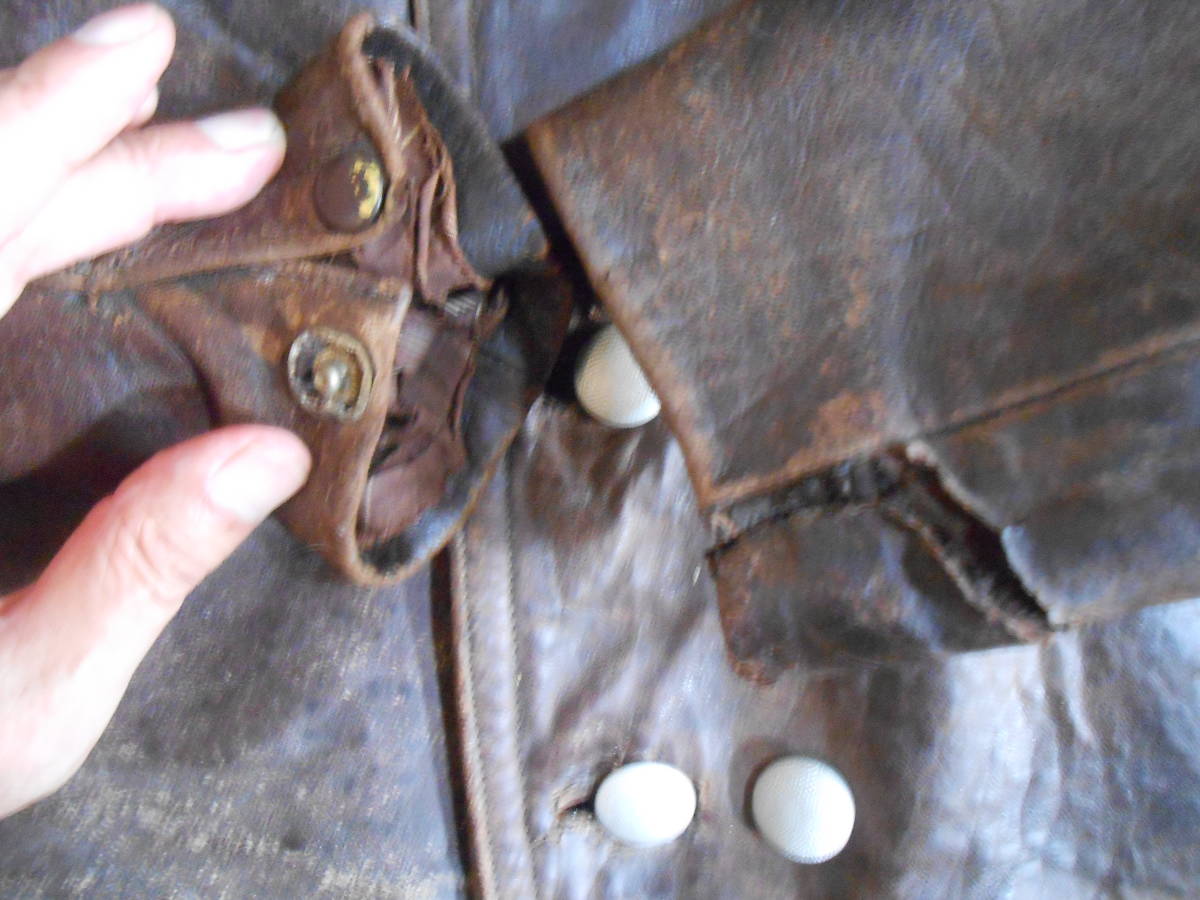
A dark leather aviation-associated jacket of German wartime character, constructed with a double-breasted front, four flap pockets, broad lapel collar, and mixed internal lining comprising a brown moleskin body and striped sleeve fabric. The leather has aged with notable suppleness and visual depth, while the overall cut suggests private-purchase or privately tailored military use rather than strict standardized issue. The neck label has been removed, and a partially unreadable internal cloth strip survives beneath the interior pocket area. Localized wear includes small surface splits, edge fatigue, and lining tears, though the garment remains structurally persuasive and historically resonant. The present example is best understood as a strong Luftwaffe-associated wartime leather from the difficult but fertile territory where military aviation history meets private tailoring and personal acquisition.
Object
German leather flight / aviator jacket, Luftwaffe-associated type
Origin
Germany
Production Era
WWII period
Category
Private-purchase or privately tailored wartime aviation leather jacket with Luftwaffe attribution
Material
Dark seal-brown to near-blackened brown leather, reading as fine kid or very refined lightweight goatskin class
Body lining in brown moleskin-type cotton
Sleeve lining in striped cotton / linen-type fabric
Button-front double-breasted closure system with reversible left-right fastening capability
Construction Features
- broad notched lapel / fold-back collar geometry
- double-breasted front with bright buttons
- four flap pockets
- inner leather-faced breast / utility pocket structure
- mixed-fabric lining strategy
- slim, shaped body line closer to private tailoring than mass-standardized utility issue
Size
Approx. US / UK 40
Japanese L range
Measured Fit
Shoulder: approx. 44 cm
Chest: approx. 51 cm
Sleeve: approx. 63 cm from shoulder / 45 cm from underarm
Length: approx. 59 cm
Condition Summary
Overall leather remains supple and visually alive
Tag removed at neck
Unreadable internal name / cloth strip remains under interior pocket area
Localized sleeve-end lining tears
Small leather surface split at left cuff area
Surface crack / split at upper left body panel
Localized leather surface lift / peel at right sleeve root area
General age wear, marks, and use-consistent fatigue throughout
Still reads as a coherent historical garment rather than a dead relic
Object Classification
Not a guaranteed regulation-issue uniform jacket
Not a generic motorcycle coat
A wartime German aviation-associated private-purchase leather with strong Luftwaffe plausibility and high material presence
COLLECTOR RELEVANCE
Tier: Private-Purchase Wartime Aviation Leather / Advanced Connoisseur Category
This piece is for:
- collectors of wartime German aviation clothing
- buyers comfortable with private-purchase ambiguity
- material-first militaria collectors
- archive builders who prioritize cut, shell, and internal logic over label certainty
- advanced vintage leather collectors who understand continental wartime tailoring
This piece is not for:
- buyers who require unquestioned regulation proof
- novice militaria collectors seeking easy category reassurance
- fashion-only buyers who want clean modern wear without responsibility
- anyone expecting simplified “Luftwaffe equals guaranteed issue” logic
This is for the collector who knows that the most convincing wartime garments are sometimes the ones that resist simple cataloging.
CONFIDENCE & VERIFICATION NOTES
Strong positives
- WWII-period German character is materially persuasive
- leather quality supports a private-purchase aviation reading
- double-breasted structure is strong and coherent
- lining strategy is highly convincing
- shell remains alive and visually powerful
- size sits in a commercially healthy range
A Jacket From the Grey Zone Where Private Purchase Becomes Military History
The strongest German wartime leather garments often do not behave like neat, standardized issue pieces. That is precisely what makes them difficult and valuable. Unlike American A-2 collecting, where contract logic and spec familiarity dominate the conversation, German aviation leather exists in a more unstable and more interesting field. Private purchase, regional manufacture, officer tailoring, civilian workshop influence, and wartime adaptation all overlap.
This jacket lives in that overlap.
That is the first thing that must be understood clearly. Its value does not depend on pretending to be a perfect regulation artifact. Its value comes from the fact that it looks and feels like the kind of wartime German aviation leather that private means, private tailoring, and private acquisition would produce.
That distinction is not a compromise. It is the category.
Why the Double-Breasted Front Matters
The front closure is the first major signal that this is not a generic copy of Allied flight-jacket logic. The left-right fastening capability, broad lapel geometry, and pocket arrangement place the jacket much closer to continental European tailoring culture and to the wartime German habit of hybridizing function with personal purchase.
This is important because it keeps the object from collapsing into simplistic comparison. It is not useful to call this “Germany’s A-2.” The structure says otherwise. The stance is longer, sharper, more tailored, and more urban in silhouette even while remaining clearly designed for hard use.
That is exactly the kind of tension that makes these jackets memorable.
The Leather Quality Is the Quiet Argument
One of the most persuasive details here is the skin itself. The leather does not read coarse or overly heavy. It reads finer, more refined, and more elegant than many rougher military utility leathers of the period. That aligns with the long-standing collector understanding that many German private-purchase aviation garments were made to a higher finish standard than standard-issue mass utility wear.
This matters because the object is not winning by insignia or drama. It is winning by material confidence.
The shell shows:
- a denser, smoother elegance
- supple rather than board-stiff age
- a dark seal-brown finish that has deepened with time
- enough retained softness to keep the garment alive
That is a much better place to be than “rare but dead.”
Moleskin Body, Striped Sleeve Lining, and the Intelligence of Construction
The lining strategy is one of the garment’s strongest forensic points. The brown body lining and striped sleeve lining suggest practical, mixed-material tailoring rather than a one-fabric factory monotony. That kind of material economy combined with structural thought is highly persuasive in wartime continental garments, especially where private tailoring or semi-bespoke workshop logic may be involved.
The striped sleeve lining is especially valuable because it feels correct in the way a good internal detail should:
not decorative,
not trying too hard,
just materially plausible.
These are the kinds of clues that make a difficult jacket stronger.
The Removed Neck Label Is a Loss, But Also a Familiar One
The missing neck label matters because it removes the easiest path to certainty. But it does not automatically weaken the piece into irrelevance. In fact, wartime German garments often force a different kind of reading. You do not always get the neat archival answer. You get:
- shell
- lining
- cut
- build logic
- wear pattern
- internal traces
That is what we have here.
The surviving unreadable inner cloth strip under the pocket area is also important. Even though it is no longer legible, it confirms that the object once carried internal ownership or maker-related identity. It supports the reading of the garment as real historical clothing rather than theatrical invention.
Motorcycle Influence Without Becoming Merely a Motorcycle Jacket
It is true that wartime German leathers and continental motorcycle jackets often share visual language. But this piece does not flatten into simple motorcycle wear. The difference is in the total body of the object:
- the air of aviation rather than street utility
- the quality of leather
- the pocket grammar
- the internal lining choices
- the overall tonal seriousness of the cut
It is best read as a jacket born in a world where motorcycle design and aviation needs were still exchanging ideas, but where this specific object leans convincingly toward aviation-associated wartime use.
That is the more intelligent reading.
Condition and Why This Jacket Still Works
There are surface splits, edge stress, lining tears, and localized peeling. None of that should be minimized. But none of it destroys the piece either. The reason is simple: the shell still has authority. The object still stands up as a garment, still reads correctly, and still preserves its category identity.
Collectors often mistake condition for value in a linear way. But with wartime garments like this, that is too simple. The better question is:
Does the damage erase the object’s meaning, or does the meaning survive through the damage?
Here, it survives.
That is enough.
Why the Current Ask Is Interesting
At ¥120,000, the jacket is being priced in a band where uncertainty is still outweighing connoisseurship. That is exactly where some of the best private-purchase military garments live. The market is comfortable paying aggressively when everything is explicit. It becomes much more cautious when the garment demands interpretation.
This jacket demands interpretation.
For casual buyers, that is a problem.
For advanced buyers, that is often where the value begins.
MATERIAL FORENSICS
Leather Shell
The leather remains the major strength of the garment. It shows age, but not collapse. There is enough retained flexibility and enough clean surface continuity to keep the piece in the zone of historical usability rather than dead display-only fragility.
Points that matter:
- shell still hangs correctly
- broad panels remain coherent
- wear reads as historical, not destructive chaos
- surface tone remains deep and attractive
This is a shell that still persuades.
Front Closure and Buttons
The bright buttons create a strong front rhythm and reinforce the double-breasted identity. Their presence helps the jacket avoid visual sag. Once these structures go incomplete, garments like this lose authority fast. Here, the front still reads properly.
Lining
The lining is both informative and practical. The body moleskin adds weight and seriousness, while the striped sleeve lining provides a more workshop-like internal signature. Wear exists, especially at sleeve ends, but the interior still communicates its construction logic clearly.
Damage Zones
The small surface split at the left cuff, the upper-left body crack, and the right sleeve-root peeling all matter, but they remain localized. None of them currently overturns the garment’s total reading. They are the kind of flaws that should be watched, not the kind that erase the object.
Label Loss
The missing neck label is the largest documentary weakness. But the jacket is strong enough physically that the absence becomes a boundary of certainty rather than a collapse of meaning.
Authenticity & Stewardship
Evaluated under the Japonista Aviation & Military Garment Authentication Framework™
Each work is examined through a structured, multi-layered assessment:
• Model classification and military typology verification (A-2, B-3, MA-1, G-1, L-2, etc.)
• Material evaluation across leather, shearling, nylon, wool, and mixed components
• Hardware inspection including zippers, snaps, and period-correct fastenings
• Graphic and nose art analysis, including paint method, iconography, and historical alignment
• Condition and structural integrity review, including wear patterns consistent with age and use
Where applicable, contract labels, manufacturer markings, and period construction details are reviewed to confirm authenticity and era alignment.
Guaranteed 100% Authentic.
All garments are curated and backed by the Japonista Lifetime Authenticity Warranty™, with emphasis on both material truth and historical accuracy.
A Note on Flight Jackets, Service & Visual Identity
Military flight jackets were engineered as functional equipment—designed for temperature regulation, durability, and survival in demanding conditions. Over time, they evolved into carriers of identity, memory, and personal expression.
Nose art and painted jackets—originally applied to aircraft and later to garments—represent a distinct form of visual folklore. Pin-up figures, squadron insignia, mascots, and symbolic imagery transformed standard-issue equipment into individualized statements of presence and morale.
At Japonista, these jackets are approached as wearable military artifacts. Surface wear, leather creasing, paint aging, and textile fatigue are evaluated as evidence of lived history rather than imperfection.
We preserve these works with restraint—allowing their material narrative to remain visible and intact.
Our role is to connect these garments with collectors who recognize their dual nature as both functional objects and historical documents.
Inquiries, Availability, and Private Consideration
Many flight jackets are singular in character due to condition, paintwork, contract variation, or production era. Certain pieces are held firmly due to rarity, historical resonance, or preservation status.
All inquiries are handled discreetly, and we welcome thoughtful discussion regarding provenance, contract details, nose art interpretation, and long-term wear or display considerations.
Collectors building focused archives—by model type, era, or graphic style—may consult with us for deeper guidance.
Concierge Support & Collector Guidance
Japonista Concierge™ provides tailored assistance for collectors seeking deeper engagement with aviation garments:
• Model and contract identification (A-2 variants, G-1 lineage, MA-1 evolution)
• Leather and textile preservation guidance
• Paint conservation and display considerations
• Wearability versus archival preservation assessment
• Strategic acquisition planning for aviation-focused collections
For select rare or historically significant works, private reservation or structured acquisition arrangements may be available on a case-by-case basis.
Before Proceeding
We encourage collectors to review our shop policies and house guidelines, available through the links in our website footer. These outline shipping protocols, handling considerations, and condition standards specific to vintage leather, painted garments, and military-issued clothing.
Understanding these guidelines supports responsible stewardship of each piece.
A Closing Note
Flight jackets occupy a distinct place within material history. They are objects of function shaped by environment, and over time, transformed into records of identity, service, and expression.
Nose art—whether applied to aircraft or garments—extends this narrative, capturing moments of humor, defiance, and individuality within structured military life.
At Japonista, we steward these works as aviation artifacts in wearable form—ensuring they continue their journey with collectors who understand both their construction and their story.
If you have questions or wish to explore related items, please feel free to contact Japonista Concierge™ at any time.