Rare Vintage, Antiques and Art Collector / Curator / Personal Shopper From Japan
WWII Bronco A-2 Flight Jacket Red Raiders Back Paint USAAF Leather Size 40 42 WW2 Vintage
WWII Bronco A-2 Flight Jacket Red Raiders Back Paint USAAF Leather Size 40 42 WW2 Vintage
Couldn't load pickup availability
Have a reasonable price in mind? Submit your best offer and our concierge will review it personally.
A U.S. ARMY AIR FORCES TYPE A-2 FLIGHT JACKET BY BRONCO MFG. CO., WITH SURVIVING “RED RAIDERS” BACK PAINT
Original WWII shell retaining contract label, patch-history ghosts, and significantly weathered squadron-art decoration; a strong wearer-collector example outside full-original purity
An original Type A-2 flight jacket produced by Bronco Mfg. Co. of New York, retaining its wartime contract label and surviving chest insignia, and further distinguished by a heavily worn but still legible painted reverse composition headed “RED RAIDERS.” The leather shell exhibits broad use-related abrasion and age, while remaining structurally expressive and visually coherent. Patch-removal traces remain visible at the chest and shoulders, contributing to the jacket’s layered service history. The lining, zipper, and knit trim have been replaced, moving the jacket away from strict archive purity but preserving usability and silhouette. The present example is best understood as a wearer-collector WWII A-2, deriving its significance from the continued life of the original shell, label, and painted identity rather than from untouched completeness.
Object
U.S. Army Air Forces Type A-2 Flight Jacket with back paint
Brand / Maker
Bronco Mfg. Co.
New York, N.Y.
Production Era
WWII period
Contract / Label Data
Type A-2
Drawing No. 30-1415
Order No. 42-18775-P
Property Air Forces U.S. Army
Bronco Mfg. Co.
New York, N.Y.
Category
Original WWII A-2 shell with later restoration / replacement components and surviving period-style squadron art
Material
Original leather shell, wartime horsehide / heavy smooth-finished hide class reading
Later replacement lining
Later replacement rib knits
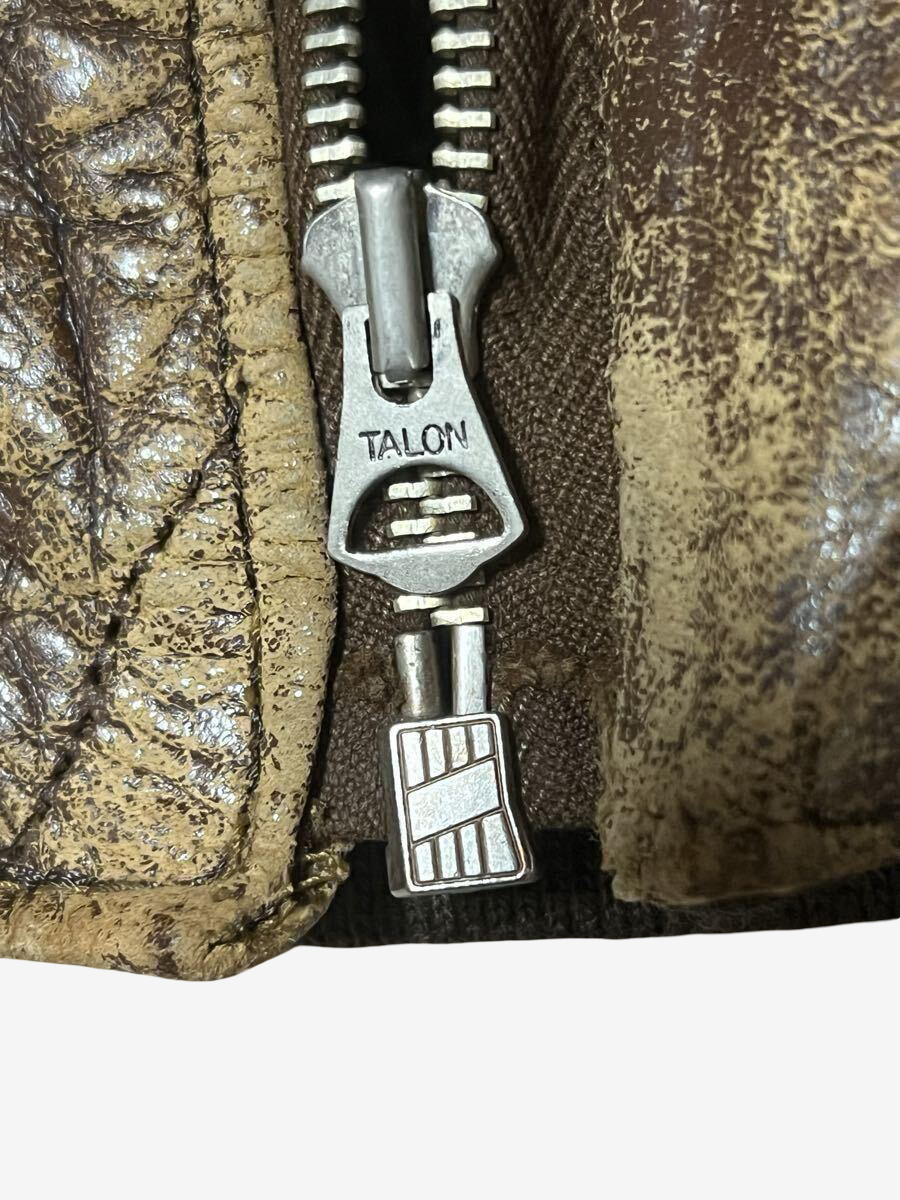
Replacement zipper
Style Basis
Standard A-2 configuration:
- snap-down collar
- front patch pockets
- zip front
- ribbed cuffs and waistband
- short waist-length military flight silhouette
Patch / Decoration Context
Front:
- surviving circular chest insignia patch with stylized yellow bird motif
- visible stitch ghosts / removal evidence at chest and both shoulders indicating earlier patch history
Back:
- heavily worn red-painted squadron-style composition
- readable top line: RED RAIDERS
- central painted graphic now significantly abraded but still visually present
- lower painted text remains partially legible through wear
Size / Fit
Actual fit reads approximately 40–42 class
Measured:
- chest 56 cm
- shoulder 47 cm
- sleeve 63 cm from shoulder
- length 63 cm
Condition Summary
Leather shell shows strong age, broad abrasion, and major field character, especially across sleeves and back
Paint significantly worn but not erased
Patch ghosts remain and materially improve the jacket’s service history reading
Zipper, lining, and knit trim replaced
Leather still reads soft and alive rather than dead or glassy
Overall object remains highly compelling because its value is anchored in shell, label, and art survival rather than in untouched originality
Object Classification
Not a full-original archive specimen
Not merely a beater with paint
A wearer-collector WWII A-2 with authentic shell life and surviving squadron-art identity
COLLECTOR RELEVANCE
Tier: Wearer-Collector Painted A-2 / Smart Entry Band
This piece is for:
- collectors who want a real WWII painted A-2 without paying top purity premiums
- Bronco contract buyers willing to trade originality for usability
- back-paint collectors who value survival and atmosphere over pristine graphics
- wearer-collectors who still want authentic WWII shell and label authority
This piece is not for:
- strict full-original purists
- museum-level component fetishists
- buyers who need perfectly readable art
- collectors who cannot tolerate replacement trim and lining
This is for the buyer who understands that some of the best military jackets live in the middle ground:
original where it matters most, changed where life demanded it.
CONFIDENCE & VERIFICATION NOTES
Strong positives
- Bronco contract label intact and readable
- shell remains compelling and alive
- “RED RAIDERS” back art still materially legible
- patch ghosts enhance rather than weaken service history
- fit sits in a commercially healthy band
CURATORIAL ANALYSIS
A Jacket Whose Value Lives in Survival, Not Purity
The first thing to say clearly is that this is not an untouched collector’s dream. The zipper, knits, and lining have already crossed out the archive-purist lane. That matters, but it is not the end of the conversation. In fact, for the right buyer, it creates a different and more practical category: the original WWII A-2 that can still be handled, worn carefully, and understood as an object with continued life rather than sealed fragility.
That is the threshold.
Once that is understood, the jacket stops being judged against perfect-contract fantasy and starts being judged on the things that now matter most:
- shell integrity
- contract legitimacy
- surviving patch history
- back-paint presence
- overall visual authority
By those standards, it becomes much stronger.
Why The Bronco Label Still Matters
Bronco is not a filler name. It is one of the makers that collectors instantly recognize as belonging to the real wartime contractor conversation. The intact label does important work here because the jacket has already lost purity in other areas. Once knits, lining, and zipper move out of full-original territory, the contract label becomes even more valuable. It anchors the shell and protects the jacket from drifting into vague “old painted leather jacket” territory.
Here, the label is not decoration. It is proof of category.
That matters because the piece needs one absolutely firm point of authority.
It has one.
The Shell Is Still Carrying the Piece Properly
The leather is where this jacket either lives or dies, and fortunately it still lives.
This is not a shell that has gone chalky, dead, or cardboard-stiff. It shows broad abrasion and high wear, yes, but it still has surface life and body. The sleeves in particular show the kind of pale high-contact wear that, on a weak jacket, would feel destructive. Here it instead reads as history written into a still-coherent surface.
That distinction is essential.
There is a big difference between:
- leather that has aged
and - leather that has failed
This jacket belongs to the first category.
The Back Paint Is Worn, But That Is Not the Same Thing as Gone
The back is the center of gravity, even in this heavily aged state. “RED RAIDERS” still announces itself at the top. The central figure is abraded, but still materially visible. Lower text and graphic traces survive enough to tell the eye that this was once a fully declarative squadron-art composition rather than a casual doodle.
This matters because many damaged painted jackets collapse into pure suggestion. This one does not. It remains legible as a painted military object.
In other words:
the art is no longer pristine,
but it still controls the jacket’s identity.
That is enough.
Why Worn Paint Can Sometimes Be Better Than Pretty Paint
There is a temptation in the market to overvalue clarity and undervalue truth. Some painted jackets survive with bright, readable art, and those are easy to love. But heavily worn art can have a different power, especially when the shell beneath is still persuasive. The abrasion here is doing two things at once:
- confirming age and use
- merging the painting into the jacket rather than leaving it as a separate surface
That is why the back still feels serious. It does not read like paint sitting on leather. It reads like paint that has lived with the leather for a long time.
That kind of merger creates emotional weight.
Patch Ghosts and Removed History
The front and shoulders are critically important. The stitch ghosts and patch-removal traces prove the jacket used to carry more identity than it does now. This is not a blank shell with one surviving chest insignia. It is a jacket with missing chapters still visible in outline.
For collectors, that kind of partial loss often adds depth rather than subtracting it. It means the object has not been staged into neatness. It has passed through real use, change, removal, and reduction. In other words, it has had a life.
The surviving bird insignia on the chest helps because it prevents the front from going silent. It preserves just enough emblematic force to keep the chest active while the ghost marks whisper what is gone.
That combination is excellent.
Replacement Components and the Correct Way to Read Them
The replaced zipper, replaced knits, and replaced lining move the jacket permanently out of full-original territory. That needs to be said plainly. But they also make another truth possible: the jacket has been preserved in a way that keeps the shell operational and the silhouette intact.
The question is not whether this is ideal for a museum purist. It is not.
The question is whether these changes destroy the jacket’s value. They do not.
Why not?
Because what is still original and valuable is exactly what buyers most remember:
- the contract shell
- the label
- the squadron-art back
- the patch history
- the body line
For a wearer-collector, this can actually be preferable to a fully original but structurally fragile example.
Fit and Body Compatibility
The fit is strong. The measured chest and shoulder place it in the range where modern buyers can still actually inhabit the jacket rather than just admire it. That matters enormously in the market. A painted WWII A-2 with real body compatibility is automatically more liquid than a tiny, stiff, visually dead original.
This piece can still sit on a person convincingly.
That increases its relevance.
Why The Current Ask Looks Light
At ¥300,000, the jacket is not being fully paid for as a painted Bronco A-2. It is being discounted for the replacements and the wear. That is understandable, but not the whole truth. Because once a collector sees past the purity loss, they are looking at a real contract shell with surviving squadron art and market-friendly fit.
That is a stronger package than the number suggests.
This is not a top-band piece.
But it is very likely a smart-band piece.
MATERIAL FORENSICS
Shell
The shell remains the real asset. Abrasion is pronounced, especially in high-contact zones, but the leather still reads flexible, broad, and coherent. It does not appear chemically overdone or posthumously stiff. That is why the jacket still has collector dignity despite component changes.
Points that matter:
- shell still holds form
- wear pattern feels natural and layered
- no immediate read of catastrophic dryness
- back paint and shell have aged together convincingly
Back Paint
The paint has moved into attritional survival mode. It is no longer display-clean, but that does not remove its importance. The top lettering, central red figure, and lower field still survive enough to make the reverse the jacket’s controlling event.
This is not decorative residue.
It is diminished but still active history.
Patch History
Ghost marks at chest and shoulders create a better front than a purely blank one would. Even where information is gone, its absence still functions as evidence. For military jackets, absence often reads just as strongly as presence if the object is honest enough.
This one is.
Knits and Lining
These are replacements and should be treated as such. Their job now is not purity but support. They preserve the waist line, restore usability, and keep the shell from collapsing into unusable relic status. For the right buyer, that is a rational trade.
Zipper
The replaced zipper similarly serves continuity rather than strict originality. The jacket remains enterable, wearable, and structurally coherent because of it. Again: not archive-pure, but market-useful.
Authenticity & Stewardship
Evaluated under the Japonista Aviation & Military Garment Authentication Framework™
Each work is examined through a structured, multi-layered assessment:
• Model classification and military typology verification (A-2, B-3, MA-1, G-1, L-2, etc.)
• Material evaluation across leather, shearling, nylon, wool, and mixed components
• Hardware inspection including zippers, snaps, and period-correct fastenings
• Graphic and nose art analysis, including paint method, iconography, and historical alignment
• Condition and structural integrity review, including wear patterns consistent with age and use
Where applicable, contract labels, manufacturer markings, and period construction details are reviewed to confirm authenticity and era alignment.
Guaranteed 100% Authentic.
All garments are curated and backed by the Japonista Lifetime Authenticity Warranty™, with emphasis on both material truth and historical accuracy.
A Note on Flight Jackets, Service & Visual Identity
Military flight jackets were engineered as functional equipment—designed for temperature regulation, durability, and survival in demanding conditions. Over time, they evolved into carriers of identity, memory, and personal expression.
Nose art and painted jackets—originally applied to aircraft and later to garments—represent a distinct form of visual folklore. Pin-up figures, squadron insignia, mascots, and symbolic imagery transformed standard-issue equipment into individualized statements of presence and morale.
At Japonista, these jackets are approached as wearable military artifacts. Surface wear, leather creasing, paint aging, and textile fatigue are evaluated as evidence of lived history rather than imperfection.
We preserve these works with restraint—allowing their material narrative to remain visible and intact.
Our role is to connect these garments with collectors who recognize their dual nature as both functional objects and historical documents.
Inquiries, Availability, and Private Consideration
Many flight jackets are singular in character due to condition, paintwork, contract variation, or production era. Certain pieces are held firmly due to rarity, historical resonance, or preservation status.
All inquiries are handled discreetly, and we welcome thoughtful discussion regarding provenance, contract details, nose art interpretation, and long-term wear or display considerations.
Collectors building focused archives—by model type, era, or graphic style—may consult with us for deeper guidance.
Concierge Support & Collector Guidance
Japonista Concierge™ provides tailored assistance for collectors seeking deeper engagement with aviation garments:
• Model and contract identification (A-2 variants, G-1 lineage, MA-1 evolution)
• Leather and textile preservation guidance
• Paint conservation and display considerations
• Wearability versus archival preservation assessment
• Strategic acquisition planning for aviation-focused collections
For select rare or historically significant works, private reservation or structured acquisition arrangements may be available on a case-by-case basis.
Before Proceeding
We encourage collectors to review our shop policies and house guidelines, available through the links in our website footer. These outline shipping protocols, handling considerations, and condition standards specific to vintage leather, painted garments, and military-issued clothing.
Understanding these guidelines supports responsible stewardship of each piece.
A Closing Note
Flight jackets occupy a distinct place within material history. They are objects of function shaped by environment, and over time, transformed into records of identity, service, and expression.
Nose art—whether applied to aircraft or garments—extends this narrative, capturing moments of humor, defiance, and individuality within structured military life.
At Japonista, we steward these works as aviation artifacts in wearable form—ensuring they continue their journey with collectors who understand both their construction and their story.
If you have questions or wish to explore related items, please feel free to contact Japonista Concierge™ at any time.