Rare Vintage, Antiques and Art Collector / Curator / Personal Shopper From Japan
Vintage WWII WW2 A-2 Flight Jacket Poughkeepsie Horsehide Queen Of Tarts Pin Up Painted Varnished
Vintage WWII WW2 A-2 Flight Jacket Poughkeepsie Horsehide Queen Of Tarts Pin Up Painted Varnished
Couldn't load pickup availability
Have a reasonable price in mind? Submit your best offer and our concierge will review it personally.
A WWII U.S. ARMY AIR FORCES A-2 FLIGHT JACKET BY POUGHKEEPSIE, WITH “QUEEN OF TARTS” PIN-UP DECORATION
Exceptional example featuring varnish-preserved painted surface and professional-grade figure execution; a rare intersection of aviation garment and fine art practice
A horsehide A-2 flight jacket produced by Poughkeepsie Leather Coat Co., the reverse painted with a large-scale pin-up composition titled “Queen Of Tarts,” depicting a reclining female figure framed by playing cards and accompanied by a lower register of bomb tally motifs. The painted surface has been sealed with a varnish coating, preserving the original coloration while producing an extensive crack network across the composition, imparting a visually layered patina akin to aged fine art surfaces. The leather remains supple, with localized wear consistent with period use, and the original knit waistband survives with moderate age-related distress. The present example stands as a highly compelling artifact within the category of painted A-2 jackets, distinguished by both the quality of execution and the unusual preservation method.
Object
A-2 Flight Jacket (Back-Painted Pin-Up Variant)
Origin
United States Army Air Forces
Manufacturer
Poughkeepsie Leather Coat Co.
Production Era
WWII (early–mid 1940s)
Category
Combat-issued A-2 flight jacket with high-grade hand-painted pin-up artwork
Material
Horsehide leather (seal brown, slightly red-toned aging)
→ dense grain, historically correct for A-2 contract production
Hardware
TALON zipper (period replacement, c. 1950s)
→ fully operational
Construction Features
- snap-down collar
- front patch pockets
- knit waistband (original)
- knit cuffs (aged; partially compromised)
- full lining (damaged but present)
Size
US 40
Measured Fit
Shoulder: 44 cm
Chest: 50 cm
Sleeve: 62 cm (shoulder) / 48 cm (underarm)
Length: 61 cm
BACK PANEL MASTERWORK (CRITICAL)
Title:
“Queen Of Tarts”
Composition Elements:
- reclining blonde pin-up figure (professional-grade execution)
- layered playing cards (Queen motif)
- bold serif lettering (red with gold outline)
- lower register: bomb tally row (repeating strike symbols)
Surface Treatment:
👉 Varnish-coated paint layer (extremely rare)
→ protective coating preserves original pigment saturation
→ creates controlled cracking pattern across artwork
CONDITION SUMMARY
Leather
- retains flexibility and structural continuity
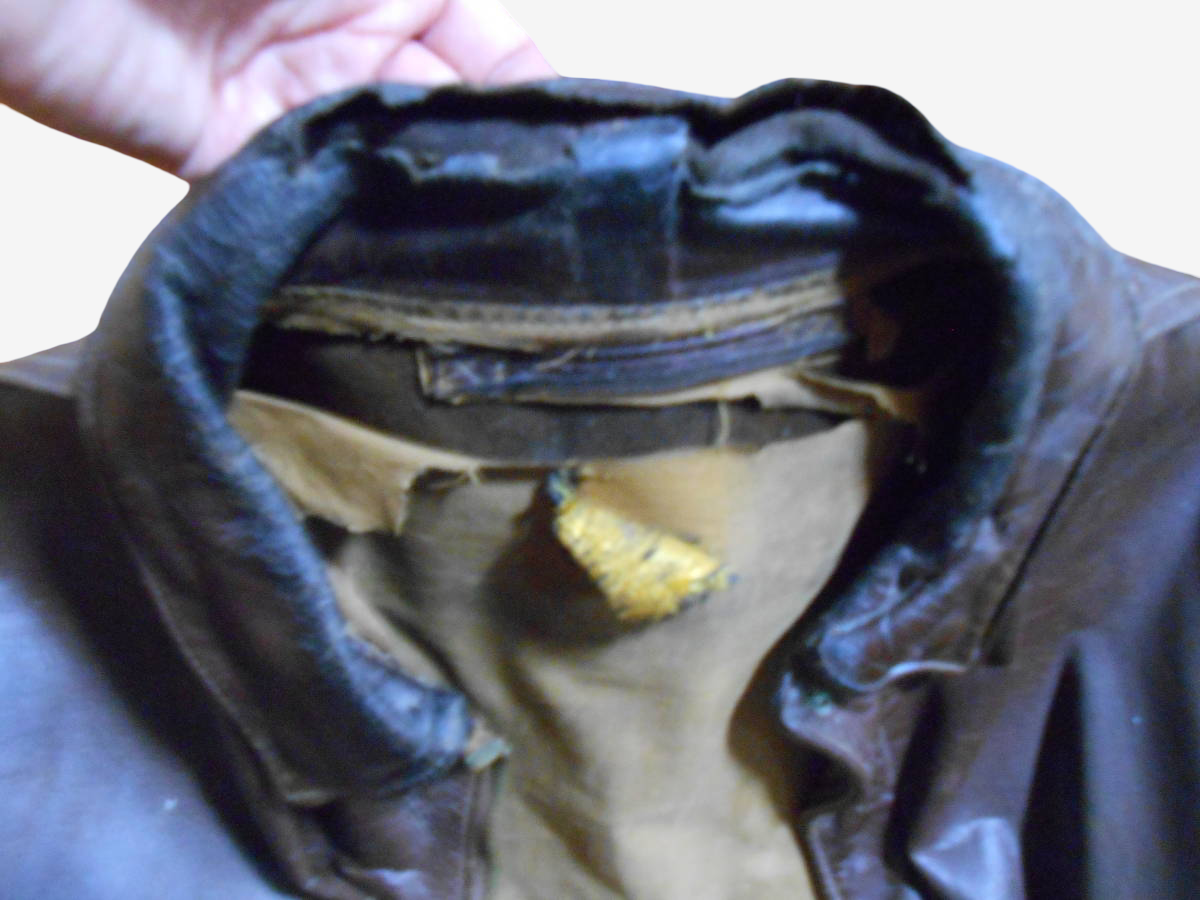
- localized wear: collar + sleeve seam stress points
- minor cut along sleeve seam
Artwork
- heavily cracked (varnish aging)
- pigment remains intact beneath fracture network
- visual presence extremely strong
Lining
- tears at neck and underarm zones
Knits
- waistband original, stable with wear
- cuffs heavily damaged
Label
- partially detached but present
→ classification: museum-grade artifact with wear-consistent integrity
COLLECTOR RELEVANCE
Tier: Museum-Level Painted A-2
Primary collectors:
- high-end aviation collectors
- WWII art garment specialists
- museum / institutional buyers
- advanced private archives
CONFIDENCE & VERIFICATION NOTES
Strong:
- WWII A-2 construction
- Poughkeepsie manufacture
- authentic aging pattern
- varnish preservation consistency
Measured:
- exact artist identity
- confirmed unit attribution
When Painting Becomes Preservation
Most painted A-2 jackets deteriorate in one direction:
- pigment loss
- fading
- abrasion
This one does something else.
It was sealed.
The varnish layer transforms the painting from:
👉 temporary expression
into
👉 protected artifact
But this protection comes at a cost:
- cracking across the surface
- fragmentation of visual continuity
And that tension—preservation vs fracture—is what defines this piece.
The Crack Network — Not Damage, But Structure
The surface cracking is not random.
It behaves like:
- dried lacquer
- aged oil painting
- ceramic glaze fracture
What you are seeing is:
👉 time mapped across a protective layer
The image underneath is still alive.
The surface above it records the decades.
Pin-Up Execution — This Is Not Amateur Work
The figure reveals:
- confident line control
- correct anatomical proportion
- layered shading
- controlled color blocking
This is not casual barracks work.
This is:
👉 trained hand-level execution
Likely:
- artistically skilled crew member
- or commissioned work within unit context
“Queen Of Tarts” — Linguistic Layer
The phrase draws from:
- Lewis Carroll reference (Queen of Hearts / tarts line)
- card symbolism (visible in composition)
But it also operates as:
👉 a double-layer identity marker
- playful literary reference
- coded personal or squad-level meaning
Bomb Tally — Lower Register Authority
The row of bomb icons anchors the piece.
Unlike chaotic tally marks, these are:
- evenly spaced
- visually structured
- integrated into composition
They act as:
👉 grounding mechanism for the artwork
Without them, the piece floats.
With them, it holds weight.
Horsehide — Why It Matters Here
The leather itself supports the painting:
- tight grain → holds pigment
- density → prevents excessive distortion
- aging pattern → complements crack network
This is the correct substrate for this kind of work.
Poughkeepsie — Quiet but Serious Maker
Not the most hyped contractor, but:
- legitimate WWII production
- correct patterning
- historically grounded output
Which means:
👉 the base jacket is already strong before the artwork is considered
MATERIAL FORENSICS
Leather
- flexible, not brittle
- grain intact
- stress localized, not systemic
Conclusion:
structurally stable WWII horsehide
Paint + Varnish Layer
- varnish intact across majority
- crack network stable (not flaking aggressively)
- pigment preserved underneath
Conclusion:
rare preserved paint system
Textile Components
- lining compromised but original
- knits aged but salvageable
Conclusion:
honest wear, not destructive failure
Authenticity & Stewardship
Evaluated under the Japonista Aviation & Military Garment Authentication Framework™
Each work is examined through a structured, multi-layered assessment:
• Model classification and military typology verification (A-2, B-3, MA-1, G-1, L-2, etc.)
• Material evaluation across leather, shearling, nylon, wool, and mixed components
• Hardware inspection including zippers, snaps, and period-correct fastenings
• Graphic and nose art analysis, including paint method, iconography, and historical alignment
• Condition and structural integrity review, including wear patterns consistent with age and use
Where applicable, contract labels, manufacturer markings, and period construction details are reviewed to confirm authenticity and era alignment.
Guaranteed 100% Authentic.
All garments are curated and backed by the Japonista Lifetime Authenticity Warranty™, with emphasis on both material truth and historical accuracy.
A Note on Flight Jackets, Service & Visual Identity
Military flight jackets were engineered as functional equipment—designed for temperature regulation, durability, and survival in demanding conditions. Over time, they evolved into carriers of identity, memory, and personal expression.
Nose art and painted jackets—originally applied to aircraft and later to garments—represent a distinct form of visual folklore. Pin-up figures, squadron insignia, mascots, and symbolic imagery transformed standard-issue equipment into individualized statements of presence and morale.
At Japonista, these jackets are approached as wearable military artifacts. Surface wear, leather creasing, paint aging, and textile fatigue are evaluated as evidence of lived history rather than imperfection.
We preserve these works with restraint—allowing their material narrative to remain visible and intact.
Our role is to connect these garments with collectors who recognize their dual nature as both functional objects and historical documents.
Inquiries, Availability, and Private Consideration
Many flight jackets are singular in character due to condition, paintwork, contract variation, or production era. Certain pieces are held firmly due to rarity, historical resonance, or preservation status.
All inquiries are handled discreetly, and we welcome thoughtful discussion regarding provenance, contract details, nose art interpretation, and long-term wear or display considerations.
Collectors building focused archives—by model type, era, or graphic style—may consult with us for deeper guidance.
Concierge Support & Collector Guidance
Japonista Concierge™ provides tailored assistance for collectors seeking deeper engagement with aviation garments:
• Model and contract identification (A-2 variants, G-1 lineage, MA-1 evolution)
• Leather and textile preservation guidance
• Paint conservation and display considerations
• Wearability versus archival preservation assessment
• Strategic acquisition planning for aviation-focused collections
For select rare or historically significant works, private reservation or structured acquisition arrangements may be available on a case-by-case basis.
Before Proceeding
We encourage collectors to review our shop policies and house guidelines, available through the links in our website footer. These outline shipping protocols, handling considerations, and condition standards specific to vintage leather, painted garments, and military-issued clothing.
Understanding these guidelines supports responsible stewardship of each piece.
A Closing Note
Flight jackets occupy a distinct place within material history. They are objects of function shaped by environment, and over time, transformed into records of identity, service, and expression.
Nose art—whether applied to aircraft or garments—extends this narrative, capturing moments of humor, defiance, and individuality within structured military life.
At Japonista, we steward these works as aviation artifacts in wearable form—ensuring they continue their journey with collectors who understand both their construction and their story.
If you have questions or wish to explore related items, please feel free to contact Japonista Concierge™ at any time.