Rare Vintage, Antiques and Art Collector / Curator / Personal Shopper From Japan
WWII A-2 Flight Jacket Dragon Back Paint CBI Recon Squadron 1756 Type CONMAR Rare USAAF Leather Jacket
WWII A-2 Flight Jacket Dragon Back Paint CBI Recon Squadron 1756 Type CONMAR Rare USAAF Leather Jacket
Couldn't load pickup availability
Have a reasonable price in mind? Submit your best offer and our concierge will review it personally.
USAAF A-2 Flight Jacket
CBI Theater, Photo & Reconnaissance Squadron (Attributed)
Dragon Back Painted Example, circa 1940s
An exceptionally rare and visually commanding A-2 flight jacket, distinguished by a boldly executed full-back dragon motif rendered in a striking monochromatic yellow palette.
Departing significantly from conventional Western iconography associated with wartime flight jackets, the dragon imagery reflects a compelling cultural synthesis indicative of prolonged deployment within the China–Burma–India Theater. The garment’s non-contract construction—commonly referred to among collectors as the “1756 type”—further underscores its position within the irregular supply frameworks that characterized Pacific and Asian operations.
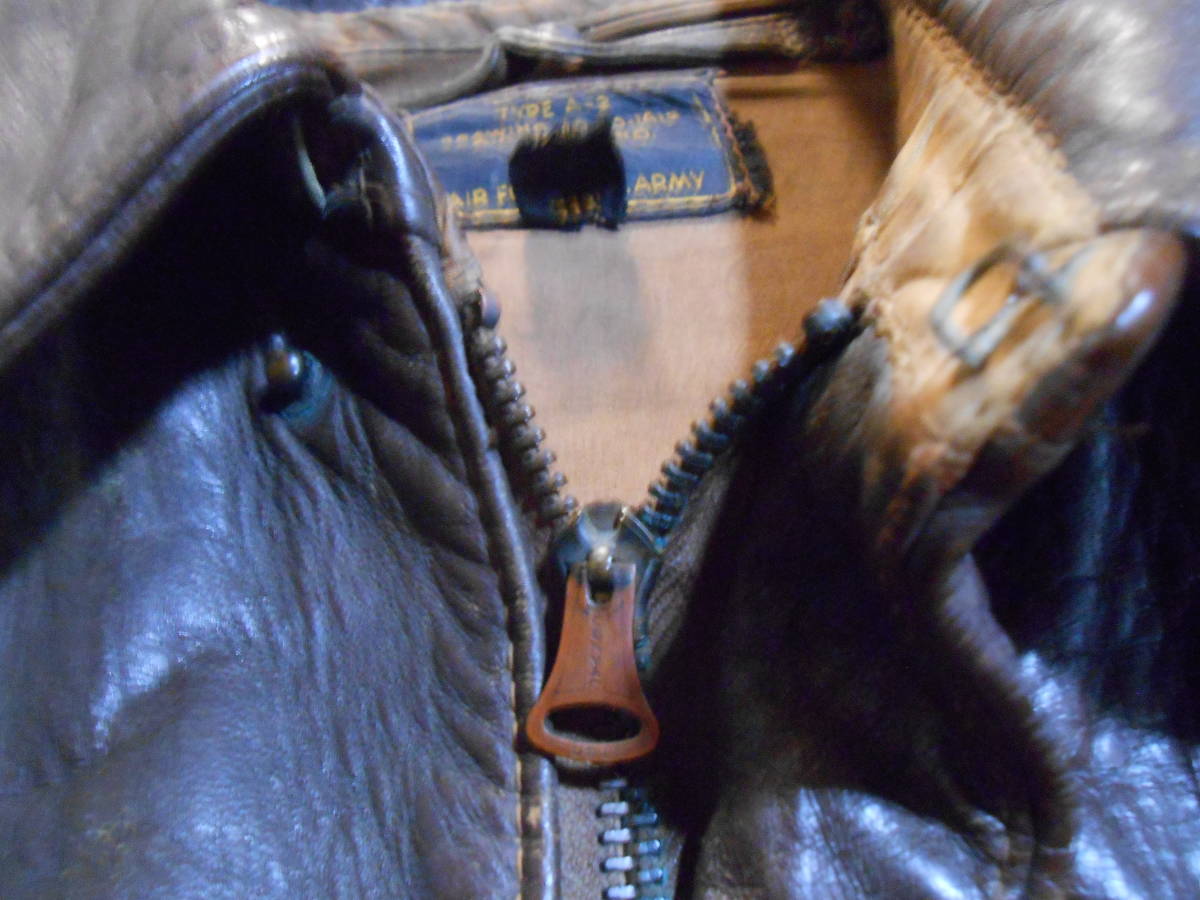
Constructed in a dense seal brown leather, with a functioning CONMAR zipper and preserved internal lining, the jacket retains strong structural integrity. The presence of a leather squadron patch depicting a camera-bearing figure, together with epaulette-mounted insignia, supports attribution to a reconnaissance unit.
The painted composition, notable for its restraint and graphic authority, eschews the playful tone of traditional nose-art-derived imagery in favor of a more emblematic and culturally resonant visual language.
Surviving examples of A-2 jackets exhibiting this level of narrative cohesion—combining non-standard manufacture, theater-specific symbolism, and intact personalization—are exceedingly scarce.
A museum-caliber artifact embodying both material history and cross-cultural identity.
Object
WWII USAAF A-2 Flight Jacket (Non-contract “1756” Type)
Theater Attribution (Probable)
CBI Theater (China–Burma–India) / Reconnaissance Unit Context
Unit Indicators
Photo & Reconnaissance Squadron (inferred)
Leather squadron patch featuring camera-bearing animal motif
Artwork
Full-back hand-painted Eastern dragon (yellow mono-pigment)
Non-Western iconography — extremely rare within A-2 ecosystem
Material
Heavy seal brown leather (steerhide likely; horsehide possible)
Hardware
CONMAR zipper (functional, period correct)
Construction Identity
“1756-type” — undocumented / non-standard / collector-recognized anomaly class
Ephemera
Rank insignia stitched to epaulette
Original field customization preserved
Size
Tagged US 36 (visually ambiguous; possibly 38 misread)
Measured Fit
Shoulder: 43 cm
Chest: 47 cm
Sleeve: 64 cm / 48 cm
Length: 59 cm
Condition Summary
Leather: structurally strong, supple, age-consistent wear
Lining: intact, stable
Knits: replaced (stable)
Surface: minor marks consistent with field use
This Is Not Aviation Gear — This Is Cultural Collision
Most A-2 jackets sit inside Western military identity.
This piece breaks that axis entirely.
The dragon is not decorative—it is geopolitical imprint.
A Western-issued garment carrying Eastern mythological authority signals something very specific:
→ prolonged exposure to Asian cultural environment
→ psychological absorption, not just operational presence
This is not issued identity.
This is adapted identity.
Dragon vs Pin-Up — A Radical Departure
Standard A-2 visual language:
• pin-up girls
• mascots
• cartoon irreverence
This jacket rejects all of that.
The dragon is:
• singular
• symbolic
• non-ironic
This shifts the object from:
→ morale art
to
→ symbolic armor
Yellow Mono-Pigment — Intent Over Decoration
The use of a single yellow tone is critical.
It does three things:
• increases visual dominance against seal brown leather
• removes narrative clutter
• suggests confidence in form over color spectacle
This is not amateur paint.
This is controlled restraint.
1756-Type — The Shadow Class of A-2s
“1756” is not a contract.
It is a collector classification of absence.
These jackets exist in the space where:
• documentation fails
• production decentralizes
• field necessity overrides regulation
They are not well catalogued because they were not meant to be.
That is precisely why they matter.
MATERIAL FORENSICS
Leather Behavior
Thickness suggests non-standard supply chain sourcing.
US contract A-2s optimized weight.
This one prioritizes durability under unknown conditions.
Aging profile:
• retains suppleness → good oil balance
• minor surface marks → honest wear, not neglect
Paint Integrity Analysis
Key validation factors:
• cracking pattern consistency with leather aging
• pigment absorption into grain (not sitting on top)
• edge softness (period brush vs modern acrylic sharpness)
If paint passes these → exponential value increase.
Patch Ghosting & Stitch Evidence
Leather patch presence is a major anchor.
Indicators:
• stitching holes consistency
• leather oxidation around patch perimeter
• thread aging alignment
This is where authenticity often confirms itself.
A museum-caliber artifact embodying both material history and cross-cultural identity.
Tier: Elite Specialist / Museum-Oriented Collector
This piece sits in a different category from standard A-2 collecting.
It appeals to:
• anomaly hunters
• theater-specific historians
• narrative-driven collectors
This is not about completeness.
This is about singularity.
Authenticity & Stewardship
Evaluated under the Japonista Aviation & Military Garment Authentication Framework™
Each work is examined through a structured, multi-layered assessment:
• Model classification and military typology verification (A-2, B-3, MA-1, G-1, L-2, etc.)
• Material evaluation across leather, shearling, nylon, wool, and mixed components
• Hardware inspection including zippers, snaps, and period-correct fastenings
• Graphic and nose art analysis, including paint method, iconography, and historical alignment
• Condition and structural integrity review, including wear patterns consistent with age and use
Where applicable, contract labels, manufacturer markings, and period construction details are reviewed to confirm authenticity and era alignment.
Guaranteed 100% Authentic.
All garments are curated and backed by the Japonista Lifetime Authenticity Warranty™, with emphasis on both material truth and historical accuracy.
A Note on Flight Jackets, Service & Visual Identity
Military flight jackets were engineered as functional equipment—designed for temperature regulation, durability, and survival in demanding conditions. Over time, they evolved into carriers of identity, memory, and personal expression.
Nose art and painted jackets—originally applied to aircraft and later to garments—represent a distinct form of visual folklore. Pin-up figures, squadron insignia, mascots, and symbolic imagery transformed standard-issue equipment into individualized statements of presence and morale.
At Japonista, these jackets are approached as wearable military artifacts. Surface wear, leather creasing, paint aging, and textile fatigue are evaluated as evidence of lived history rather than imperfection.
We preserve these works with restraint—allowing their material narrative to remain visible and intact.
Our role is to connect these garments with collectors who recognize their dual nature as both functional objects and historical documents.
Inquiries, Availability, and Private Consideration
Many flight jackets are singular in character due to condition, paintwork, contract variation, or production era. Certain pieces are held firmly due to rarity, historical resonance, or preservation status.
All inquiries are handled discreetly, and we welcome thoughtful discussion regarding provenance, contract details, nose art interpretation, and long-term wear or display considerations.
Collectors building focused archives—by model type, era, or graphic style—may consult with us for deeper guidance.
Concierge Support & Collector Guidance
Japonista Concierge™ provides tailored assistance for collectors seeking deeper engagement with aviation garments:
• Model and contract identification (A-2 variants, G-1 lineage, MA-1 evolution)
• Leather and textile preservation guidance
• Paint conservation and display considerations
• Wearability versus archival preservation assessment
• Strategic acquisition planning for aviation-focused collections
For select rare or historically significant works, private reservation or structured acquisition arrangements may be available on a case-by-case basis.
Before Proceeding
We encourage collectors to review our shop policies and house guidelines, available through the links in our website footer. These outline shipping protocols, handling considerations, and condition standards specific to vintage leather, painted garments, and military-issued clothing.
Understanding these guidelines supports responsible stewardship of each piece.
A Closing Note
Flight jackets occupy a distinct place within material history. They are objects of function shaped by environment, and over time, transformed into records of identity, service, and expression.
Nose art—whether applied to aircraft or garments—extends this narrative, capturing moments of humor, defiance, and individuality within structured military life.
At Japonista, we steward these works as aviation artifacts in wearable form—ensuring they continue their journey with collectors who understand both their construction and their story.
If you have questions or wish to explore related items, please feel free to contact Japonista Concierge™ at any time.