Rare Vintage, Antiques and Art Collector / Curator / Personal Shopper From Japan
WW2 WWII Luftwaffe Attributed Black Leather Flight Jacket Heavy Buffalo Hide German Private Purchase Jacket
WW2 WWII Luftwaffe Attributed Black Leather Flight Jacket Heavy Buffalo Hide German Private Purchase Jacket
Couldn't load pickup availability
Have a reasonable price in mind? Submit your best offer and our concierge will review it personally.
German Leather Flight Jacket
Luftwaffe-attributed, private-purchase type, circa 1940s
A striking and materially formidable black leather flight jacket attributed to the wartime private-purchase culture surrounding the German Luftwaffe. Distinguished by its substantial weight, heavily grained hide, and cross-over front construction, the jacket occupies the compelling borderland between aviation garment and continental military motorwear, while remaining unmistakably martial in tone.
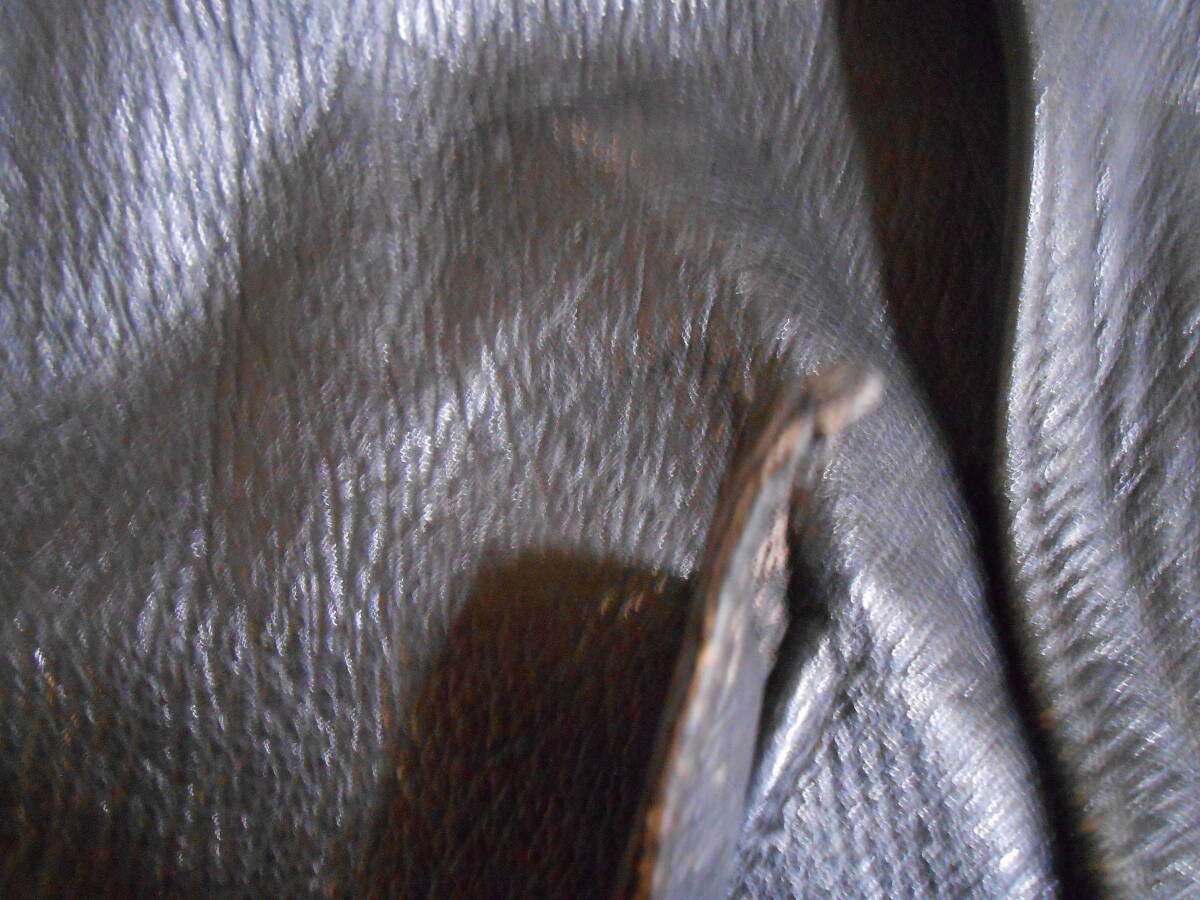
The shell appears to be cut from an unusually robust black hide, likely from a heavy bovine family, whose depth of grain and retained suppleness lend the garment exceptional authority. Internally, a pale brown wool body lining is paired with differing sleeve linings, further reinforcing the impression of a privately specified, quality-driven wartime garment rather than a generic later imitation.
Though lacking documentary provenance and with its neck label removed, the jacket presents a highly persuasive material case. Minor stitch loss to the pocket area and light surface rubs do little to diminish its force. On the contrary, they underscore its life as a used object rather than a preserved abstraction.
A rare and deeply atmospheric example of wartime German aviation-style leather, especially notable for its weight, silhouette, and almost sculptural presence.
Object
German Luftwaffe-attributed leather flight jacket
Primary Attribution
WWII-period German private-purchase aviation jacket
Seller presents it as Luftwaffe
Documentary certainty is not established
Type
Double-breasted / left-front buttoning leather flight jacket with cross-over motorcycle-adjacent front architecture and aviation-weight execution
Country / Branch Context
Germany
Second World War
Luftwaffe private-purchase ecosystem
Material
Heavy black leather described by seller as likely buffalo hide or related heavy bovine-family leather
Most important practical conclusion: the shell is exceptionally dense, heavily grained, and materially unusual
Color
Black
Lining
Body lined in pale brown wool
Sleeves lined in cotton / synthetic-type fabric according to seller’s reading
Label Situation
Trace of removed label at neck area
Seller interprets this in the context of wartime label removal, but this remains interpretive, not proof
Construction Character
Extremely weighty build
Seller emphasizes that garments of this type are no longer realistically made in such manner today
Raglan-like sleeve construction improves movement despite substantial leather mass
Condition Notes
- minor white-ish surface rub areas to back / leather face
- loose stitching above right pocket
- two small traces at lower back suggesting something may once have been attached or stitched
- overall shell remains supple and strong
- reportedly worn outdoors twice by seller without issue
Fit
Approx. US/UK 42
Approx. EU 52
Approx. Japan large L to XL
Measured Fit
Sleeve to neck / yuki: approx. 87 cm
Sleeve from underarm: approx. 44 cm
Chest: approx. 58 cm
Back length: approx. 63 cm
Object Classification
Not a paperwork-secure museum artifact
A highly convincing connoisseur-grade German wartime aviation leather jacket whose force lies in construction, hide, silhouette, and aura
COLLECTOR RELEVANCE
Tier: Advanced Connoisseur / Material-First Buy
This is ideal for:
- collectors of German wartime aviation clothing
- buyers who understand private-purchase military garments
- connoisseurs of unusual heavy hides and European military tailoring
- collectors willing to live in the space between proof and persuasion
This is not for:
- beginners needing fully documented branch certainty
- buyers expecting regulation neatness
- those uncomfortable with attribution nuance
This is a piece for someone who can read leather the way others read paper.
CONFIDENCE & VERIFICATION NOTES
Key due diligence points:
- confirm lining age agreement with shell
- inspect neck label-removal traces closely
- test hide flexibility and seam security
- examine whether black finish is naturally aged or later enhanced
- compare front construction to known Luftwaffe private-purchase examples
CURATORIAL ANALYSIS
A Jacket Built Like an Argument
Some wartime garments persuade through documents. Others persuade through image. This one persuades through mass.
Before insignia, before label traces, before branch attribution, the first thing this jacket communicates is physical seriousness. It is heavy, dark, deeply grained, and built with the kind of material confidence that immediately separates it from ordinary vintage outerwear. Even through photographs, it does not read as costume. It reads as a thing made for hard use and private pride.
That is why it is interesting.
It is not the easiest kind of object to classify, which is exactly why advanced collectors may be drawn to it. Easy objects are catalogued. Difficult objects are read.
Private-Purchase Luftwaffe Logic
German wartime aviation leather cannot be approached with the same contract mentality as U.S. A-2 collecting. The Luftwaffe field is broader, less standardized in the public imagination, and more hospitable to private purchase, tailor-made deviation, cross-pollination with motorwear, and officer-led material preference.
This jacket appears to sit precisely in that world.
Its cross-over front, its dense black hide, its hybrid motorcycle-flight language, and its lack of bureaucratic obviousness all point toward a private-purchase ecology rather than a neat issue-garment story. That matters because in this category, variation is not necessarily a warning sign. It can be the very evidence of authenticity.
The question is not whether it matches an American-style contract grid.
The question is whether all of its parts agree that it belongs to wartime German aviation culture.
Here, they appear to agree rather loudly.
Black Leather and the Aesthetic of Severity
Brown leather often carries warmth, nostalgia, and human softness. Black leather carries command. On a German wartime-attributed aviation jacket, black changes the emotional register entirely. The object becomes sharper, more architectural, more forbidding. It no longer merely belongs to air culture. It belongs to discipline, speed, and private martial style.
That is one reason this piece feels so distinct. It is not only rare in type. It is rare in mood.
The black hide, especially in such heavy grain, gives the jacket a stern physicality that many brown wartime jackets never attempt. It sits at the border between officer elegance and functional aggression. That border is where some of the best European military clothing lives.
The Hide as the Main Event
The seller’s uncertainty over whether the leather is true water-buffalo, European buffalo, bison-family, or another heavy hide type is less important than the practical reality: the material appears extraordinary.
The grain is large, alive, and confident.
The shell has weight.
The surface reflects age without losing integrity.
This is precisely the kind of leather that creates collector conviction even when paperwork falls short. Some jackets are interesting because of what they represent. Others are interesting because of what they physically are. This one is both, but it begins with the second.
If the hide remains supple in hand, the argument for the jacket becomes much stronger than the modest asking price would suggest.
Motorcycle Influence, Aviation Outcome
The seller notes that many such German pieces were influenced by French or continental motorcycle jackets. That is historically plausible and visually meaningful. Yet they insist this one still reads as flight jacket more than motorcycle coat. Looking at the front and body logic, that seems right.
This is not a civilian biker jacket that wandered into a military fantasy. It appears instead like a military-minded garment willing to borrow the assertive crossing lines of continental motorwear while remaining committed to aviation proportions and seriousness. That hybridization gives it a special charge. It feels neither soft nor theatrical. It feels engineered by someone who wanted the best of both worlds.
That sort of borrowing is often where the most desirable European garments emerge.
Wear, But Not Weakness
The condition issues are modest and, importantly, intelligible:
- light whitish rub to the leather face
- loose stitch above pocket
- traces of prior attachment low on back
None of these strike at the heart of the object. They are surface-level admissions of time, not structural collapse. More important is the seller’s repeated insistence that the shell remains supple and fully wearable, and that the raglan-like cut makes it easier to move in than one might expect.
That matters. A very heavy wartime jacket that still moves well is not merely collectible. It is materially impressive.
Aura and the Problem of Proof
The seller’s phrase about the object having “aura” is unusually apt. In many cases, aura is just marketing fog. Here it names something real: the phenomenon whereby construction, cut, hide, lining, and age combine to produce conviction even in the absence of total proof.
Aura is not evidence.
But neither is it empty.
In high-level collecting, aura matters because it often tells you where to look more closely. It is what makes a difficult object impossible to dismiss.
This jacket has that problem in abundance.
MATERIAL FORENSICS
Leather
This is the value center. Key in-hand checks:
- whether grain is natural and deep across panels
- whether the hide retains density without brittleness
- whether rubs are finish-level only
- whether stress at armhole and pocket seams remains stable
- whether the black surface has been over-dressed or remains honestly aged
If the leather is as good in person as it appears in the description, the jacket is dramatically underappreciated at the ask.
Lining
The wool body lining paired with different sleeve lining fabric is one of the strongest signs of non-generic construction. It suggests a jacket designed with thermal logic and material hierarchy, not simply assembled cheaply. That is a major positive in a private-purchase reading.
Label Trace
The missing label must remain neutral evidence. It is neither proof of wartime removal nor proof against originality. What matters more is whether the neck area, stitch ghosts, and lining age all agree materially.
Pocket Stitch Loss
The loosened thread above the pocket is a minor but useful detail. It is the kind of honest issue that appears on real garments that have lived. More important is whether the pocket line remains geometrically correct and under no major tension failure.
Authenticity & Stewardship
Evaluated under the Japonista Aviation & Military Garment Authentication Framework™
Each work is examined through a structured, multi-layered assessment:
• Model classification and military typology verification (A-2, B-3, MA-1, G-1, L-2, etc.)
• Material evaluation across leather, shearling, nylon, wool, and mixed components
• Hardware inspection including zippers, snaps, and period-correct fastenings
• Graphic and nose art analysis, including paint method, iconography, and historical alignment
• Condition and structural integrity review, including wear patterns consistent with age and use
Where applicable, contract labels, manufacturer markings, and period construction details are reviewed to confirm authenticity and era alignment.
Guaranteed 100% Authentic.
All garments are curated and backed by the Japonista Lifetime Authenticity Warranty™, with emphasis on both material truth and historical accuracy.
A Note on Flight Jackets, Service & Visual Identity
Military flight jackets were engineered as functional equipment—designed for temperature regulation, durability, and survival in demanding conditions. Over time, they evolved into carriers of identity, memory, and personal expression.
Nose art and painted jackets—originally applied to aircraft and later to garments—represent a distinct form of visual folklore. Pin-up figures, squadron insignia, mascots, and symbolic imagery transformed standard-issue equipment into individualized statements of presence and morale.
At Japonista, these jackets are approached as wearable military artifacts. Surface wear, leather creasing, paint aging, and textile fatigue are evaluated as evidence of lived history rather than imperfection.
We preserve these works with restraint—allowing their material narrative to remain visible and intact.
Our role is to connect these garments with collectors who recognize their dual nature as both functional objects and historical documents.
Inquiries, Availability, and Private Consideration
Many flight jackets are singular in character due to condition, paintwork, contract variation, or production era. Certain pieces are held firmly due to rarity, historical resonance, or preservation status.
All inquiries are handled discreetly, and we welcome thoughtful discussion regarding provenance, contract details, nose art interpretation, and long-term wear or display considerations.
Collectors building focused archives—by model type, era, or graphic style—may consult with us for deeper guidance.
Concierge Support & Collector Guidance
Japonista Concierge™ provides tailored assistance for collectors seeking deeper engagement with aviation garments:
• Model and contract identification (A-2 variants, G-1 lineage, MA-1 evolution)
• Leather and textile preservation guidance
• Paint conservation and display considerations
• Wearability versus archival preservation assessment
• Strategic acquisition planning for aviation-focused collections
For select rare or historically significant works, private reservation or structured acquisition arrangements may be available on a case-by-case basis.
Before Proceeding
We encourage collectors to review our shop policies and house guidelines, available through the links in our website footer. These outline shipping protocols, handling considerations, and condition standards specific to vintage leather, painted garments, and military-issued clothing.
Understanding these guidelines supports responsible stewardship of each piece.
A Closing Note
Flight jackets occupy a distinct place within material history. They are objects of function shaped by environment, and over time, transformed into records of identity, service, and expression.
Nose art—whether applied to aircraft or garments—extends this narrative, capturing moments of humor, defiance, and individuality within structured military life.
At Japonista, we steward these works as aviation artifacts in wearable form—ensuring they continue their journey with collectors who understand both their construction and their story.
If you have questions or wish to explore related items, please feel free to contact Japonista Concierge™ at any time.