Rare Vintage, Antiques and Art Collector / Curator / Personal Shopper From Japan
WW2 WWII German Luftwaffe Attributed Leather Flight Jacket Private Purchase Brown Zip Front Aviation Jacket Rare
WW2 WWII German Luftwaffe Attributed Leather Flight Jacket Private Purchase Brown Zip Front Aviation Jacket Rare
Couldn't load pickup availability
Have a reasonable price in mind? Submit your best offer and our concierge will review it personally.
German Leather Flight Jacket
Luftwaffe-attributed, private-purchase type, circa 1940s
A remarkably persuasive wartime German aviation-style leather jacket, attributed by form, material character, and overall construction to the private-purchase ecosystem associated with Luftwaffe personnel during the Second World War.
Though lacking surviving labels or documentary confirmation, the jacket presents a highly coherent wartime profile: refined seal-brown leather of notable quality, a short-waisted flight-jacket silhouette, a restrained zip-front construction, and a sophisticated internal lining system combining a moleskin-type body cloth with lighter sleeve linings. Such features align strongly with the privately acquired garments that often sat adjacent to formal issue within German military aviation culture.
The absence of overt insignia or bureaucratic clarity is offset by the strength of the object itself. The leather remains supple and visually rich, while the condition overall is notably strong for the category, with only limited sleeve-lining wear, minor zipper-top stitching separation, and reinforced neck-area conservation. These traces of use and preservation contribute to the jacket’s credibility rather than detract from it.
As with many of the most compelling European wartime garments, its authority rests less in surviving paperwork than in the agreement of all material parts. It is precisely this coherence that gives the jacket its unusual force.
A rare and deeply atmospheric example of wartime German aviation leather, occupying the fertile ground between certainty and connoisseurship.
Object
German Luftwaffe-attributed leather flight jacket
Primary Attribution
WWII-period Luftwaffe private-purchase / tailor-made flight jacket
Attribution not guaranteed
Country / Service Context
Germany
Second World War
Luftwaffe aviation culture / officer private-purchase ecosystem
Type
Zip-front leather flight jacket with short-waisted aviation profile
Material
Seal-brown high-quality leather
Exact hide unresolved: possibly horsehide, steerhide, or heavy goatskin family
Present condition suggests mature, supple wartime-grade hide with unusually refined hand
Construction Character
Luxury-grade private-purchase quality
More elevated material and tailoring feel than many period U.S. A-2s, according to seller’s direct comparison
Lining Configuration
Body lined in brown moleskin-like material
Sleeves lined in plain cotton/linen-type textile
Hardware
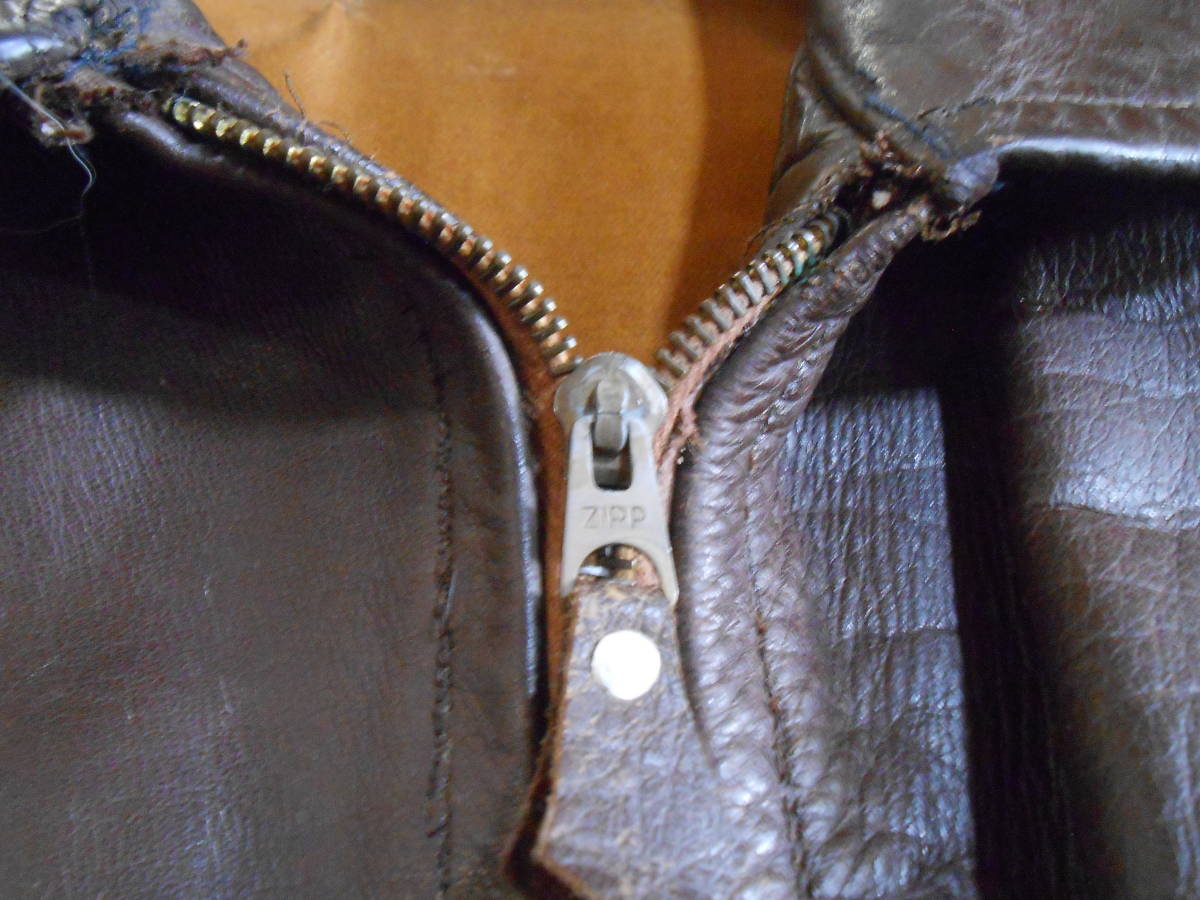
Main zipper marked ZIP
Label Status
No surviving label
No obvious trace of removal according to seller
Seller notes wartime anecdotal possibility that identifying labels were sometimes removed to avoid factory-location exposure under Allied bombing pressure
Condition Notes
Sleeve-end lining damage present
Upper zipper stitching thread break noted
Neck area shows period reinforcement
Overall leather remains notably supple and strong
Wear level is low relative to age category
Fit
Approx. US/UK 40
Approx. Japan L
Measured Fit
Sleeve: 62 cm from shoulder / 42 cm from pit
Shoulder: 47 cm
Chest: 51 cm
Length: 53 cm
Classification Warning
This is not a fully documented, institutionally secure Luftwaffe flight-jacket attribution
It should be treated as a highly compelling wartime German aviation-style jacket with strong Luftwaffe plausibility
COLLECTOR RELEVANCE
Tier: Advanced Eye / High-Reward Connoisseur Buy
This is ideal for:
collectors of German wartime aviation material
buyers comfortable with strong attribution without full paperwork
people who value superior leather and private-purchase elegance
collectors who understand that the best objects are sometimes the least overexplained
This is not for:
beginners needing label certainty
buyers who only collect contract-number clarity
those wanting airtight institutional proof at entry-level prices
This is a jacket for someone who trusts material intelligence.
CONFIDENCE & VERIFICATION NOTES
This jacket should be approached with disciplined curiosity.
Key checks:
- leather grain and age consistency across panels
- stitching chronology around zipper top and neck reinforcement
- lining weave and oxidation coherence
- zipper installation age and tape integrity
- overall cut comparison to known Luftwaffe private-purchase examples
If these agree, the current price becomes extremely favorable.
CURATORIAL ANALYSIS
An Object Made of Conviction, Not Certainty
This jacket lives in one of the most difficult and therefore most intellectually interesting categories in military collecting: the object that is strongly persuasive but not conclusively certified. Many collectors fear this territory because it requires judgment rather than checklist buying. Serious collections, however, are often built precisely here.
The seller is careful, and that care matters. They do not overstate. They do not claim documentary certainty. They say plainly that no papers survive linking the piece conclusively to the Luftwaffe, even while insisting that the jacket possesses the material authority of wartime aviation use.
That is the correct way to present such a thing.
And it immediately tells us that the object must be evaluated not through label fetish, but through construction logic, leather quality, silhouette, lining system, hardware, and cultural fit.
Why Private-Purchase Luftwaffe Jackets Matter
German aviation jackets are not as standardized in the collector imagination as American A-2s. That is partly because Luftwaffe leather garments often circulated through a much more fragmented ecosystem of private purchase, tailor production, regional manufacture, and officer-level customization. Variation is not a bug in that world. It is part of the system itself.
This means the absence of a textbook template does not invalidate the jacket. In fact, it may reinforce the very category into which it appears to fall.
Where American jackets often gain confidence through contract numbers, German private-purchase jackets gain it through style coherence. The cut, materials, lining, zip choice, waist treatment, collar language, and overall visual proportion must all agree. When they do, the garment begins to persuade.
This example appears to persuade strongly.
The Silhouette — Not Motorcycle, But Adjacent
The seller notes the French motorcycle-jacket influence that appears in some German wartime leather garments, while insisting this example still reads more like a flight jacket than a motorcycle coat. That distinction is important. Many European wartime leather jackets inhabit a border zone between motoring, aviation, and officer private purchase. The best examples often draw from all three while collapsing fully into none of them.
This jacket’s short-waisted balance, restrained front, and broad aviation posture suggest exactly that crossover zone. It does not perform like a civilian postwar fashion jacket. It does not overstate hardware. It does not chase decorative aggression. Instead, it holds itself with the kind of quiet self-possession one expects from a privately purchased officer’s garment designed for use rather than spectacle.
That is why it feels persuasive.
Material Hierarchy and the German Preference for Quality
One of the strongest claims in the listing is also one of the most believable: that the leather and general making feel several grades finer than many contemporary U.S. A-2s. This is not anti-American rhetoric. It reflects a real difference in procurement cultures and private tailoring traditions.
When one moves from standardized military issue into private-purchase continental Europe, especially Germany, one often encounters:
denser hides
finer linings
more elegant internal handling
better drape architecture
This jacket appears to belong to that world.
If so, its importance is not simply that it is old. It is that it reflects a different philosophy of military leather: less democratic, more sartorial, more privately aspirational.
The Missing Label Problem
The lack of a label is simultaneously its greatest weakness and one of its most believable features. In many collecting categories, missing labels create panic because modern buyers are addicted to textual proof. But objects predate databases, and wartime objects often survive in damaged, altered, or de-identified states.
The seller’s note that labels could be removed to obscure place of manufacture under bombing threat is plausible as historical texture, though not independently dispositive. It should not be treated as proof. It should be treated as part of the interpretive field.
What matters more is whether the jacket still makes sense without the label.
And here, remarkably, it seems to.
The hide, the lining mismatch between body and sleeves, the restrained zipper choice, the non-American silhouette, the private-purchase elegance, the period wear profile, the neck reinforcement, and the honest seam issues all suggest an object that continues to say “wartime Europe” even when the label is silent.
That is powerful.
Condition and the Privilege of Survival
The jacket’s condition profile is especially attractive because it avoids two common failures. It is neither over-restored into blankness nor ruined into fragility. Instead, it occupies the ideal collector middle register:
wear where expected
repairs where believable
structural life still present
surface character fully intact
The sleeve-lining damage, upper zipper stitch break, and reinforced neck are not warnings to flee. They are precisely the kinds of issues one expects on a jacket that survived use rather than archival fantasy. More importantly, the seller stresses that the leather itself remains supple and strong. In old leather garments, the shell is the kingdom. If the shell survives well, the object remains viable both as study piece and as carefully worn preservation object.
MATERIAL FORENSICS
Leather
This jacket must be handled in person to resolve its hide more confidently. Yet the exact species may be less important than the behavior. The real questions are:
Does the leather resist collapse while remaining flexible?
Does it show war-era tanning character rather than postwar softness?
Does the surface read as aged naturally rather than conditioned into artificial gloss?
If yes, then the material case strengthens dramatically.
Lining System
The dual lining logic is persuasive. Body moleskin-like lining with simpler sleeve lining is exactly the sort of mixed internal economy one sees in garments made for function but with enough quality to matter. It suggests decision, not randomness.
Zipper
The “ZIP” marking is a detail worth close inspection. It is not a glamorous brand anchor like Talon or Conmar in U.S. collecting, but it is exactly the kind of less-flashy component that can support a European wartime reading if age and installation feel right.
Neck Reinforcement
The reinforced neck area is one of the strongest emotional details in the entire listing. It suggests period preservation rather than later cosmetic rescue. Such repair zones often show where a wearer or tailor decided the jacket was worth saving because it was still needed.
That is not merely damage. That is preference made visible.
Authenticity & Stewardship
Evaluated under the Japonista Aviation & Military Garment Authentication Framework™
Each work is examined through a structured, multi-layered assessment:
• Model classification and military typology verification (A-2, B-3, MA-1, G-1, L-2, etc.)
• Material evaluation across leather, shearling, nylon, wool, and mixed components
• Hardware inspection including zippers, snaps, and period-correct fastenings
• Graphic and nose art analysis, including paint method, iconography, and historical alignment
• Condition and structural integrity review, including wear patterns consistent with age and use
Where applicable, contract labels, manufacturer markings, and period construction details are reviewed to confirm authenticity and era alignment.
Guaranteed 100% Authentic.
All garments are curated and backed by the Japonista Lifetime Authenticity Warranty™, with emphasis on both material truth and historical accuracy.
A Note on Flight Jackets, Service & Visual Identity
Military flight jackets were engineered as functional equipment—designed for temperature regulation, durability, and survival in demanding conditions. Over time, they evolved into carriers of identity, memory, and personal expression.
Nose art and painted jackets—originally applied to aircraft and later to garments—represent a distinct form of visual folklore. Pin-up figures, squadron insignia, mascots, and symbolic imagery transformed standard-issue equipment into individualized statements of presence and morale.
At Japonista, these jackets are approached as wearable military artifacts. Surface wear, leather creasing, paint aging, and textile fatigue are evaluated as evidence of lived history rather than imperfection.
We preserve these works with restraint—allowing their material narrative to remain visible and intact.
Our role is to connect these garments with collectors who recognize their dual nature as both functional objects and historical documents.
Inquiries, Availability, and Private Consideration
Many flight jackets are singular in character due to condition, paintwork, contract variation, or production era. Certain pieces are held firmly due to rarity, historical resonance, or preservation status.
All inquiries are handled discreetly, and we welcome thoughtful discussion regarding provenance, contract details, nose art interpretation, and long-term wear or display considerations.
Collectors building focused archives—by model type, era, or graphic style—may consult with us for deeper guidance.
Concierge Support & Collector Guidance
Japonista Concierge™ provides tailored assistance for collectors seeking deeper engagement with aviation garments:
• Model and contract identification (A-2 variants, G-1 lineage, MA-1 evolution)
• Leather and textile preservation guidance
• Paint conservation and display considerations
• Wearability versus archival preservation assessment
• Strategic acquisition planning for aviation-focused collections
For select rare or historically significant works, private reservation or structured acquisition arrangements may be available on a case-by-case basis.
Before Proceeding
We encourage collectors to review our shop policies and house guidelines, available through the links in our website footer. These outline shipping protocols, handling considerations, and condition standards specific to vintage leather, painted garments, and military-issued clothing.
Understanding these guidelines supports responsible stewardship of each piece.
A Closing Note
Flight jackets occupy a distinct place within material history. They are objects of function shaped by environment, and over time, transformed into records of identity, service, and expression.
Nose art—whether applied to aircraft or garments—extends this narrative, capturing moments of humor, defiance, and individuality within structured military life.
At Japonista, we steward these works as aviation artifacts in wearable form—ensuring they continue their journey with collectors who understand both their construction and their story.
If you have questions or wish to explore related items, please feel free to contact Japonista Concierge™ at any time.