Rare Vintage, Antiques and Art Collector / Curator / Personal Shopper From Japan
Vintage West Pac Tour Sukajan Jacket Velvet Navy 90s Japan Dragon Eagle Embroidery Rare
Vintage West Pac Tour Sukajan Jacket Velvet Navy 90s Japan Dragon Eagle Embroidery Rare
Couldn't load pickup availability
Have a reasonable price in mind? Submit your best offer and our concierge will review it personally.
Vintage Sukajan / Western Pacific Souvenir Tradition
“WEST PAC TOUR” Velvet Embroidered Sukajan Jacket
Japan, circa 1990s (revival-era interpretation of mid-20th-century military tour jackets)
Velvet construction example; materially elevated variant within the WEST PAC TOUR lineage, combining revival-era craftsmanship with historically rooted multi-region embroidery.
A richly composed example from the revival period of Japanese souvenir jackets, this WEST PAC TOUR sukajan encapsulates a layered narrative that extends beyond its immediate visual impact. Rooted in the tradition of postwar military garments produced for Western servicemen stationed in Japan, the WEST PAC TOUR motif historically functioned as both memento and map—an embroidered record of movement across the Pacific.
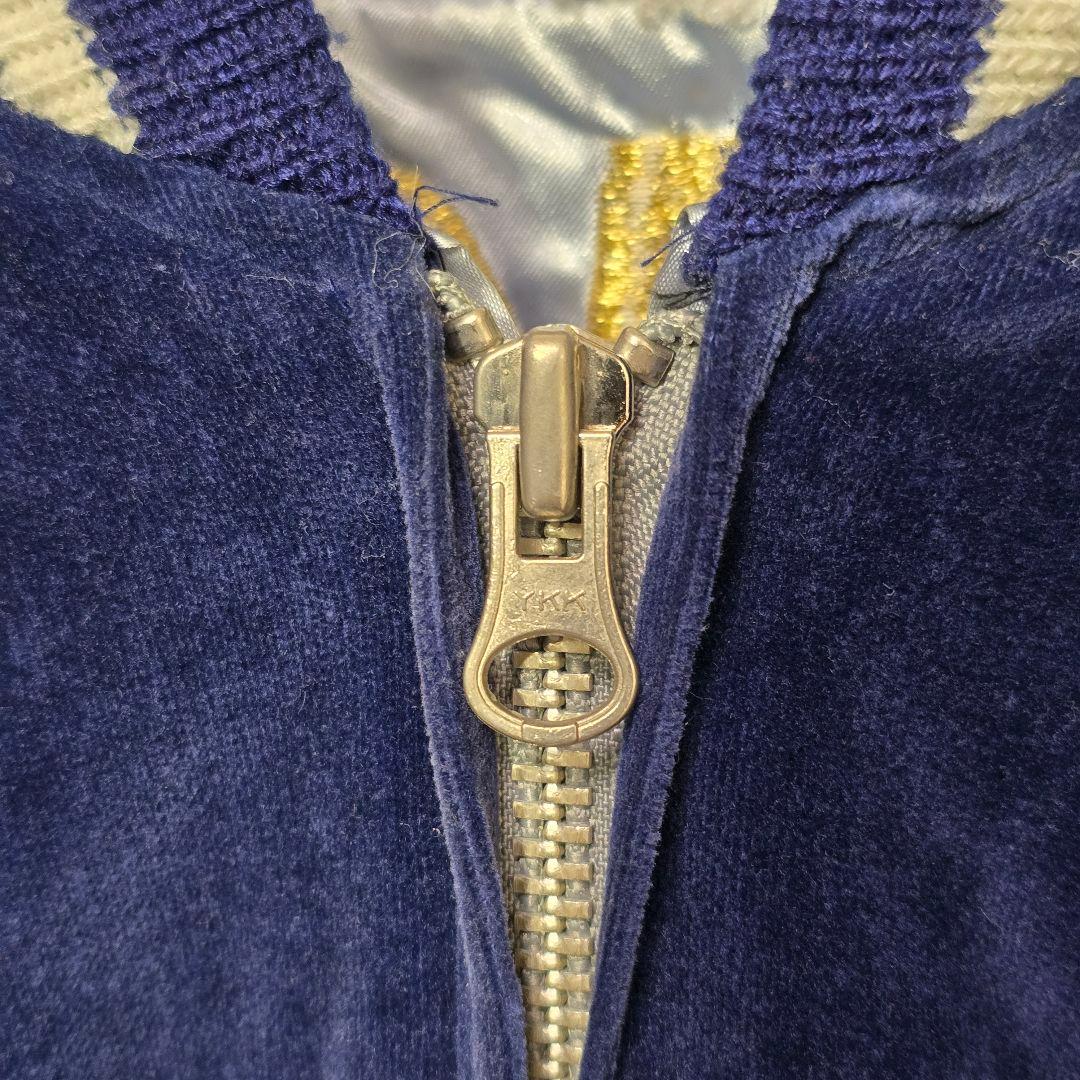
Here, that language is reinterpreted through a distinctly 1990s lens. The surface is executed not in the more commonly encountered satin, but in a deep navy velvet whose soft pile absorbs light and lends the composition a heightened sense of depth and atmosphere. This material choice transforms the embroidery from surface decoration into something more sculptural, with threads appearing to rise subtly from the ground.
The central composition brings together Mount Fuji, the eagle, and the dragon—symbols that operate across cultural boundaries. Fuji anchors the image in Japan, while the eagle and dragon introduce a dynamic interplay between Western and Eastern iconography. Encircling these elements, embroidered place names—Japan, Korea, Singapore, Hong Kong—trace a route that mirrors historical naval itineraries, effectively turning the jacket into a cartographic object rendered in thread.
Such pieces occupy a unique position within the broader sukajan archive. They are neither purely historical reproductions nor entirely contemporary inventions. Instead, they function as reinterpretations—objects that preserve the symbolic vocabulary of earlier decades while amplifying it through richer materials and more elaborate execution.
The velvet ground, in particular, marks this example as a materially distinct variant. Where satin emphasizes sheen and immediacy, velvet introduces depth and quiet intensity, allowing the embroidered imagery to emerge with greater contrast and presence. The result is a garment that feels less ephemeral and more enduring, aligning it more closely with collectible textile work than with standard outerwear.
Overview
This piece belongs to a specific lineage of sukajan that transcends fashion and enters the territory of cultural artifact. The “WEST PAC TOUR” embroidery directly references the historic naval tour routes of the Western Pacific, originally commemorated by U.S. servicemen stationed in Japan during the postwar period. By the 1990s, this visual language was revived and reinterpreted, often with heightened embroidery density and bolder textile choices such as velvet.
Unlike minimalist or character-driven sukajan, this jacket operates as a map, a narrative surface where geography, identity, and memory intersect.
Iconography
The back composition is a classic but elevated arrangement: Mount Fuji anchors the upper field, symbolizing Japan as both destination and mythic center. Below, an eagle and dragon converge in dynamic opposition and harmony—an enduring East-West symbolic pairing. Surrounding them, embroidered place names form a circular route: Japan, Korea, Singapore, Hong Kong—each stitched in vibrant color, forming a visual itinerary.
This is not decoration. It is movement, travel, and presence translated into thread.
Material
The velvet construction is a major differentiator. Where satin reflects light outward, velvet absorbs and deepens it. The result is a darker, more saturated visual field where embroidery appears almost illuminated from within. The pile of the velvet adds a tactile richness rarely seen in standard sukajan, giving the jacket both visual and physical depth.
This materially shifts the piece from casual outerwear into something closer to textile art.
Historical Context
Original WEST PAC TOUR jackets trace back to mid-20th-century military culture. This 1990s example reflects a revival period where Japanese makers reinterpreted these motifs for both domestic fashion and global export. During this era, embroidery became more elaborate, color palettes more experimental, and materials more varied.
Velvet examples, in particular, were less common, often positioned as higher-end or more visually dramatic interpretations.
Collector Relevance
This piece sits at an intersection:
military souvenir history
Japanese streetwear evolution
textile craftsmanship
Collectors drawn to authentic sukajan history, rather than purely fashion-driven pieces, will recognize the importance of WEST PAC TOUR iconography. The velvet construction further narrows the field, making it attractive to buyers seeking material rarity alongside historical reference.
Summary
A richly executed velvet sukajan that bridges postwar souvenir heritage with 1990s revival craftsmanship. The WEST PAC TOUR narrative, combined with deep navy velvet and multicolor embroidery, positions this as a strong collector-grade example with both historical resonance and visual impact.
Authenticity & Stewardship
Evaluated under the Japonista Embroidered Garment Authentication Framework™
Each work is examined through a disciplined, multi-layered review process:
• Era attribution and construction typology assessment (postwar, Showa, Heisei, modern reinterpretation)
• Textile, lining, and hardware evaluation across satin, rayon, wool, and mixed materials
• Embroidery technique analysis including stitch density, thread composition, and execution method
• Iconographic verification of motifs, regional symbolism, and cultural context
• Condition and structural integrity review, including wear, repair, and aging consistency
Guaranteed 100% Authentic.
All garments are curated and backed by the Japonista Lifetime Authenticity Warranty™, with emphasis on both material truth and cultural accuracy.
A Note on Embroidery, Subculture & Wearable History
Japanese embroidered jackets—whether sukajan, souvenir jackets, or sutajan—are not simply garments. They are textile narratives shaped by movement, memory, and identity.
Emerging in the aftermath of postwar exchange, sukajan jackets carried imagery of dragons, eagles, maps, and mythic landscapes—stitched as portable souvenirs of place and encounter. Sutajan (stadium jumpers), while structurally different, evolved within parallel youth cultures—embedding identity, affiliation, and aspiration into wearable form.
At Japonista, these works are approached as wearable historical documents. Embroidery is not decoration; it is authorship. Stitch variation, thread aging, minor fray, and surface wear are read as evidence of lived passage rather than imperfection.
We preserve these garments with restraint—allowing their histories to remain visible, legible, and intact.
Our role is to connect these pieces with collectors who understand both their visual impact and the layered cultural narratives carried within every thread.
Inquiries, Availability, and Private Consideration
Many embroidered jackets are singular in character—defined by unique embroidery execution, condition, or period-specific construction. Certain works are held firmly due to rarity, historical resonance, or preservation status.
All inquiries are handled with discretion. We welcome thoughtful discussion regarding provenance, embroidery technique, cultural context, and long-term wear or display considerations.
Collectors building focused archives—by motif (dragon, tiger, eagle), era, or regional influence—may consult with us for deeper guidance and acquisition support.
Concierge Support & Collector Guidance
Japonista Concierge™ provides tailored assistance for collectors seeking deeper engagement with embroidered garment culture:
• Era differentiation and subculture mapping (postwar, sukajan evolution, stadium lineage)
• Embroidery technique interpretation and motif symbolism
• Textile preservation and long-term storage guidance
• Wearability assessment versus archival conservation
• Strategic acquisition planning for building cohesive collections
Whether worn, displayed, or archived, each garment is guided toward its next chapter with respect for both material and meaning.
For select rare or historically significant pieces, private reservation or structured acquisition arrangements may be available on a case-by-case basis.
Before Proceeding
We encourage collectors to review our shop policies and house guidelines, available through the links in our website footer. These outline shipping protocols, handling considerations, and condition standards specific to vintage, textile-based, and culturally significant garments.
Understanding these guidelines supports responsible stewardship of each piece.
A Closing Note
Thank you for exploring Japonista’s curated selection of Japanese embroidered jackets. These garments stand at the intersection of history, identity, and design—and we are honored to help place them where they will continue to be valued and remembered. They are records of movement—across borders, across subcultures, across generations.
Each piece carries not only craftsmanship, but memory—stitched in silk, worn into fabric, and preserved through time.
At Japonista, we steward these works with clarity and discipline, ensuring they continue their journey with collectors who recognize their weight beyond fashion.
If you have questions or wish to explore related items, please feel free to contact Japonista Concierge™ at any time.