Rare Vintage, Antiques and Art Collector / Curator / Personal Shopper From Japan
Vintage YAMANE EVISU Kintaro Koi Embroidered Jeans W31 Tapered Japanese Amekaji Denim Lot 1926
Vintage YAMANE EVISU Kintaro Koi Embroidered Jeans W31 Tapered Japanese Amekaji Denim Lot 1926
Couldn't load pickup availability
Rare Indigo Five-Pocket Jeans with Waterfall Carp Embroidery, Kintarō Folk Hero and Auspicious Face Back Pocket
Description
A visually exceptional pair of YAMANE Lot 1926 embroidered jeans combining dark indigo denim, classic five-pocket workwear construction and an elaborate Japanese folklore scene extending across the front left thigh.
The embroidery depicts Kintarō, Japan’s legendary “Golden Boy,” crouching above a rocky waterfall with his characteristic axe while powerful carp surge through foaming water below. Worked in coral red, black, yellow, turquoise, silver-grey, pale green and gold-toned thread, the composition has the scale and density of sukajan embroidery translated onto heavyweight denim.
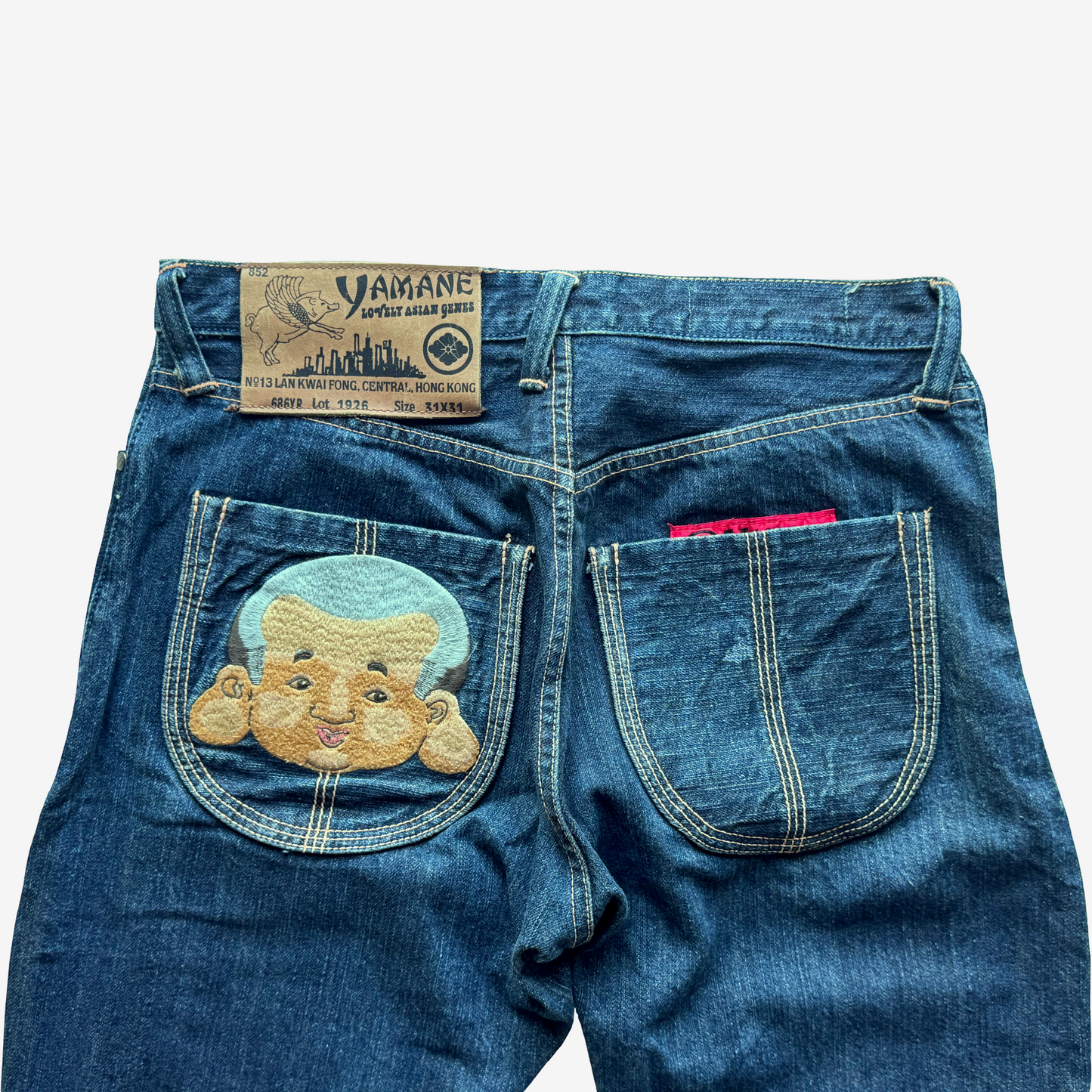
The reverse introduces a second focal point: a large smiling auspicious face embroidered directly across the left back pocket. Its exaggerated cheeks, ears and pale blue hair give the jeans an unmistakably playful YAMANE character, while the opposite pocket remains comparatively restrained.
Originally tagged 31 × 31, this pair appears to have been previously shortened and tapered into a cleaner contemporary silhouette. The actual inseam is approximately 70 cm / 27.6 in, so the physical measurements should be used rather than the original tagged length.
Design Character
From a distance, these read as richly aged dark-indigo jeans with restrained fading. Up close, the embroidery opens into an entire miniature narrative.
The upper body remains mostly undecorated, allowing the denim’s naturally developed whiskering, vertical grain and tonal movement to remain visible. The embroidered scene begins below the front pocket and travels down the thigh, creating a strong asymmetrical composition without overwhelming the whole garment.
The child hero’s vermilion complexion and striped apron provide the brightest color, while the lower section shifts into cooler aquatic shades. Silver and charcoal carp emerge through turquoise water, surrounded by reeds, foam and rock formations. Gold-toned fins and vegetation catch the light against the deep blue ground.
The reverse has an entirely different personality. The oversized smiling face sits inside the curved back-pocket construction, turning a functional denim detail into a bold emblem. Together, the front folklore scene and rear portrait create a garment that changes character depending on the viewing angle.
Identification
Brand: YAMANE / ヤマネ
Collector Association: EVISU and YAMANE denim lineage
Lot: 1926
Patch Wording: YAMANE Sophisticated Urban Genes
Patch Address: No. 13 Lan Kwai Fong, Central, Hong Kong
Tagged Size: 31 × 31
Material: 100% cotton
Country Marking: Made in China
Garment Type: Five-pocket embroidered denim jeans
Closure: Multi-button fly
Silhouette: Regular upper block with adjusted tapered leg
Color: Dark indigo blue
Style: Japanese amekaji, embroidered denim, folklore streetwear
Gender Presentation: Unisex
The jeans themselves are branded YAMANE. Japanese retailers and resale specialists frequently catalogue Lot 1926 garments within the broader EVISU/YAMANE collector category, reflecting the close design and market association between the names.
Kintarō and the Carp
The central embroidered figure is consistent with Kintarō, the famously powerful child hero of Japanese folklore.
Kintarō is traditionally shown with a ruddy or vermilion body, a patterned apron and a large axe. One of his most celebrated visual narratives places him beside, riding or wrestling an enormous carp near a waterfall. Historic versions of the subject survive in major museum collections, including a nineteenth-century Kintaro with Carp at the Metropolitan Museum of Art and a British Museum diptych describing the strong boy wrestling a giant carp at the base of a waterfall.
On these jeans, the traditional confrontation is arranged vertically. Kintarō occupies the rocky summit while the carp rise through turbulent water below. The design draws together themes of exceptional strength, spirited determination and the struggle to overcome powerful natural forces.
The scene is not merely a small decorative logo. It functions as a complete pictorial embroidery extending from the upper thigh toward the knee, placing the jeans within the same visual universe as Japanese sukajan jackets, wagara workwear and contemporary tattoo-influenced denim.
Embroidered Back-Pocket Figure
The left rear pocket carries a large smiling face with rounded cheeks, prominent ears and pale blue-grey hair.
Its precise character name is not stated on the visible labels, so it is presented here as an auspicious or humorous YAMANE face motif rather than assigned an unsupported identity. The expression introduces warmth and wit to the otherwise dramatic Kintarō composition.
The embroidery fills most of the pocket while preserving the original curved pocket shape and contrast stitching. This unusual placement gives the rear view immediate collector appeal without relying on the more common painted seagull or oversized Daicock-style pocket treatment associated with many EVISU-family jeans.
A narrow red textile accent is visible inside the upper edge of the opposite back pocket, providing a small but deliberate flash of contrast.
Denim, Construction and Hardware
The jeans are constructed in substantial indigo cotton denim with a classic five-pocket arrangement:
- Two curved front pockets
- Small coin pocket
- Two rear patch pockets
- Reinforced belt loops
- Metal rivets
- Multi-button fly
- Contrast copper-orange stitching
- V-shaped rear yoke
- Large branded waist patch
- Embroidered front and rear artwork
The fly uses several individually decorated metal buttons rather than a zipper. The hardware has developed natural darkening and surface variation that harmonize with the worn indigo.
The denim retains a rich, relatively dark base with visible fading around the lap, front pockets, knees, seat and seam edges. Horizontal creasing and soft whiskering give the fabric depth, while the lower legs remain comparatively even and dark.
The original 31-inch length has been altered. The present approximately 70 cm / 27.6 in inseam indicates that the legs were shortened, and the shape appears to have been narrowed into a more tapered line. This alteration makes the pair easier to style with boots, loafers or sneakers, but buyers should rely strictly on the actual measurements.
No claim of Japanese manufacture is made. The interior woven label clearly identifies the jeans as 100% cotton and Made in China.
Brand and Label Details
The rear waist patch reads:
YAMANE
Sophisticated Urban Genes
No. 13 Lan Kwai Fong, Central, Hong Kong
Lot 1926
Size 31 × 31
The interior label repeats the 31 × 31 size and identifies the material as 100% cotton with Chinese manufacture.
This Lan Kwai Fong and Made in China YAMANE label configuration was already being discussed by denim collectors in 2006. That documentation supports an early-to-mid-2000s attribution for the line, although it does not establish the exact production year of this individual pair.
Period Assessment
Likely dating to the early or mid-2000s, these jeans belong to the period when YAMANE and EVISU-related denim expanded beyond minimalist heritage reproductions into elaborate embroidery, humorous character work and regionally distributed fashion lines.
The Lot 1926 designation, Lan Kwai Fong patch, multi-button fly, oversized embroidery and dark-indigo finish are consistent with surviving YAMANE examples from that era.
The precise year has not been confirmed. The most responsible public attribution is therefore:
Vintage or vintage-era YAMANE Lot 1926, likely early-to-mid 2000s.
Condition
Presented in good pre-owned vintage condition with visible wear, natural fading and a previous alteration to the legs.
The denim shows:
- Natural whiskering and fading across the upper thighs
- Soft vertical and horizontal tonal variation
- Creasing from wear and storage
- Mild abrasion around pocket edges and seams
- Wear and loose fibers around selected belt loops
- Fraying around the buttonhole and fly area
- Natural oxidation and darkening to the hardware
- Surface wear to the rear waist patch
- Minor loose or raised embroidery threads
- Light rubbing across portions of the carp and foliage embroidery
- Softening around the back pockets and seat
- Previously shortened and tapered legs
- Visible alteration at the hems
The Kintarō, carp and rear-pocket face embroidery remain visually strong and substantially intact. Their colors retain excellent contrast against the indigo denim.
No major open tear or large structural loss is visible in the photographed areas. The jeans retain the character expected of an older, previously worn and altered collector garment.
Dimensions and Fit
Approximate laid-flat measurements:
Tagged size: 31 × 31
Waist laid flat: 40 cm / 15.7 in
Approximate waist circumference: 80 cm / 31.5 in
Front rise: 30 cm / 11.8 in
Inseam: 70 cm / 27.6 in
Total length / outseam: 100 cm / 39.4 in
The tagged 31-inch waist remains broadly consistent with the photographed measurement. The present inseam, however, is significantly shorter than the original tagged 31-inch length.
The upper block has a classic amekaji jean profile with a substantial rise and comfortable room through the seat and thigh. The adjusted lower legs create a more tapered, contemporary finish.
This pair may work particularly well for someone who normally wears approximately W30–31 and prefers a cropped or ankle-length silhouette. Fit will vary according to body shape and where the waistband is worn.
Please compare every measurement with a well-fitting pair of jeans. The actual measurements take precedence over the original tag.
Styling and Collecting Appeal
These jeans sit at the intersection of several important Japanese fashion categories:
- YAMANE and EVISU-associated denim collecting
- Japanese amekaji
- Wagara embroidered clothing
- Sukajan-inspired streetwear
- Japanese folklore fashion
- Early-2000s designer denim
- Tattoo-art-inspired embroidery
- Vintage hip-hop denim
- Japanese workwear
- Statement jeans
The dark indigo keeps them surprisingly wearable despite the elaborate artwork. From one side, the outfit remains quiet and workwear-oriented. From the embroidered side, the Kintarō and waterfall composition becomes the visual center.
They pair especially well with:
- Plain white or black T-shirts
- Loopwheel sweatshirts
- Sukajan jackets
- Denim chore coats
- Leather jackets
- Military outerwear
- Engineer boots
- High-top sneakers
- Japanese heritage brands
- Cropped or boxy streetwear layers
The altered length can be used intentionally to expose boots, patterned socks or high-top footwear rather than being treated simply as a limitation.
For display, the embroidery has enough scale and narrative detail for the jeans to function as a collectible textile object even when not worn.
Offers, Shipping and Store Policies
Respectful and reasonable offers may be considered. Flexibility depends on the rarity, condition, embroidery quality and current international demand for the piece.
These are pre-owned vintage jeans sold in their existing condition. The photographs form an essential part of the description and document the denim fading, embroidery, labels, hardware and adjusted silhouette.
Please review the dimensions carefully before purchasing. The jeans have been shortened and tapered, and the actual inseam differs from the original 31-inch tag.
Returns, claims and exchanges are not ordinarily accepted, subject to applicable Etsy policies, purchase protection and mandatory consumer law.
Worldwide shipping is available through Japan Post EMS where service is offered. The parcel will include tracking and will normally be prepared within 3–5 business days. Delivery timing depends on destination and customs processing. Import duties and local taxes remain the buyer’s responsibility where applicable.
#Yamane #YamaneJeans #EvisuYamane #EvisuJeans #Kintaro #KintaroJeans #KoiEmbroidery #CarpEmbroidery #JapaneseDenim #VintageDenim #Amekaji #JapaneseStreetwear #Wagara #EmbroideredJeans #IndigoDenim #Lot1926 #JapanFashion #JapaneseFolklore #WearableArt #SukajanStyle #TattooArtFashion #VintageStreetwear #MensDenim #UnisexJeans #TaperedJeans #DarkIndigo #CollectorDenim #JapaneseWorkwear #RareDenim #Japonista
yamane jeans, evisu yamane, kintaro jeans, koi embroidered, japanese denim, amekaji jeans, w31 denim, lot 1926 jeans, tapered jeans, embroidered denim, japan streetwear, vintage denim, folk art jeans
Material Tags
cotton denim, embroidery thread, metal buttons, metal rivets, woven label, waist patch, sewing thread