Rare Vintage, Antiques and Art Collector / Curator / Personal Shopper From Japan
Vintage WWII B-15 Flight Jacket USAAF Hand Painted Squadron Art Military Bomber
Vintage WWII B-15 Flight Jacket USAAF Hand Painted Squadron Art Military Bomber
Couldn't load pickup availability
Have a reasonable price in mind? Submit your best offer and our concierge will review it personally.
A U.S. ARMY AIR FORCES TYPE B-15 FLIGHT JACKET, CIRCA MID-1940s
With hand-painted squadron insignia; a transitional aviation garment marking the shift from leather to insulated flight systems
A cloth flight jacket of Type B-15 configuration, produced during the late stages of the Second World War or immediately thereafter, constructed with insulated lining and a fur collar for high-altitude use. The chest bears a hand-painted insignia executed directly onto the fabric, reflecting individual or squadron identity layered over standard issue equipment. The surface exhibits wear consistent with operational use, including fading and knit degradation, while retaining its structural form. The B-15 model represents a pivotal moment in aviation garment development, bridging earlier leather flight jackets and the nylon MA-1 that would follow.
Object
Type B-15 Flight Jacket
Origin
United States Army Air Forces (USAAF)
Production Era
Late WWII to immediate postwar transition (circa mid-1940s)
Category
Cloth flight jacket (pre-MA-1 evolutionary platform)
Material
Cotton flight satin / early nylon-type shell
alpaca/wool pile lining
fur collar (mouton/sheepskin type)
Hardware
Front zip closure
buttoned storm flap
military-grade hardware system
Construction Features
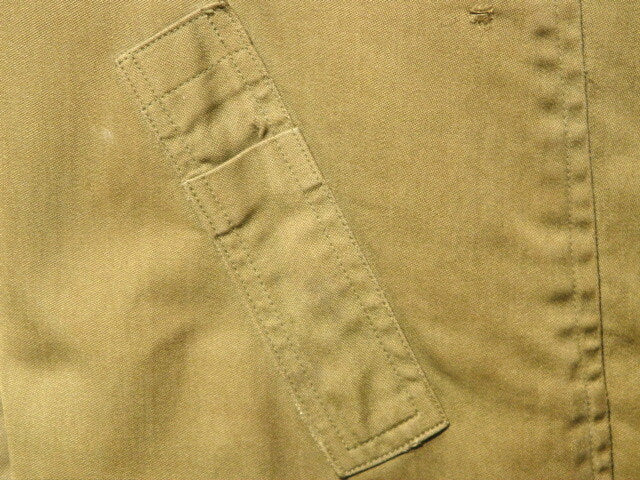
- oxygen mask tab system
- pen/pencil sleeve pocket (arm)
- ribbed knit waistband and cuffs
- heavy insulation for high-altitude environments
MEASUREMENTS
Shoulder: ~43 cm
Chest: ~50 cm
Sleeve: ~58 cm
Length: ~62 cm
→ compact wartime sizing (modern S–M equivalent)
ICONOGRAPHY (CRITICAL)
Chest Area
- hand-painted squadron insignia
- stylized figure with bold red tonal dominance
- organic brushwork, not stencil-applied
Additional Surface Elements
- faded USAAF roundel (star insignia) remains visible
- evidence of layered wear and service exposure
CONDITION SUMMARY
- visible age fading across shell
- cuff damage (expected stress points)
- general wear consistent with operational use
- paint remains partially intact despite textile aging
→ classification:
authentic service-worn cloth flight jacket with preserved hand-applied artwork
OBJECT CLASSIFICATION
WWII-era transitional flight jacket with personalized squadron painting
COLLECTOR RELEVANCE
Tier: Transitional Aviation Artifact
Ideal for:
- WWII aviation collectors
- flight jacket historians
- textile evolution specialists
- collectors of personalized military garments
CONFIDENCE & VERIFICATION NOTES
Strong:
- correct B-15 structure
- period-consistent wear
- authentic paint behavior
Measured:
- exact squadron identification
The Missing Link Between A-2 and MA-1
The B-15 is not just another jacket.
It is the bridge.
- A-2 → leather, WWII
- B-15 → insulated cloth, high-altitude adaptation
- MA-1 → jet-age nylon evolution
This piece lives exactly in that transition.
Why Cloth Changed Everything
Leather had limits:
- heavy
- less insulating at altitude
- stiff in extreme cold
B-15 introduced:
- insulation layering
- improved mobility
- technical functionality
This was not aesthetic change.
👉 it was survival engineering
The Collar — A Functional Crown
That thick fur collar isn’t decorative.
It is:
- wind shield
- thermal seal
- cockpit survival component
It frames the piece visually, yes—
but originally, it framed life and death conditions.
Hand-Painted Insignia — Discipline Broken by Identity
Military garments begin as uniform.
But time changes them.
Here, the chest painting represents:
- squadron pride
- personal identity
- rebellion against uniform anonymity
Unlike leather A-2 back art:
- this is more intimate
- more restrained
- closer to the body
👉 less spectacle
👉 more personal claim
Paint on Fabric — A Fragile Defiance
Painting on cloth is risky:
- fibers flex
- paint cracks
- wear destroys surface
And yet, it was done anyway.
Why?
Because permanence wasn’t the goal.
👉 expression was
Wear Patterns — Honest Aging
This jacket doesn’t perform aging.
It contains it.
- sleeve damage = repeated movement
- fading = sun + airfield exposure
- knit wear = operational friction
This is not stylized distress.
👉 this is accumulated time
The Quiet Power of the Piece
Compared to loud tour jackets or bold A-2 backs:
This one speaks in a lower tone.
But it carries:
- structural importance (design evolution)
- historical authenticity
- personal intervention
It is less theatrical—
and more architectural in history.
MATERIAL FORENSICS
Shell Fabric
- softened from wear
- structurally intact
- visible aging but not compromised
Conclusion:
authentic period textile with stable integrity
Paint Layer
- partial retention
- natural cracking patterns
- embedded into fabric fibers
Conclusion:
original field-applied artwork, not later reproduction
Knits
- cuff damage present
- consistent with age and use
Conclusion:
expected degradation, repairable without replacement bias
Authenticity & Stewardship
Evaluated under the Japonista Aviation & Military Garment Authentication Framework™
Each work is examined through a structured, multi-layered assessment:
• Model classification and military typology verification (A-2, B-3, MA-1, G-1, L-2, etc.)
• Material evaluation across leather, shearling, nylon, wool, and mixed components
• Hardware inspection including zippers, snaps, and period-correct fastenings
• Graphic and nose art analysis, including paint method, iconography, and historical alignment
• Condition and structural integrity review, including wear patterns consistent with age and use
Where applicable, contract labels, manufacturer markings, and period construction details are reviewed to confirm authenticity and era alignment.
Guaranteed 100% Authentic.
All garments are curated and backed by the Japonista Lifetime Authenticity Warranty™, with emphasis on both material truth and historical accuracy.
A Note on Flight Jackets, Service & Visual Identity
Military flight jackets were engineered as functional equipment—designed for temperature regulation, durability, and survival in demanding conditions. Over time, they evolved into carriers of identity, memory, and personal expression.
Nose art and painted jackets—originally applied to aircraft and later to garments—represent a distinct form of visual folklore. Pin-up figures, squadron insignia, mascots, and symbolic imagery transformed standard-issue equipment into individualized statements of presence and morale.
At Japonista, these jackets are approached as wearable military artifacts. Surface wear, leather creasing, paint aging, and textile fatigue are evaluated as evidence of lived history rather than imperfection.
We preserve these works with restraint—allowing their material narrative to remain visible and intact.
Our role is to connect these garments with collectors who recognize their dual nature as both functional objects and historical documents.
Inquiries, Availability, and Private Consideration
Many flight jackets are singular in character due to condition, paintwork, contract variation, or production era. Certain pieces are held firmly due to rarity, historical resonance, or preservation status.
All inquiries are handled discreetly, and we welcome thoughtful discussion regarding provenance, contract details, nose art interpretation, and long-term wear or display considerations.
Collectors building focused archives—by model type, era, or graphic style—may consult with us for deeper guidance.
Concierge Support & Collector Guidance
Japonista Concierge™ provides tailored assistance for collectors seeking deeper engagement with aviation garments:
• Model and contract identification (A-2 variants, G-1 lineage, MA-1 evolution)
• Leather and textile preservation guidance
• Paint conservation and display considerations
• Wearability versus archival preservation assessment
• Strategic acquisition planning for aviation-focused collections
For select rare or historically significant works, private reservation or structured acquisition arrangements may be available on a case-by-case basis.
Before Proceeding
We encourage collectors to review our shop policies and house guidelines, available through the links in our website footer. These outline shipping protocols, handling considerations, and condition standards specific to vintage leather, painted garments, and military-issued clothing.
Understanding these guidelines supports responsible stewardship of each piece.
A Closing Note
Flight jackets occupy a distinct place within material history. They are objects of function shaped by environment, and over time, transformed into records of identity, service, and expression.
Nose art—whether applied to aircraft or garments—extends this narrative, capturing moments of humor, defiance, and individuality within structured military life.
At Japonista, we steward these works as aviation artifacts in wearable form—ensuring they continue their journey with collectors who understand both their construction and their story.
If you have questions or wish to explore related items, please feel free to contact Japonista Concierge™ at any time.