Rare Vintage, Antiques and Art Collector / Curator / Personal Shopper From Japan
Vintage USAF L-2B Flight Jacket Skyline Clothing MIL-J-7448C Early Nylon Military Jacket Small Original
Vintage USAF L-2B Flight Jacket Skyline Clothing MIL-J-7448C Early Nylon Military Jacket Small Original
Couldn't load pickup availability
Have a reasonable price in mind? Submit your best offer and our concierge will review it personally.
U.S. Air Force L-2B Flight Jacket
Skyline Clothing Corporation, MIL-J-7448C
circa late 1950s–1961
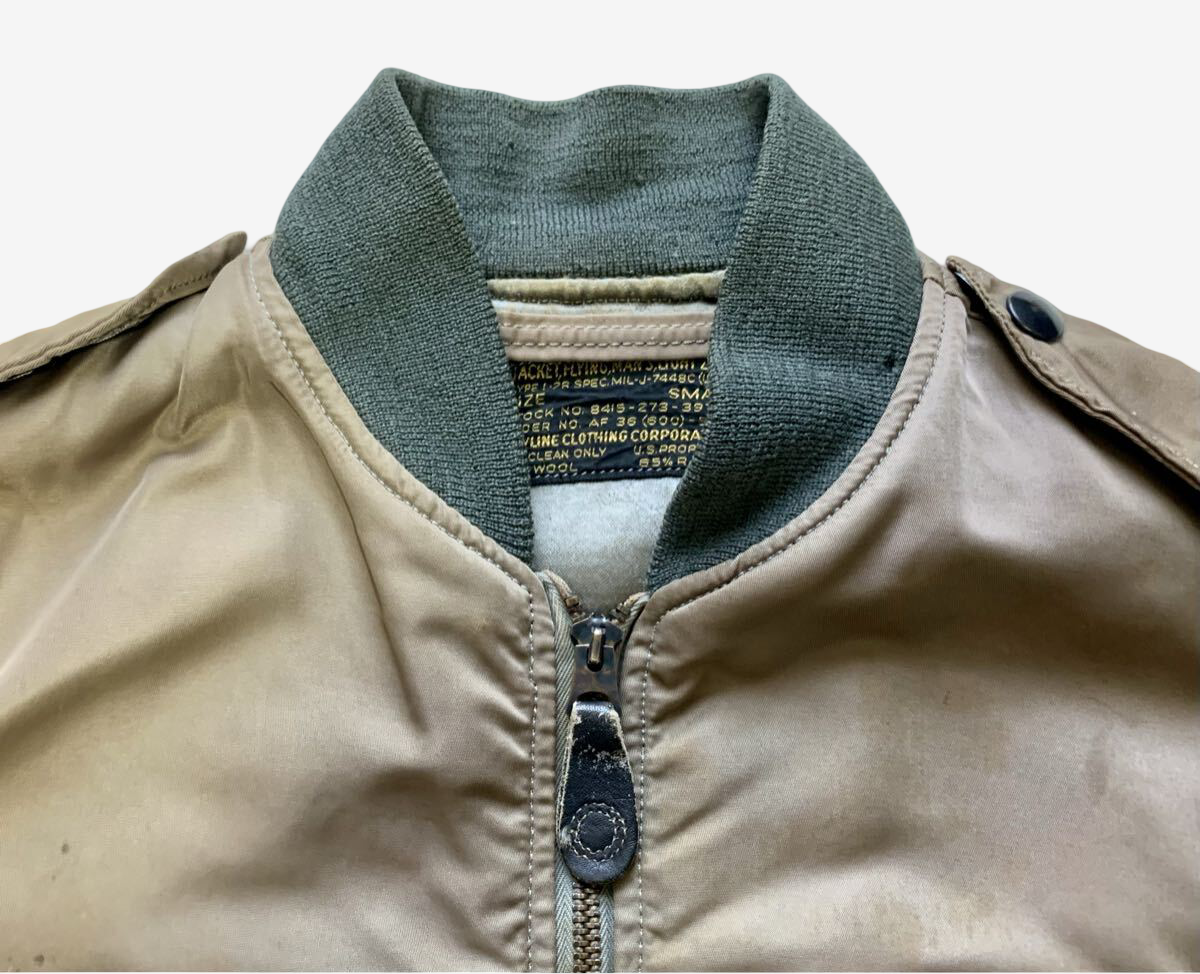
A highly atmospheric and authentic early U.S. Air Force L-2B flight jacket by Skyline Clothing Corporation, preserving the contract identity and material logic of the first mature generation of nylon flightwear.
Executed in olive-toned nylon and fitted with characteristic knit cuffs and waistband, the jacket has acquired a deeply persuasive patina through age, with natural color transformation, rib wear, and surface marking combining to produce a garment of considerable visual and historical presence. Particularly notable is the way in which the shell has faded into a softened khaki-olive register, allowing the passage of time to become part of the object’s aesthetic force.
Unlike later mass-familiar flight jackets that circulate primarily through fashion, this example still belongs to the period when the L-2B was first and foremost a service garment. Its Skyline contract identity and MIL-J-7448C specification reinforce that status, anchoring it securely within the evolution of postwar U.S. Air Force clothing.
Though no longer a condition-driven example, the jacket survives as a highly compelling patina object: one whose wear is inseparable from its authority.
An excellent collector’s piece from the early nylon era of military aviation dress.
Object
U.S. Air Force L-2B Flight Jacket
Spec
MIL-J-7448C
Manufacturer
Skyline Clothing Corporation
Branch
U.S. Air Force
Era
Late 1950s to 1961 production window, consistent with seller description for this contract generation
Type Significance
Early L-2B, representing the slimmer, lighter, pre-late-era phase of USAF nylon flightwear before the jacket’s longer mass-fashion afterlife fully absorbed it into civilian culture
Marking
U.S. Air Force insignia printed on shell
Color / Age Character
Originally sage / olive-toned nylon, now heavily mellowed by time into a soft, naturally faded khaki-olive register with strong atmospheric patina
Material
Nylon shell
Wool-knit cuffs and waistband
Standard L-2B utility zipper and sleeve pocket configuration
Size
SMALL
Measured Fit
Length: approx. 58 cm
Shoulder: approx. 44 cm
Sleeve: approx. 58 cm
Hem width: approx. 37 cm
Waist rib width: approx. 8 cm
Cuff rib width: approx. 7 cm
Condition Summary
Substantial age and wear
Natural overall color shift / sunless fade and oxidation tone change
Rib moth damage present
Staining, spotting, and use marks throughout
Still wearable with caution, but best treated as a collector’s display-grade survivor with occasional short wear
Object Classification
A genuine postwar USAF nylon flight jacket with strong collector value in material authenticity and patina, but not a near-mint investment-grade specimen
COLLECTOR RELEVANCE
Tier: Strong Mid-High Early Nylon Collector Piece
This is ideal for:
- collectors of early USAF nylon jackets
- buyers who prefer authenticity and age over cosmetic perfection
- historians of the transition from leather to postwar technical fabrics
- collectors building out real contract L-2B runs
This is not for:
- buyers seeking near-mint examples
- daily wear first, collecting second
- people unable to tolerate rib damage or visible age
This is a jacket for someone who understands that sometimes the best survivors are the ones that show they survived.
CONFIDENCE & VERIFICATION NOTES
Important checks:
- shell brittleness vs healthy age
- label legibility and contract consistency
- insignia print integrity
- extent of rib loss and whether structural hold remains sufficient
- zipper and seam strength for occasional wear
CURATORIAL ANALYSIS
The Moment Flight Jackets Became Modern
The L-2B is one of the garments that marks the true psychological break between the romantic leather age of flight clothing and the colder, more technical modernity of the jet era. When you stand in front of a real early L-2B, what you are seeing is not simply “another flight jacket.” You are seeing the military learning to dress for speed, machinery, and altitude in a way that belongs to the postwar world rather than the heroic mythology of the prewar and wartime cockpit.
The move from leather to nylon was not cosmetic.
It was philosophical.
Leather belonged to a world of visible toughness.
Nylon belonged to a world of operational efficiency.
That shift is what gives early L-2Bs their lasting power. They are light, almost plain, but loaded with the authority of transition.
MIL-J-7448C and the Calm Precision of Real Contract Clothing
One of the strengths of this jacket is that it does not need romance to matter. It already has the two things serious military-clothing collectors want most:
- real contract identity
- real age registered honestly on the material
The spec line MIL-J-7448C is important because it grounds the jacket in the developmental sequence of the L-2B family. This is not a civilian echo or late fashion imitation. It is a garment from the phase when the L-2B still belonged first to the Air Force and only secondarily to style history.
That distinction matters because many buyers meet the L-2B backwards: through fashion and only later through military provenance. Jackets like this reverse the direction. They return the form to its source.
Why Patina Matters More Than Cleanliness Here
If this were a late-model nylon jacket, the staining, rib damage, and color drift might be mere condition noise. But on an early contract L-2B, age is not just tolerated. It is often the very thing that gives the object emotional gravity.
The seller’s description of the fade is unusually telling. They do not present it as simple damage. They describe it as a natural retreat of color over time, something that lets the decades become visible. That is exactly right. Good military nylon does not merely wear out. It changes key. It loses saturation and gains atmosphere.
This jacket appears to have done that beautifully.
What was once operational olive now reads closer to a dry, faded khaki-green, a tone that immediately signals time rather than trend. The fabric stops looking military-new and begins to look historical.
That is where the aura comes from.
The Ethics of Damage in Nylon Flightwear
The damaged ribs are significant, but not disqualifying. Early nylon jackets almost always force the collector into an ethical question: preserve, repair, or replace?
Replace too much, and the jacket loses its tension with history.
Repair too little, and the object collapses.
This seller’s suggestion that the jacket should mostly be displayed and only worn briefly is correct. It acknowledges the object as a survivor rather than a daily garment. That is the right frame. Unlike a modern repro or late civilian MA-1, an early L-2B does not need to prove wearability to justify itself. It just needs to remain legible as the thing it is.
The ribs here tell part of that story. They are damaged because the jacket actually lived.
Skyline Clothing and the Material Politics of Contract Manufacture
Skyline Clothing Corporation is not merely a label. It is part of the distributed industrial system through which the Air Force built out the language of postwar flightwear. Contract manufacturers matter because they anchor the garment in production reality. They remind us that these jackets were not designed to become icons. They were designed to solve problems.
And yet, paradoxically, that problem-solving clarity is exactly why they became iconic.
The clean front, angled pockets, sleeve utility compartment, lean waist, and low visual noise all feel inevitable in hindsight. But they only feel inevitable because jackets like this one got there first.
Small Size and the Original Body Logic
Size SMALL deserves more attention than it often gets. Modern buyers sometimes prefer larger sizes for wearability, but early flight jackets in their original smaller proportions often preserve the silhouette most faithfully. A small early L-2B tends to sit tighter, shorter, and more aerodynamically, which is precisely how these garments were meant to behave.
That makes this less universally wearable in a contemporary sense, but more correct visually. For a collector who values form as much as function, that matters.
This jacket is not trying to flatter modern oversized taste.
It is preserving the line of an actual service garment.
This Is a Patina Object, Not a Condition Object
That distinction is essential.
A condition object attracts buyers because it is clean.
A patina object attracts buyers because it is convincing.
This jacket belongs to the second category. It is valuable not because it escaped time, but because time has worked on it in a persuasive and beautiful way. The shell has softened chromatically, the insignia remains visible, the contract survives, and the overall presence feels unmistakably old without collapsing into ruin.
That is a very hard balance to achieve.
MATERIAL FORENSICS
Shell
The shell is the value center here. Important in-hand checks would include:
- oxidation consistency across front, back, and sleeves
- whether color change is naturally environmental rather than spot-cleaning related
- seam tension around zipper base and pocket corners
- whether the nylon retains dry strength or has become brittle
If the shell remains strong despite age, the jacket remains an excellent collector object.
Ribs
The cuffs and waistband have known moth / age damage. Their value now is architectural, not cosmetic. They still shape the garment, but they should be treated conservationally. The right buyer will not chase perfect knit replacement unless absolutely necessary. Originality matters more here than neatness.
Insignia Print
The U.S. Air Force print is crucial because it preserves branch identity at a glance. On faded nylon jackets, printed insignia often become ghosted or lost entirely. If it remains clear enough to read, it supports both aesthetics and classification.
Label and Contract Visibility
The contract label and maker read are among the strongest value anchors. In a jacket with visible wear, readable labeling matters even more because it keeps the object from drifting into generic vintage-nylon territory.
Authenticity & Stewardship
Evaluated under the Japonista Aviation & Military Garment Authentication Framework™
Each work is examined through a structured, multi-layered assessment:
• Model classification and military typology verification (A-2, B-3, MA-1, G-1, L-2, etc.)
• Material evaluation across leather, shearling, nylon, wool, and mixed components
• Hardware inspection including zippers, snaps, and period-correct fastenings
• Graphic and nose art analysis, including paint method, iconography, and historical alignment
• Condition and structural integrity review, including wear patterns consistent with age and use
Where applicable, contract labels, manufacturer markings, and period construction details are reviewed to confirm authenticity and era alignment.
Guaranteed 100% Authentic.
All garments are curated and backed by the Japonista Lifetime Authenticity Warranty™, with emphasis on both material truth and historical accuracy.
A Note on Flight Jackets, Service & Visual Identity
Military flight jackets were engineered as functional equipment—designed for temperature regulation, durability, and survival in demanding conditions. Over time, they evolved into carriers of identity, memory, and personal expression.
Nose art and painted jackets—originally applied to aircraft and later to garments—represent a distinct form of visual folklore. Pin-up figures, squadron insignia, mascots, and symbolic imagery transformed standard-issue equipment into individualized statements of presence and morale.
At Japonista, these jackets are approached as wearable military artifacts. Surface wear, leather creasing, paint aging, and textile fatigue are evaluated as evidence of lived history rather than imperfection.
We preserve these works with restraint—allowing their material narrative to remain visible and intact.
Our role is to connect these garments with collectors who recognize their dual nature as both functional objects and historical documents.
Inquiries, Availability, and Private Consideration
Many flight jackets are singular in character due to condition, paintwork, contract variation, or production era. Certain pieces are held firmly due to rarity, historical resonance, or preservation status.
All inquiries are handled discreetly, and we welcome thoughtful discussion regarding provenance, contract details, nose art interpretation, and long-term wear or display considerations.
Collectors building focused archives—by model type, era, or graphic style—may consult with us for deeper guidance.
Concierge Support & Collector Guidance
Japonista Concierge™ provides tailored assistance for collectors seeking deeper engagement with aviation garments:
• Model and contract identification (A-2 variants, G-1 lineage, MA-1 evolution)
• Leather and textile preservation guidance
• Paint conservation and display considerations
• Wearability versus archival preservation assessment
• Strategic acquisition planning for aviation-focused collections
For select rare or historically significant works, private reservation or structured acquisition arrangements may be available on a case-by-case basis.
Before Proceeding
We encourage collectors to review our shop policies and house guidelines, available through the links in our website footer. These outline shipping protocols, handling considerations, and condition standards specific to vintage leather, painted garments, and military-issued clothing.
Understanding these guidelines supports responsible stewardship of each piece.
A Closing Note
Flight jackets occupy a distinct place within material history. They are objects of function shaped by environment, and over time, transformed into records of identity, service, and expression.
Nose art—whether applied to aircraft or garments—extends this narrative, capturing moments of humor, defiance, and individuality within structured military life.
At Japonista, we steward these works as aviation artifacts in wearable form—ensuring they continue their journey with collectors who understand both their construction and their story.
If you have questions or wish to explore related items, please feel free to contact Japonista Concierge™ at any time.