Rare Vintage, Antiques and Art Collector / Curator / Personal Shopper From Japan
Vintage TOA Style Diving Helmet Nautical Maritime Industrial Antique Display Object
Vintage TOA Style Diving Helmet Nautical Maritime Industrial Antique Display Object
Couldn't load pickup availability
Have a reasonable price in mind? Submit your best offer and our concierge will review it personally.
A VINTAGE HARD-HAT DIVING HELMET, POSSIBLY TOA-MARKED, FOUND IN JAPAN
Large and visually commanding example with strong oxidized surface character and classic multi-port form.
Approx. 43 cm high, approx. 16 kg, offered as a decorative maritime collectible.
An atmospheric object of industrial and nautical interest with exceptional display presence.
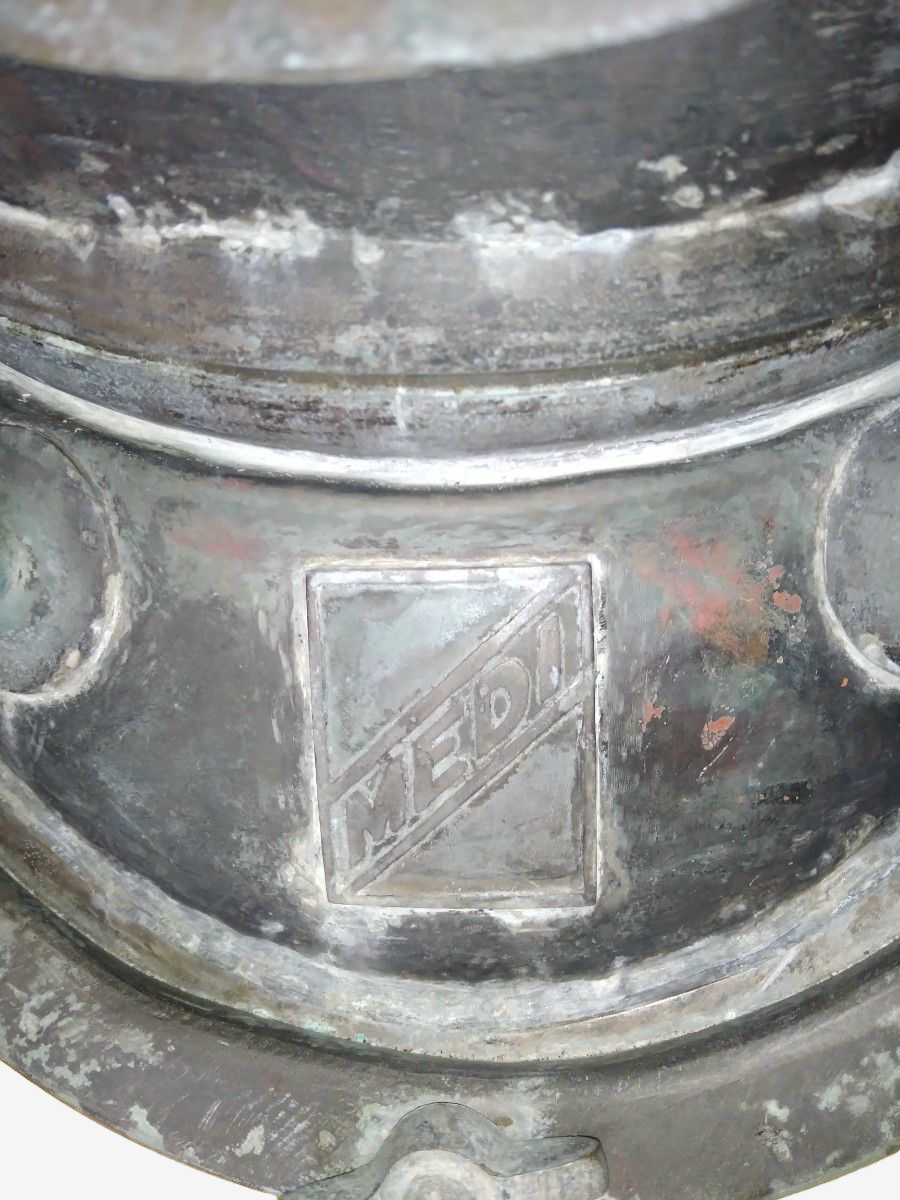
A substantial vintage hard-hat diving helmet of classic commercial form, the darkened metal body fitted with a large circular front viewport, side ports with protective grills, and a broad lower neck assembly, the whole retaining heavy oxidation, marine-toned patina, and age-softened surface character. Apparently marked with a diamond-form badge to the lower front, possibly reading TOA, and found in Japan, the helmet is best understood as a display-grade maritime object of strong decorative and collector appeal. Its sculptural silhouette and richly weathered finish make it particularly suited to nautical interiors, industrial design settings, or cabinets of curiosities.
Item: Vintage retro diving helmet
Category: Maritime & Diving Antiques / Nautical Industrial Object / Deep-Sea Memorabilia
Object Type: Full-size classic hard-hat style diving helmet
Visible Marking: Diamond plate on lower front appears to read TOA or a similar maker mark
Material Read: likely mixed metal construction, visually consistent with copper-alloy / brass / bronze-toned maritime metal components, with heavy oxidation and aged surface bloom
Viewports: large front circular faceplate with side portholes protected by external crossbars
Form Language: traditional commercial / helmet-diving silhouette with bonnet, front port, side ports, neck ring, and lower corselet-style base
Dimensions Provided:
- Height: approx. 43 cm
- Depth: approx. 43 cm
- Width: approx. 37 cm
- Weight: approx. 16 kg
Condition Impression: strong age, oxidation, patina, mineral bloom, surface wear, and likely decorative / collectible condition rather than ready technical use
Market Identity: display-grade nautical object / maritime conversation piece / coastal, industrial, or steampunk collector centerpiece
Overview
This is the kind of object that makes a room rearrange itself around it.
A classic hard-hat diving helmet, even before questions of maker, era, or exact metallurgy are settled, carries one of the most magnetic silhouettes in industrial history. It is instantly cinematic. It belongs equally to labor history, maritime engineering, salvage romance, submarine mythology, and the half-imagined world of men descending into green-black water tethered only by hose, weight, and nerve. Unlike many antiques that require explanation before they begin to glow, a diving helmet announces itself immediately. It has presence before it has provenance.
The present example has exactly that presence. The body swells upward into the iconic rounded bonnet form, the central circular faceplate dominates the composition like a single giant eye, and the side portholes, protected by crossbars, give the whole piece an almost creature-like intelligence. It feels less manufactured than conjured, as though lifted from a shipwreck chapel or an engine room altar. The heavy mineral bloom, the darkened body, the pale oxidation around seams and lower fittings, and the greenish tones behind the glass all contribute to an atmosphere that modern reproductions usually fail to achieve. This one does not look freshly “styled.” It looks weathered into memory.
That matters enormously in the market. Decorative nautical objects often live or die by whether they feel theatrical in the wrong way. Cheap reproductions can be loud but hollow. Authentic old or convincingly old examples have weight, texture, asymmetry, and silence. This helmet has silence. Its 16-kilogram mass alone tells you that it is not pretending. The dimensions, too, support its authority. At roughly 43 cm tall and deep, with a width of about 37 cm, it is large enough to dominate a shelf, console, study, gallery corner, or hospitality installation without disappearing into mere novelty. It is not an ornament. It is an event.
The visible plaque or diamond badge on the lower front appears to suggest TOA, a detail that is especially intriguing in a Japanese context. If this identification is correct, it may connect the object to Japanese diving-industrial manufacture or maritime usage culture, which gives it a sharper identity than a generic “old helmet” listing. Even without overclaiming, that possibility adds a layer of regional specificity that international buyers often find compelling. A helmet found in Japan, potentially tied to Japanese industrial or coastal diving history, is already more narratively alive than a generic decorative prop.
This is also an object of extraordinary crossover appeal. It belongs to maritime collectors, certainly, but also to interior designers, steampunk and industrial aesthetes, film set dressers, luxury hospitality buyers, antique dealers, collectors of scientific and mechanical objects, and anyone building a room around exploration, danger, engineering, or oceanic imagination. In the right setting, it becomes the nucleus of an entire visual world.
Form & Object Presence
The great strength of a traditional diving helmet is that it is both functional and mythic at once. Every curve and aperture originally answered a practical need, but over time those same solutions hardened into archetype. The round bonnet protected the head under pressure. The front and side ports preserved visibility. The lower assembly met the suit and collar system. External bars protected the glass. Fasteners, seams, fittings, and neck hardware made the whole unit survivable in punishing environments. Yet today, when one encounters such an object outside the water, it reads almost as ceremonial armor for the abyss.
This example preserves that archaic-industrial majesty beautifully. The front view is especially strong. The single large round faceplate is framed by a lighter-toned metal ring, creating a dramatic contrast against the darker body. That ring acts almost like the border of a portrait painting. The viewer does not simply look at the helmet. The helmet looks back. The side ports with their protective grills deepen the anthropomorphic quality, giving the object a multi-eyed, watchful stance. The top guard or cage adds still more silhouette interest, crowning the helmet with an almost naval or ecclesiastical profile.
Its lower front is equally compelling. The broad corselet-like base gives the object gravity and architectural footing. The fasteners, knobs, and visible fittings at the lower section remind the viewer that this was not fantasy costume but equipment, designed to seal, withstand, and endure. Even when incomplete for operational use, such features preserve the grammar of purpose. That grammar is what collectors pay for.
The helmet is especially successful as display because it works from every angle. The rear view shows the broad uninterrupted dome, which allows the oxidation patterns and old surface bloom to become almost painterly. The three-quarter views emphasize its marine-animal quality, somewhere between machine and shell. From above and front, the protected crown structure reinforces its ruggedness. It is not a one-view object. It rotates beautifully.
Material, Surface & Patina
From the photographs, the helmet appears to be composed of mixed maritime metals, likely within the family of copper-alloy and brass/bronze-associated construction, though without hands-on verification it is wisest to phrase this as a visual read rather than a laboratory fact. What matters commercially is that the object presents exactly how collectors hope such a thing will present: darkened body, pale oxidation, greenish mineral traces, aged glass, and the unmistakable bloom of long stillness.
The patina is doing enormous work here. It creates depth without any need for embellishment. You see grey-white crusting and oxidation across the lower flange and fitting areas, subtle green and blue marine tonality around the windows and inner glass field, and a darker, almost solemn skin over the main dome. These are not merely “flaws.” They are the topography of time. In maritime objects, sterile shine can actually reduce emotional power. Patina, when coherent and believable, is the soul.
Importantly, this helmet’s surface does not look artificially distressed in the modern decorative sense. It does not have the contrived crispness of newly made imitation props. Instead it has irregularity, softness of edge, and a kind of accumulated atmospheric wear that suggests long storage, marine association, or age-related metal activity. That gives the object authority.
Collectors of nautical metalwork often respond strongly to exactly this kind of finish because it carries two stories at once. First, it signals age and environmental contact. Second, it softens the industrial object into something almost sculptural. The helmet ceases to be mere equipment and becomes a relic. This one has fully crossed that threshold.
Maker / Regional Significance
The most tantalizing detail is the lower-front diamond badge, which appears to resemble TOA. In a Japanese context, that raises the possibility that the helmet may be tied to domestic industrial, diving, or equipment manufacture rather than being a random export-form reproduction. That does not mean one should overstate provenance, but it is absolutely a detail worth foregrounding intelligently.
A Japanese-linked diving helmet has special commercial appeal because Japan’s maritime identity is deep and broad: commercial fishing, salvage, port labor, shipbuilding, pearl diving mythology, naval-industrial history, and coastal engineering all enrich the narrative field around such an object. Even if the exact usage history is unknown, the possibility of Japanese industrial association differentiates it from generic Western reproduction décor.
For international buyers, “found in Japan” is already a meaningful phrase. It carries the implication of preservation culture, unusual sourcing channels, and objects that often escaped Western saturation. When paired with a visually compelling helmet form, that becomes a useful layer of desirability.
Safest wording:
“Vintage TOA-marked or TOA-style diving helmet found in Japan, sold as a display-grade maritime collectible.”
That keeps the mystery alive without making claims you cannot presently prove.
Historical Atmosphere
A diving helmet like this condenses an entire age of human ambition into one object. It belongs to the centuries when the sea was not merely crossed but entered, when men were lowered into dark working depths to inspect hulls, cut obstructions, recover lines, salvage losses, and perform the brutal invisible labor beneath maritime commerce. It belongs to the time before compact modern scuba gear democratized underwater experience, when descent was slow, encumbered, dangerous, and mechanically mediated.
That historical charge matters to collectors. The appeal is not just “old metal.” It is the sensation of technology at the edge of fear. A hard-hat diving helmet evokes pressure, isolation, communication through umbilicals, and a kind of nearly mythic courage. It is one of the few industrial objects that remains emotionally legible even to people who know little about engineering history. Everyone understands, instinctively, that such a helmet was made for worlds hostile to ordinary human life.
This is why the category performs so well in interiors. The helmet functions as a condensed narrative engine. Place it in a study, library, hotel bar, coastal residence, or collector display, and suddenly the room acquires stories: wrecks, harbors, storms, signal lamps, brass instruments, sea charts, watch officers, and ghostly descents below the hull line. Few antiques do atmosphere this efficiently.
Condition Report
The seller’s dimensions and weight indicate a substantial object. The photographs show:
- heavy age and patina across the entire metal body
- oxidized lower rim / flange area
- weathering around seams and fittings
- aged viewing glass with internal discoloration / marine-toned residue visible
- general surface wear consistent with long storage or aged use/display
- no claim of operational completeness or diving readiness
Commercial Condition Summary
Decorative antique / vintage condition with strong age, oxidation, patina, and surface weathering. Best understood and sold as a display-grade maritime collectible rather than certified operational equipment.
That is the right lane. It protects the listing while enhancing desirability. Buyers for this object usually do not want restoration to bright polished condition. They want exactly this haunted shipyard dignity.
Collector Relevance
This helmet has unusually broad collector reach.
Maritime Collectors
It sits naturally in any group of nautical instruments, ship lanterns, brass compasses, telegraphs, naval trunks, or salvage artifacts. It provides immediate scale and drama.
Interior Designers
For industrial, steampunk, coastal, dark academia, gentlemen’s club, or maritime-luxury environments, this is a signature anchor piece. One object can set the tone for the whole room.
Film / Hospitality / Display Buyers
Restaurants, bars, yacht clubs, hotel lounges, and set designers are constantly hunting for objects with instant narrative force. This is exactly that type of object.
Japanese Antique Export Buyers
Because it appears to be a Japanese-market-found example with possible maker identification, it offers more intrigue than a generic decorative reproduction.
Cabinet of Curiosities Buyers
For collectors who mix scientific, mechanical, natural-history, and industrial pieces, a diving helmet is one of the crown-jewel object types.
Collector’s Resonance
Some antiques sit quietly and ask to be appreciated. This one stands like a witness. It feels as though it has listened to pressure, rope signals, and the muffled violence of water. Whether or not its full operational biography can be reconstructed, its emotional biography is already intact. It is an object from the era when human beings answered danger not by retreating from it, but by bolting themselves into metal and stepping closer.
That is why diving helmets endure as icons. They are not merely maritime. They are existential. They embody bravery, mechanical trust, isolation, and the old industrial belief that ingenuity could carry flesh into impossible places. This example, with its scarred metal, dim glass, and mineral bloom, retains all of that poetry. It does not need restoration to become beautiful. It is beautiful because time has already spoken across it.
Placed correctly, this piece becomes more than décor. It becomes a room’s submerged moon.
Confidence & Verification Notes
High Confidence
- full-size classic diving helmet form
- heavy metal construction
- approximate dimensions and weight as given by seller
- strong age patina and oxidation
- display-grade collector appeal
Authenticity & Stewardship
Evaluated under the Japonista Maritime & Diving Heritage Authentication & Provenance Framework™
Each object is assessed through a structured, cross-disciplinary review:
• Object typology and period attribution (nautical instruments, ship fittings, diving apparatus, naval equipment)
• Material analysis across brass, copper, bronze, steel, glass, rubber, and composite components
• Manufacturing and maker identification, including foundry marks, engraved plates, and workshop signatures
• Functional and mechanical assessment where applicable (valves, gauges, seals, joints)
• Surface condition and patina evaluation, distinguishing age-consistent oxidation from later alteration
• Provenance indicators, including maritime usage context or collection history where available
Guaranteed 100% Authentic.
All works are curated and backed by the Japonista Lifetime Authenticity Warranty™, with emphasis on material integrity, historical accuracy, and responsible documentation.
A Note on Navigation, Depth & Human Ingenuity
Maritime and diving objects were created at the edge of human capability—where navigation depended on precision, and survival relied on engineering.
From shipboard instruments to early diving helmets, these objects reflect a convergence of craft, science, and risk. Each component—glass port, weighted fitting, pressure mechanism—was designed with purpose under demanding conditions.
At Japonista, these works are approached as functional artifacts of exploration. Wear, salt exposure, oxidation, and structural aging are read as part of their operational history rather than imperfection.
They are records of movement across oceans and descent into depth—material traces of environments few objects endure.
Inquiries, Availability, and Private Consideration
Maritime and diving antiques are often singular due to survival rates, condition, and construction variation. Larger or mechanically complex pieces may be especially limited.
All inquiries are handled with discretion. We welcome thoughtful discussion regarding maker attribution, functional components, restoration history, and display considerations.
Collectors, institutions, and designers building maritime-focused collections may consult with us for deeper guidance.
Concierge Support & Collector Guidance
Japonista Concierge™ provides tailored support for maritime collectors:
• Object identification and dating across nautical and diving categories
• Material preservation guidance, particularly for metals exposed to marine environments
• Display strategies for both decorative and large-format industrial objects
• Mechanical stabilization considerations for legacy equipment
• Acquisition planning for building cohesive maritime collections
For rare or large-scale works, private reservation or structured acquisition arrangements may be available.
Before Proceeding
We encourage collectors to review our shop policies and handling guidelines available through the links in our website footer. These outline shipping logistics, condition disclosure, and care considerations specific to heavy, fragile, or mechanically complex objects.
Understanding these guidelines ensures safe handling and long-term preservation.
A Closing Note
Maritime and diving artifacts are shaped by environments defined by pressure, motion, and uncertainty. They carry the marks of salt, depth, and time.
What remains is not only the object, but the evidence of its endurance.
At Japonista, we steward these works as records of exploration and engineering, ensuring they continue forward with context, integrity, and respect for the conditions that formed them.
If you have questions or wish to explore related items, please feel free to contact Japonista Concierge™ at any time.