Rare Vintage, Antiques and Art Collector / Curator / Personal Shopper From Japan
Vintage Tailor Toyo TT11145 Reversible Sukajan M-L 335th Chiefs Chitose Hawaii Pan Am Flying Clippers Souvenir Jacket M-L
Vintage Tailor Toyo TT11145 Reversible Sukajan M-L 335th Chiefs Chitose Hawaii Pan Am Flying Clippers Souvenir Jacket M-L
Couldn't load pickup availability
Have a reasonable price in mind? Submit your best offer and our concierge will review it personally.
Rare Discontinued Toyo Enterprise Aviation Sukajan with 1954 USAF Squadron Artwork, Personalized “Bob” Embroidery and Hawaiian Islands Reverse
Description
A rare and highly narrative reversible sukajan by Tailor Toyo, combining two distinct chapters of postwar Pacific aviation culture within one collectible Japanese souvenir jacket.
The first face is rendered in lustrous emerald-green satin with silver-gray sleeves and burgundy, gold and cream striped ribbing. Its back is dominated by a profile portrait derived from the historic insignia of the 335th Fighter Squadron “Chiefs”, framed by the embroidered motto “FOURTH BUT FIRST” and the commemorative wording “335TH FTR SQDN CHIEFS CHITOSE 1954.”
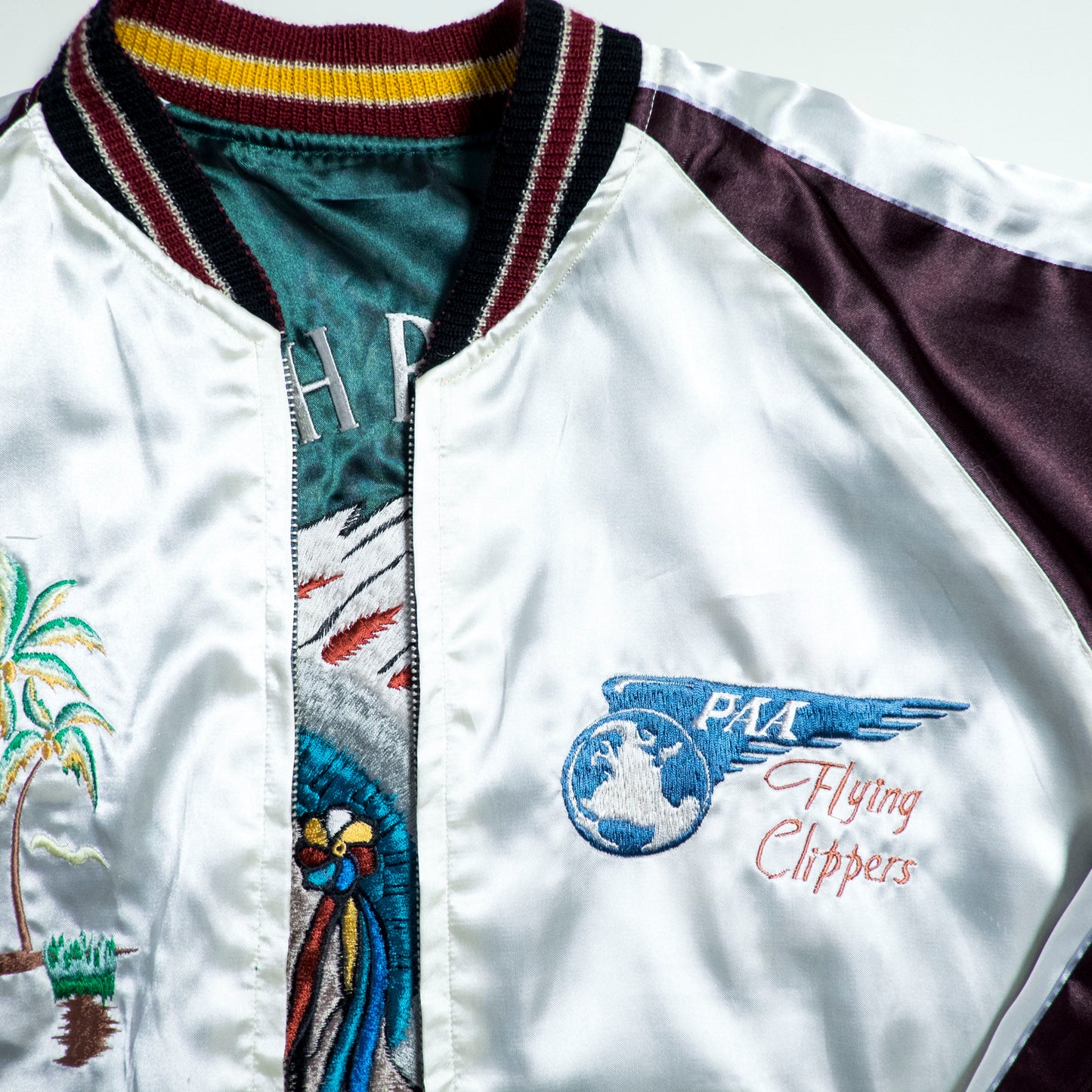
The second face travels south from Hokkaido to Hawaii. A cream satin body with deep wine-burgundy sleeves carries an embroidered Pan American Airways-inspired travel composition featuring a classic passenger aircraft, the words “Hawaii” and “Flying Clippers,” labeled Hawaiian islands, tropical imagery, marine life and the winged PAA globe emblem.
One face feels military, personal and squadron-specific. The other evokes the golden age of trans-Pacific air travel. Together, they create a wearable textile document of the routes, bases and memories that connected Japan, Hawaii and the American Pacific during the mid-20th century.
Opening Impression
This jacket possesses the quality that separates the strongest Tailor Toyo pieces from ordinary embroidered bombers: it tells a complete story on both sides.
The green face reads like a personalized squadron tour jacket. Its large central portrait, military lettering, heraldic chest badge and embroidered name give it the atmosphere of a piece commissioned to preserve one individual’s service memories.
The cream-and-burgundy face becomes a colorful travel souvenir. A Pan American Flying Clipper crosses above an embroidered map of Hawaii, surrounded by island names and small scenes drawn from the visual language of vintage tourism, postcards and airline advertising.
It is simultaneously a military-history sukajan, an aviation collectible, a Hawaii souvenir jacket and a distinctive example of Japanese amekaji craftsmanship.
Identification and Subject
Brand: Tailor Toyo
Manufacturer: Toyo Enterprise Co., Ltd.
Model number: TT11145
Historic catalog reference: No. 160
Garment type: Fully reversible sukajan / Japanese souvenir jacket
Tag size: XL
Construction: Lightweight satin-to-satin reversible bomber
Material: 100% polyester satin on both faces
Primary face: Emerald green and silver-gray
Reverse face: Cream white and wine burgundy
Principal subjects: 335th Fighter Squadron Chiefs, Chitose 1954, Native American chief-profile squadron emblem, Hawaii map, Pan American Airways Flying Clippers and trans-Pacific aviation
Personalized embroidery: “Bob” with Japanese katakana 「バブ」
Matching documentation identifies this exact design as Tailor Toyo model TT11145, with the green “335th FTR SQDN Chiefs Chitose 1954” face paired with the Hawaii and Flying Clippers reverse. Surviving catalog information records the original construction as satin on both sides, without padding, and lists the original retail price as ¥29,400.
The 335th Fighter Squadron “Chiefs” Face
Fourth But First
The words “FOURTH BUT FIRST” arch across the upper back in large cream-colored embroidered lettering.
This was the motto associated with the celebrated 4th Fighter Group and later 4th Fighter Wing lineage. The 335th Fighter Squadron formed part of that organization and carried the nickname “Chiefs.” The embroidered wording therefore does not function as decorative fantasy. It refers to a documented American fighter-unit tradition.
The motto gives the jacket an assertive, heraldic structure. It crowns the back portrait and immediately establishes the military identity of the design before the viewer reaches the squadron wording below.
Historic Chief-Profile Insignia
At the center is a large profile portrait wearing a feathered headdress, densely embroidered in cream, white, gray, turquoise, red, yellow and dark outlining.
The image reproduces the historical visual identity of the 335th Fighter Squadron rather than serving as unrelated generic ornament. The United States Air Force’s official squadron history explains that the “Chief’s Head” insignia originated with RAF No. 121 Squadron, one of the Eagle Squadrons formed from American volunteers before the United States entered World War II. That lineage later became part of the 335th Fighter Squadron.
The portrait is executed with a deliberate mid-century souvenir-jacket character. The facial modeling is relatively flat and graphic, while the feathers create the composition’s most elaborate region through repeated white shapes, colored interior accents and red-tipped ends.
The turquoise headband introduces a bright horizontal division between the face and headdress. Red, yellow and blue hanging ornaments bring movement to the lower portion of the portrait and echo the color of the striped ribbing.
Chitose 1954
Below the portrait appears the embroidered wording:
335TH FTR SQDN CHIEFS
CHITOSE 1954
This inscription refers to Chitose Air Base in Hokkaido, Japan. Historical unit records place the 335th Fighter Squadron at Chitose from approximately November 26, 1954 until December 8, 1957, during the post-Korean War period.
The date 1954 belongs to the historical subject being commemorated. It should not be interpreted as the manufacturing date of this Tailor Toyo reproduction.
The 4th Fighter organization relocated to Chitose during this era with F-86 Sabre aircraft and participated in the air defense of northern Japan. That history gives the green face unusual specificity. It is not simply a broadly military-styled jacket, but a textile recreation of an identifiable base, unit and moment in postwar aviation history.
Squadron-Style Chest Embroidery
The front continues the military narrative.
One chest carries a heraldic shield embroidered in yellow-gold and blue, topped by a fierce feline head and accompanied by the “Fourth But First” banner. The angular shield, diagonal lightning-like element and warm gold thread contrast sharply against the deep-green satin.
The opposite chest carries the personalized name:
Bob
バブ
The katakana is embroidered exactly as shown on the garment. Although 「ボブ」 would be the more conventional modern katakana rendering of Bob, the jacket preserves the original design’s 「バブ」 lettering.
This personalized detail strengthens the period-tour-jacket atmosphere. Names and nicknames were central to the emotional language of souvenir garments, transforming a standardized design into something that felt connected to one wearer, posting or remembered journey.
Green and Silver Color Architecture
The green face uses a rich emerald body with pale silver-gray sleeves. Long green satin panels run from the neck across the shoulders and down the sleeves, bordered by fine reddish piping.
Burgundy ribbing is striped with yellow and cream at the collar, cuffs and hem. These warm stripes prevent the cool green-and-silver body from feeling sterile and quietly repeat the red and yellow accents within the chief-profile embroidery.
The combination feels distinctly mid-century, somewhere between a military athletic jacket, a squadron souvenir and a luxurious Japanese satin bomber.
Hawaii and Flying Clippers Reverse
Hawaii Travel Panorama
The reverse replaces military green with a cream-white body framed by deep wine-burgundy raglan sleeves.
The back is headed by the word “Hawaii” in large copper-brown script. Beneath it, a classic passenger aircraft travels horizontally across the upper body. The fuselage bears “Flying Clipper,” while the tail carries “PAA,” referring to Pan American Airways.
The aircraft is embroidered in white, gray, black, turquoise and red, with its long profile forming a visual bridge across the upper back.
Below the plane is a stylized map of the Hawaiian archipelago. Individual islands are outlined and labeled in varied colors:
Kauai
Niihau
Oahu
Molokai
Lanai
Kahoolawe
Maui
Hawaii
Small decorative elements enrich the map. These include tropical botanical imagery, a hula figure, marine fish and island-specific interior motifs.
Rather than presenting Hawaii as a single palm-tree symbol, the jacket treats the islands as a journey across an archipelago.
Golden Age of Pacific Aviation
The Flying Clippers imagery evokes the period when Pan American Airways transformed Hawaii into a major gateway within trans-Pacific aviation.
Pan Am began developing its Pacific routes during the 1930s, initially through survey and airmail flights before establishing scheduled trans-Pacific passenger service. Honolulu became one of the defining stops within the romantic public image of Clipper travel.
The aircraft embroidered here resembles a postwar land-based passenger airliner rather than one of the earlier ocean-landing flying boats. The phrase “Flying Clippers,” however, preserves the prestigious Clipper branding that Pan American continued to associate with international travel.
The visual effect is pure aviation nostalgia: white satin, an airborne silver aircraft, colorful island outlines and the idea of Hawaii as a distant point reached through the expanding sky routes of the Pacific.
PAA Flying Clippers Chest
The cream face carries two balanced front compositions.
One chest displays a pair of palm trees standing on a small island or shoreline, accompanied by pale cloud embroidery and small green vegetation.
The opposite chest carries the blue winged-globe insignia with the letters PAA and the embroidered script “Flying Clippers.”
These designs are smaller and more restrained than the back map, giving the jacket a highly wearable front while retaining immediate recognition for collectors of airline and aviation memorabilia.
Wine-Burgundy Sleeves
The reverse sleeves are a deep burgundy-brown satin, divided by long cream stripes running from shoulder to cuff.
The collar, cuffs and hem use black, burgundy, cream and metallic-looking striped ribbing. The darker trim grounds the light central body and gives the Hawaii face a slightly dressier, more mature appearance than the brighter green reverse.
The two wearable faces share the same fundamental silhouette while presenting entirely different color identities.
Iconography and Cultural Meaning
Military Souvenir Culture
Military souvenir jackets were created to preserve memory through clothing. Unit names, bases, dates, aircraft, maps and personal names allowed service members to transform garments into portable records of where they had been.
The official Toyo Enterprise history traces the sukajan tradition to the late 1940s, when Japanese-made embroidered jackets were supplied to American military-base PX stores as souvenirs. Toyo Enterprise’s predecessor, Kosho & Co., participated directly in this postwar trade.
TT11145 draws heavily from that historical language. Chitose, 1954, the squadron insignia and the name Bob provide a military-personal narrative, while the Hawaii reverse adds the tourism and travel imagery frequently encountered on genuine period souvenir garments.
Chief-Profile Squadron Emblem
The central portrait should be understood within the documented history of the 335th Fighter Squadron insignia.
Rather than presenting the imagery as a generalized depiction of Native American identity, the jacket recreates a specific military emblem inherited from RAF No. 121 Squadron and later associated with the 335th “Chiefs.”
For collectors, this distinction is important. The image is part of an identifiable unit history and should be described respectfully in that archival context.
Hawaii Map
Map jackets occupy an important place within souvenir-jacket collecting because they record geography as memory.
The labeled Hawaiian islands transform the reverse into a textile itinerary. Instead of one symbolic destination, the design represents a chain of places connected through aircraft, sea routes, military movement and tourism.
Airplane and Clipper Imagery
The aircraft symbolizes mobility, technological optimism and the shrinking distances of the postwar Pacific.
Placed opposite a Chitose fighter-squadron composition, it also creates a compelling civilian-and-military aviation pairing. One side concerns air defense and squadron identity. The other concerns passenger travel, islands and the romance of international flight.
Style, Materials and Construction
This garment is a lightweight, non-padded sukajan designed for transitional weather and fluid layering.
Its known and visible construction details include:
- Fully reversible two-sided design
- 100% polyester satin on both wearable faces
- Lightweight, non-insulated construction
- Dense multicolor machine embroidery
- Raglan sleeve silhouette
- Reversible metal zipper
- TYE Tokyo-branded zipper hardware
- Angled welt pockets on both sides
- Contrasting shoulder and sleeve stripes
- Fine decorative piping
- Striped rib-knit collar, cuffs and waistband
- Tailor Toyo Hand Embroidery label
- Toyo Enterprise care label
- Japanese M-L size tag
Matching photographs of this exact example show the Tailor Toyo Hand Embroidery label, yellow XL size tab, Toyo Enterprise care label and a zipper pull engraved TYE TOKYO.
The polyester satin produces a bright, flowing sheen without the fragility associated with some vintage acetate or silk examples. Its surface shifts noticeably with light, causing the green to move between emerald and forest tones while the cream side changes from bright ivory to warmer champagne.
Period Assessment
This is a discontinued early-21st-century Tailor Toyo reproduction sukajan, not an original garment manufactured in 1954.
The Chitose 1954 wording identifies the historical scene recreated by the embroidery. The garment itself belongs to Tailor Toyo’s later archive of historically inspired souvenir-jacket designs.
Surviving model references identify it as TT11145 / No. 160, originally priced at ¥29,400. The model has been described in the Japanese secondary market as an older Tailor Toyo release purchased approximately fifteen years ago, placing it broadly within the late-2000s to early-2010s era. Because a confirmed season catalog has not been located, it is best presented as a discontinued archive piece rather than assigned an unsupported exact production year.
The jacket is therefore collectible for three separate reasons:
- It is a discontinued Tailor Toyo model.
- It recreates a highly specific 335th Fighter Squadron Chitose design.
- It offers an unusually detailed Hawaii and Pan American Airways reverse.
Condition
Good pre-owned collectible condition with visible characteristics consistent with age, storage and prior use.
The photographs show:
- General wrinkling and storage creasing across both satin faces
- Normal changes in sheen created by the direction of the satin weave
- Light surface wear consistent with a previously owned jacket
- Possible faint age toning or light discoloration on portions of the cream satin, particularly around lower areas and edges
- Minor surface irregularities that may include fine pulls or handling marks
- Embroidery remaining vivid, legible and substantially intact
- Chief-profile, lettering, aircraft, map and chest embroidery retaining strong definition
- Rib-knit collar, cuffs and waistband appearing complete
- Reversible zipper present
- No obvious large holes, major tears or severe areas of embroidery loss visible in the supplied photographs
The reflective satin can exaggerate folds, shadows and tonal variation under direct photography. Buyers should examine every image closely, as the photographs form an important part of the condition description.
This garment has not been represented as new, mint or unworn. Its light signs of history are consistent with the character of a discontinued, pre-owned Tailor Toyo souvenir jacket.
Size and Dimensions
A surviving period size chart associated with model No. 160 lists the following reference measurements for size M-L:
- Chest width: approximately 62 cm / 24.4 in
- Body length including ribbing: approximately 61 cm / 24.0 in
- Yuki sleeve length, center back neck to cuff: approximately 89 cm / 35.0 in
These are model-chart reference measurements and minor variation may occur between individual garments and measuring methods.
The short bomber body and raglan sleeve construction are characteristic of the sukajan silhouette. Buyers should compare the dimensions with a well-fitting jacket.
Fit and Styling
The jacket offers a classic short souvenir-jacket profile with a relaxed chest, flexible raglan shoulders and a gathered rib-knit waistband.
The green face pairs naturally with dark denim, military trousers, fatigue pants, chinos and leather footwear. Its silver sleeves and aviation embroidery give it a strong amekaji and heritage-flight-jacket presence.
The cream Hawaii face works beautifully with burgundy, brown, indigo, cream or tropical-inspired styling. It can be worn as a softer resort-aviation piece while retaining the authority of a collector-grade Tailor Toyo jacket.
Because each side has a complete front and back design, this is effectively two highly distinctive jackets occupying one garment.
Design Character and Collectibility
This model stands apart from more familiar tiger, dragon and eagle sukajan designs.
Its appeal is unusually broad:
- Tailor Toyo and Toyo Enterprise collectors
- Military souvenir-jacket enthusiasts
- 335th Fighter Squadron and 4th Fighter Wing historians
- Chitose and Hokkaido aviation collectors
- F-86 Sabre-era memorabilia enthusiasts
- Pan American Airways collectors
- Flying Clipper and airline-history collectors
- Hawaii souvenir and map-jacket collectors
- Amekaji and Japanese Americana buyers
- Personalized military-garment collectors
- Archive streetwear and reversible fashion enthusiasts
The jacket’s embroidered “Bob” personalization is especially evocative. It gives the piece the atmosphere of an individual tour souvenir rather than a purely anonymous fashion reproduction.
The dual geography also strengthens its narrative rarity. Few jackets move so convincingly between the cold northern airfields of Hokkaido and the tropical air routes of Hawaii.
On display, the green face reads like a squadron banner. The cream face resembles a satin travel poster. Worn in motion, the reflective fabric animates the feathers, aircraft, islands and lettering as the light moves across the folds.
Purchase, Shipping and Vintage Policy
This is a pre-owned, discontinued collectible garment offered in its present condition. Natural wear, storage creasing, surface variation, minor thread irregularities, faint marks and other characteristics associated with age and previous use should be expected.
Please review all photographs, measurements and descriptive information carefully before purchasing. Colors may appear slightly different depending on lighting, screen calibration and the reflective direction of the satin.
Because of the individual nature of vintage, pre-owned and collectible garments, all purchases are considered final. Returns, exchanges, cancellations and claims based on fit, minor condition characteristics, color interpretation or personal preference cannot be accepted.
The item will be packed carefully and shipped worldwide from Japan through EMS or another appropriate tracked international service.
Preparation, shipping and handling normally takes 5–10 business days or earlier. Tracking information will be provided following dispatch.
Import duties, taxes, customs charges and local handling fees, where applicable, remain the responsibility of the buyer and are not included in the item price or shipping charge.
Respectful offers may be considered depending on current demand, rarity and availability.
If you are looking for this design or model in another size, please feel free to message us. Although availability cannot be guaranteed, we may be able to locate the same or a closely matching piece in a different size through our sourcing network.
Hashtags
#TailorToyo #ToyoEnterprise #TT11145 #ReversibleSukajan #Sukajan #SouvenirJacket #Chitose1954 #335thFighterSquadron #FourthButFirst #ChiefsSquadron #MilitaryJacket #AviationJacket #PanAmerican #PanAm #FlyingClippers #HawaiiJacket #HawaiiMap #JapaneseStreetwear #Amekaji #JapaneseAmericana #EmbroideredJacket #SatinBomber #YokosukaJacket #ArchiveFashion #MilitaryCollectible #AirlineCollectible #WearableHistory #JapanVintageStyle #UnisexBomber #Japonista
tailor toyo jacket, reversible sukajan, chitose jacket, 335th chiefs, pan am jacket, hawaii sukajan, flying clippers, souvenir jacket, japanese bomber, aviation jacket, native chief art, amekaji jacket, vintage streetwear
Material Tags
polyester satin, embroidery thread, rib knit, metal zipper, embroidered textile, satin fabric, woven polyester