Rare Vintage, Antiques and Art Collector / Curator / Personal Shopper From Japan
Vintage Tailor Toyo M18279 Honolulu Hawaii Hula Girl Dragon Velvet Reversible Sukajan Japanese Souvenir Jacket
Vintage Tailor Toyo M18279 Honolulu Hawaii Hula Girl Dragon Velvet Reversible Sukajan Japanese Souvenir Jacket
Couldn't load pickup availability
Have a reasonable price in mind? Submit your best offer and our concierge will review it personally.
Early M-Number Tailor Toyo Hawaii Jacket with Dancing Hula Girl, Rising Dragons and Quilted Island Map Reverse
Description
A rare early Tailor Toyo M-number reversible sukajan combining Japanese souvenir-jacket craftsmanship with richly embroidered Hawaiian travel imagery.
The primary face is constructed in deep chocolate-brown velveteen. Across the back, a hula dancer appears beneath the sweeping embroidered words “Honolulu” and “Hawaii,” framed by a volcanic island landscape, shoreline and stylized clouds. Both sleeves carry long rising dragons worked in ivory, grey, gold and red thread, while mirrored palm-tree landscapes decorate the chest.
Reverse the jacket and the mood changes completely.
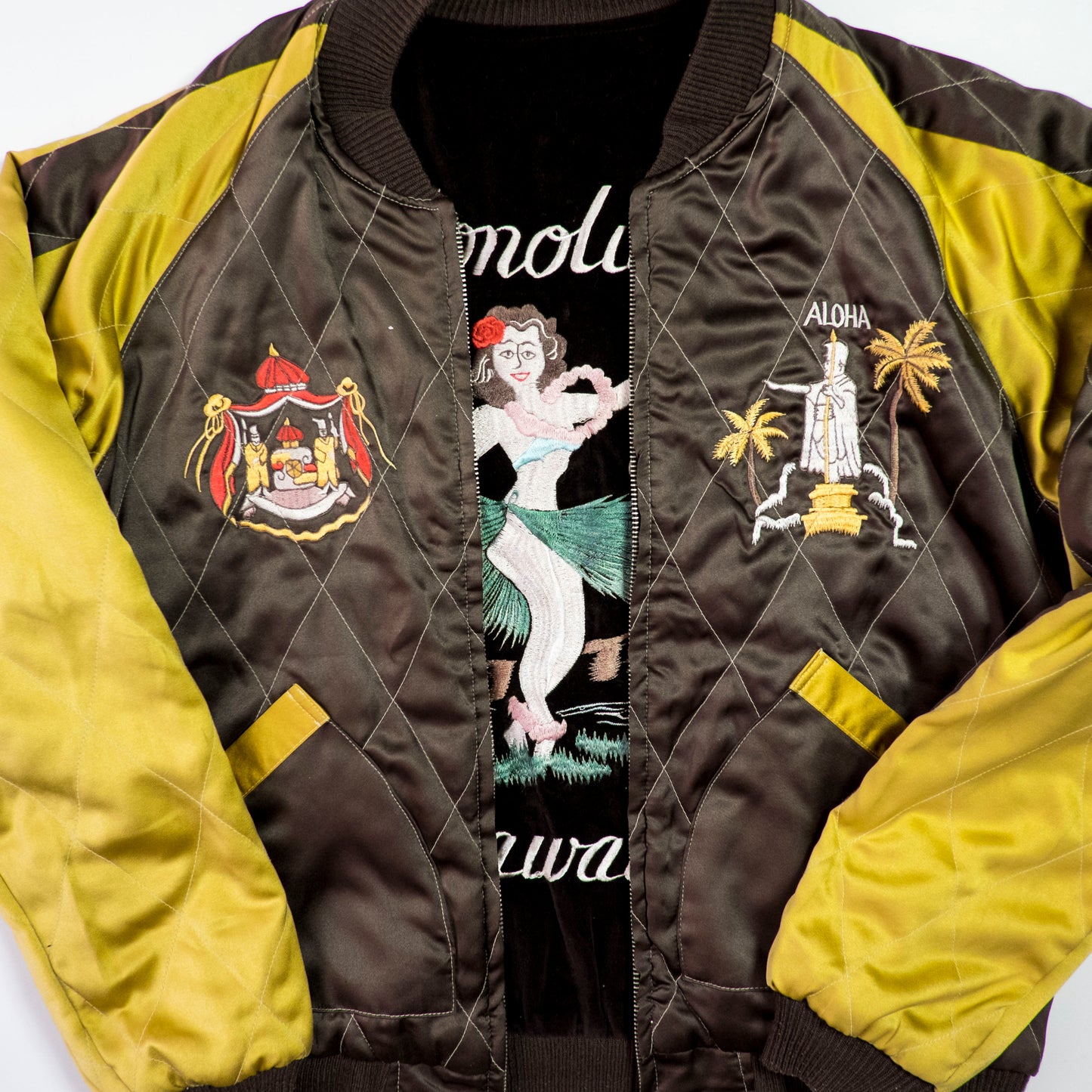
The second face is made from glossy brown and antique-gold satin, stitched throughout with a large diamond-quilt pattern. Its back presents an embroidered map of the Hawaiian Islands surrounded by palm trees, clouds, an outrigger canoe and the welcoming word “Aloha.” The chest carries a Hawaiian royal-style crest on one side and a tropical tower-and-palm scene on the other.
The exact combination of hula dancer, Honolulu lettering, sleeve dragons, palm-tree chest embroidery and quilted Hawaii map reverse is documented in Japan as the early Tailor Toyo M18279 model.
This is a particularly atmospheric Tailor Toyo design. Rather than choosing between Japanese mythology and tropical souvenir imagery, it lets both worlds share the same jacket.
Opening Statement
Honolulu glows across dark velvet.
A hula dancer moves beneath the lettering while dragons climb the sleeves like embroidered guardians. Turn the jacket inside out and the midnight island scene becomes a quilted travel map in bronze, gold and palm green.
It is Hawaii remembered through the language of the Japanese sukajan: romantic, theatrical and built to be seen from every direction. 🌺🐉
Identification
Brand: Tailor Toyo
Manufacturer: Toyo Enterprise
Model: M18279
Production Series: Early M-number Tailor Toyo
Garment Type: Reversible padded sukajan
Alternative Names: Japanese souvenir jacket, Yokosuka jacket, embroidered bomber
Primary Theme: Honolulu and the Hawaiian Islands
Primary Face: Dark brown velveteen
Reverse Face: Brown and antique-gold quilted satin
Back Motifs: Hula dancer, Hawaii landscape, Hawaiian Islands map, palms and outrigger canoe
Sleeve Motifs: Rising East Asian dragons and cloud forms
Chest Motifs: Palm-tree islands, royal-style crest and tropical tower scene
Construction: Fully reversible, lightly padded, raglan sleeve
Closure: Reversible metal zipper
Pockets: Angled hand pockets on both wearable faces
Tagged Size: Label not shown in the supplied photographs
Measured Fit: Closely consistent with Japanese size M examples of this model
Gender Presentation: Unisex
Origin: Japanese-market Tailor Toyo fashion
Tailor Toyo has produced souvenir jackets for more than half a century and specializes in reviving the materials, motifs and construction associated with postwar sukajan.
The Velveteen Honolulu Face
The velveteen side carries the jacket’s most dramatic composition.
The body and sleeves are formed from dark brown fabric whose short pile shifts between espresso, black-brown and muted plum according to the direction of the light. This changing surface creates a deep stage for the pale embroidery.
Across the upper back, “Honolulu” is written in flowing ivory script. Beneath it stands a dancing woman wearing a green grass skirt and pink lei, her arms raised in a rhythmic pose. A low volcanic island rises behind her, while dark water and shoreline embroidery ground the scene.
The word “Hawaii” completes the composition beneath the dancer.
The design resembles an embroidered mid-century travel postcard, but the dark velveteen prevents it from feeling overly cheerful or novelty-driven. The pale figure, green skirt and pink accents glow against the nearly black ground.
Hula Dancer Embroidery
The central figure gives this model its identity.
She is rendered with stylized facial features, waved hair, a flower and lei, pale garments and a layered green skirt. The stitch direction changes across the skirt to suggest movement, while small pink details at the wrists, ankles and neckline connect the figure visually to the surrounding tropical imagery.
Hula imagery appears in historic Hawaiian souvenir jackets preserved and reproduced within the Tailor Toyo archive. Web Japan specifically illustrates a Honolulu souvenir jacket with a dancing hula girl from the Tailor Toyo collection, showing that this subject belongs to the broader history of regional souvenir embroidery rather than being a recent decorative invention.
Here, the dancer is not treated as a tiny decorative emblem. She occupies the central visual axis of the back, turning the garment into a full Hawaiian scene.
Rising Dragon Sleeves
Each velveteen sleeve carries an elongated dragon surrounded by tightly curled cloud forms.
The dragons are embroidered predominantly in ivory and silver-grey, with gold claws, red mouths and small yellow details. Their bodies rise vertically from the cuffs toward the shoulders, allowing the imagery to follow the wearer’s arms.
This sleeve placement gives the jacket its Japanese counterpoint.
The hula dancer and Honolulu lettering establish the location, while the dragons retain the visual vocabulary of classic sukajan. They act almost like guardians around the central island scene, linking the Hawaiian subject back to the jacket’s East Asian souvenir tradition.
Because the designs continue along both sleeves, the jacket remains visually active even when viewed from the side.
Palm-Tree Chest Motifs
The front of the velveteen face is comparatively restrained.
Mirrored tropical islands sit above the pockets, each showing a tall palm tree, low greenery, cloud lines and a reflection beneath. The embroidery uses green, cream, gold and pale pink against the dark brown ground.
Their symmetry balances the much larger imagery on the sleeves and back.
When the jacket is zipped, the two palms face one another across the center. When worn open, each becomes an independent chest emblem.
The black-trimmed angled pockets nearly disappear into the velveteen, preserving the clean front silhouette.
The Quilted Aloha Face
The reverse changes the garment from dark velvet to luminous satin.
The body is chocolate brown, while the raglan sleeves are antique gold. Both areas are crossed by diamond quilting in pale thread, giving the surface a geometric texture that catches light differently across every panel.
This face feels lighter, brighter and more overtly mid-century.
The diamond quilting is functional as well as decorative. It secures the internal padding while recreating the distinctive look of early insulated souvenir jackets.
The contrast between dark brown and muted gold gives the reverse a warmer, more glamorous presence than the velvet face.
Hawaiian Islands Map
The reverse back presents a stylized map of the Hawaiian archipelago beneath the embroidered word “Aloha.”
The islands are individually outlined and labelled:
Kauai
Niihau
Oahu
Lanai
Kahoolawe
Molokai
Maui
Hawaii
Different colors distinguish the island names and outlines, including turquoise, pink, green, ivory and gold.
Rather than creating a strict cartographic rendering, the embroidery treats the islands as a decorative constellation floating among palm trees and clouds.
The map stretches diagonally across the brown quilted ground, giving the back movement while leaving enough open satin for the diamond stitching to remain visible.
Aloha Lettering
The word “Aloha” is embroidered high across the reverse back in golden script.
Its sweeping lettering mirrors the “Honolulu” script on the opposite face, creating a thoughtful relationship between the two sides:
One face names the city and islands.
The other offers their greeting.
The golden thread coordinates with the sleeves and brightens the upper composition without overwhelming the map below.
Palm Trees, Clouds and Canoe
Clusters of tall palms rise across the map, worked in muted green, cream, gold and brown.
White cloud outlines fill the spaces between the island groups, creating a playful travel-poster atmosphere. At the lower center, a small outrigger canoe carries several embroidered figures across stylized waves.
The canoe is one of the most charming details on the jacket.
It rewards close inspection and prevents the map from feeling purely diagrammatic. The small figures give the scene life, while the surrounding water and palms turn the geography into a lived island landscape.
Reverse Chest Embroidery
The quilted front carries two different emblems.
One chest displays a richly detailed Hawaiian royal-style crest with red canopy, gold ornament and shield-like central forms. The opposite chest presents a tall Honolulu tower surrounded by palm trees and the word “ALOHA.”
These motifs provide strong visual interest without competing with the larger map on the back.
The angled pockets are trimmed in matching antique-gold satin, creating a clean connection between the body and sleeves.
Two Complete Personalities
The jacket offers two genuinely distinct presentations.
Velveteen Face
Dark chocolate-black ground
Honolulu and Hawaii lettering
Central hula dancer
Volcanic island landscape
Rising dragons on both sleeves
Mirrored palm-tree chest embroidery
Soft matte pile with changing tonal depth
Quilted Satin Face
Chocolate-brown body
Antique-gold sleeves
Diamond quilting throughout
Aloha lettering
Hawaiian Islands map
Palm trees, clouds and outrigger canoe
Royal-style crest and tower chest motifs
Luminous padded bomber character
This is not a reversible jacket where one side feels secondary. Each face has its own complete composition, color architecture and styling possibilities.
Color Architecture
The palette is unusually sophisticated for a tropical souvenir jacket.
The velveteen face is dominated by dark brown, ivory and muted green, with restrained touches of pink, red and gold.
The satin face introduces more warmth through bronze-brown and antique mustard gold. Turquoise island outlines and pink lettering provide small sparks of color across the map.
The restrained colors allow the Hawaiian imagery to remain playful without becoming costume-like.
Depending on the lighting, the jacket may appear:
Dark espresso and silver
Black-brown and pale green
Bronze and antique gold
Muted plum and champagne
Chocolate and tropical turquoise
Materials and Construction
The exact care and composition label is not visible in the supplied photographs.
The visible construction is consistent with early Tailor Toyo velveteen and quilted-satin souvenir jackets:
Exterior Face: Dense velveteen with soft directional pile
Reverse Face: Smooth synthetic satin
Padding: Light internal insulation
Embroidery: Multicolored machine embroidery
Quilting: Large diamond grid
Trim: Rib-knit collar, cuffs and waistband
Closure: Metal reversible zipper
Sleeves: Raglan construction
Pockets: Finished pockets on both wearable sides
Reinforcement: Textile backing beneath dense embroidered areas
Japanese resale references describe comparable M18279 jackets as velveteen paired with quilted satin.
No claim of silk is made without a visible fiber label.
Embroidery Technique
The jacket uses changing stitch directions to separate figures, animals, landscape and lettering.
The hula skirt is formed from long radiating green stitches that create a sense of swaying movement. The dragons use denser overlapping stitches to build scales, claws, facial contours and clouds.
The map side relies on thinner outline embroidery for island shapes, names and cloud forms, allowing the diamond quilting beneath to remain part of the design.
The combination of heavy pictorial stitching and lighter linear work gives the jacket depth without covering every inch of the fabric.
Natural puckering around dense embroidery is visible and characteristic of embroidered velveteen and satin garments.
Period Assessment
The model is documented as M18279, part of Tailor Toyo’s earlier M-number production.
Collector and resale references commonly associate M-number Tailor Toyo jackets with the brand’s earlier revival period before the later TT-number system became standard. Japanese listings frequently describe M18279 as an early or 1990s-era model, although a precise official production year for this specific colorway is not presently confirmed.
The most responsible attribution is:
Vintage 1990s-era Tailor Toyo M18279 reversible Honolulu Hawaii sukajan, exact production year unconfirmed.
This is a Japanese revival of mid-century souvenir-jacket imagery, not an original 1950s jacket.
Condition
Presented in good pre-owned vintage condition with visible age character appropriate to an early Tailor Toyo M-number jacket.
Visible characteristics include:
Natural tonal variation and directional shading across the velveteen
Light surface lint and small fibers within the dark pile
Gentle flattening or softening of the velveteen in handled areas
General creasing across the quilted satin face
Light rippling around dense embroidery
Mild fuzziness and wear to the rib-knit collar, cuffs and waistband
Minor raised or loose embroidery fibers
Small thread irregularities associated with vintage machine embroidery
Natural quilted-panel puckering
Light handling wear around the zipper and pocket openings
The hula dancer, sleeve dragons, map, lettering, palms and chest motifs remain highly legible, colorful and visually strong.
No major tear, large missing embroidered section or severe structural damage is apparent in the supplied photographs.
The velveteen should be expected to change tone when brushed in different directions. This is a natural property of the pile and contributes to the jacket’s rich surface character.
Please examine all photographs carefully, as they form an essential part of the condition description.
Dimensions
Approximate laid-flat measurements:
Chest width, pit to pit: 56 cm / 22.0 in
Back length, collar seam to hem: 58 cm / 22.8 in
Sleeve length, underarm to cuff: 51 cm / 20.1 in
Measurements may vary slightly depending on how the padded garment is positioned.
The dimensions are closely consistent with documented Japanese size M examples of the same M18279 model, commonly measuring approximately 54–57 cm across the chest and 55–57 cm in body length.
Fit
The jacket has a compact vintage sukajan silhouette:
Rounded raglan shoulders
Moderately full sleeves
Lightly padded body
Shorter bomber-style length
Gathered cuffs and waistband
Relaxed chest with a fitted hem
It is likely to suit approximately a contemporary Western unisex Small to fitted Medium, depending on body shape, layering and preferred silhouette.
Please compare the listed measurements with a similar jacket that fits comfortably rather than relying solely on modern size expectations.
Styling
The dark velveteen side pairs beautifully with:
Black denim
Wide dark trousers
Engineer boots
Brown leather
Western shirts
Cream knitwear
Vintage Hawaiian shirts
Silver jewelry
Rockabilly styling
Japanese Americana
Classic Amekaji outfits
The quilted brown-and-gold side works especially well with:
Faded indigo denim
White T-shirts
Khaki chinos
Canvas sneakers
Loafers
Workwear trousers
Resort-inspired layers
Vintage sportswear
Earth-tone streetwear
The Hawaiian theme gives the jacket a softer and more playful character than conventional tiger or eagle sukajan, while the sleeve dragons preserve its unmistakable Japanese identity.
Visual Presence
The velveteen face feels nocturnal and cinematic.
Its hula dancer appears illuminated against the dark pile, while the sleeve dragons create movement every time the wearer raises or turns an arm.
The quilted face feels warmer and more graphic. Its diamond grid catches the light like a bronze mosaic, and the island map becomes clearer as the viewer approaches.
From a distance, it is a rich brown bomber.
Up close, it becomes an embroidered travel diary.
Collecting Appeal
This model sits at the intersection of several highly collectible categories:
Early Tailor Toyo M-number production
Vintage Japanese sukajan
Hawaii souvenir fashion
Honolulu travel imagery
Hula dancer embroidery
Dragon sleeve embroidery
Velveteen souvenir jackets
Quilted satin bombers
Japanese Americana
Amekaji fashion
1990s Japanese archive clothing
Reversible wearable art
Tropical map embroidery
The Hawaiian subject is considerably less common than Tailor Toyo’s standard tiger, eagle, dragon and Japan-map designs.
Its appeal lies in the completeness of the design. Both sides are heavily considered, each sleeve carries embroidery, and even the small chest motifs contribute to the overall narrative.
Display Appeal
Displayed on the velveteen face, the jacket resembles an embroidered Honolulu travel poster framed by two dragons.
Displayed on the satin face, it becomes a quilted map of the Hawaiian Islands with palm trees, canoe and golden lettering.
Either side would make a striking textile display in a collection of:
Japanese souvenir jackets
Vintage Hawaiian clothing
Postwar travel memorabilia
Embroidered bomber jackets
Toyo Enterprise fashion
Japanese Americana
Mid-century-inspired resort design
The jacket’s reversible construction makes it especially rewarding for collectors because the entire interior becomes a second finished artwork.
Offers, Shipping and Store Policies
Respectful and serious offers may be considered. Flexibility depends on condition, rarity and current international collector demand.
This is a pre-owned vintage garment sold in its existing condition. Natural pile variation, minor rib wear, creasing, embroidery irregularities and light signs of previous use are part of its documented character.
Please review all photographs, measurements and condition details carefully before purchasing.
The garment is offered as-is. Returns, exchanges or claims based on disclosed vintage wear, photographed condition or sizing are not ordinarily accepted, subject to applicable Etsy policies, purchase protection and mandatory consumer law.
Worldwide shipping is available through Japan Post EMS wherever service is offered.
The parcel will include tracking and will normally be prepared within 5-10 business days.
Delivery timing depends on destination and customs processing. Import duties, taxes and local handling charges remain the buyer’s responsibility where applicable.
#TailorToyo #M18279 #TailorToyoJacket #VintageSukajan #HawaiiSukajan #HonoluluJacket #HulaGirl #HulaJacket #DragonJacket #VelvetSukajan #VelveteenJacket #ReversibleSukajan #SouvenirJacket #JapaneseBomber #HawaiiMap #AlohaJacket #HawaiianFashion #JapaneseStreetwear #Amekaji #JapaneseAmericana #Y2KJapan #90sJapanese #ArchiveFashion #EmbroideredJacket #QuiltedBomber #TropicalJacket #WearableArt #UnisexJacket #VintageJapan #Japonista
tailor toyo, m18279 sukajan, hula girl jacket, hawaii sukajan, velvet sukajan, dragon sleeve, aloha jacket, japanese bomber, reversible jacket, vintage japan, souvenir jacket, hawaii map coat, y2k streetwear
Material Tags
velveteen fabric, synthetic satin, embroidery thread, quilted satin, synthetic padding, rib-knit trim, metal zipper, textile backing, sewing thread