Rare Vintage, Antiques and Art Collector / Curator / Personal Shopper From Japan
Vintage Studio D’Artisan ALABUTA Pig Tank Reversible Sukajan Size M Embroidered Velveteen Osaka Souvenir Jacket
Vintage Studio D’Artisan ALABUTA Pig Tank Reversible Sukajan Size M Embroidered Velveteen Osaka Souvenir Jacket
Couldn't load pickup availability
Have a reasonable price in mind? Submit your best offer and our concierge will review it personally.
Rare Circa-2008 Japanese Amekaji Jacket with ALABUTA Thunder Pig Embroidery and Quilted “3rd Osaka Division” Tank Reverse
Description
A wonderfully eccentric and increasingly difficult-to-find Studio D’Artisan reversible sukajan, uniting the brand’s signature pig mascot with two lovingly exaggerated interpretations of classic vintage souvenir-jacket imagery.
The principal face is constructed in deep brown-black velveteen and presents the celebrated ALABUTA design: a large embroidered pig stands beneath bolts of yellow lightning, surrounded by the words “ALABUTA” and “Artisan Denim Frontier.” Smaller matching pigs occupy the chest, while an entire procession of expressive pig characters travels down both sleeves.
Turn the jacket inside out and the mood changes from comic Alaska-inspired folklore to fictional military pageantry.
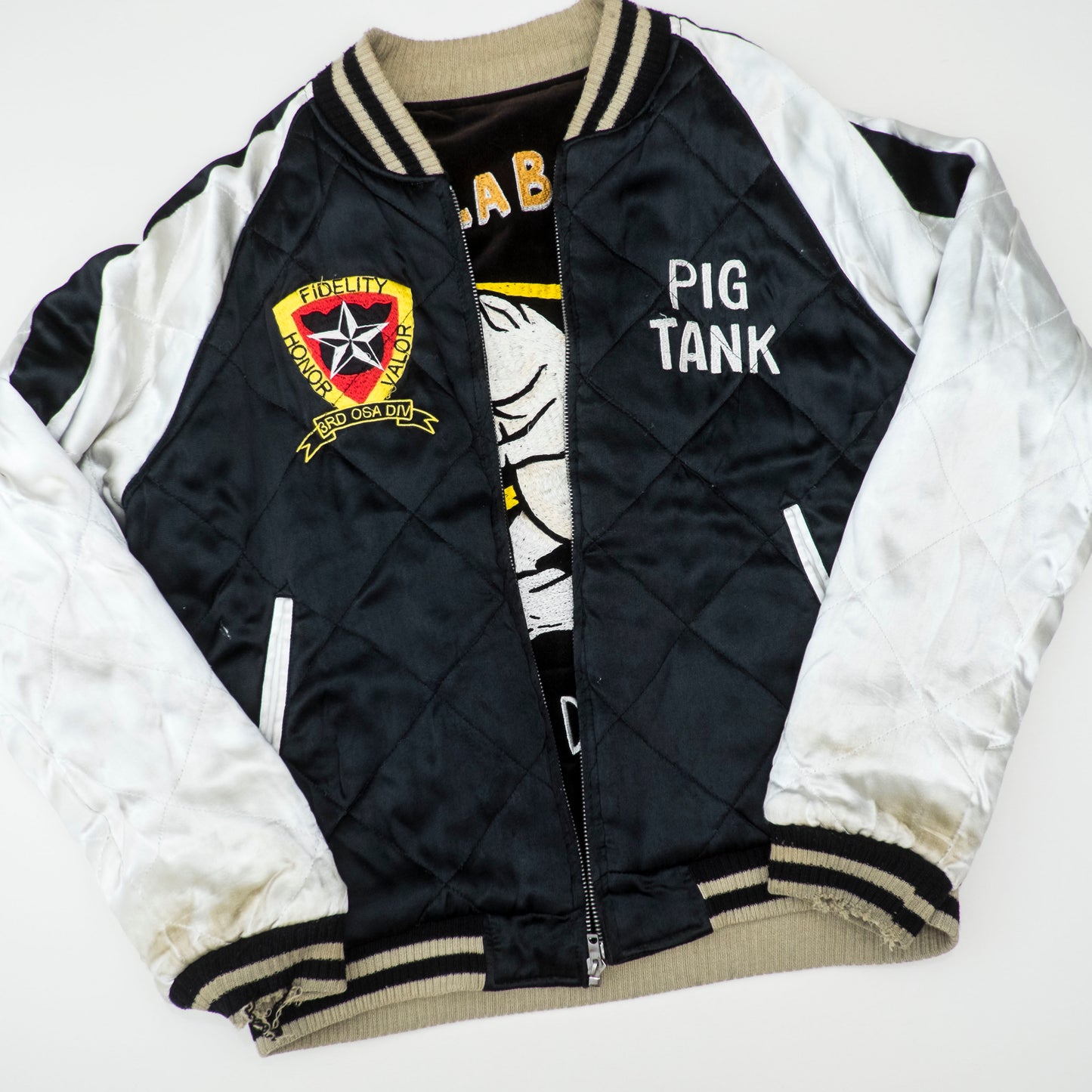
The reverse is made in black diamond-quilted satin with contrasting ivory sleeves. Its back reads “3rd Osaka Div.”, “3rd Tank BN Naniwa” and “79 08,” framing a cartoon tank fitted with distinctly porcine details. The chest carries a shield-style unit emblem and the words “Pig Tank.”
It is playful without becoming disposable novelty clothing, precisely because the embroidery, reversible construction and historical references are handled with the seriousness of genuine Japanese Amekaji craftsmanship.
This is a jacket where the joke has excellent tailoring. 🐖⚡
Opening Impression
At first glance, the velveteen side resembles a classic Alaska souvenir jacket.
The dark pile fabric, pale central animal, frozen-looking ground and lightning bolts all recall the dramatic compositions found on mid-century embroidered outerwear. Look more closely, however, and the expected polar bear has been replaced by a cheerful Studio D’Artisan pig.
The sleeves deepen the joke. Rather than conventional dragons or eagles, they carry a long parade of pigs in different sizes and poses, some appearing to march, tumble or gather into strange little formations.
The reverse continues the transformation. Military insignia, battalion lettering and a tracked vehicle are reimagined as the fictional Pig Tank unit of Osaka, turning the visual language of a commemorative military jacket into a distinctly D’Artisan piece of wearable satire.
Identification
Brand
Studio D’Artisan
ステュディオ・ダ・ルチザン
Design
ALABUTA × Pig Tank
Approximate Period
Circa 2008
The embroidered “79 08” on the quilted side appears to reference Studio D’Artisan’s founding year of 1979 and the jacket’s apparent 2008 production era.
This interpretation is strengthened by the fact that Studio D’Artisan’s official 2014 anniversary material described that year’s ALABUTA design as a revival of an earlier celebrated motif. The photographed jacket is therefore best understood as an earlier ALABUTA-generation piece rather than the later 2014 SP-023 anniversary release.
Garment Type
Reversible sukajan
Japanese souvenir jacket
Velveteen bomber jacket
Quilted satin jacket
Embroidered Amekaji outerwear
Japanese heritage streetwear
Tagged Size
M
Japanese size M generally presents with a compact vintage bomber silhouette. The fit may feel closer to a contemporary Western small-to-medium depending on the wearer’s preferred layering and proportions.
Primary Colors
Deep brown-black
Black
Ivory white
Oatmeal beige
Yellow
Red
Silver-grey
Gold
Black-and-beige striped ribbing
Visual Presence
This jacket succeeds because both sides are complete designs.
The velveteen face is immediately recognizable from a distance. Its composition is clean, graphic and almost poster-like: one pale pig, a dark field and sharp yellow bolts. The limited palette gives the artwork tremendous clarity.
The quilted side is denser and more typographic. It uses military-style lettering, a fictional armored-unit identity and a deliberately crude pig-shaped tank to create the visual equivalent of an inside joke shared by denim enthusiasts.
Both faces carry strong personality, yet neither relies on excessive color or visual clutter.
The velveteen side feels playful and archival.
The satin side feels industrial, comic and proudly Osaka-born.
The ALABUTA Velveteen Side
Central Back Embroidery
The back is dominated by an upright white pig embroidered against dark velveteen.
The pig stands on an uneven pale ground with its front legs raised, mouth open and red tongue visible. Four angular yellow lightning bolts cut across the surrounding darkness.
Above the figure appears the word:
ALABUTA
Below is the partially visible phrase:
ARTISAN DENIM FRONTIER
The design plays with the visual vocabulary of vintage Alaska souvenir jackets. The word itself combines the sound of “Alaska” with buta, the Japanese word for pig, producing the wonderfully absurd concept of an “Ala-buta” jacket.
Studio D’Artisan later continued using ALABUTA imagery in other garments, describing the design as an adaptation of popular vintage Alaska-style souvenir graphics through the company’s pig-centered visual language.
Chest Embroidery
Two smaller pigs face inward across the chest.
Each is surrounded by yellow lightning and stands over a small patch of pale ground. The mirrored placement keeps the jacket visually balanced when worn closed and allows the design to remain recognizable even when the large back artwork is hidden.
Full-Sleeve Pig Embroidery
The sleeves are perhaps the jacket’s most unusual feature.
Multiple pigs descend from the shoulders toward the cuffs in irregular formations. Some appear stacked or clustered, while others stand independently. Their bodies are rendered primarily in pale thread with black outlines and small pink-red snouts.
The arrangement gives the jacket continuous movement from every angle.
Unlike a conventional sukajan that reserves its most important artwork for the back, this piece allows its characters to travel down the arms, making the jacket animated even when viewed from the side.
Velveteen Surface
The dark face appears to use a short-pile velveteen or cotton-velvet material.
Its surface absorbs and redirects light depending on the direction of the pile. As a result, the fabric can shift between black, dark brown, charcoal and soft bronze under different lighting.
This tonal movement gives the relatively simple embroidery a richer background and helps distinguish the jacket from ordinary flat satin souvenir jackets.
The Pig Tank Quilted Side
“3rd Osaka Division” Back
The reverse centers on a fictional military-style insignia composed around a cartoon tank.
The back includes the embroidered wording:
3RD OSAKA DIV.
79 08
3RD TANK BN
NANIWA
“Naniwa” is a historic name strongly associated with Osaka, reinforcing Studio D’Artisan’s local identity.
The tracked vehicle itself is deliberately humorous. The tank’s upper structure resembles a pig, complete with a rounded snout-like cannon, pointed ears and a curling tail.
The image transforms an intimidating armored vehicle into a waddling mechanical mascot.
Diamond-Quilted Construction
The body and sleeves are stabilized with diamond-pattern quilting.
The stitching introduces structure, light insulation and visual texture. It also closely follows the construction vocabulary of reversible mid-century souvenir jackets, where the reverse frequently functioned as a padded or quilted face rather than a conventional hidden lining.
Chest Insignia
The left chest carries a shield-style emblem with a central star and the words:
FIDELITY
HONOR
VALOR
3RD OSA DIV
The opposing chest reads:
PIG TANK
The result resembles a fictional unit jacket assembled for a battalion that exists only inside Studio D’Artisan’s peculiar universe.
Black and Ivory Color Blocking
The black quilted body is framed by contrasting ivory sleeves with dark shoulder stripes.
This athletic color blocking introduces an element of vintage varsity and military-tour outerwear. It also makes the reverse lighter and more immediately graphic than the dark velveteen face.
Iconography and Meaning
The Pig
The pig is central to Studio D’Artisan’s identity.
Here, it replaces the heroic animals normally seen on souvenir jackets. Bears, tigers and eagles traditionally project strength or ferocity, while D’Artisan’s pig brings humor, stubbornness and warmth.
The substitution does not reject the history of the sukajan. It affectionately bends that history until it belongs to the brand.
Yellow Lightning
Lightning gives the otherwise friendly pig an exaggerated supernatural charge.
The bolts recall vintage American athletic mascots, pulp illustrations and Alaska souvenir imagery. Their sharp geometry also breaks through the soft velvet surface with immediate visual energy.
The Tank
The tank represents the jacket’s most elaborate visual pun.
From a distance, it resembles a military emblem. Closer inspection reveals the ears, snout and tail of the Studio D’Artisan pig.
It is not intended as an authentic military-unit garment. It is a fictional Osaka-themed parody that borrows the typography and composition of commemorative service jackets.
“Naniwa” and Osaka
The Osaka terminology is especially important because Studio D’Artisan began in Osaka in 1979 and became part of the movement later known as the Osaka Five, a group associated with the rise of Japanese selvedge denim and vintage-inspired craftsmanship.
“79 08”
The numerals appear to link the founding year 1979 with 2008.
Rather than functioning as a random military serial number, they anchor the fictional Pig Tank division within the company’s own timeline and support a circa-2008 period attribution.
Studio D’Artisan and Japanese Amekaji
Studio D’Artisan began in Osaka in 1979, during the formative period of Japan’s modern heritage-denim movement. The company became known for studying older weaving, dyeing and sewing methods while producing Japanese interpretations of American workwear.
Although its roots are in selvedge denim, the brand’s most memorable outerwear often combines serious construction with humor.
The pigs allow Studio D’Artisan to reference military garments, workwear advertising, motorcycles, vintage denim labels and souvenir embroidery without simply copying them.
This ALABUTA jacket embodies that approach.
It understands the visual codes of American and Japanese vintage clothing, then rewrites them in Osaka dialect with a pig driving the tank.
Sukajan Tradition
The sukajan emerged from the postwar exchange between Japanese embroidery workshops and American servicemen stationed in Japan.
Early jackets combined American bomber construction with Japanese dragons, tigers, eagles, landscapes, maps and unit references. They functioned as wearable souvenirs, carrying memories of specific locations, bases or periods of service.
Later Japanese brands transformed the sukajan into a major category within Amekaji, or Japanese American-casual fashion.
This Studio D’Artisan example belongs to that later interpretive tradition. It respects the reversible bomber structure and commemorative typography of older souvenir jackets while replacing expected imagery with the brand’s comic pigs.
Embroidery and Construction
Visible Construction Details
Reversible construction
Raglan sleeves
Full front zipper
Dark velveteen face
Black-and-ivory quilted satin reverse
Diamond-pattern quilting
Rib-knit collar
Rib-knit cuffs
Rib-knit waistband
Angled front pockets on both faces
Full back embroidery on both sides
Mirrored chest motifs
Extended sleeve embroidery
Contrasting athletic striping
Embroidery Character
The embroidery uses a deliberately graphic, vintage-cartoon approach rather than photorealistic rendering.
The pigs are outlined in dark thread with pale bodies and pink-red snouts. Yellow lightning introduces the strongest color contrast on the velveteen face.
The quilted side relies heavily on white lettering and linework against black satin. The limited palette allows the fictional Pig Tank insignia to resemble period military-tour embroidery while retaining its unmistakably humorous character.
Period Assessment
The jacket appears consistent with an earlier ALABUTA production from approximately 2008.
The embroidered “79 08” provides the strongest internal evidence. The design also predates Studio D’Artisan’s documented 2014 thirty-fifth-anniversary ALABUTA revival, which the company officially described as a return of a previous popular motif.
This distinction gives the jacket added interest.
It is not simply a current reinterpretation of the design. It appears to represent an earlier chapter in the ALABUTA lineage, complete with its original Pig Tank counterpart.
No model-number or composition label is visible in the supplied photographs, so the listing avoids assigning an unconfirmed product code.
Condition
Vintage Condition with Visible Wear
This jacket has substantial authentic wear and should be purchased as a character-rich vintage garment rather than a pristine collector example.
The supplied photographs show:
Visible soiling, discoloration and age-related marks on the ivory satin sleeves
More concentrated staining and darkening around the cuffs and lower sleeves
Noticeable fraying, thinning and small damaged areas in portions of the rib-knit cuffs and waistband
Loose or projecting embroidery threads in several areas
Natural lint and surface fibers on the dark velveteen
Changes in the direction and appearance of the velveteen pile
General rubbing, flattening and surface wear
Creasing throughout the quilted satin side
Possible small pulls, scuffs and stitch irregularities
Wear around the pocket openings and zipper area
Age-related yellowing or tonal variation in the beige ribbing
Small holes or weakened points visible around parts of the lower rib-knit trim
The embroidery remains visually strong and the principal artwork is clearly readable on both faces.
No complete structural inspection beyond the supplied photographs has been performed for this description. Buyers should examine every image carefully and assume there may be additional small signs of wear consistent with age and use.
The condition contributes to a convincingly worn Amekaji appearance, but buyers seeking mint, unworn or near-new condition should not purchase this example.
Professional cleaning or textile restoration may improve some areas, although no specific result can be guaranteed.
Tagged Size and Fit
Tagged Size
M
Expected Silhouette
Compact Japanese bomber fit
Raglan shoulder construction
Moderately roomy chest
Shorter vintage-style body
Tapered ribbed hem
Full sleeves
Suitable for light layering
A currently listed comparable ALABUTA × Pig Tank example in size M records approximately:
Chest width: 54 cm
Length: 59 cm
Raglan sleeve reach: 83 cm
These figures belong to another garment and are provided only as a general reference. Exact measurements of this jacket should be confirmed before purchase.
Dimensions
Exact flat measurements will be added when available.
Please message us before purchasing if measurement confirmation is essential. Priority measurements can be provided for serious inquiries.
Styling
Vintage Denim Uniform
Pair the velveteen side with high-rise raw denim, a loopwheel sweatshirt and work boots.
The black-brown surface works especially well with indigo because both fabrics develop character through texture rather than bright color.
Graphic Streetwear
Wear it with wide black trousers, a simple white shirt and low-profile sneakers.
The unusual sleeve procession gives the jacket enough visual movement to carry an otherwise minimal outfit.
Workwear with Humor
Combine the Pig Tank side with fatigues, a chambray shirt or canvas trousers.
Its fictional unit graphics play naturally against real military-inspired clothing without making the outfit appear excessively severe.
Japanese Archive Fashion
The jacket can also be styled with cropped trousers, vintage sneakers, silver accessories or other early-2000s Japanese streetwear.
The combination of mascot design, reversible construction and strong branding makes it a natural conversation piece in an archive-focused wardrobe.
Why This Jacket Stands Apart
This piece combines several characteristics rarely found together:
An earlier ALABUTA design
The double-main ALABUTA × Pig Tank configuration
A dark velveteen face
A contrasting quilted satin face
Extensive embroidery on both sleeves
Full back artwork on both sides
Studio D’Artisan’s signature pig humor
Osaka and Naniwa references
A probable 2008 production-era date
Tagged Japanese size M
Strong visual patina
A design later important enough to receive an anniversary revival
Many reversible jackets have one obvious primary face and one comparatively plain reverse.
This jacket refuses to pick a favorite.
The ALABUTA side provides the bold mascot design, while the Pig Tank side offers an entirely separate graphic identity. Both are capable of functioning as the exterior rather than merely serving as a lining.
Display and Collectible Potential
The jacket displays exceptionally well with the sleeves extended.
On the velveteen face, the pigs descending both sleeves frame the central lightning composition and create an almost comic-strip rhythm across the entire garment.
On the quilted face, the white sleeves form a high-contrast border around the black unit graphic, allowing the Pig Tank emblem and Osaka typography to read clearly from across a room.
It would suit:
A Studio D’Artisan archive
Japanese denim collections
Amekaji displays
Sukajan collections
Mascot-art collections
Vintage streetwear wardrobes
Japanese pop-design collections
Editorial fashion styling
Music and stage wardrobes
Textile and embroidery displays
Its visible wear makes it particularly compelling as an authentic wardrobe piece rather than a garment preserved without life behind glass.
Purchase, Shipping and Vintage Policy
This is a pre-owned vintage garment and is sold in its present condition.
Natural and visible signs of previous ownership, wear, handling, storage and age are present. These include staining, discoloration, rib-knit wear, fraying, small damaged areas, loose threads, surface friction, lint, pile changes, creasing and other characteristics described above or visible in the photographs.
Please review all photographs carefully before purchasing. The photographs form an essential part of the item description.
Because this is a unique vintage collectible, all sales are final. Returns, exchanges, cancellations, partial refunds and post-delivery claims based on fit, color interpretation, expected vintage characteristics or condition details visible in the photographs are not accepted.
Dark velveteen can appear black, brown, charcoal or navy depending on lighting and the direction of its pile. Satin may also appear lighter or darker depending on reflected light and screen calibration.
Preparation, shipping and handling normally takes 5–10 business days or earlier.
Worldwide shipping is normally arranged through Japan Post EMS or another appropriate tracked international delivery service. Tracking information will be supplied after dispatch.
International buyers are responsible for customs duties, import taxes, brokerage fees and other destination-country charges when applicable.
Respectful and realistic offers may be considered.
If you are looking for this design or model in another size, please feel free to message us. Although availability cannot be guaranteed, we may be able to locate the same or a closely matching piece in a different size through our sourcing network.
#StudioDArtisan #StudioDArtisanJapan #ALABUTA #PigTank #Sukajan #VintageSukajan #JapaneseSukajan #SouvenirJacket #ReversibleJacket #VelvetSukajan #VelveteenJacket #QuiltedJacket #JapaneseStreetwear #JapaneseVintage #Amekaji #OsakaFashion #OsakaFive #PigEmbroidery #MascotFashion #EmbroideredJacket #VintageBomber #JapaneseDenim #HeritageFashion #ArchiveFashion #RareJapaneseFashion #WearableArt #JapanJacket #StreetwearArchive #SizeM #Japonista
studio d artisan, alabuta jacket, pig tank sukajan, reversible jacket, velvet sukajan, japanese vintage, souvenir jacket, osaka streetwear, embroidered pig, amekaji jacket, size m bomber, military parody, rare japan jacket
Material Tags
velveteen, velvet pile fabric, quilted satin, embroidery thread, rib knit, metal zipper, padded lining, woven trim, satin sleeves