Rare Vintage, Antiques and Art Collector / Curator / Personal Shopper From Japan
Vintage Reversible Sukajan Tiger Dragon Japan Black Velvet Blue Satin Embroidered Souvenir Bomber Jacket
Vintage Reversible Sukajan Tiger Dragon Japan Black Velvet Blue Satin Embroidered Souvenir Bomber Jacket
Couldn't load pickup availability
Have a reasonable price in mind? Submit your best offer and our concierge will review it personally.
Rare Double-Sided Japanese Yokosuka Jacket with Roaring Tigers, Sleeve Dragons, Mount Fuji and “Japan” Embroidery
A commanding vintage reversible sukajan built around the two most iconic forces in Japanese souvenir-jacket imagery: the tiger and the dragon.
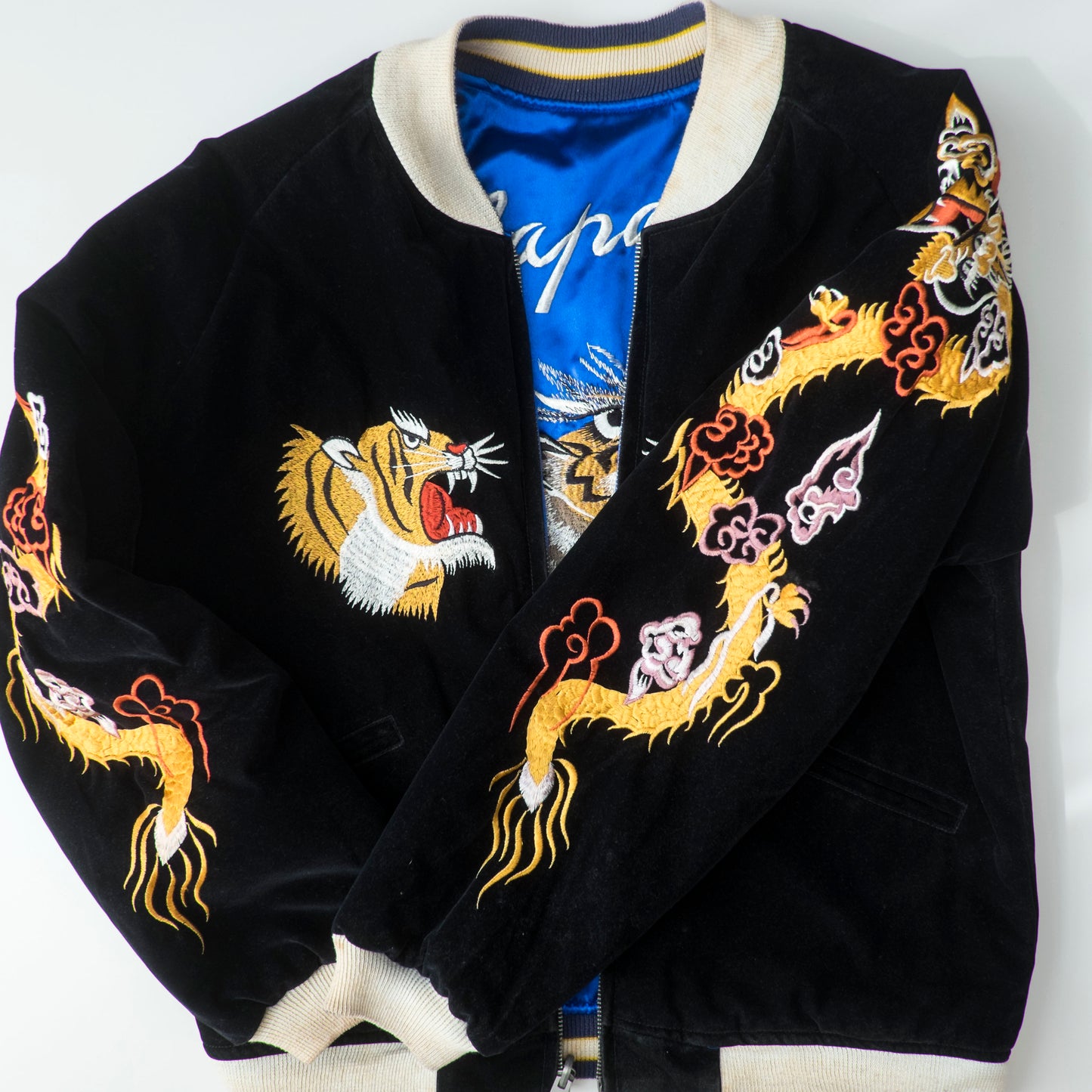
One face is rendered in deep black velveteen, richly embroidered with mirrored tiger heads across the chest, long golden dragons winding down both sleeves and a monumental roaring tiger beneath the word “Japan.” Reverse the jacket and an entirely different personality appears: brilliant royal-blue satin with ivory sleeves, paired tiger chest embroidery and another large tiger composition across the back.
This is not merely a jacket with a decorative lining. Both faces are fully realized, wearable designs. Together they form a portable gallery of classic Yokosuka-jacket imagery, balancing nocturnal black velvet against electric blue satin, celestial dragons against mountain tigers, and restrained vintage construction against embroidery that arrives with claws out.
Opening Description
There are sukajan that decorate the body, and there are sukajan that seem to occupy the entire room.
This piece belongs to the latter category.
The black face has the depth and weight of vintage theater velvet. Golden dragons coil down each sleeve through stylized clouds, their bodies embroidered in yellow, orange, ivory, crimson and pale pink. Two roaring tiger heads guard the chest, while the back presents a full-bodied tiger standing among bamboo and mountain scenery beneath an elegant embroidered “Japan” signature.
On the reverse, the jacket flashes into royal blue. The brighter satin face has ivory sleeves, contrasting piping and mirrored tiger embroidery across the chest. Its back is dominated by a seated roaring tiger rising from angular mountain forms beneath another sweeping “Japan” inscription.
The result is a jacket with two distinct emotional temperatures: one dark, luxuriant and dramatic; the other bright, athletic and unmistakably rooted in the golden age of Japanese souvenir fashion.
Identification
Garment Type: Reversible sukajan / Japanese souvenir jacket
Alternative Names: Yokosuka jacket, souvenir bomber, embroidered Japanese jacket
Maker: Unconfirmed; the maker label is not shown in the available photographs
Marked Size: Not shown
Fit: Please rely on exact flat measurements when available
Construction: Fully reversible raglan-sleeve bomber
Primary Face: Black velveteen with extensive tiger and dragon embroidery
Reverse Face: Royal-blue satin with ivory sleeves and tiger embroidery
Closure: Reversible metal front zipper
Trim: Striped rib-knit collar, cuffs and waistband
Pockets: Two welt pockets on each wearable face
Origin: Japanese-market sukajan design
Period Assessment: Appears consistent with a later vintage Showa-to-early-Heisei souvenir jacket, likely circa 1980s–1990s
Condition: Vintage pre-owned condition with visible age-related wear, discoloration and textile patina
The precise maker and production date should remain conservatively described unless a surviving brand or care label is documented.
Black Velveteen Face
Roaring Tiger and Mount Fuji Back
The black face is centered on a large embroidered tiger shown in an elevated, frontal pose.
Rather than running horizontally across the jacket, the animal rises vertically from stylized rockwork and bamboo. Its shoulders are lifted, claws extended and mouth open, producing the impression that the tiger is climbing directly toward the viewer.
The embroidery uses a warm spectrum of golden yellow, burnt orange, black and ivory. White thread along the throat, muzzle and whiskers gives the animal additional dimension, while the red mouth and pale fangs sharpen its expression.
Behind the tiger, a snow-covered mountain form evokes Mount Fuji, one of the most enduring visual signatures of Japan. Bamboo leaves rise around the animal, and flowing white lines near the hem suggest water, clouds or the shifting terrain of a traditional landscape.
Above the composition is the word:
Japan
The lettering is embroidered in a fluid white script, creating a striking contrast against the dense black pile of the velveteen.
The composition merges several classic souvenir-jacket ideas into one scene: place-name embroidery, Japanese landscape, predatory animal, bamboo and a dramatic central back emblem.
Tiger Chest Embroidery
The front carries two mirrored roaring tiger heads.
Each tiger is embroidered with:
- Golden-orange fur
- Black facial striping
- White cheek and throat details
- Red open mouth
- Pale fangs
- Extended white whiskers
- Strong black outlines
Their placement on either side of the zipper creates the symmetrical front architecture traditionally associated with sukajan design.
When the jacket is closed, the two heads appear to confront one another across the center line. When worn open, they frame the reverse jacket underneath, making the reversible construction part of the visual performance.
Full-Length Dragon Sleeves
The sleeves are among the jacket’s strongest features.
A long embroidered dragon travels down each arm, beginning near the upper sleeve and continuing toward the cuff. The dragons are worked in golden yellow and orange with ivory facial accents, crimson details and curling clouds in pink, white, black and red.
The embroidery does not remain confined to a small shoulder emblem. It occupies nearly the entire visible length of each sleeve.
This transforms the jacket from a conventional tiger sukajan into a full dragon-and-tiger composition. With the arms relaxed, the dragons frame the tiger on the back. In motion, they appear to coil and stretch with the wearer.
The sleeve embroidery is especially effective against the black velveteen because the pile absorbs light while the threads reflect it. The imagery seems to rise from a dark field rather than simply rest on top of the fabric.
Royal-Blue Satin Reverse
Tiger in the Mountains Back
The reverse shifts from the shadowed depth of black velvet to a luminous royal-blue satin ground.
The back again carries the word “Japan,” this time in white script above a large seated or rising tiger. The animal is embroidered in golden yellow, black, ivory, grey and warm brown, with its head tilted upward and mouth open.
Angular brown and grey forms beneath the animal suggest mountainous terrain, rocky peaks or waves rendered in the compact graphic language of souvenir-jacket embroidery.
The blue ground gives the tiger a different atmosphere from the black side. Against velvet, the tiger feels nocturnal and territorial. Against royal blue, it becomes brighter, more heraldic and more immediately connected to the classic visual vocabulary of mid-century Japanese tour jackets.
Blue Tiger Front
The front of the royal-blue face carries another mirrored pair of tiger heads.
These are slightly more compact than the black-side chest motifs, positioned above white-trimmed welt pockets. Each head rises from a small embroidered mountain base, giving the front a more complete scenic quality.
The ivory sleeves provide a bold contrast with the blue body. Narrow red-and-white twisted piping traces the raglan seams, while blue, grey, yellow and cream ribbing completes the athletic bomber silhouette.
Although both faces use tiger imagery, they do not feel repetitive.
The black face is dense, dark and highly ornamented, with dragons occupying both sleeves. The blue side is cleaner and brighter, allowing the satin sheen and simplified color blocking to carry more of the design.
Tiger, Dragon, Bamboo and Mountain Imagery
The Tiger
Within the visual language of East Asian art and Japanese tattoo culture, the tiger is associated with physical courage, instinct, authority and the power to endure hostile terrain.
On this jacket, the tiger is not passive or decorative. Every version is shown roaring, climbing, guarding or asserting its presence.
The repeated tiger motif gives the garment unusual thematic unity. The wearer does not simply choose between unrelated pictures. Both faces explore different versions of the same animal force.
The Dragon
The dragon introduces a complementary energy.
Where the tiger is terrestrial and muscular, the dragon is fluid, airborne and supernatural. Its curling body follows the sleeves, moving through cloud forms and turning each arm into a vertical narrative panel.
The dragon-and-tiger pairing is often read as a balance between two equally formidable powers: sky and earth, movement and stillness, strategy and force.
Rather than illustrating a literal battle, the jacket holds both energies in tension.
Bamboo
Bamboo strengthens the tiger composition by suggesting endurance and controlled flexibility.
It bends, survives harsh weather and continues to grow. Placed beside the tiger, it creates an image that combines raw strength with adaptability rather than aggression alone.
Mount Fuji and “Japan”
The mountain imagery and embroidered place name connect the animal compositions directly to Japan.
Early souvenir jackets were commonly decorated with regional names, maps, mountains, eagles, dragons and tigers so that the garment functioned as both clothing and travel record. The word “Japan” was not a secondary label. It was part of the artwork itself.
In this jacket, “Japan” crowns both back compositions, making the reversible garment read as two separate souvenir emblems.
Visual Presence
Black Side
The black velveteen face has a luxurious, almost nocturnal character.
Its embroidery is dense but carefully distributed. The tiger dominates the back, while the dragons extend the imagery across the sleeves without overcrowding the center. Cream ribbing softens the contrast, giving the jacket an aged monochrome frame.
This side works especially well for collectors drawn to tattoo imagery, rockabilly clothing, Japanese biker fashion and dark embroidered streetwear.
Blue Side
The royal-blue side feels brighter, sportier and more visibly connected to classic souvenir-jacket color blocking.
The blue-and-ivory combination creates a strong mid-century athletic silhouette, while the tiger embroidery keeps the design unmistakably Japanese.
It offers a highly practical reverse for collectors who want one dramatic dark face and one vivid heritage face in the same garment.
Materials and Construction
The jacket appears to combine a black cotton-like velveteen or velvet-pile textile with a lustrous synthetic satin reverse.
Construction details visible in the photographs include:
- Fully reversible construction
- Black velveteen outer face
- Royal-blue satin reverse
- Contrasting ivory satin sleeves
- Extensive multicolor machine embroidery
- Raglan sleeve pattern
- Reversible metal zipper
- Dual sets of welt pockets
- Striped rib-knit collar
- Rib-knit cuffs
- Rib-knit waistband
- Decorative piping along the blue-side raglan seams
- Embroidery across the fronts, backs and sleeves
- Lightweight, apparently unpadded structure
The satin naturally forms ripples and reflective highlights. The velveteen absorbs light and may display tonal changes depending on the direction of its pile.
These surface characteristics are inherent to the materials and contribute to the jacket’s vintage visual depth.
Sukajan Heritage
Sukajan developed in postwar Yokosuka as souvenir garments for American service members stationed in Japan. Local embroidery workshops adapted Japanese imagery such as tigers, dragons, eagles, maps and mountains to Western-style bomber and varsity-jacket forms. Yokosuka City continues to identify the sukajan as a local product originating from the postwar souvenir trade around Dobuita Street.
The word is generally understood as an abbreviation of Yokosuka jumper. Reversible construction became one of the form’s defining characteristics, allowing two different combinations of imagery and color to occupy the same garment.
Over subsequent decades, sukajan moved beyond military souvenir culture and entered Japanese youth fashion, rockabilly, motorcycle, delinquent, vintage and international designer circles.
This jacket belongs to that broader later-vintage tradition. It preserves the historical vocabulary of “Japan,” tiger, dragon, mountain and satin bomber construction while presenting the motifs through dense machine embroidery and strong late-twentieth-century color blocking.
Period Assessment
The jacket appears consistent with a later vintage Japanese souvenir jacket, likely dating from approximately the 1980s to 1990s.
This assessment is based on:
- The black velveteen and synthetic satin pairing
- Extensive modern machine embroidery
- Compact reversible construction
- Rib-knit pattern and coloration
- Repeated revival-era tiger imagery
- The combination of traditional motifs with a brighter athletic reverse
- Apparent age toning to the cream knit trim
- The absence of clear features proving an occupation-era origin
The dating should therefore be understood as an informed stylistic assessment rather than an exact manufacturing year.
It should not be represented as a confirmed 1940s or 1950s military souvenir jacket without additional documentation, period labels or hardware evidence.
Comparable vintage-market jackets with black velvet, blue satin, tiger and dragon imagery are often positioned as 1980s revival pieces, while securely dated late-1950s examples can command substantially higher prices.
Condition
Authentic Vintage Condition with Visible Age Patina
The jacket is offered in pre-owned vintage condition.
The embroidery remains visually powerful, with strong golden, orange, blue, ivory and red coloration. The primary tiger and dragon compositions remain clear and highly legible.
Visible age-related characteristics include:
- General wrinkling and storage creasing
- Natural rippling across the satin
- Surface variation in the black velveteen pile
- Scattered lint or light surface particles on the dark fabric
- Age toning to the cream rib-knit trim
- Yellowish or brownish discoloration around portions of the collar
- Discoloration and wear around the cuffs
- Darkened areas along the cream waistband
- Minor marks on the pale satin sleeves
- Possible faint spotting or handling marks
- Light rubbing around edges and pocket openings
- Embroidery puckering around dense stitched areas
- Minor thread irregularities consistent with age
- General signs of previous wear and long-term storage
The cream ribbing on the black face displays particularly noticeable vintage toning. This is most visible around the collar, cuffs and lower waistband.
The white sleeves of the blue face may show subtle marks and uneven coloration. Buyers seeking a uniformly bright, factory-fresh white textile should consider the visible patina carefully.
No major tears, large holes or extensive embroidery loss are immediately apparent in the supplied photographs. The zipper is present, although all hardware and seams should be treated with care due to the garment’s age.
The jacket has not been represented as professionally restored or newly cleaned.
Please inspect every photograph closely. The photographs form an essential part of the condition record and should be considered together with this written description.
Size and Measurements
The marked size and care label are not shown in the available photographs.
Vintage Japanese sukajan often have a shorter body, compact chest and narrower overall proportions than contemporary Western bomber jackets. Letter sizing alone is therefore not a reliable indication of fit.
Exact flat measurements should be confirmed before purchase, particularly:
Chest Width: Armpit to armpit
Back Length: Base of collar to lower hem
Sleeve Length: Center back neck to cuff along the raglan sleeve
Underarm Sleeve: Armpit to cuff
Hem Width: Straight across the rib-knit waistband
Please compare the measurements with a similar raglan jacket that already fits comfortably.
Because this is a reversible garment, the layered construction and embroidery may also influence how it feels when worn.
Styling and Display
Wearing the Black Face
Pair the black velveteen side with:
- Black or washed charcoal denim
- Wide-leg military trousers
- Engineer or motorcycle boots
- Plain black knitwear
- Vintage workwear
- Minimal monochrome layers
- Rockabilly or Japanese biker styling
The embroidery already carries substantial visual information, so understated supporting garments allow the tiger and sleeve dragons to remain dominant.
Wearing the Blue Face
The royal-blue side works beautifully with:
- Raw indigo denim
- Cream or ecru trousers
- Olive fatigues
- White sneakers
- Vintage athletic clothing
- Japanese workwear
- Classic Americana
- Dark navy or brown footwear
This face has a lighter, more casual personality while retaining the unmistakable authority of the tiger embroidery.
Display
The jacket is also suitable for textile display.
The black tiger back creates a strong focal point for a private collection, vintage boutique, tattoo studio, Japanese restaurant interior, fashion archive or wall-mounted sukajan presentation.
Because both backs are fully embroidered, the jacket may be periodically reversed to change the display without replacing the garment.
Why This Piece Matters
This jacket combines several qualities sought by serious sukajan collectors:
- Fully reversible construction
- Two complete embroidered back compositions
- Tiger imagery on both faces
- Full-length dragon embroidery across both sleeves
- Black velveteen and royal-blue satin contrast
- Embroidered “Japan” lettering on both sides
- Traditional Mount Fuji and mountain imagery
- Extensive front, sleeve and back embroidery
- Strong later-Showa vintage character
- Naturally developed age patina
- Highly displayable wearable-art presence
- Classic Yokosuka souvenir-jacket vocabulary
- Increasingly difficult-to-replace vintage configuration
Its most compelling feature is the continuity between the two faces.
The reverse is not an unrelated second design added merely for novelty. Both sides explore the tiger as a guardian, climber and territorial force, while the black face introduces dragons as a contrasting celestial energy.
That cohesion gives the garment the feeling of a deliberately composed textile artwork rather than a collection of disconnected decorative motifs.
Purchase, Shipping and Vintage Policy
This is a unique vintage collectible garment offered in its present condition.
Vintage clothing may display fading, age toning, discoloration, wrinkles, surface rubbing, fabric pulls, weakened fibers, loose threads, embroidery irregularities, minor stains, storage odor, previous repairs or other evidence of age and use.
Please review all photographs and written condition details carefully before purchasing. The photographs form an essential part of the listing and condition record.
Because this is a unique vintage collectible, all sales are final. Returns, exchanges, cancellations, partial refunds and post-delivery claims based on fit, expected vintage characteristics, color interpretation or details visible in the photographs cannot be accepted, subject to applicable marketplace rules and consumer law.
Velvet, velveteen and satin can appear substantially different depending on lighting, camera exposure and screen calibration. The blue may appear cobalt, royal blue or electric blue, while the black textile may shift between deep black and charcoal according to the direction of the pile.
Preparation, shipping and handling normally takes 5–10 business days or earlier.
Worldwide shipping is normally arranged through Japan Post EMS or another appropriate tracked international service. Tracking information will be supplied after dispatch.
International buyers are responsible for customs duties, import taxes, brokerage charges and other destination-country fees where applicable.
Respectful and realistic offers may be considered. Price flexibility depends on rarity, condition, collector demand and replacement availability.
If you are looking for this design or model in another size, please feel free to message us. Although availability cannot be guaranteed, we may be able to locate the same or a closely matching piece in a different size through our sourcing network.
#VintageSukajan #TigerSukajan #DragonSukajan #JapaneseSukajan #ReversibleJacket #SouvenirJacket #YokosukaJacket #JapaneseBomber #BlackVelvetJacket #BlueSatinJacket #TigerJacket #DragonJacket #JapaneseEmbroidery #EmbroideredJacket #JapanSouvenir #ShowaVintage #JapaneseStreetwear #VintageStreetwear #WearableArt #WagaraFashion #RockabillyFashion #BikerJacket #JapanVintage #MountFuji #BambooTiger #JapaneseFashion #SukajanCollector #RareJacket #UnisexVintage #JapanCollector
vintage sukajan, tiger jacket, dragon jacket, japan souvenir, reversible bomber, velvet sukajan, blue satin jacket, embroidered jacket, japanese streetwear, yokosuka jacket, showa vintage, wearable art, rare japan jacket
Material Tags
black velveteen, royal blue satin, ivory satin, multicolor embroidery thread, rib-knit trim, reversible metal zipper, woven pocket fabric, synthetic satin textile