Rare Vintage, Antiques and Art Collector / Curator / Personal Shopper From Japan
Vintage Reversible Sukajan Jacket XL Hannya Mask Jiraiya Toad Hero Blue Gray Japanese Y2K Souvenir Bomber
Vintage Reversible Sukajan Jacket XL Hannya Mask Jiraiya Toad Hero Blue Gray Japanese Y2K Souvenir Bomber
Couldn't load pickup availability
Have a reasonable price in mind? Submit your best offer and our concierge will review it personally.
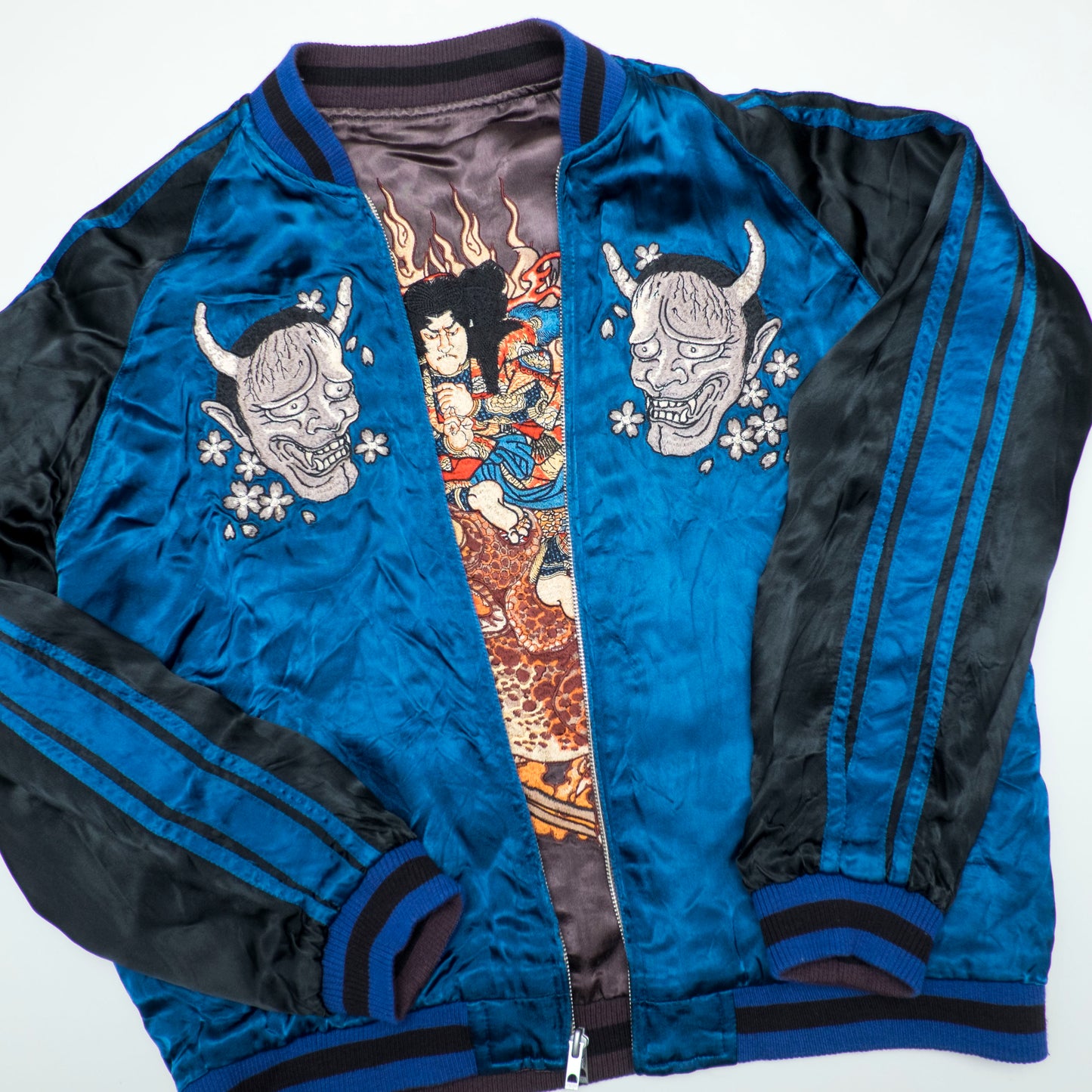
Embroidered Yokosuka Jumper with Silver Hannya, Sakura, Jiraiya on a Giant Toad, Flaming Toad Medallions, and Two Complete Satin Faces
COLLECTOR’S OVERVIEW
A commanding reversible Japanese sukajan built around two dramatically different supernatural narratives: a silver Hannya mask suspended among cherry blossoms on a luminous cobalt-blue face, and a heroic Jiraiya-inspired warrior riding a giant toad through fire on the smoky charcoal reverse.
The blue face is cool, spectral, and immediately recognizable. A monumental horned Hannya mask dominates the back, embroidered in silver-gray, ivory, charcoal, and black against saturated blue satin. White sakura blossoms, drifting petals, and curling cloud-like forms surround the mask, softening its fierce expression and creating a powerful contrast between anguish and beauty. Smaller Hannya masks appear symmetrically across the chest, each framed by blossom clusters.
Reversed, the jacket becomes an entirely different garment. The body shifts into smoky taupe-gray satin with near-black sleeves, muted plum striping, and dense orange, cream, blue, brown, and black embroidery. The back presents a heroic figure consistent with Jiraiya, the legendary toad-riding protagonist of Japanese popular folklore, seated upon an immense spotted amphibian amid rising flames and serpentine movement. The figure’s clasped hands suggest supernatural technique or ritual concentration, while the giant toad gives the scene monumental weight.
Flaming toad-head medallions appear across the chest, with additional fire-wreathed calligraphic embroidery traveling along the sleeves. This second face is darker, warmer, and more theatrical, combining kabuki-like characterization, folkloric heroism, flame symbolism, and tattoo-art intensity.
The jacket offers two complete visual identities rather than a decorated shell with an ordinary lining. One side explores the emotional transformation embodied by the Hannya mask. The other presents mastery, courage, and supernatural adventure through Jiraiya and his giant toad. Together they form an exceptional piece of wearable narrative art rooted in Japanese theatre, folklore, tattoo aesthetics, and modern sukajan culture.
IDENTIFICATION
Object Type
Vintage reversible Japanese sukajan, also known as a Yokosuka jumper, embroidered souvenir bomber, Japanese tour jacket, or reversible streetwear jacket.
Tagged Size
XL.
Approximate Western Fit
A vintage Japanese XL generally fits closest to a contemporary Western M-L, or a trim XL depending on chest width, shoulder breadth, sleeve preference, and the amount of layering worn beneath the jacket.
The raglan-style shoulder construction and gathered waistband create the compact silhouette traditionally associated with Japanese souvenir bombers.
Primary Face
Cobalt or peacock-blue satin-finish body with near-black sleeves, blue racing stripes, large silver Hannya back embroidery, paired chest masks, cherry blossoms, drifting petals, and striped blue-black ribbing.
Reverse Face
Smoky taupe, brown-gray, or muted charcoal satin-finish body with near-black sleeves, plum-gray paneling, heroic Jiraiya-inspired toad-rider embroidery, flaming toad-head chest medallions, flame-framed sleeve calligraphy, and dark striped ribbing.
Principal Motifs
Hannya mask, sakura blossoms, drifting petals, scrolling clouds or smoke, Jiraiya-inspired hero, giant toad, flames, supernatural movement, serpentine form, calligraphic sleeve details, and fire-ringed toad heads.
Construction
Fully reversible bomber construction with raglan-style sleeves, central reversible metal zipper, contrasting sleeve panels, striped rib-knit collar, cuffs and waistband, and two fully developed embroidered faces.
Color Architecture
Cobalt blue, peacock blue, black, silver-gray, ivory, charcoal, smoky taupe, muted plum, orange, rust, cream, brown, red, turquoise, and pale gold.
THE SUKAJAN TRADITION
Yokosuka Jumper Heritage
The sukajan developed from embroidered souvenir jackets associated with Yokosuka and other Japanese port communities during the postwar era.
American bomber and athletic-jacket construction was combined with Japanese embroidery craftsmanship, creating garments decorated with dragons, tigers, eagles, maps, Mount Fuji, flowers, place names, military emblems, and symbolic animals.
Over subsequent decades, the sukajan moved beyond its souvenir origins and entered Japanese rockabilly, motorcycle fashion, punk, visual-kei wardrobes, luxury design, anime-inspired fashion, tattoo culture, and international streetwear.
This jacket belongs to the later narrative tradition of the sukajan, where entire mythological or theatrical scenes are built across the garment rather than limited to one isolated emblem.
Two Worlds in One Garment
The reversibility is central to the design.
The blue face presents a mask, flowers, and psychological transformation.
The gray face presents a heroic figure, supernatural fire, and a giant toad.
One side is inward and emotional.
The other is active and legendary.
The jacket changes not only color when reversed, but subject, symbolism, atmosphere, and narrative direction.
COBALT-BLUE HANNYA FACE
Saturated Blue Satin Ground
The principal face uses a vivid cobalt, peacock-blue, or jewel-toned blue satin across the central body.
Its reflective surface changes according to light and fabric direction, shifting between brilliant blue, dark cyan, blue-green, and near-navy shadow.
This saturated ground gives the silver Hannya mask extraordinary visibility. The pale embroidery appears almost illuminated against the blue, while the darker hair and facial contours remain sharply defined.
Near-Black Sleeves
The sleeves are constructed in black or very dark charcoal satin.
Blue bands run along the shoulders and outer arms, visually connecting the sleeves with the central body.
The darker sleeves frame the bright center and give the jacket a stronger athletic structure than a single-color shell.
Blue and Black Ribbing
The collar, cuffs, and waistband combine bright blue with black or very dark navy stripes.
The ribbing gathers the lightweight satin into a rounded bomber silhouette while reinforcing the electric blue-and-black palette.
THE HANNYA MASK
Monumental Back Image
A large Hannya mask occupies most of the blue back panel.
The face is rendered in silver-gray, white, pale taupe, black, and charcoal embroidery. Two long horns rise from the forehead, the eyebrows bend sharply downward, the eyes stare outward, and the mouth opens into a wide, tooth-bearing expression.
Dark embroidered hair forms a heavy crown above the forehead, while fine stitched lines create wrinkles, tension, and carved-looking contours across the face.
The mask is not treated as a flat emblem. Variations in thread direction and density create raised cheekbones, deep eye areas, a prominent nose, and sharply defined teeth.
Hannya in Japanese Theatre
The Hannya mask belongs to the visual language of Japanese Noh theatre.
It represents a woman transformed by overwhelming jealousy, grief, rage, betrayal, or emotional anguish. Its horns and fierce expression appear demonic, yet the mask is not a simple symbol of evil.
Its emotional power comes from contradiction.
Viewed directly, the face appears furious and threatening.
Viewed from a lowered angle, the eyes and mouth may appear sorrowful.
This duality allows the Hannya to embody anger and suffering at the same time.
Not Merely a Devil
The Hannya is often grouped casually with oni or demon imagery, but its meaning is more psychologically complex.
The mask represents what human emotion can become when pain is allowed to consume identity.
Its frightening form preserves traces of the person who existed before the transformation.
This makes the Hannya one of the most emotionally layered motifs in Japanese theatre, tattoo art, fashion, and decorative culture.
Horns and Expression
The upward horns create vertical tension and immediately distinguish the figure from an ordinary human face.
The furrowed brow expresses rage and concentration.
The exposed teeth suggest aggression, but the long face and strained eyes also retain sadness.
The design captures the mask at its most intense, creating a striking centerpiece without relying on bright multicolored thread.
SAKURA BLOSSOMS AND FALLING PETALS
Floral Frame
White and pale-gray cherry blossoms surround the Hannya mask.
They appear above the horns, beside the cheeks, around the jaw, and throughout the outer embroidered field.
Some remain attached to curling branches or cloud-like lines, while individual petals drift freely across the blue ground.
Sakura Symbolism
Sakura represents spring, renewal, beauty, celebration, impermanence, and the awareness that life’s most luminous moments are temporary.
The flowers are admired not because they remain, but because they bloom intensely and disappear quickly.
Hannya and Sakura
The pairing of Hannya and cherry blossoms creates a powerful emotional contrast.
The mask represents emotion hardened into suffering.
The blossoms represent beauty that accepts change and release.
The Hannya holds pain tightly.
The sakura lets go.
This opposition gives the design greater depth than either motif would possess alone.
Beauty Around Anguish
The flowers do not erase the mask’s severity.
Instead, they create a visual reminder that beauty can continue to exist around pain, rage, and transformation.
The drifting petals make the composition feel active, as though the mask is appearing within a spring wind rather than floating in empty space.
SCROLLING CLOUDS, SMOKE, AND ARABESQUE FORMS
Pale Curving Embroidery
Ivory and silver-gray lines move around the mask in curling, flame-like and cloud-like shapes.
These forms are intentionally ambiguous. They may be read as smoke, supernatural energy, wind, clouds, flowing hair, or decorative karakusa-style scrolls.
Visual Movement
The pale lines prevent the large mask from appearing static.
They rise behind the horns, move through the blossoms, and curl around the lower jaw.
This movement gives the composition the atmosphere of an apparition emerging through air, smoke, or dream space.
Negative Space
The embroidery does not completely cover the blue satin.
Open blue areas remain visible between the flowers, mask, and curling lines, allowing the reflective textile to function as sky, night, and depth.
BLUE-FACE FRONT
Paired Hannya Masks
Two smaller Hannya masks appear symmetrically across the chest.
Each repeats the principal elements of the back:
Silver-gray face.
Dark hair.
Long horns.
Exposed teeth.
Furrowed expression.
White sakura blossoms.
Loose petals.
The paired placement creates a heraldic effect, framing the central zipper and presenting the Hannya imagery immediately even when the back is not visible.
Chest Balance
The two masks are similar in scale and orientation but retain enough natural embroidery variation to avoid looking mechanically duplicated.
Their placement across the upper chest gives the front a strong visual identity without overcrowding the lower torso.
Black and Blue Sleeve Structure
The black sleeves use long blue satin bands and narrow black dividing lines.
These panels lengthen the arms visually and connect the blue chest with the striped ribbing.
Central Closure
A metal zipper runs through the center front.
The dark zipper tape blends into the blue body, while the silver-toned teeth provide a narrow vertical contrast between the paired masks.
HANNYA SYMBOLISM IN FASHION AND TATTOO ART
Emotional Transformation
The Hannya is often chosen as a symbol of emotional extremity, transformation, survival, and the destructive force of jealousy or betrayal.
Within fashion, the image can be worn as a confrontation with fear rather than an endorsement of it.
Protective Interpretation
In some contemporary contexts, frightening masks are also worn as protective imagery.
The fierce face appears capable of turning danger away, functioning almost as a guardian through intimidation.
Dual Nature
The Hannya is neither entirely monster nor entirely victim.
This ambiguity is precisely what makes the motif enduring.
It speaks to the uncomfortable space in which pain, anger, love, memory, and identity can coexist.
SMOKY GRAY JIRAIYA REVERSE
Complete Atmospheric Transformation
When reversed, the brilliant blue jacket becomes smoky taupe-gray, muted plum, black, orange, brown, cream, and red.
The psychological stillness of the Hannya is replaced by supernatural action.
The blossoms become flames.
The mask becomes a heroic figure.
The cool silver palette becomes a warm field of fire and earth.
Taupe-Gray Satin Body
The central body is rendered in a reflective gray-brown or smoky taupe satin.
Depending on lighting, it may appear charcoal, mushroom gray, dusty plum, brown-gray, or muted bronze.
This subdued ground provides strong contrast for the orange flames, blue costume details, cream skin tones, and densely embroidered giant toad.
Near-Black Sleeves
The sleeves are formed from very dark green-black or charcoal satin.
Smoky plum-gray panels travel along the shoulders and lower arms, creating a darker counterpart to the blue racing stripes on the opposite face.
Dark Plum Ribbing
The reverse is framed with dark brown, plum, and black rib-knit.
This muted trim gives the side a heavier, more antique atmosphere and harmonizes with the brown and orange embroidery.
THE JIRAIYA-INSPIRED HERO
Central Heroic Figure
A powerful male figure occupies the upper center of the reverse back.
He is shown with thick black hair, a stern expression, layered robes, and both hands clasped before the chest in a concentrated gesture.
The costume is richly embroidered in red, orange, blue, cream, white, black, and patterned gold-toned thread.
The figure is seated upon an immense toad, surrounded by flames, supernatural scrolls, and a coiling serpentine form.
Identification as Jiraiya
The combination of heroic figure, giant toad, magical gesture, flames, and supernatural action is consistent with Jiraiya, the legendary protagonist of Jiraiya Gōketsu Monogatari, commonly translated as The Tale of the Gallant Jiraiya.
Jiraiya became a celebrated figure in nineteenth-century Japanese popular literature, kabuki, ukiyo-e, illustrated books, tattoo imagery, and later popular culture.
He is characteristically associated with toad magic and is frequently depicted riding or commanding an enormous amphibian.
The Heroic Pose
The clasped hands suggest ritual concentration or the activation of supernatural technique.
His posture remains controlled despite the surrounding flames and monstrous scale of the toad beneath him.
This contrast communicates mastery rather than panic.
The world around him is chaotic, but the hero remains centered.
Kabuki-Like Character
The figure’s dramatic hair, concentrated face, elaborate costume, and compressed action resemble the heightened visual language of kabuki and ukiyo-e warrior prints.
The embroidery translates that theatrical intensity into a wearable textile panel.
THE GIANT TOAD
Monumental Amphibian
The lower half of the back is occupied by an enormous spotted toad.
Its broad head, heavy eye, wide mouth, textured skin, powerful limbs, and low body are worked in brown, rust, cream, orange, charcoal, and pale gold embroidery.
The animal’s scale is intentionally exaggerated, making it less a natural creature than a supernatural mount or magical companion.
Embroidered Skin Texture
Dense spotted and mottled stitching creates the toad’s rough skin.
The eye is outlined in dark thread and highlighted with warm gold and cream.
The mouth and facial ridges are carefully articulated, giving the creature a formidable yet watchful expression.
Toad Symbolism
Toads are associated with the earth, water, transformation, hidden power, fertility, weather, and movement between different realms.
Because amphibians live between water and land, they naturally carry symbolism of passage and adaptability.
Within the Jiraiya tradition, the toad becomes a sign of magical authority and supernatural alliance.
Hero and Toad
The toad is not merely background decoration.
It establishes Jiraiya’s identity and power.
The hero’s relatively small human form is elevated by the colossal creature beneath him, turning the composition into a partnership between discipline and elemental force.
FIRE AND SUPERNATURAL ENERGY
Rising Flame Halo
Tall cream, orange, rust, and red flames rise behind Jiraiya.
Some flames have pale centers and dark outlines, while others twist into red ribbon-like tongues around the figure.
The fire creates a halo of danger and supernatural intensity without obscuring the hero.
Flame Symbolism
Fire represents transformation, purification, destruction, passion, illumination, and power.
It consumes one condition and produces another.
This makes it a natural counterpart to the Hannya imagery on the opposite face, where emotional pain has already transformed human identity.
Controlled Fire
The flames surround Jiraiya rather than overwhelming him.
His composed posture suggests command within danger.
The imagery therefore communicates courage, mastery, and concentration rather than uncontrolled destruction.
SERPENTINE MOVEMENT
Coiling Form
A tan, gold, and dark-outlined serpentine form appears beside and behind the hero.
Its curved body introduces another layer of movement within the already complex composition.
Folkloric Tension
Snake imagery is frequently associated with transformation, hidden danger, renewal, knowledge, and supernatural rivalry.
Within a Jiraiya-inspired scene, the serpentine presence deepens the folklore atmosphere and creates visual tension between toad, human hero, flame, and coiling creature.
Composition Role
The serpent-like curve balances the broad horizontal body of the toad.
It guides the eye upward toward the figure and helps contain the flame field within a unified circular composition.
REVERSE-FACE FRONT
Flaming Toad Heads
Two embroidered toad-head medallions appear across the smoky-gray chest.
Each creature is shown in profile or three-quarter view with a large circular eye, broad mouth, spotted skin, and a surrounding crown of orange and cream flames.
The pair faces inward toward the zipper, creating a powerful mirrored front.
Heroic Symbol in Condensed Form
The chest medallions act as a concise visual reference to the giant toad on the back.
Even when worn beneath another layer or viewed only from the front, the jacket retains its Jiraiya identity.
Flame-Wreathed Sleeve Embroidery
Long embroidered panels travel down both sleeves.
Orange, cream, black, and smoky-gray flames surround dark calligraphic forms.
The lettering appears integrated into the fire rather than applied as ordinary text, giving the sleeves the character of dramatic banners or magical inscriptions.
Racing Stripes and Paneling
Smoky plum-gray bands run parallel along the sleeves, echoing athletic track-jacket construction.
This sporting structure contrasts with the mythological embroidery and keeps the jacket grounded in modern streetwear.
Welt Pockets
Small angled welt pockets are integrated near the lower body.
Their dark edging remains visually discreet against the smoky satin.
JIRAIYA IN JAPANESE VISUAL CULTURE
Popular Literature
Jiraiya emerged as a popular heroic figure through Edo-period and nineteenth-century illustrated fiction.
His adventures combine warrior drama, supernatural skill, romantic intrigue, transformation, and rivalry.
Kabuki and Ukiyo-e
The character was adapted into kabuki and widely depicted in ukiyo-e prints.
Artists frequently emphasized the giant toad, dramatic hair, magical gestures, weaponry, flames, and energetic movement.
Tattoo Influence
Jiraiya became an important subject within Japanese tattoo imagery.
The large toad, heroic body, flames, serpents, waves, and theatrical costume translate naturally into expansive compositions designed to move across the body.
The reverse of this jacket draws strongly from that tattoo-like visual tradition.
Modern Streetwear
By placing Jiraiya imagery on a reversible bomber, the jacket transforms a historic popular hero into contemporary material culture.
The result connects literature, theatre, printmaking, tattoo art, folklore, and Y2K Japanese fashion.
SYMBOLIC DUALITY
Hannya and Jiraiya
The two faces create an unusually rich psychological pairing.
Hannya represents emotion transformed into torment.
Jiraiya represents discipline applied to supernatural power.
The Hannya is overtaken by feeling.
Jiraiya remains centered within chaos.
Mask and Hero
One face presents a disembodied mask.
The other presents a full narrative figure.
The mask asks the viewer to confront inner emotion.
The hero asks the viewer to imagine action, endurance, and mastery.
Blossom and Fire
Sakura blossoms surround the Hannya.
Flames surround Jiraiya.
The blossoms represent beauty, impermanence, and release.
The flames represent transformation, danger, and purification.
Blue and Gray
The blue face is cool, luminous, spectral, and floral.
The gray face is warm, smoky, earthly, and theatrical.
Reversing the jacket changes its emotional register from haunted elegance to folkloric power.
CONSTRUCTION AND TEXTILE DETAILS
Satin-Finish Shell
Both faces use smooth, reflective satin-finish textiles.
The fabric changes dramatically under light, producing bright highlights, deep shadow, and visible tonal movement through folds.
Raglan-Style Shoulders
The sleeves extend diagonally from the neckline toward the underarms.
This construction creates a smooth shoulder line and provides broad uninterrupted areas for the sleeve panels and embroidery.
Reversible Metal Zipper
A central metal zipper is configured for closure from either side.
The slider, lower box, and pin should be aligned carefully before fastening.
Ribbed Trim
The collar, cuffs, and waistband use elastic rib-knit with different dominant colors visible according to which side is worn outward.
The knit gathers the satin and helps maintain the rounded sukajan silhouette.
Embroidery Density
The back images use substantial machine embroidery.
The Hannya mask relies on dense pale thread and dark contour work.
The Jiraiya scene uses an extensive multicolored field covering much of the smoky-gray back.
Directional Stitching
Thread direction follows facial contours, hair, clothing folds, toad skin, flames, sakura petals, and mask wrinkles.
This allows the embroidery to catch light independently from the satin ground.
Embroidery Puckering
Localized rippling is visible around densely embroidered sections.
This is common where heavy threadwork is applied to lightweight satin and contributes to the dimensional character of the garment.
PERIOD AND STYLE ASSESSMENT
Likely Era
The jacket appears consistent with Japanese sukajan and embroidered streetwear produced during the 2000s to early 2010s.
Its jewel-toned blue satin, smoky reverse, oversized Hannya motif, Jiraiya folklore scene, reversible construction, sleeve striping, and tattoo-inspired embroidery align strongly with Y2K and post-Y2K Japanese fashion.
Heisei-Era Character
The jacket reflects the eclectic visual language associated with Heisei-era streetwear.
Traditional theatre masks, Edo popular heroes, kabuki imagery, tattoo composition, athletic paneling, and synthetic satin are combined into one modern garment.
Archive Appeal
The strong narrative pairing, larger tagged size, complete reversible embroidery program, and unusual blue-gray color system give the jacket particular relevance for collectors of Japanese archive fashion, visual-kei, tattoo-inspired streetwear, and embroidered souvenir jackets.
CONDITION
Overall Condition
Vintage pre-owned condition with visible satin creasing, directional sheen, embroidery-related rippling, light surface variation, and age-appropriate wear associated with handling and storage.
Both wearable faces retain strong visual impact, and the principal Hannya and Jiraiya compositions remain substantially complete.
Blue Satin Body
The blue body displays natural folds, pressure lines, and changing reflectivity.
Areas may appear cobalt, dark teal, blue-green, or navy depending on light and fabric direction.
Gentle tonal variation and light surface marks are visible across portions of the satin.
Black Sleeves
The dark sleeves show normal creasing and directional sheen.
The blue striping remains clearly visible and provides strong contrast along the arms.
Hannya Embroidery
The monumental back mask remains clearly defined.
The horns, face, hair, teeth, eyes, wrinkles, sakura blossoms, petals, and curling pale forms retain substantial detail.
Minor raised fibers, isolated loose thread ends, subtle edge wear, or small embroidery irregularities may be present within the densely stitched surface.
Blue-Face Chest Embroidery
The paired Hannya masks remain balanced and legible.
The surrounding blossoms and petals continue to contrast clearly against the blue satin.
Smoky-Gray Reverse
The gray-brown face shows creasing, changes in sheen, and areas of lighter or darker tonal movement.
Its reflective surface may shift between taupe, charcoal, dusty plum, and brown-gray.
Jiraiya Embroidery
The heroic figure, giant toad, flames, costume details, serpent-like form, and surrounding supernatural elements remain strongly articulated.
The large field retains substantial orange, blue, red, cream, brown, and black color separation.
Toad-Head Chest Motifs
The paired flaming toad heads remain clear and visually balanced.
Their eyes, mouths, skin texture, and flame outlines are readily identifiable.
Sleeve Embroidery
The flame-and-calligraphy panels remain visible along both reverse sleeves.
Gentle puckering, thread movement, or light surface wear may be present where the embroidery meets the satin.
Ribbing
The collar, cuffs, and waistband remain present and structurally cohesive.
The knit shows normal softening, waviness, mild stretching, and age-related surface character.
Zipper and Structure
The metal zipper and lower fastening hardware are present.
The principal body panels, raglan seams, sleeves, embroidery fields, cuffs, waistband, and pocket openings appear structurally complete.
No catastrophic tear, major missing textile panel, or extensive embroidery loss is visible in the supplied photographs.
Vintage Character
This jacket is not presented as factory-new.
Natural satin creasing, tonal variation, embroidery tension, thread irregularities, ribbing relaxation, and signs of previous wear form part of its authentic vintage identity.
SIZING AND FIT
Tagged Size
XL.
Approximate Western Conversion
Generally comparable to a contemporary Western M-L, or a trim XL depending on body proportions, desired layering, and preferred bomber silhouette.
Fit Character
The garment appears to follow a traditional Japanese sukajan profile with:
Raglan-style shoulders.
A relatively compact body.
Full sleeves.
A gathered waistband.
Flexible ribbed cuffs.
Additional body from the reversible construction.
Styling Fit
A closer fit emphasizes the classic Yokosuka-jumper silhouette.
A more relaxed fit allows the embroidery to spread fully across the chest and back while leaving room for knitwear or layered streetwear beneath.
Unisex Wear
The jacket is suitable for masculine, feminine, and gender-neutral styling.
Fit should be selected according to body measurements and preferred silhouette rather than gendered size assumptions.
COLLECTOR DESIRABILITY
Dual Narrative Program
The jacket does not simply reverse from one color to another.
It changes from Hannya theatre imagery to a complete Jiraiya folklore composition.
Monumental Hannya Back
The large silver mask offers immediate visual impact and remains legible from a considerable distance.
Paired Chest Masks
The front remains strongly embroidered and collector-facing even when the back is not visible.
Jiraiya and Giant Toad Reverse
The complete heroic scene is far more elaborate than a simple animal emblem and gives the second face substantial independent value.
Flaming Toad Medallions
The reverse chest motifs directly connect the front with the large toad image on the back.
Tattoo-Inspired Sleeve Work
The flame-wreathed calligraphic panels extend the design beyond the torso and give the reverse a full-body composition.
Cobalt and Smoky-Taupe Palette
The two faces offer dramatically different but equally wearable color systems.
Tagged XL
The larger Japanese tag size broadens the jacket’s appeal among collectors seeking more generous vintage sukajan proportions.
Display Potential
Either back functions as textile art.
The Hannya side offers cool, spectral drama.
The Jiraiya side offers warm folkloric action and intricate narrative detail.
DISPLAY, STYLING, AND CULTURAL VALUE
Blue Hannya Styling
Pair the blue face with black trousers, washed charcoal denim, dark boots, simple knitwear, or monochrome layers.
The silver mask and blossoms already carry strong visual detail, so surrounding garments can remain restrained.
Gray Jiraiya Styling
The smoky reverse works with black, brown, rust, muted orange, cream, indigo, and dark green.
Its warmer palette suits workwear trousers, heavy denim, boots, and layered vintage streetwear.
Japanese Streetwear
Wear with wide-leg trousers, cargo pants, faded denim, sneakers, or minimal base layers.
The compact bomber silhouette balances naturally with fuller lower-body proportions.
Visual-Kei and Alternative Styling
The Hannya mask, blue satin, flames, supernatural hero, and dark sleeve panels work especially well within visual-kei, gothic streetwear, punk, rock, tattoo-inspired, and theatrical wardrobes.
Biker and Rockabilly Styling
The jacket may be paired with cuffed denim, engineer boots, leather trousers, open-collar shirts, or a plain fitted T-shirt.
Its imagery offers a more culturally layered alternative to conventional eagle or tiger bombers.
Gender-Neutral Styling
The athletic construction and mythological subjects move comfortably across masculine, feminine, and gender-neutral wardrobes.
Editorial and Stagewear
The two satin faces react differently under directional lighting.
The blue side produces brilliant jewel-toned highlights and silver embroidery.
The gray side creates smoky folds, orange flames, and dense earthy color.
This makes the jacket especially effective for music photography, performance wardrobes, editorial fashion, film styling, and visual merchandising.
Wearable Theatre
The Hannya face draws from Noh.
The Jiraiya face draws from popular literature, kabuki, ukiyo-e, and tattoo art.
Wearing the jacket becomes a movement between two theatrical traditions: one psychological and masked, the other heroic and narrative.
CARE AND PRESERVATION
Professional Cleaning
Professional dry cleaning by a specialist experienced with embroidered satin, reversible garments, ribbed knit, and vintage souvenir jackets is recommended.
Do not machine wash, soak, bleach, scrub, wring, or tumble dry.
Embroidery Care
Do not iron directly over the Hannya masks, sakura, Jiraiya figure, giant toad, flames, chest medallions, or sleeve calligraphy.
Direct pressure may flatten raised threads, distort detailed facial work, or alter the satin sheen.
Satin Care
Protect the jacket from rough bags, hook-and-loop fasteners, sharp jewelry, textured walls, abrasive straps, and exposed hardware.
Satin may snag, pull, or develop permanent changes in reflectivity through friction.
Steaming
Gentle steaming from a safe distance may help relax light creasing.
Do not saturate the textile or place concentrated heat directly against the embroidery, ribbing, seams, zipper tape, or hardware.
Ribbing Care
Do not carry the garment by the collar, cuffs, or waistband.
Handle the ribbed knit evenly and avoid unnecessary stretching.
Zipper Care
Align the reversible zipper carefully before fastening.
Keep satin, embroidery, and ribbing clear of the teeth. Do not force the slider if resistance is encountered.
Reversing the Jacket
Turn the jacket slowly while supporting the body and sleeves.
Avoid pulling one cuff sharply through the opposite sleeve, as this may stress the ribbing, embroidery, and seam joins.
Storage
Store on a broad padded hanger capable of supporting the reversible construction and dense embroidery.
Use a breathable garment cover rather than sealed plastic.
Keep the jacket away from direct sunlight, high humidity, smoke, perfume, dust, and prolonged compression.
Display
Alternate the visible face periodically when displaying the jacket for extended periods.
This helps reduce uneven light exposure and allows both major compositions to be appreciated.
SHIPPING, OFFERS, AND FINAL-SALE POLICIES
Shipping
Worldwide tracked shipping is available from Japan, generally through Japan Post EMS or another suitable tracked international service.
The jacket will be carefully folded with protective material placed between the Hannya embroidery, Jiraiya scene, satin surfaces, sleeve panels, ribbed trim, zipper, and hardware.
Tracking information is normally provided approximately 3–5 business days after dispatch.
Delivery times depend on destination, customs processing, postal conditions, and the international service available at the time of shipment.
Protective Packaging
Special care will be taken to reduce pressure on the Hannya horns and teeth, sakura blossoms, Jiraiya figure, giant toad, flames, chest medallions, and sleeve embroidery.
Gentle transit folds may remain upon arrival and should be allowed to relax naturally rather than treated with direct high heat.
Additional Photographs
Additional photographs may be available upon request.
Detailed views can be useful for examining the embroidery edges, satin surfaces, ribbing, zipper, sleeve panels, pocket openings, cuffs, waistband, and fit proportions.
Offers
Reasonable offers may be considered on selected items.
Because of the reversible construction, extensive embroidery, unusual Hannya-and-Jiraiya pairing, and larger tagged size, price flexibility may be limited. Serious and respectful proposals are nevertheless welcome and considered individually.
Product Representation
Every effort has been made to represent the jacket accurately through the photographs and description.
Satin changes considerably according to lighting, camera exposure, viewing angle, fabric direction, and screen calibration.
The blue may appear cobalt, teal, peacock blue, or navy. The reverse may shift between smoky taupe, charcoal, dusty plum, and brown-gray.
Vintage Condition
This is a pre-owned vintage or vintage-era garment and is not presented as factory-new.
Natural satin creasing, color variation, embroidery puckering, small thread irregularities, ribbing relaxation, and age-related textile character may be present.
Final Sale
The jacket is sold in its present condition as photographed and described.
All sales are final. No returns, claims, cancellations, or exchanges are accepted for accurately disclosed vintage wear, approximate sizing, satin variation, color variation, creasing, embroidery tension, ribbing relaxation, patina, or other age-related characteristics, subject to applicable Etsy rules and consumer law.
Please review all photographs, condition information, sizing guidance, care instructions, and policies carefully before completing your purchase.
#VintageSukajan #ReversibleSukajan #HannyaJacket #JiraiyaJacket #JapaneseSouvenirJacket #HannyaMask #GiantToad #JapaneseFolklore #JapaneseStreetwear #Y2KJapaneseFashion #BlueSukajan #TattooArtJacket #KabukiFashion #NohMask #SakuraEmbroidery #JapaneseBomber #YokosukaJumper #JapaneseEmbroidery #VisualKeiFashion #ArchiveStreetwear #UnisexVintage #CollectorJacket #SouvenirBomber #WearableArt #JapanVintage #FolkloreFashion #ReversibleBomber #StatementOuterwear #JapaneseTextileArt #Japonista
hannya sukajan, jiraiya jacket, reversible bomber, japanese streetwear, giant toad jacket, blue sukajan, noh mask jacket, y2k japan fashion, tattoo art bomber, yokosuka jumper, folklore jacket, vintage sukajan, wearable art coat
MATERIAL TAGS
satin-finish textile, embroidery thread, ribbed knit, metal zipper, reversible satin