Rare Vintage, Antiques and Art Collector / Curator / Personal Shopper From Japan
Vintage Original 1930s US Navy 37J1 Flight Jacket Original Pre WWII Aviation USN Rare
Vintage Original 1930s US Navy 37J1 Flight Jacket Original Pre WWII Aviation USN Rare
Couldn't load pickup availability
Have a reasonable price in mind? Submit your best offer and our concierge will review it personally.
A U.S. NAVY MODEL 37J1 FLIGHT JACKET, CIRCA 1930s
Rare pre-war naval aviation example retaining USN stencil and foundational structural identity; an early platform piece preceding later standardized U.S. flight jacket forms
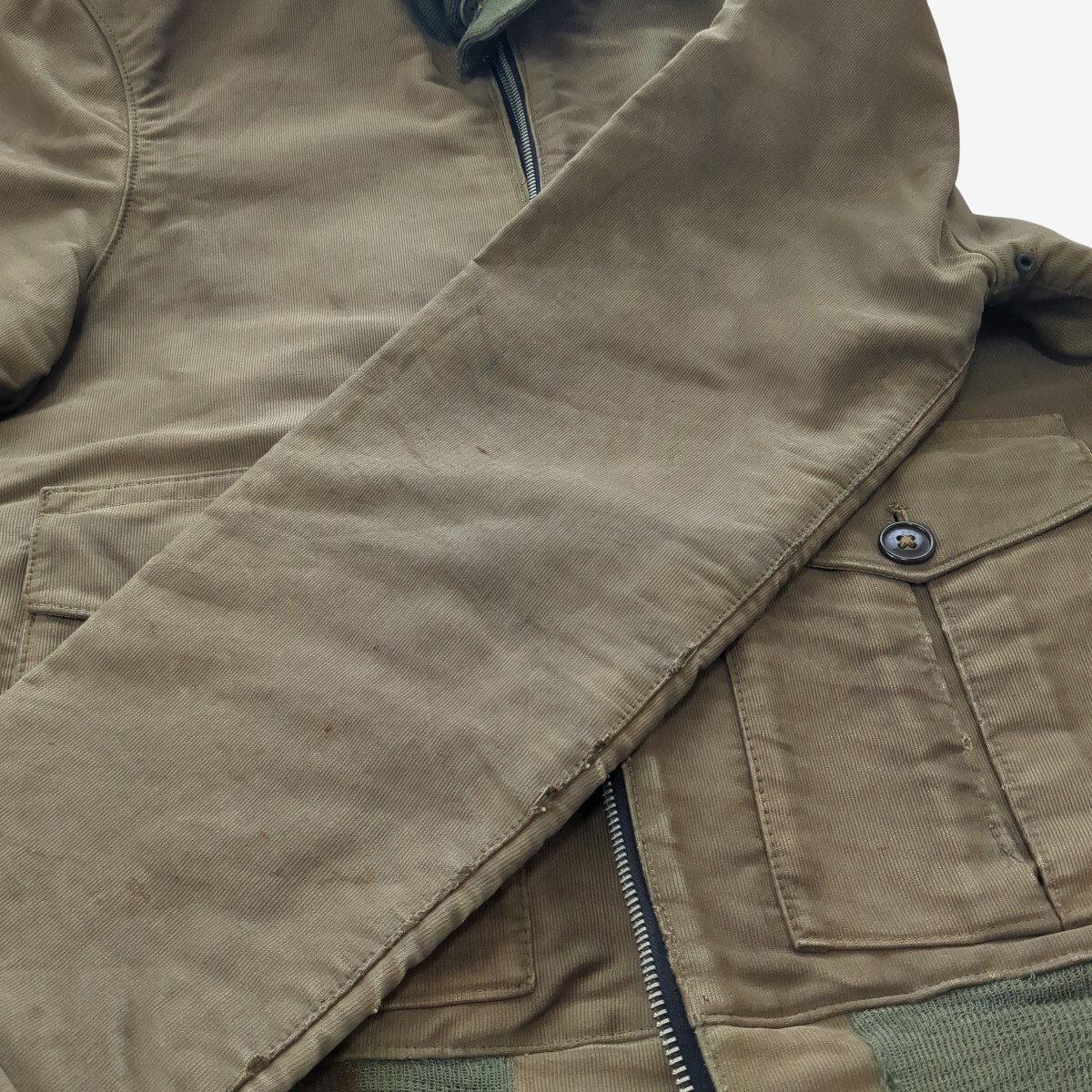
A rare U.S. Navy flight jacket of 37J1 type, constructed in olive jungle cloth with ribbed knit waistband and cuffs, zip-front closure, and dual flap pockets. The chest bears a black stenciled “USN,” preserving the garment’s institutional identity in a notably restrained form. The jacket exhibits age and service wear throughout, including replacement knit cuffs and a period-style front zipper substitution, while the principal shell remains intact and legible. As an early naval aviation garment predating the M-422 and later G-1 lineage, the present example occupies a position of exceptional historical importance within the development of American flight clothing. Its significance rests not in decorative flourish but in structural ancestry, rarity of survival, and the clarity with which it preserves an earlier stage of military aviation design.
Object
U.S. Navy 37J1 Flight Jacket
Brand / Maker
Original U.S. Navy issue
Exact contract maker not asserted from the surviving visible data here
Production Era
Circa 1930s, pre-World War II naval aviation period
Category
Original military-issued early naval flight jacket
Material
Tightly woven olive jungle cloth / aviation cotton shell
Wool knit waistband and cuffs
Light interior lining
Metal zipper front closure
Style Basis
Early naval short flight jacket pattern preceding the M-422 family and the later G-1 lineage
Marking / Decoration Context
Black stenciled USN chest marking present
No theatrical repainting or souvenir customization
Authority here comes from structure, scarcity, and survival rather than decoration
Size
Approx. tagged / fitting as 36 class
Compact prewar military proportions
Condition Summary
Original shell remains present and structurally legible
Front zipper has been replaced with a period eyelet-type zipper
Sleeve knits have been replaced
Collar lining shows friction wear and age-related abrasion
General staining, soiling, and use-consistent patina throughout
Overall object remains highly collectible because the shell, cut, and identity survive clearly
Object Classification
Not a decorative vintage jacket
Not a later postwar aviation piece
A primary-source prewar U.S. naval aviation garment
COLLECTOR RELEVANCE
Tier: Foundational Aviation Artifact / Advanced Collector Category
This piece is for:
- early U.S. naval aviation collectors
- serious flight jacket historians
- archive builders
- lineage-driven military garment collectors
- reproduction researchers and reference collectors
This piece is not for:
- casual vintage buyers seeking easy wear
- fashion-first purchasers looking for a dramatic visual hit
- purity absolutists who cannot tolerate survival maintenance
- buyers who only understand later iconic models
This is for the collector who understands that some pieces matter not because they are flashy, but because later history stands on top of them.
CONFIDENCE & VERIFICATION NOTES
Strong positives
- correct overall 37J1 visual language
- USN stencil present
- shell survival strong relative to rarity class
- age-consistent wear pattern
- maintenance choices consistent with continued life
A Garment from Before the Canon Was Finalized
Most collectors enter naval flight jackets through the pieces that became visually canonical: M-422, M-422A, 55J14, G-1. Those models feel familiar because history has already edited them into the public imagination. The 37J1 lives before that comfort. It belongs to the period when U.S. naval aviation clothing was still working toward a solved language.
That is the first and most important threshold.
This jacket is not a variation of a standard everybody knows. It is part of the stage in which the standard itself was still forming. That immediately changes the object’s weight. It stops being “rare vintage flight jacket” and becomes “structural ancestor.”
That difference changes everything.
Why 37J1 Matters
The 37J1 matters because it sits in the chain of development, not at the end of it. It shows the naval system before later wartime refinement locked in the look that collectors now recognize. The short cut, the utilitarian pocket arrangement, the disciplined military face, the zipped front, the ribbed waist logic, the compact proportions, and the practical shell all belong to a phase where aviation garments were still being aggressively engineered around need.
This is not nostalgia design.
This is unresolved design becoming history in real time.
That is why the 37J1 has such gravitational pull among serious collectors. It offers something later jackets cannot: not merely use, but prototype-era authority.
Jungle Cloth and Naval Logic
The shell is critical. Jungle cloth is not as immediately seductive as horsehide, which is precisely why it is so easy for casual buyers to underestimate. But for early naval aviation, the material logic is intelligent and revealing. Dense woven cloth allows mobility, wind resistance, and a functional relationship to salt air, cockpit movement, and layered wear without turning the garment into dead weight.
Leather announces itself. Jungle cloth does not. It works quietly.
That quietness is part of the 37J1’s seriousness. This is a garment from a moment when performance logic was not yet subordinated to mythology. It had a job first. The romance came later.
The USN Chest Stencil and the Authority of Restraint
There is no painted pin-up here. No squadron cartoon, no post-service flourish, no noisy claim for attention. Instead, the chest bears the simple USN stencil. That restraint is exactly what gives the jacket force.
The stencil does three things at once:
It anchors the object institutionally.
It confirms identity without embellishment.
It keeps the jacket within the language of issue rather than later personalization.
For many jackets, decoration is the main value driver. For a 37J1, decoration would almost be a distraction. The authority comes from the fact that the jacket did not need help. It was already important before anybody touched it.
Replacement Components and the Problem of Purity
Weak collectors get trapped by purity. Serious collectors understand survival.
The front zipper has been replaced with a period eyelet-style zipper. The sleeve knits have also been replaced. For an ordinary vintage jacket, those points would materially affect collector enthusiasm. For a 37J1, they matter, but they do not define the piece. Why? Because garments like this were not born collectible. They were maintained so they could continue functioning. Functional replacement is not an insult to history here. It is part of history.
An untouched 37J1 with failed components may satisfy the fantasy of archival purity, but a preserved 37J1 with coherent structural life often tells a truer story of how such garments actually survived. The wrong buyer sees replacement and stops. The right buyer sees continued life.
Scale, Cut, and Why Small Sizes Matter Here
The compact size is not a drawback. In early aviation garments, smaller sizing often reinforces period integrity. These jackets were not cut for modern layering habits or fashion silhouette preferences. They were cut for purpose, economy, and body profiles of the era. A compact 37J1 reads correctly in a way that oversized later pieces often do not.
That creates a split market:
Some buyers want wearability first and will hesitate.
Others want the object to remain authentic to its period proportions and will see the compact cut as a positive.
For a prewar collector, the latter group matters more.
Condition, Read Properly
The collar area shows use. The shell shows staining and age. The object has lived. But the important thing is not whether the jacket reads “clean.” It is whether it still reads true.
And it does.
The silhouette still holds. The shell still speaks. The chest stencil still anchors the identity. The object has not fallen into ruin or become a ghost of itself. It remains legible as a 37J1, and for a garment of this age and scarcity, legibility is a premium.
That is the axis on which serious valuation should turn.
MATERIAL FORENSICS
Shell
The shell remains the central victory of the piece. This is where fragile early cloth flight garments often fail. Here, the jungle cloth still holds enough density and continuity to preserve the jacket’s form and its category. Surface wear is visible, but that is not the same as structural collapse. The object still reads with authority.
Points that matter:
- shell remains intact and not disintegrated
- surface staining is secondary to survival of form
- body still carries period military geometry
If the shell had gone dead, the entire value proposition would narrow. It has not.
Knits
The sleeve knits have been replaced, and that should be read as maintenance rather than deception. In collector terms, the question is not “are these untouched?” but “does the replacement allow the jacket to remain visually and structurally coherent without distorting the pattern?” Here, yes.
The waistband still supports the short aviation silhouette. That matters. Once the waist logic dies, the jacket loses its stance. This one still stands.
Zipper
The eyelet-type front zipper replacement is part of the jacket’s survival story. A dead zipper on a garment like this is not romantic. It is a compromised access point and a stress multiplier. Replacement allowed continuity of use. For an object this early, coherent continued life can outweigh hardware absolutism.
Collar / Lining Zone
Wear at the neck and lining area is exactly where you would expect real use to register. The collar line is where the garment meets skin, sweat, friction, handling, and repeated motion. Concentrated wear there is consistent with a jacket that was actually used rather than merely stored.
That kind of wear is documentary.
Authenticity & Stewardship
Evaluated under the Japonista Aviation & Military Garment Authentication Framework™
Each work is examined through a structured, multi-layered assessment:
• Model classification and military typology verification (A-2, B-3, MA-1, G-1, L-2, etc.)
• Material evaluation across leather, shearling, nylon, wool, and mixed components
• Hardware inspection including zippers, snaps, and period-correct fastenings
• Graphic and nose art analysis, including paint method, iconography, and historical alignment
• Condition and structural integrity review, including wear patterns consistent with age and use
Where applicable, contract labels, manufacturer markings, and period construction details are reviewed to confirm authenticity and era alignment.
Guaranteed 100% Authentic.
All garments are curated and backed by the Japonista Lifetime Authenticity Warranty™, with emphasis on both material truth and historical accuracy.
A Note on Flight Jackets, Service & Visual Identity
Military flight jackets were engineered as functional equipment—designed for temperature regulation, durability, and survival in demanding conditions. Over time, they evolved into carriers of identity, memory, and personal expression.
Nose art and painted jackets—originally applied to aircraft and later to garments—represent a distinct form of visual folklore. Pin-up figures, squadron insignia, mascots, and symbolic imagery transformed standard-issue equipment into individualized statements of presence and morale.
At Japonista, these jackets are approached as wearable military artifacts. Surface wear, leather creasing, paint aging, and textile fatigue are evaluated as evidence of lived history rather than imperfection.
We preserve these works with restraint—allowing their material narrative to remain visible and intact.
Our role is to connect these garments with collectors who recognize their dual nature as both functional objects and historical documents.
Inquiries, Availability, and Private Consideration
Many flight jackets are singular in character due to condition, paintwork, contract variation, or production era. Certain pieces are held firmly due to rarity, historical resonance, or preservation status.
All inquiries are handled discreetly, and we welcome thoughtful discussion regarding provenance, contract details, nose art interpretation, and long-term wear or display considerations.
Collectors building focused archives—by model type, era, or graphic style—may consult with us for deeper guidance.
Concierge Support & Collector Guidance
Japonista Concierge™ provides tailored assistance for collectors seeking deeper engagement with aviation garments:
• Model and contract identification (A-2 variants, G-1 lineage, MA-1 evolution)
• Leather and textile preservation guidance
• Paint conservation and display considerations
• Wearability versus archival preservation assessment
• Strategic acquisition planning for aviation-focused collections
For select rare or historically significant works, private reservation or structured acquisition arrangements may be available on a case-by-case basis.
Before Proceeding
We encourage collectors to review our shop policies and house guidelines, available through the links in our website footer. These outline shipping protocols, handling considerations, and condition standards specific to vintage leather, painted garments, and military-issued clothing.
Understanding these guidelines supports responsible stewardship of each piece.
A Closing Note
Flight jackets occupy a distinct place within material history. They are objects of function shaped by environment, and over time, transformed into records of identity, service, and expression.
Nose art—whether applied to aircraft or garments—extends this narrative, capturing moments of humor, defiance, and individuality within structured military life.
At Japonista, we steward these works as aviation artifacts in wearable form—ensuring they continue their journey with collectors who understand both their construction and their story.
If you have questions or wish to explore related items, please feel free to contact Japonista Concierge™ at any time.