Rare Vintage, Antiques and Art Collector / Curator / Personal Shopper From Japan
Vintage Onigashima Zero Fighter Sukajan M Reversible WWII Aviation Battleship Japanese Embroidered Souvenir Jacket
Vintage Onigashima Zero Fighter Sukajan M Reversible WWII Aviation Battleship Japanese Embroidered Souvenir Jacket
Couldn't load pickup availability
Have a reasonable price in mind? Submit your best offer and our concierge will review it personally.
Turquoise and Pearl-Ivory Rayon Bomber with Three Zero Fighters, Japan Map, Naval Warship and Minimalist Reversible Face
Description
A rare vintage Onigashima / 鬼ヶ島 reversible sukajan built around an unusually elaborate Japanese military-aviation composition.
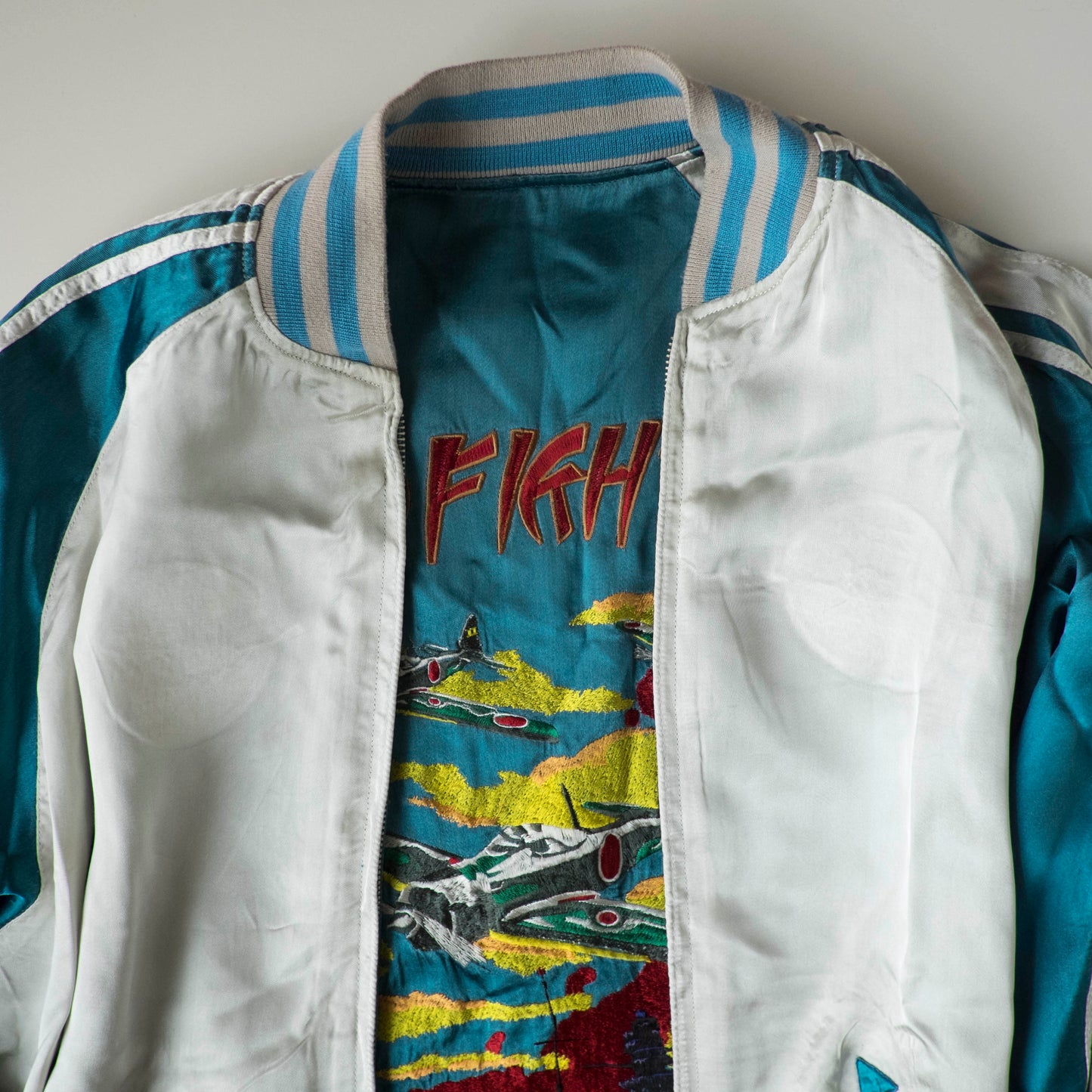
The principal turquoise face depicts three stylized Zero fighters sweeping across bands of yellow, gold and crimson sky. Behind them stretches a vivid red silhouette of the Japanese archipelago, while a dark navy and violet battleship anchors the lower back. Large angular “ZERO FIGHTERS” lettering arcs across the shoulders like the title of a wartime manga or painted aviation poster.
The front continues the theme with matching circular aircraft emblems on both sides of the chest. An additional embroidered upper-sleeve patch strengthens the atmosphere of a custom squadron jacket.
Turn the garment inside out and the entire personality changes. The reverse presents a largely unadorned pearl-ivory body with turquoise sleeves, athletic racing stripes, arrow-shaped pocket trim and matching striped ribbing. One side is a dense embroidered historical fantasy; the other is a clean vintage sportswear bomber.
Japanese resale documentation identifies this design as an Onigashima Zero Fighter sukajan in rayon, tagged size M. Comparable examples are increasingly uncommon, and Onigashima pieces now appear primarily through the secondary market rather than regular retail distribution.
Design Character
The electric turquoise ground gives this jacket a visual identity far removed from the darker navy, black and olive tones normally associated with military-inspired outerwear.
Its colors feel closer to a hand-painted movie poster:
- Turquoise sky and body
- Pearl-white sleeves
- Crimson Japanese archipelago
- Yellow and gold atmospheric bands
- Deep green aircraft
- Red Japanese roundels
- Navy and violet warship
- Silver-grey metallic highlights
- Pale blue and grey striped ribbing
The embroidery is pictorial rather than heraldic. Aircraft, land and naval imagery are stacked vertically across the back, creating a complete air-land-sea composition rather than a single isolated badge.
The oversized lettering adds a punk and manga-inflected edge. It is intentionally dramatic and graphic, giving the jacket strong crossover appeal beyond traditional amekaji.
Identification
Brand: Onigashima / 鬼ヶ島
Garment Type: Reversible embroidered sukajan
Alternative Names: Japanese souvenir jacket, Yokosuka jumper, satin bomber
Tagged Size: M
Primary Face: Turquoise body with pearl-ivory sleeves
Reverse Face: Pearl-ivory body with turquoise sleeves
Primary Subject: Japanese Zero fighter aircraft formation
Secondary Subjects: Japanese archipelago and naval battleship
Front Motifs: Matching circular Zero Fighter emblems
Construction: Raglan sleeves with reversible zipper
Material: Rayon according to documented Japanese resale records
Gender Presentation: Unisex
Approximate Period: Late twentieth century to early 2000s
Origin: Japanese fashion market
The jacket is fashion apparel inspired by wartime aviation imagery. It is not presented as an original military-issued garment, identified squadron jacket or documented piece of World War II equipment.
Zero Fighter Formation
Three aircraft dominate the principal back.
Each is shown with the red disc markings associated with Japanese military aircraft and rendered through overlapping green, white, grey, black and metallic-toned thread. The largest plane flies toward the viewer across the center, creating a forceful sense of movement and depth.
Two smaller aircraft appear above it at different angles, forming a loose three-plane formation.
The imagery references Japan’s famous Zero fighter, formally the Zero carrier fighter, but the embroidery is stylized rather than technically precise enough to assign a particular production variant. The composition is best understood as graphic aviation art rather than an engineering illustration.
Japanese Archipelago
A large crimson map of Japan runs behind the aircraft and naval scene.
The archipelago connects every level of the design. It appears behind the fighters in the sky, descends toward the warship and visually unifies the air and sea imagery.
Map embroidery has deep roots in souvenir-jacket design. Historic sukajan often recorded bases, ports, countries or military tours through embroidered geography. This jacket reinterprets that tradition with a far more theatrical late-century streetwear aesthetic.
Battleship Composition
A large dark naval vessel stretches across the lower back in navy, purple and black thread.
Its towering superstructure and elongated hull create a strong horizontal counterweight beneath the diagonal motion of the aircraft. A smaller vessel appears nearby, strengthening the sense of a naval formation.
The ship is stylized and not presented as a securely identified historical vessel. Its role is symbolic and compositional: a dark maritime foundation beneath the bright aircraft and red map.
“ZERO FIGHTERS” Typography
The shoulder lettering is among the jacket’s most distinctive features.
Large red letters with gold-toned outlines span almost the entire upper back. Their sharp, irregular structure resembles hand-painted manga titles, heavy-metal graphics and Japanese custom-motorcycle lettering.
The wording identifies the aviation subject directly while giving the garment a rebellious visual energy quite different from formal military insignia.
Although “kamikaze jacket” is sometimes used as a broad search phrase for this type of apparel, the visible embroidery reads “ZERO FIGHTERS” and does not identify a particular special-attack unit. The jacket is therefore described through its documented Zero-fighter and WWII aviation imagery rather than assigned unsupported unit provenance.
Chest and Sleeve Embroidery
Two matching circular emblems sit symmetrically across the turquoise chest.
Each badge combines:
- Deep crimson circular ground
- Pale aircraft silhouette
- “ZERO FIGHTER” lettering
- Smaller decorative text
- White embroidered border
Their symmetrical placement gives the front the appearance of a custom aviation-club or squadron bomber while allowing the elaborate back to remain the principal attraction.
An additional rectangular embroidered patch is positioned on the upper sleeve. Its red border, Japanese decorative imagery and pale ground introduce a small wagara accent into the otherwise aviation-centered composition.
Pearl-Ivory Reversible Face
The reverse is intentionally restrained.
A pearl-ivory body replaces the embroidered turquoise back, while turquoise raglan sleeves provide bold contrast. Narrow ivory and turquoise racing stripes travel over the shoulders and along the arms.
Visible reverse-side details include:
- Clean pearl-ivory back
- Turquoise sleeves
- Athletic double stripes
- Arrow-shaped welt-pocket trim
- Fully finished exterior seams
- Reversible zipper
- Striped collar, cuffs and waistband
- Lightweight vintage bomber silhouette
The ivory face allows the jacket to be worn as simpler retro sportswear. When partly unzipped, fragments of the aircraft embroidery become visible inside, producing a dramatic layered effect.
Materials and Construction
Japanese resale records document this Onigashima model as rayon, size M. A closely comparable example was measured at approximately 53.5 cm across the chest, 63–64 cm in body length and 85.5 cm through the raglan sleeve. Those figures support the relatively generous Japanese size-M proportions visible in this garment, although the measurements listed below are specific to the present jacket.
Visible construction includes:
- Rayon satin exterior
- Fully reversible design
- Multicolored machine embroidery
- Raglan sleeve construction
- Full-length metal zipper
- Pockets on both wearable faces
- Arrow-shaped pocket openings
- Striped rib-knit collar
- Striped rib-knit cuffs
- Striped rib-knit waistband
- Contrasting racing stripes
- Reinforcement beneath major embroidered areas
The rayon produces a fluid drape and a changing reflective surface. Turquoise sections shift between blue and green according to the light, while the ivory satin moves between pearl white, pale silver and warm cream.
Sukajan Heritage
The sukajan developed from embroidered souvenir jackets created for American servicemen stationed in postwar Japan. Traditional examples combined baseball-jacket construction with Japanese dragons, tigers, eagles, landscapes, maps and military inscriptions. Modern Japanese brands later expanded the form into collectible fashion and streetwear.
This Onigashima jacket belongs to that later revival tradition.
Rather than recreating a restrained 1940s or 1950s tour jacket, it amplifies the military imagery through vivid turquoise satin, manga-like lettering and a poster-scale aircraft scene. It reflects the period when sukajan imagery crossed into motorcycle culture, tattoo fashion, rock styling and Japanese urban streetwear.
Period Assessment
The jacket appears consistent with a late-1990s to early-2000s Japanese revival sukajan.
Its rayon construction, bold typography, vivid color blocking, lightweight reversible architecture and densely illustrated embroidery differ from original postwar souvenir jackets. The documented Onigashima branding also places it within a later Japanese fashion context.
The precise production year has not been confirmed.
The responsible public attribution is:
Vintage or vintage-era Onigashima reversible Zero Fighter sukajan, likely late twentieth century to early 2000s.
Condition
Presented in pre-owned vintage condition with visible age-related surface character.
The photographs and existing garment documentation show:
- Natural creasing throughout the rayon satin
- Uneven sheen caused by folds and previous wear
- General tonal variation across the turquoise face
- Faint discoloration and marks on the ivory sections
- More visible handling wear around sleeve and edge areas
- Localized darkening near selected seams
- Light abrasion around the zipper and pockets
- Minor loose or raised embroidery fibers
- Small irregularities within the principal back embroidery
- Natural puckering around densely stitched areas
- Gentle wear to the rib-knit collar, cuffs and waistband
- Surface patina consistent with an older reversible satin jacket
The Zero fighters, Japanese map, battleship, lettering and chest emblems remain bold, colorful and highly legible.
No major open tear or large missing embroidered section is apparent in the supplied photographs. The garment should nevertheless be expected to show the creasing, marks, tonal changes and textile irregularities of authentic pre-owned rayon outerwear.
Dimensions and Fit
Tagged size: M
Approximate garment measurements recorded through the Japonista A–E sukajan measurement system:
A: 70 cm / 27.6 in
B: 55 cm / 21.7 in
C: 85 cm / 33.5 in
D: 60 cm / 23.6 in
E: 42 cm / 16.5 in
Please consult the corresponding Japonista sukajan sizing guide for the precise A–E measuring positions.
The approximately 55 cm chest width and long raglan measurement suggest a relatively generous vintage Japanese M. It may correspond approximately to:
- A relaxed Western S
- A regular Western M
- A slimmer fit on some Western L frames
The jacket retains a traditionally compact sukajan body, gathered waistband and rounded raglan shoulders. Body shape, layering and preferred silhouette will affect the fit.
Please compare every measurement with a similar jacket that already fits comfortably.
Styling
The turquoise embroidered face works especially well with:
- Dark indigo denim
- Black wide-leg trousers
- Olive military pants
- Leather trousers
- Engineer boots
- High-top sneakers
- Plain black T-shirts
- Japanese biker fashion
- Rockabilly styling
- Tattoo-inspired streetwear
- Punk and visual-kei outfits
The ivory reverse can be styled more quietly with:
- Faded blue denim
- Cream workwear trousers
- White sneakers
- Retro sportswear
- Minimal knitwear
- Pale military chinos
- Vintage varsity layers
The jacket can also be worn partly open to expose the embroidered aircraft composition beneath the plain ivory face.
Display and Collecting Appeal
This piece crosses several specialist collecting categories:
- Onigashima archive fashion
- Vintage Japanese sukajan
- Zero Fighter memorabilia-inspired apparel
- WWII aviation imagery
- Japanese military streetwear
- Embroidered souvenir jackets
- Aviation collector fashion
- Battleship embroidery
- Japan-map jackets
- Vintage rayon bombers
- Japanese tattoo-art clothing
- Amekaji and biker fashion
- Wearable textile art
Its strongest characteristics are the turquoise colorway, three-aircraft formation, Japanese map, large naval silhouette and dramatically different reversible side.
Displayed flat, the back resembles an embroidered aviation poster. Worn, the reflective rayon and moving folds cause the planes, clouds and battleship to change continuously with the light.
Offers, Shipping and Store Policies
Respectful and reasonable offers may be considered. Flexibility depends on the rarity, condition, embroidery and current international collector demand.
This is a pre-owned vintage garment sold in its existing condition. The photographs form an essential part of the description and document the satin creasing, discoloration, textile variation, embroidery and signs of prior wear.
Please review all photographs and measurements carefully before purchasing.
The garment is offered as-is. Returns, claims and exchanges based on disclosed vintage wear, photographed condition or sizing are not ordinarily accepted, subject to applicable Etsy policies, purchase protection and mandatory consumer law.
Worldwide shipping is available through Japan Post EMS wherever service is offered. The parcel will include tracking and will normally be prepared within 3–5 business days.
Delivery time varies according to destination and customs processing. Import duties, taxes and local charges remain the buyer’s responsibility where applicable.
#Onigashima #OnigashimaJacket #ZeroFighter #ZeroFighterJacket #VintageSukajan #JapaneseSukajan #ReversibleSukajan #AviationJacket #WWIIAviation #JapaneseBomber #SouvenirJacket #YokosukaJumper #AircraftEmbroidery #BattleshipJacket #JapanMapJacket #MilitaryStreetwear #JapaneseStreetwear #VintageJapanese #RayonJacket #SatinBomber #Amekaji #BikerFashion #TattooArtFashion #PunkStreetwear #AviationCollector #VintageOuterwear #WearableArt #UnisexJacket #SizeMSukajan #Japonista
onigashima jacket, zero fighter jacket, vintage sukajan, wwii aviation coat, japanese bomber, reversible jacket, embroidered bomber, battleship jacket, japan map jacket, yokosuka jumper, military streetwear, size m sukajan, aviation collector
Material Tags
rayon satin, embroidery thread, rib-knit trim, metal zipper, woven pocket lining, textile reinforcement, sewing thread