Rare Vintage, Antiques and Art Collector / Curator / Personal Shopper From Japan
Vintage Korea Tour Jacket Patch Covered Military Souvenir Jacket 40s 50s Squadron Badge Trophy Jacket Rare
Vintage Korea Tour Jacket Patch Covered Military Souvenir Jacket 40s 50s Squadron Badge Trophy Jacket Rare
Couldn't load pickup availability
Have a reasonable price in mind? Submit your best offer and our concierge will review it personally.
American Military Souvenir / Tour Jacket
Korea-associated, patch-saturated commemorative example, circa mid-20th century
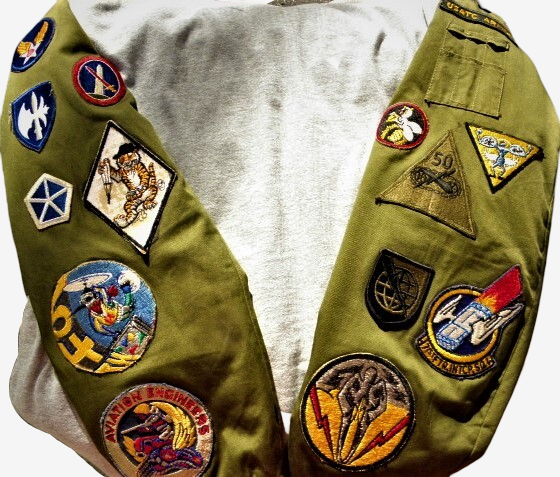
An exceptionally dense and visually arresting military souvenir jacket, distinguished by the extraordinary accumulation of squadron patches, military insignia, embroidered devices, and applied badges across multiple surfaces. Centered around a pronounced Korea-themed identity, the garment transforms a simple military-style jacket into a textile field of affiliation, memory, and post-service display.
Unlike regulation garments prized for formal correctness, this example operates within the vernacular tradition of commemorative military customization, where service memory is expressed through layering rather than order. The resulting surface is animated, almost collage-like, and possesses a distinct folk-art energy uncommon even within the broader category of tour jackets.
Condition is consistent with age and long-term survival, including wear to the knitted cuffs and waistband, possible lining alteration, and general use-related fading and repair. Yet these very traits contribute to the object’s credibility, reinforcing its identity as a lived and assembled piece rather than a staged decorative reproduction.
A rare and compelling example of military memory culture in garment form, occupying the space between memorabilia, fashion, and vernacular textile art.
Object
U.S. Army / Korea-era souvenir tour jacket / trophy jacket heavily customized with squadron patches, military badges, and theater-recall insignia
Probable Era
Late 1940s to 1950s base garment, later built up through patching and badge accumulation
Seller frames it broadly as 40s–50s / WWII–Korean War atmosphere, but the jacket should be treated as a multi-period assembled military souvenir object, not a clean single-moment issue garment
Type
Zip-front military-style souvenir / tour jacket
Front and back densely covered with insignia, patches, and metallic badges
Thematic Geography
Strong Korea reference visible in the composition
Patch language suggests a memory-board logic rather than a regulation garment logic
Customization Character
Heavy all-over patchwork and badge montage across front, sleeve, and back
This is not a uniform in the strict sense
It is a personalized commemorative object, almost scrapbook-like in textile form
Material
Olive drab shell, likely cotton-based military cloth or military-style workwear fabric
Precise fabric composition unresolved from listing alone
Lining
Seller suspects lining may have been replaced
Condition Notes
Used vintage condition throughout
Color fade, wear, dirt, damage, repair history, and age-related distress explicitly acknowledged
Both sleeve ribs and waist rib damaged
General patina is part of the object’s identity
Measurements
Shoulder: approx. 49 cm
Chest: approx. 56 cm
Sleeve: approx. 60 cm
Length: approx. 59 cm
Object Classification
Not a clean archival military issue piece
Not a single-theater untouched artifact
A folk-military memory jacket with strong visual and collector appeal
COLLECTOR RELEVANCE
Tier: Visual Rarity / Folk-Military Collector Piece
This is best for:
- collectors of military souvenir garments
- vintage buyers who value patch saturation and visual drama
- Americana / Korea-war memory collectors
- fashion collectors who want a one-off statement object with real age
This is not for:
- strict regulation-uniform purists
- buyers who need airtight single-owner provenance
- collectors seeking untouched issue garments
This is a jacket for someone who understands that memory is often messier than history.
CONFIDENCE & VERIFICATION NOTES
This piece should be judged on the following terms:
- authenticity of vintage base garment
- age coherence of attachments
- whether patch layering feels cumulative rather than recently decorative
- structural viability of shell and ribs
- honesty of wear relative to visual density
If the patching is old and organically layered, the jacket’s real value is cultural rather than documentary.
CURATORIAL ANALYSIS
A Jacket as Memory Board
This object should not be approached like a regulation garment. It behaves more like a portable wall of remembrance. The moment you stop asking whether it is “correct” in a narrow uniform sense and start asking what it is trying to preserve, the jacket becomes far more interesting.
It is not streamlined.
It is not disciplined.
It is not elegant in the military-tailoring sense.
It is accumulative.
Each patch, tab, badge, and insignia fragment turns the garment into a surface of attachment. The jacket ceases to be clothing first and becomes a textile board onto which affiliations, places, fantasies, boasts, and memories have been pinned.
That is why it feels powerful.
From Uniform Logic to Souvenir Logic
Uniform logic is about order.
Souvenir logic is about retention.
This jacket belongs to the second category. It does not present itself as a coherent official system. Instead, it assembles fragments of military belonging into a visual field that behaves almost like a veteran’s locker door, trunk lid, or private wall display. The front is overloaded, the sleeves continue the story, and the back appears to participate in the same excess.
That excess is not a flaw. It is the entire point.
Tour jackets and post-service custom jackets often matter precisely because they break military order after military life. They allow the wearer or owner to rearrange service memory into something more personal, more chaotic, and often more emotionally honest than regulation clothing ever permits.
The Korea Axis
The word KOREA running through the composition is structurally important. It anchors the object geographically and emotionally. Without it, the jacket could read as generic patch accumulation. With it, the object gains a center.
But even here, caution is necessary. This is not the kind of piece where every insignia necessarily belongs to one exact service path. Such jackets often become layered over time, mixing genuine association, souvenir collecting, aftermarket additions, and aesthetic composition. That does not make them fake. It makes them assembled history.
The serious question is not whether each element shares one biography.
The serious question is whether the whole object convincingly expresses the culture of military memory.
This one does.
Visual Density as Value Driver
Some military garments are valuable because they are restrained. This is valuable, if at all, because it is unrestrained.
The jacket works through saturation:
- chest fully activated
- sleeves carrying peripheral identity
- metallic badges creating punctuation
- large script and patch fields creating hierarchy
- color interruptions against the olive base generating continuous movement
This is not minimal collecting.
This is carnival memory rendered through military debris.
That quality gives the object a folk-art edge. It begins to behave less like clothing and more like vernacular assemblage.
Folk Military, Not Museum Military
There is a critical distinction here.
Museum military objects are often valued for exact provenance, unit assignment, and intact regulation purity.
Folk military objects are valued for how service is remembered, displayed, exaggerated, and worn.
This jacket sits firmly in the second category.
Its power lies in:
- emotional immediacy
- patch abundance
- patinated authenticity of use
- refusal of neatness
- visual storytelling without archival neatness
For some collectors, that will reduce appeal. For others, it will increase it dramatically.
Condition and the Ethics of Damage
The seller is almost aggressive in their warnings about wear, damage, fading, and repairs. That bluntness is useful. It tells you not to romanticize the object’s condition. The damaged ribs, worn shell, possible lining replacement, and general age fatigue are real.
But in a jacket like this, total cleanliness would actually be suspicious.
A heavily decorated souvenir jacket that survives too perfectly can feel curated after the fact. One that carries fray, fading, unevenness, and patch-weight fatigue often feels much more believable. The wear is not incidental. It is part of the piece’s visual truth.
The correct approach is not restoration toward cleanliness.
It is stabilization toward survival.
The Object as American Veteran Pop Language
There is also something deeply American in this jacket’s visual temperament, even through a Japanese marketplace lens. It speaks in the language of accumulation, display, and self-mythology. It turns service into emblem, affiliation into ornament, and memory into cluttered authority.
That is why it resonates beyond strict military collectors. It can appeal to:
- vintage fashion buyers
- Americana collectors
- outsider-art sensibilities
- folk textile enthusiasts
- military memorabilia people who prefer human mess over archival order
It is a hybrid object. And hybrid objects often have the longest cultural afterlife.
MATERIAL FORENSICS
Shell
The exact cloth needs handling to resolve properly, but the garment reads as a real vintage military-style base rather than a recent fantasy piece. Important checks would include:
- seam aging under patch weight
- oxidation and color shift consistency around high-contact areas
- whether fading is global and natural rather than localized and artificial
- sleeve articulation and underarm wear logic
Patch Attachment
This is the most important physical zone. On a jacket this loaded, stitching chronology matters more than patch identity in isolation. A good in-hand reading would examine:
- thread color variation
- patch edge wear vs shell wear
- whether all attachments belong to one mounting period or several
- metallic badge puncture logic and backing stress
If the attachments are period-layered rather than recently composed, the jacket gains substantial character value.
Ribs
The damaged cuffs and waistband are not surprising. In fact, they are structurally predictable for a patch-loaded vintage jacket with long storage life. The key is whether they still hold the silhouette enough for display and occasional careful wear. If yes, conservation rather than replacement remains the right path.
Lining
If replaced, it alters purity but not necessarily desirability. In this category, buyers are paying for the exterior field of memory more than inner-contract fidelity. Still, the lining should be inspected for stitch chronology and whether the replacement, if any, is old enough to belong to the garment’s life rather than a recent cosmetic intervention.
Authenticity & Stewardship
Evaluated under the Japonista Aviation & Military Garment Authentication Framework™
Each work is examined through a structured, multi-layered assessment:
• Model classification and military typology verification (A-2, B-3, MA-1, G-1, L-2, etc.)
• Material evaluation across leather, shearling, nylon, wool, and mixed components
• Hardware inspection including zippers, snaps, and period-correct fastenings
• Graphic and nose art analysis, including paint method, iconography, and historical alignment
• Condition and structural integrity review, including wear patterns consistent with age and use
Where applicable, contract labels, manufacturer markings, and period construction details are reviewed to confirm authenticity and era alignment.
Guaranteed 100% Authentic.
All garments are curated and backed by the Japonista Lifetime Authenticity Warranty™, with emphasis on both material truth and historical accuracy.
A Note on Flight Jackets, Service & Visual Identity
Military flight jackets were engineered as functional equipment—designed for temperature regulation, durability, and survival in demanding conditions. Over time, they evolved into carriers of identity, memory, and personal expression.
Nose art and painted jackets—originally applied to aircraft and later to garments—represent a distinct form of visual folklore. Pin-up figures, squadron insignia, mascots, and symbolic imagery transformed standard-issue equipment into individualized statements of presence and morale.
At Japonista, these jackets are approached as wearable military artifacts. Surface wear, leather creasing, paint aging, and textile fatigue are evaluated as evidence of lived history rather than imperfection.
We preserve these works with restraint—allowing their material narrative to remain visible and intact.
Our role is to connect these garments with collectors who recognize their dual nature as both functional objects and historical documents.
Inquiries, Availability, and Private Consideration
Many flight jackets are singular in character due to condition, paintwork, contract variation, or production era. Certain pieces are held firmly due to rarity, historical resonance, or preservation status.
All inquiries are handled discreetly, and we welcome thoughtful discussion regarding provenance, contract details, nose art interpretation, and long-term wear or display considerations.
Collectors building focused archives—by model type, era, or graphic style—may consult with us for deeper guidance.
Concierge Support & Collector Guidance
Japonista Concierge™ provides tailored assistance for collectors seeking deeper engagement with aviation garments:
• Model and contract identification (A-2 variants, G-1 lineage, MA-1 evolution)
• Leather and textile preservation guidance
• Paint conservation and display considerations
• Wearability versus archival preservation assessment
• Strategic acquisition planning for aviation-focused collections
For select rare or historically significant works, private reservation or structured acquisition arrangements may be available on a case-by-case basis.
Before Proceeding
We encourage collectors to review our shop policies and house guidelines, available through the links in our website footer. These outline shipping protocols, handling considerations, and condition standards specific to vintage leather, painted garments, and military-issued clothing.
Understanding these guidelines supports responsible stewardship of each piece.
A Closing Note
Flight jackets occupy a distinct place within material history. They are objects of function shaped by environment, and over time, transformed into records of identity, service, and expression.
Nose art—whether applied to aircraft or garments—extends this narrative, capturing moments of humor, defiance, and individuality within structured military life.
At Japonista, we steward these works as aviation artifacts in wearable form—ensuring they continue their journey with collectors who understand both their construction and their story.
If you have questions or wish to explore related items, please feel free to contact Japonista Concierge™ at any time.