Rare Vintage, Antiques and Art Collector / Curator / Personal Shopper From Japan
Vintage UFO Robot Grendizer Jumbo Machinder Figure Soft Vinyl ~60cm w ZZ-7 Punch Action Showa Era Giant Robot Display Collectible
Vintage UFO Robot Grendizer Jumbo Machinder Figure Soft Vinyl ~60cm w ZZ-7 Punch Action Showa Era Giant Robot Display Collectible
Couldn't load pickup availability
Have a reasonable price in mind? Submit your best offer and our concierge will review it personally.
Jumbo Machinder refers to a large-scale Japanese robot toy format, typically produced in soft vinyl at approximately 60 cm in height. Developed during the 1970s super-robot era, these figures were designed as monumental display pieces with missile-launching features and bold mechanical presence. Many of the most iconic examples were produced by Popy, a Bandai subsidiary renowned for defining the standards of Japanese robot toys.
CURATORIAL OVERVIEW — WHAT THIS OBJECT ACTUALLY IS
This is the kind of object that doesn’t behave like a “toy” anymore. At roughly 60 cm tall, a jumbo Grendizer figure crosses into room-presence: a standing sculpture made of soft vinyl, engineered for impact, designed to be seen from across a tatami room, a shop shelf, or a child’s floor. The surface tells you immediately it’s from an era when mass culture was physical, loud, and proudly stylized. It is not a delicate miniature. It’s a big-bodied, front-facing monument to the age of giant robots, meant to be grabbed, staged, posed, and admired.
The included ZZ-7 accessory matters here: it anchors the piece in a specific play-pattern and character logic, and it upgrades the object from “big figure” into “complete display narrative.” On this scale, accessories are not small extras. They’re visual proof of the line’s original ambition: interactive hero hardware, built for dramatic action and then preserved by time into collector artifact.
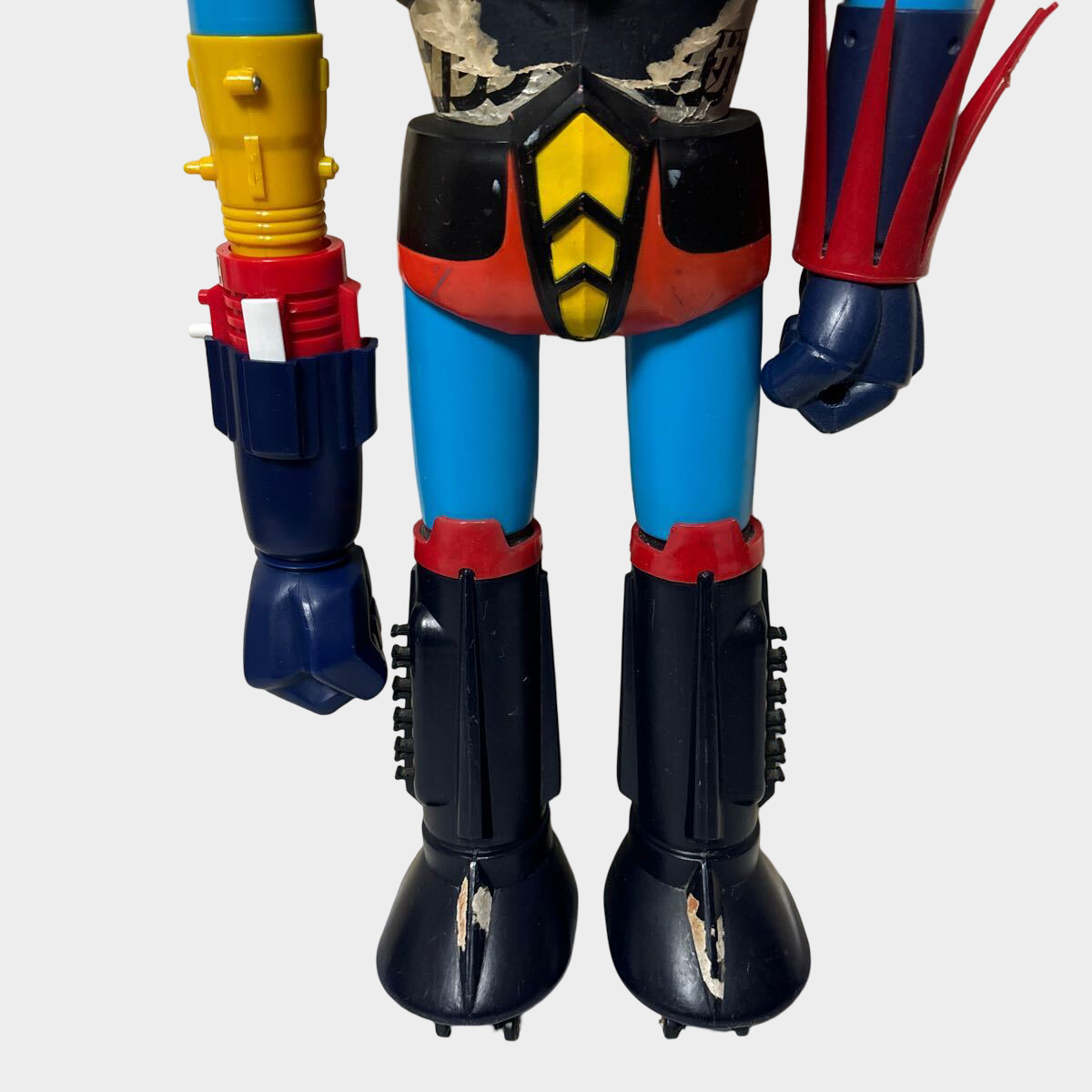
This example has lived. That’s not a flaw to hide. It’s the truthful biography: scuffs, aging, and material fatigue are part of why these survive in the first place. Large soft vinyl figures were not manufactured for 50-year futures. They were manufactured for the present tense. So when one arrives intact, with action confirmed, it becomes a survivor-object, the kind collectors treat like a theater prop rescued from history.
Object: Vintage jumbo-scale UFO Robot Grendizer character figure with ZZ-7 punch-firing accessory
Era: Showa-era vintage (classic Japanese tokusatsu/anime collector category)
Maker line (most consistent with): Popy-style Jumbo Machinder era large-format character figures (collector classification)
Material: Soft vinyl body with mixed materials (painted components; internal mechanism for punch action)
Approx size (figure): H ~60 cm (about 23.6 in)
Included: Figure + ZZ-7 accessory (what you see is what ships)
Condition: Heavy age wear and deterioration present; sticker/label wear with peeling visible; surface aging and scuffs; sold as an honest vintage survivor
Functionality: Punch-firing action confirmed
Packaging: No box (figure only)
Display footprint (estimated): ~22 cm W x 16 cm D (8.7 in x 6.3 in)
ICONOGRAPHY & THEMATIC ANALYSIS
Grendizer is a helmeted sentinel: horned silhouette, bold chest geometry, and blocky limb language that reads instantly even at a distance. This design isn’t subtle, it’s ceremonial. Giant robot iconography from this period communicates “guardian power” through symmetry and armor-like color blocking, and that’s why jumbo figures work so well. The sculpt doesn’t need fine detail to be convincing. It needs correct proportions, strong mask presence, and the unmistakable chest and shoulder shapes that signal identity.
The punch-action mechanism is not merely a gimmick. It’s a physical translation of the genre’s grammar: the decisive forward strike, the heroic release, the moment of impact turned into a child-operated ritual. The ZZ-7 accessory reinforces the “equipment mythology” that made these series feel like militarized fairy tales, where the hero’s identity is inseparable from their named hardware.
In display terms, this figure reads like a poster you can walk around. Front view is iconic, but the side and rear angles matter too, because the scale makes silhouette king. This is why collectors chase jumbo pieces even in imperfect condition: you’re collecting presence, not micro-detail.
Who is UFO Robot Grendizer?
UFO Robot Grendizer is a 1975 super-robot anime created by Go Nagai, and the third major entry in the Mazinger lineage, following Mazinger Z and Great Mazinger.
Unlike his predecessors, Grendizer is not built on Earth.
He is an alien robot, brought to Earth by a refugee prince fleeing an interstellar empire.
That single change reshaped the genre.
👤 The pilot: Duke Fleed
Grendizer is piloted by Duke Fleed, a prince from the destroyed planet Fleed.
This matters because:
-
The pilot is not a reckless teenager or soldier
-
He is a survivor of planetary annihilation
-
The story carries themes of exile, loss, and responsibility
Grendizer fights not to prove strength, but to protect a world that adopted him.
🧠 What makes Grendizer different
Grendizer broke several assumptions at once:
-
🌍 Cosmic scale
The conflict is interstellar, not local or underground. -
🛸 UFO integration
The robot docks into a flying saucer (the Spazer), blending robot and spacecraft. -
⚔️ Energy-based combat
More beam weapons, fewer brute punches. -
🎭 Tragic tone
The hero already lost everything before the story begins.
Design-wise, Grendizer looks sleeker and more regal than Mazinger Z:
-
Narrower face
-
Crescent-like horns
-
Emphasis on speed and flight
He feels less like a machine—and more like a guardian deity from space.
🌍 Cultural impact (especially important)
Grendizer became enormously popular outside Japan, particularly in:
-
Europe (France, Italy, Middle East)
-
Parts of the Mediterranean region
For many international fans, Grendizer was their first Japanese robot.
This made Grendizer:
-
One of the earliest global anime icons
-
A bridge between Japanese super robots and worldwide audiences
🧸 Importance in toy history
Grendizer’s UFO + robot format translated perfectly into toys:
-
Docking gimmicks
-
Flight accessories
-
Large-scale display presence
As a result, Grendizer became a centerpiece for:
-
Popy Chogokin
-
Jumbo Machinder releases
-
Later revival and collector editions
Collectors often treat Grendizer as:
the most elegant of the classic Go Nagai robots.
MATERIAL & CRAFT ASSESSMENT
Soft vinyl at jumbo scale has its own virtues: it’s forgiving, lightweight for its size, and it holds bold shapes without becoming brittle in the way hard plastics can. The tradeoff is that it ages honestly. You see it in surface sheen changes, sticker wear, paint fatigue, and the small stresses around joints and mechanisms. That aging is typical, and it’s exactly why condition must be described as a spectrum rather than a yes/no.
This piece is best understood as a large-format vintage display figure with functional action, preserved in “survivor” state. It is not a restoration candidate for everyone, but for the right collector it’s perfect as-is: authentic surface, original life, and a scale that makes it feel like a miniature stage prop.
HISTORICAL CONTEXT — WHY THESE SURVIVE AT ALL
Jumbo hero figures were built in an era when entertainment was broadcast once, then carried forward by objects you could touch. If you missed an episode, you still had the hero standing in your room. That’s the historical job these figures performed: they were memory engines. And because they were used hard, very few survive with intact structure, intact identity, and working action.
Collectors now treat this category as “industrial pop sculpture.” It sitseats the line between toy history and design history, because the forms are bold enough to function as interior objects. The passage of decades converts playwear into provenance of use: evidence the object did what it was made to do.
COLLECTOR RELEVANCE
-
Scale premium: ~60 cm is true jumbo territory, the size bracket collectors chase because it’s visually dominant.
-
Character clarity: Grendizer’s silhouette reads instantly; it displays like a brand mark.
-
Action confirmed: punch-firing feature working adds both value and confidence.
-
Accessory anchor: ZZ-7 included strengthens “complete scene” presentation.
-
Showa survivor appeal: honest wear is normal and often preferred over suspicious “too-new” surfaces.
This is a collector’s piece for people who want their shelves to feel like a museum of broadcast-era imagination, not a row of identical small boxes.
SUMMARY — WHY THIS PIECE MATTERS
A jumbo Grendizer is not just nostalgia, it’s scale-translation: a classic hero turned into a standing object with gravity. This example carries the right signals: the correct silhouette, confirmed action, and the ZZ-7 element that keeps the figure from becoming generic. Wear is present, but survival is the headline. For collectors of Showa robot culture, this is the kind of piece that changes a room.
Why Popy Matters
Founded in 1971 and later integrated into Bandai, Popy occupies a foundational position in the history of Japanese character toys. During the explosive growth of anime and tokusatsu in the 1970s, Popy established the manufacturing and design standards that would define how robots and heroes were translated from screen to physical form.
Popy’s significance lies not only in licensing major properties, but in formalizing scale, weight, and material language. Through lines such as Chogokin and Jumbo Machinder, the company set expectations for mass, durability, and visual authority—creating toys that felt monumental rather than disposable. These objects were designed to command space, functioning as both playthings and display icons within the home.
Many conventions now taken for granted in Japanese robot toys—die-cast heft, oversized proportions, bold mechanical silhouettes—were normalized through Popy’s output. Even after the brand was absorbed into Bandai in the early 1980s, the term “Popy era” continues to signal a peak period of experimentation, quality, and cultural impact.
For collectors, Popy represents origin rather than revival: the moment when Japanese toy design matured into a globally influential language. Items bearing the Popy name are recognized not merely as licensed merchandise, but as historical benchmarks in the evolution of modern toy culture.
Authenticity & Collectible Stewardship
Evaluated under the Japonista Collectibles Authentication Framework™:
-
Period, manufacturer, and production-era assessment
-
Material, paint, lithography, and surface-wear analysis
-
Mechanical, structural, and component integrity review (where applicable)
-
Design, iconography, and cultural-context verification
Guaranteed 100% Authentic.
Every piece is backed by the Japonista Lifetime Authenticity Warranty™ and curated with collector-grade scrutiny.
A Note on Collecting & Preservation
At Japonista, we approach vintage and modern toys not merely as nostalgic objects, but as design artifacts, cultural touchstones, and expressions of their era—from postwar ingenuity and Showa imagination to contemporary pop and designer movements.
Each work is carefully examined, researched, and presented with respect for its original intent, historical context, and collector relevance, balancing preservation with the honest character earned through time and play.
Our role is not only to offer access to meaningful collectibles, but to act as thoughtful custodians—connecting the right pieces with collectors who value history, originality, and lasting significance.
Inquiries, Availability, and Private Consideration
Some collectible works may allow room for discussion, while others are held firmly due to rarity, condition, provenance, or cultural importance. All inquiries are reviewed personally and discreetly, and we welcome thoughtful questions or expressions of interest.
If you are exploring a specific theme, franchise, maker, era, or mechanical category—or seeking guidance in building a focused collection—our team is always available to assist with informed, quiet expertise.
Concierge Support & Collector Guidance
Japonista Concierge™ offers personalized assistance for collectors seeking deeper understanding, strategic acquisitions, or long-term curation across vintage and modern collectibles.
Whether your interest lies in nostalgia, design history, mechanical fascination, or pop-culture legacy, we are here to support your collecting journey with clarity, care, and discretion.
For select high-value or historically significant pieces, private reservation or structured payment arrangements may be available on a case-by-case basis. Please contact us to discuss eligibility and options.
Before Proceeding
We kindly encourage collectors to review our shop policies and house guidelines, available through the links in our website footer, which outline shipping, handling, and condition standards specific to vintage, mechanical, and collectible works.
A Closing Note
Thank you for exploring Japonista’s collection of vintage and modern toys, robots, and cultural collectibles. We are honored to share these enduring objects of imagination and design—and to help place them where they may continue to be appreciated, studied, and enjoyed.
If you have questions or wish to explore related works, please feel free to contact Japonista Concierge™ at any time.