Rare Vintage, Antiques and Art Collector / Curator / Personal Shopper From Japan
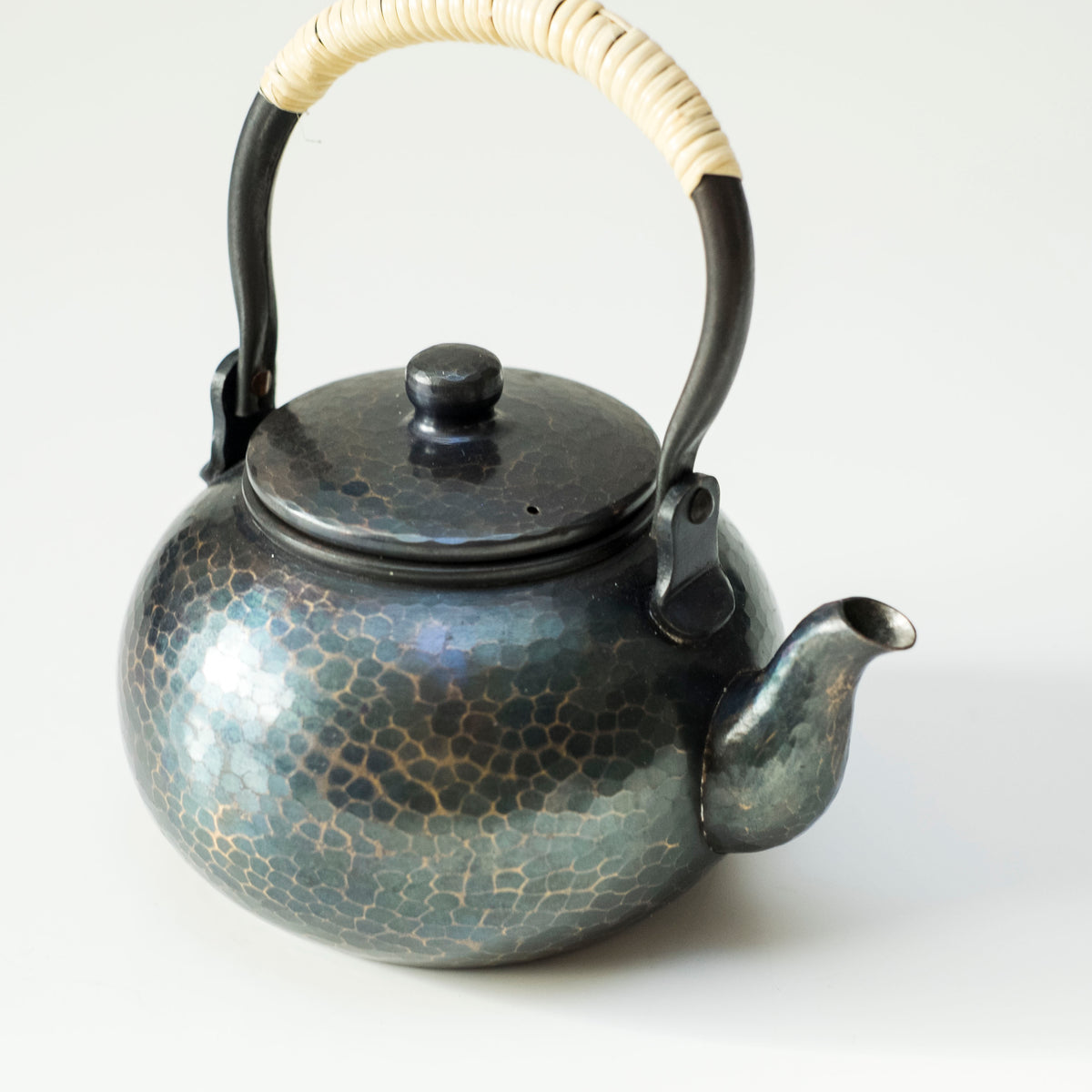
Vintage Japanese Tsuiki Doki Hammered Copper Kyusu Teapot with Woven Handle & Inscribed Wooden Box
Vintage Japanese Tsuiki Doki Hammered Copper Kyusu Teapot with Woven Handle & Inscribed Wooden Box
Couldn't load pickup availability
Have a reasonable price in mind? Submit your best offer and our concierge will review it personally.
Hand-Hammered Japanese Copper Tea Pot with Deep Aged Patina, Tsuchime Surface, Wrapped Arch Handle and Traditional Kiribako Presentation
Introduction
A beautiful marriage of utility and metal artistry, this vintage Japanese hammered copper kyusu teapot transforms an everyday tea vessel into a quietly sculptural object.
Its rounded body has been worked with an extraordinarily dense field of individual hammer impressions, creating a surface that catches light almost like reptile scales, hammered stone or overlapping cells. Across that texture sits a remarkable dark patina, shifting from charcoal and deep brown to smoky bronze, blue-black and flashes of turquoise-green depending on the direction of the light.
Above the compact body rises a tall arching metal handle, partially wrapped in pale natural fiber for both comfort and visual contrast. The curved spout, fitted lid and small lid knob preserve the simplicity of the traditional vessel, while the subtle irregularity of the hammered surface reminds us that this was conceived as craft rather than anonymous industrial kitchenware.
Accompanying the teapot is its wooden presentation and storage box. The calligraphy identifies the object as a copper hammered kyusu, directly supporting the technique and material visible in the photographs.
For collectors of Japanese metalwork, traditional tea utensils, copperware and objects shaped by decades of natural aging, this is the kind of piece that rewards looking closely.
The first impression is dark and restrained.
Then the light moves.
And the copper begins to glow.
A Surface Made by the Hammer
The most immediate characteristic of this teapot is its remarkable surface.
Thousands of compact hammer marks cover the rounded body, creating a dense, irregular network of facets. They are not merely decorative dots applied to an otherwise finished vessel. The hammered texture becomes the skin of the entire form.
Each indentation responds differently to light.
Some remain almost black.
Others reveal warm brown copper.
A few catch blue, violet or green tones created by the aged surface.
From farther away, the body appears smooth and dark.
Move closer and an entire topography emerges.
That transformation is central to the appeal of traditional Japanese hammered metalwork.
The craftsman's tool remains visible in the finished piece.
The surface remembers how it was made.
Tsuiki Doki
This type of Japanese metalwork is associated with tsuiki doki, the tradition of forming and finishing copper vessels through repeated hammering.
Unlike objects whose character comes primarily from applied ornament, tsuiki copperware derives much of its visual identity from the relationship between material, hammer and hand.
A plain sheet or body of copper can gradually acquire volume, curvature and surface character through repeated controlled strikes.
On this kyusu, the final hammer finish is particularly attractive because it follows the rounded profile naturally.
Near the widest part of the body, the facets seem to stretch horizontally across the surface.
As the form curves upward toward the lid, reflections compress.
The result is almost organic.
Nothing appears perfectly mechanical.
Yet the overall silhouette is controlled and balanced.
That tension between disciplined form and handmade irregularity is one of the great pleasures of Japanese metalwork.
The Patina
Time has become a second artisan here.
The copper no longer presents itself as bright orange metal.
Instead, decades of oxidation and handling have created a complex dark surface.
Charcoal.
Smoky brown.
Deep gunmetal.
Muted copper.
Blue-black.
Hints of green.
Under strong directional light, some areas even reveal a subtle iridescent quality.
This is not the flat darkness of painted metal.
The underlying copper remains visually active beneath the surface.
Different sections react independently to the light, giving the vessel extraordinary depth.
Collectors who appreciate aged copper often value precisely this quality because no modern uniform finish can perfectly reproduce the slow accumulation of tonal variation created over time.
The teapot is therefore not simply an old object.
Its age has become part of its design.
A Quietly Powerful Shape
The body itself is beautifully economical.
It is broad and low, with a rounded almost flattened-spherical profile that gives the kyusu a reassuring physical presence.
There is no unnecessary ornament.
The spout rises cleanly from one side.
The handle arcs high above the vessel.
The lid sits close to the shoulder.
A compact knob provides a simple visual punctuation at the center.
From the side, these elements form a remarkably satisfying composition.
The low body anchors the vessel.
The tall handle pulls the eye upward.
The spout extends outward.
Together they create a triangle of movement around an otherwise calm central mass.
It is functional geometry softened by handwork.
The Handle
The handle deserves attention of its own.
Rather than being completely wrapped, much of the dark metal remains visible, allowing the handle to relate visually to the body of the teapot.
Only the upper gripping section is covered in pale woven material.
This creates a beautiful contrast.
Dark against light.
Metal against fiber.
Cool material against warm tactile wrapping.
The wrapping also introduces a subtle rhythm of repeating horizontal bands, providing a different texture from the hammered body below.
The result feels unmistakably Japanese: materials are not disguised from one another.
Each is allowed to look like itself.
Woven Natural-Fiber Grip
The pale handle wrapping is particularly attractive against the darkened copper.
It appears to be a traditional cane, rattan or similar natural-fiber wrap, tightly wound around the upper grip.
The material has developed a gently aged ivory tone rather than looking newly replaced.
Viewed from the front, the wrapped handle forms a near-perfect arch above the lid.
It gives the teapot a taller visual profile while keeping the actual copper vessel compact.
This is a small detail, yet it dramatically affects the personality of the piece.
Without it, the kyusu would feel severe.
With it, the metalwork becomes warmer and more inviting.
The Lid
The fitted copper lid continues the hammered aesthetic in a more restrained manner.
Its low profile allows it to sit neatly within the top of the vessel without interrupting the body line.
At the center sits a small rounded knob, darkened to nearly the same color as the surrounding surface.
A tiny vent opening is visible in the lid.
These practical details remind us that despite its sculptural appearance, this object was designed as tea ware.
It belongs to that particularly Japanese category of objects where practical use does not need to be separated from aesthetic refinement.
A useful object can still deserve an artisan's attention.
The Spout
The short rising spout has been integrated into the rounded body rather than attached as an oversized decorative element.
Its upward curve gives the teapot a lively profile and balances the height of the handle.
The mouth is gently shaped rather than perfectly circular, contributing to the handmade character.
From above, the relationship between spout, handle and lid becomes particularly clear.
Nothing is oversized.
Nothing competes unnecessarily for attention.
The vessel remains compact and harmonious.
Interior
The available overhead photograph provides a useful view into the vessel.
The interior displays a comparatively pale metallic surface, contrasting strongly with the dark exterior patina.
This may represent a traditional interior lining or treated metal surface, although the precise lining material cannot be confirmed from photographs alone.
That contrast between exterior and interior is visually fascinating.
Outside, years of patina create darkness and complexity.
Inside, the vessel is much lighter and comparatively quiet.
Because this is a vintage object and the exact composition and present condition of the interior lining have not been laboratory verified, anyone intending regular beverage preparation should independently assess and clean the vessel appropriately before use.
For collectors, it can equally be enjoyed purely as Japanese metal art.
The Wooden Box
The accompanying wooden box materially enriches the piece.
Japanese craft objects have long been stored in fitted or dedicated wooden boxes not merely for transportation, but as part of the culture of preservation surrounding the object.
Here the front bears brush-written Japanese calligraphy.
The inscription reads as:
銅製 鎚起 急須
or essentially:
Copper / Hammered Work / Kyusu Teapot
This is particularly valuable because the box itself confirms what the object visually tells us.
Copper.
Hammered construction.
Kyusu.
Rather than relying on a later seller's interpretation, the traditional box records the identity of the vessel directly.
That makes the teapot and box much more satisfying as an ensemble.
Copper, Wood and Fiber
One reason this piece photographs so beautifully is the relationship between its materials.
The copper is dark, reflective and cool.
The wooden box is warm, pale and matte.
The handle wrapping is creamy and tactile.
Placed together, the three materials form an understated Japanese palette that feels almost architectural.
Black-brown metal.
Natural blond wood.
Ivory fiber.
There is virtually no applied color, yet the combination is rich.
It is a perfect example of how material itself can become decoration.
Wabi-Sabi Without Artificial Distressing
Objects are often marketed today as "wabi-sabi" simply because they have been artificially weathered.
This teapot needs no such invention.
Its character comes naturally from its materials and age.
The patina changes across the body.
The hammered cells are not perfectly identical.
The natural wrapping shows subtle tonal variation.
The wooden box has developed its own gentle age.
These are not flaws imposed to create atmosphere.
They are records of material existence.
The result feels far more convincing than deliberately manufactured rusticity.
This is genuine visual depth created through workmanship and time.
Japanese Tea Culture and Metalware
Japanese tea culture encompasses far more than ceramic teapots.
Metal kettles, water vessels, braziers, tea scoops, trays and serving implements occupy their own important place within the broader world of tea utensils.
Copper offers a particularly compelling material for such objects because it changes visibly with time.
Unlike porcelain, whose fired glaze often remains largely stable, copper continues to react with its environment.
It darkens.
It softens visually.
It develops tonal variation.
The owner therefore becomes, in a small way, part of the object's history.
Every generation inherits a slightly different surface.
Sculptural Utility
There is a useful distinction between a decorative sculpture that resembles a teapot and a real vessel whose practical engineering happens to be beautiful.
This belongs firmly to the latter category.
The body is proportioned to hold liquid.
The lid is removable.
The handle pivots from metal mounts.
The upper grip is wrapped.
The spout is shaped for pouring.
The tiny vent helps regulate flow.
Every visual element corresponds to a practical need.
Yet those practical solutions collectively produce a beautiful silhouette.
That is design at its most elegant.
Nothing needs to be added merely for effect.
The Rhythm of Tsuchime
Collectors often use the word tsuchime for a hammered surface texture.
Here that texture covers almost the entire copper body.
Rather than large theatrical depressions, the hammer impressions are relatively small and closely arranged.
This makes the vessel especially interesting under lateral light.
Each tiny plane catches a slightly different reflection.
Seen from a distance, hundreds of individual marks dissolve into a soft shimmer.
Seen up close, the handwork becomes unmistakable.
It is almost like looking at fish scales, cracked earth or a field of irregular mosaic tiles.
The surface is orderly without becoming repetitive.
Light and Copper
Copper is one of those materials that changes personality dramatically according to illumination.
Under soft room light this teapot appears nearly black.
Under brighter daylight, warmer copper tones emerge.
Under directional light, blue and green oxidation becomes more visible.
The hammered facets amplify all of these changes.
This makes the kyusu particularly rewarding as a display object.
Placed near a window, it can look different in the morning and evening.
Displayed under warm gallery lighting, its brown and bronze tones deepen.
Against a pale neutral wall, its silhouette becomes extremely graphic.
The object is quiet, but never visually static.
A Piece for the Collector of Japanese Metalwork
For the dedicated Japanese craft collector, this piece intersects several desirable categories:
traditional copperware,
hammered metalwork,
tea utensils,
kyusu,
tsuiki technique,
tsuchime surface decoration,
natural patina,
wooden box presentation,
and mixed-material handle construction.
That combination makes it far more interesting than an ordinary vintage kitchen teapot.
The box inscription further anchors the identity of the piece.
Even without a clearly identified artisan name, the craftsmanship itself is easy to appreciate.
A Piece for the Tea Collector
For collectors focused on tea rather than metalwork, the attraction is different.
This vessel reflects an era in which even practical tea ware could receive considerable hand-finishing.
A tea collection built entirely from ceramics can become visually repetitive.
Introducing a dark hammered copper kyusu adds weight, contrast and material diversity.
Placed beside sencha cups, a bamboo tray or a lacquer tea caddy, it would create a particularly handsome arrangement.
It also works beautifully alongside iron kettles because the copper surface offers a softer visual alternative to cast iron.
A Piece for the Modern Interior
Despite its traditional origin, the teapot feels remarkably contemporary.
Its silhouette is minimal.
Its color palette is almost monochrome.
Its hammered surface gives it texture without pattern.
Its wood box adds warmth.
This allows it to enter a modern interior effortlessly.
Japandi.
Minimalist.
Wabi-sabi.
Industrial.
Mid-century.
Natural modern.
Even a very restrained contemporary space can accommodate it because it does not depend upon ornate decoration.
On a pale shelf with generous negative space, it becomes a small piece of sculpture.
Displaying the Box
The wooden box does not need to disappear into storage.
Displayed behind or beside the teapot, it adds another layer to the story.
The bold vertical calligraphy visually balances the curved vessel.
The blond wood separates beautifully from the dark metal.
Together, they make a much stronger presentation than either piece alone.
For an interior display, place the box slightly behind the teapot and offset it to one side rather than centering everything symmetrically.
This allows the arch of the handle to remain visually clear.
A small spotlight or indirect daylight will bring the hammered body alive.
Japanese Preservation Culture
One of the most appealing aspects of collecting Japanese craft is the care often given to storage.
Wooden boxes protect delicate finishes from impact, dust and unnecessary handling.
But they also preserve information.
Titles.
Materials.
Techniques.
Artists.
Workshops.
Occasionally dates.
In this case, even the straightforward descriptive inscription is valuable because it identifies the piece specifically as a hammered copper kyusu.
The box is therefore not simply packaging.
It is part of the object's documentary life.
It should remain with the teapot.
The Beauty of Aged Copper
New copper announces itself loudly.
Bright orange.
Highly reflective.
Almost fiery.
Old copper speaks differently.
This teapot has reached that later stage.
Its copper has become smoky and dark.
Warmth remains visible beneath the patina, but it no longer dominates.
This gives the piece a depth that works particularly well with Japanese aesthetics.
The metal no longer demands attention through brightness.
Instead, it rewards attention.
You notice more the longer you look.
A Sensory Object
Even without lifting it, the photographs communicate a surprising amount about how the vessel would feel.
The body would be cool and dense.
The hammer marks would give the surface subtle texture.
The handle wrapping would feel warmer and slightly softer.
The lid knob would sit solidly between the fingers.
That sensory contrast is part of what makes handcrafted functional objects compelling.
They were designed not simply to be seen.
They were designed to be handled.
Condition
The kyusu presents with a substantial aged patina across the exterior, including brown, charcoal, blue-green and darker oxidized areas consistent with vintage copper.
The hammered surface remains clearly defined.
The handle, pivot mounts, lid, knob and spout are present in the supplied photographs.
The pale natural-fiber handle wrapping appears intact overall, with age-related variation and minor irregularity visible.
The interior shows normal signs of age and use, including light marks and surface variation.
The original wooden box displays light age toning and small signs of handling consistent with storage.
No attempt should be made to aggressively polish the copper without careful consideration, as doing so may permanently remove the mature patina that contributes significantly to the piece's appearance and collector interest.
Please examine all supplied photographs carefully. They form an important part of the condition description.
Care
For display, gently remove loose dust using a dry, soft cloth.
Avoid abrasive polishes, metal cleaners, acids or aggressive chemical treatments unless restoration of the copper to a brighter surface is specifically desired.
For collectors, retaining the existing patina is generally the most conservative approach.
Avoid soaking the wrapped handle.
Keep the wooden box in a dry environment away from prolonged moisture and direct sunlight.
If the buyer wishes to use the vessel for preparing beverages, the interior should be independently inspected and appropriately cleaned first because the exact composition and condition of the interior surface have not been scientifically tested.
Why This Piece Stands Out
This is not simply a copper teapot with hammer marks.
Its appeal comes from the completeness of the ensemble.
A beautifully proportioned vessel.
Dense hand-hammered surface work.
A mature multi-tonal patina.
An elegant arch handle.
Traditional wrapped grip.
Fitted lid.
Original-style wooden storage box.
Japanese calligraphy identifying the material, technique and object.
Together those details elevate the kyusu from utilitarian vintage ware into a compelling example of Japanese metal craft.
Brand Heritage
Japanese craftsmanship has long blurred the boundary between tool and artwork.
A vessel does not need to cease being useful in order to become beautiful.
A hammer does not merely shape metal.
It leaves rhythm behind.
A box does not merely protect.
It preserves identity.
A handle does not simply allow lifting.
Its wrapping introduces warmth and touch.
This kyusu embodies that philosophy beautifully.
Its visual richness does not come from ornament applied after construction.
It comes from construction itself.
The curves.
The hammering.
The patina.
The materials.
The years.
That is why the vessel still feels alive.
Closing
There is something deeply satisfying about an object whose beauty becomes richer rather than poorer with age.
The copper darkens.
The surface develops color.
The wood mellows.
The wrapped handle softens visually.
Yet the fundamental form remains.
A rounded vessel.
A rising spout.
An arching handle.
A lid.
A few essential components refined until utility becomes sculpture.
Placed in a tea collection, it brings material history.
Placed in a Japanese art collection, it brings craftsmanship.
Placed in a modern interior, it brings texture and quiet gravity.
And displayed beside its inscribed wooden box, it becomes more than a teapot.
It becomes a small archive of Japanese craft, preserved in copper, fiber, wood and ink.
Purchase, Shipping and Vintage Policy
This is a vintage Japanese collectible and is offered in its present condition as photographed.
Vintage and pre-owned objects may naturally display patina, oxidation, surface marks, discoloration, small scratches, storage wear and other evidence of age. These characteristics form part of the history and individuality of the piece and should not be confused with the appearance of newly manufactured merchandise.
Some items in our collection have a little room for negotiation while others are more firmly priced. Respectful offers are always welcome and are considered individually.
Preparation, shipping and handling normally takes 5–10 business days or earlier whenever possible. The teapot and its wooden box will be carefully protected for international transportation.
Tracking information will be provided once the parcel has been prepared and dispatched.
International buyers are responsible for customs duties, import taxes or destination-country charges where applicable.
If you are looking for this design or model in another size, please feel free to message us. Although availability cannot be guaranteed, we may be able to locate the same or a closely matching piece in a different size through our sourcing network.
#JapaneseTeapot #JapaneseKyusu #Kyusu #CopperTeapot #HammeredCopper #TsuikiDoki #Tsuiki #Tsuchime #JapaneseCopperware #JapaneseMetalwork #JapaneseCraft #TraditionalJapaneseCraft #JapaneseTea #JapaneseTeaWare #JapaneseTeaCulture #Sencha #SenchaWare #TeaUtensil #TeaCollector #TeaCollectible #VintageJapanese #VintageJapan #JapaneseVintage #JapaneseAntiqueStyle #CopperPatina #AgedCopper #PatinatedCopper #HammeredMetal #HandHammered #MetalArt #JapaneseArt #JapaneseCollectible #AsianAntiques #AsianArt #WabiSabi #WabiSabiDecor #Japandi #JapandiDecor #ZenInterior #JapaneseInterior #JapaneseDecor #TeaRoom #TeaCeremonyDecor #SlowLiving #ArtisanCraft #HandcraftedJapan #Kiribako #WoodenBox #JapaneseCalligraphy #CollectorTeapot
japanese teapot, copper kyusu, hammered copper, tsuiki doki, copper teapot, japanese copper, vintage kyusu, japanese teaware, tsuchime copper, tea collector, wabi sabi decor, japanese metalwork, wooden box
Material Tags
copper, hammered copper, hand worked copper, patinated copper, oxidized copper, copper alloy fittings, metal, hammered metal, natural patina, dark copper patina, blue green oxidation, woven rattan, cane wrapping, natural fiber wrap, bamboo style wrapping, wooden box, paulownia style wood, ink calligraphy, metallic interior lining, traditional Japanese metalwork