Rare Vintage, Antiques and Art Collector / Curator / Personal Shopper From Japan
Vintage Japanese Suiseki Pair | Deep Plum Mountain Viewing Stones on Black Daiza | Bonsai Scholar Rock Tokonoma Art
Vintage Japanese Suiseki Pair | Deep Plum Mountain Viewing Stones on Black Daiza | Bonsai Scholar Rock Tokonoma Art
Couldn't load pickup availability
Have a reasonable price in mind? Submit your best offer and our concierge will review it personally.
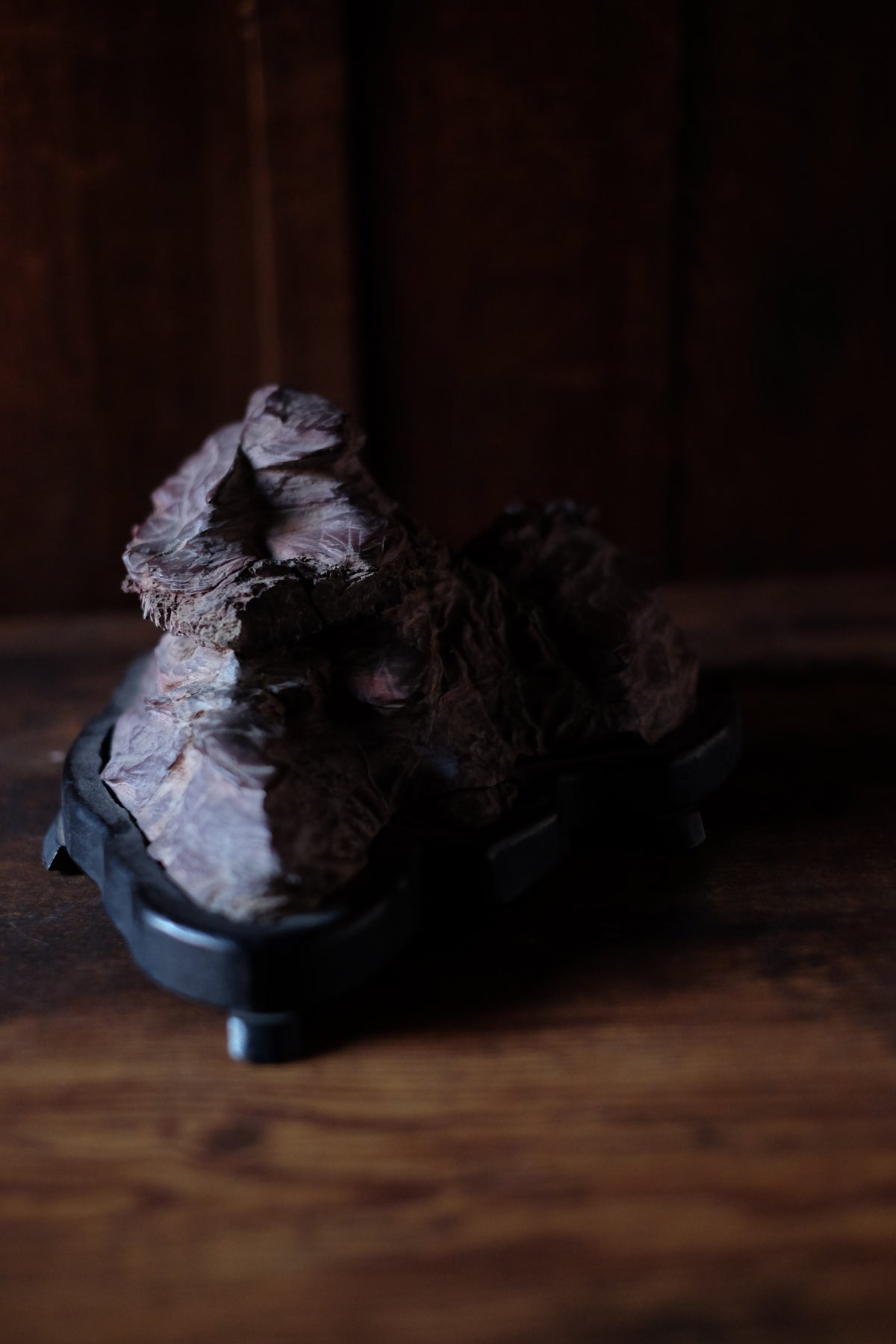
A dramatic pair of Japanese viewing stones in layered plum, burgundy and violet mineral tones, each presented on its own fitted black daiza display base
Introduction
Two mountains small enough to rest on a table, yet visually vast enough to wander through.
This striking pair of Japanese suiseki-style viewing stones transforms naturally rugged mineral formations into miniature landscapes for contemplation. Each stone rises from a fitted black daiza base, allowing its irregular ridges, layered faces, valleys and crag-like projections to be appreciated as sculpture without interrupting the natural character of the material.
Seen together, the two stones form an unusually compelling landscape dialogue. One presents a broader, more horizontal formation with overlapping masses that resemble eroded cliffs or a low mountain range. The other rises more decisively, with stronger central elevations and stepped geological layers. Their related deep plum and burgundy coloration unifies the pair, while differences in contour prevent them from feeling repetitive.
The result is much more interesting than a conventional decorative stone.
These are objects for looking slowly.
At one angle, the formations suggest weathered mountain ridges. From another they resemble islands, ancient cliffs, distant plateaus or abstract sculpture. Shadows settle into the natural crevices while pale mineral streaks and fractured planes emerge under directional light. The fitted black bases isolate the stones visually, creating the impression that each landscape is floating slightly above the surface beneath it.
That ability to reveal different landscapes according to the viewer's imagination lies at the heart of the Japanese suiseki tradition.
This pair would sit beautifully beside bonsai, within a tokonoma-inspired alcove, on a low cabinet, in a meditation room, study or restrained contemporary interior. They are equally suited to collectors of natural history, Japanese decorative arts, scholar's objects and wabi-sabi interiors.
Their beauty does not come from perfection.
It comes from geological time made visible.
The Japanese Art of Suiseki
Suiseki is the Japanese tradition of appreciating naturally expressive stones as miniature landscapes and contemplative objects.
Unlike conventional sculpture, the central idea is not to impose an image upon the material.
Instead, the viewer discovers an image already suggested by nature.
A ridge may become a mountain.
A depression becomes a valley.
A pale mineral seam becomes snow, mist or distant water.
A rough fractured plane may suggest a cliff face weathered by centuries.
This imaginative transformation is what gives viewing stones their quiet power.
The stone itself remains stone, yet the mind travels beyond it.
Suiseki developed alongside other refined Japanese arts concerned with disciplined observation, including bonsai, tea culture, calligraphy and tokonoma display. Rather than overwhelming a space with decoration, a well-chosen stone creates a point of concentration.
The object becomes an invitation to notice.
A Rare Pair Rather Than a Single Stone
One of the most compelling aspects of this offering is that the photographs show two distinct viewing stones, each accompanied by its own fitted display base.
This creates several possibilities for presentation.
Placed together, they read almost like a miniature mountain range separated by distance.
Positioned apart, they can establish visual conversation across a shelf, alcove or cabinet.
One can accompany bonsai while the other remains as a standalone scholar's object.
They can also be rotated seasonally or displayed individually when a more minimal arrangement is desired.
Pairs of closely related viewing stones can be particularly satisfying because the stones do not need to match exactly.
In fact, variation is essential.
The relationship here is built through color, geological texture and display treatment rather than identical shape.
That makes the pair feel collected rather than manufactured.
Deep Plum and Burgundy Mineral Color
The stones possess an unusual color palette.
Rather than the charcoal black, brown or grey associated with many viewing stones, these examples display deep muted plum, wine-red, burgundy and violet-brown tones.
The coloration changes dramatically according to light.
Under soft illumination, the stones appear almost earthy brown.
Under stronger directional light, reddish-purple areas become visible.
Across fractured surfaces, paler lavender and dusty mineral bands create subtle contrast.
This tonal complexity gives the pair considerable decorative flexibility.
They can sit naturally among dark wood, iron, bronze, lacquerware or ceramics without becoming visually loud.
At the same time, their burgundy coloration provides enough distinction to make them memorable within a collection.
Layered Geological Character
Close examination reveals pronounced natural layering.
Thin planes run through several portions of the stones, creating stacked formations that resemble sedimentary cliffs or compressed rock strata.
Elsewhere, the material breaks into thicker blocks and sloping ridges.
The most visually successful viewing stones often possess this balance between structure and irregularity.
Too smooth, and a stone can become merely decorative.
Too chaotic, and the landscape association disappears.
These examples occupy an appealing middle ground.
Their broad masses remain legible from across a room, while the smaller fractures and veining reward closer inspection.
Mountain Landscape Imagery
The strongest visual reading is mountainous.
The raised central masses suggest weathered summits.
Lower formations descend like foothills.
Horizontal breaks create natural terraces.
Recessed areas evoke ravines.
From some viewpoints, the stones resemble miniature mountain islands surrounded by imagined water.
From others, they resemble eroded volcanic terrain or ancient cliffs.
Suiseki appreciation traditionally values exactly this ambiguity.
A stone becomes more engaging when it encourages interpretation rather than immediately announcing a single subject.
These pieces accomplish that beautifully.
The Larger Horizontal Formation
The broader stone presents a low, expansive profile.
Its masses overlap in several directions, producing the feeling of a landscape seen from a distance.
The upper forms rise gradually rather than forming a single sharp summit.
This gives the piece a calm, grounded character.
Viewed from the front, the formations appear layered one behind another.
Viewed diagonally, individual projections become more sculptural.
The color also changes as each plane catches or rejects the light.
This stone would work especially well in a horizontal display composition beside bonsai, scroll art or a low ceramic vessel.
The More Elevated Formation
The second stone carries a stronger sense of vertical rise.
Its higher central mass produces a more dramatic mountain silhouette, while lower adjoining formations spread outward beneath it.
Its layered sides appear almost carved by erosion, although the listing conservatively presents these features as the natural visual character of the stone rather than asserting a specific geological formation process.
Because it is more upright, this stone provides a useful visual counterpoint to its broader companion.
Together they create a pleasing rhythm of high and low forms.
Fitted Black Daiza Bases
Each stone rests within a fitted black display base in the daiza tradition.
The purpose of a daiza is not merely practical.
It acts as a visual threshold between nature and interior space.
The stone remains irregular.
The base introduces refinement.
The stone represents geological time.
The base represents human appreciation.
A successful daiza does not compete with the stone. It follows the contour closely enough to support and frame it while allowing the natural form to remain dominant.
The black finish used here is particularly effective against the plum-colored mineral surfaces.
It creates a crisp silhouette and visually separates the stones from the table beneath them.
Small projecting feet gently elevate the bases, giving the pair an almost floating appearance.
Nature and Craft in Balance
One of the pleasures of viewing stones is the relationship between untouched natural form and deliberately designed presentation.
The stones themselves communicate age, fracture, density and geological irregularity.
The daiza bases introduce control.
That tension creates the aesthetic experience.
The eye reads the stone as something discovered.
Then it reads the base as evidence that someone found the stone worthy of preservation and contemplation.
That act of selection is central to the tradition.
A viewing stone does not become meaningful merely because it is unusual.
It becomes meaningful because someone recognized a landscape within it.
The Beauty of Imperfection
The surfaces contain irregularities that would be flaws in many decorative objects.
Here they are the subject.
Edges are uneven.
Layers break unexpectedly.
Pits and mineral variations interrupt smoother planes.
Some portions appear weathered while others reveal sharper fractured surfaces.
These differences prevent the stones from becoming static.
Under changing light, every irregularity produces a different shadow.
The aesthetic aligns naturally with wabi-sabi, where age, irregularity and impermanence are not hidden but appreciated.
Nothing here is trying to imitate machine-made perfection.
The stones are compelling precisely because they refuse it.
Slow Looking
Viewing stones work differently from most decorative art.
They do not demand immediate attention with brilliant color or narrative imagery.
Their effect arrives gradually.
A first glance reveals shape.
A second reveals texture.
A third begins to invent geography.
Perhaps a ridge becomes a mountain road.
Perhaps a pale seam becomes mist.
Perhaps a fractured shelf becomes a cliff above an imagined valley.
This process of imaginative projection is one reason scholars and collectors have valued stones across East Asian art traditions for centuries.
The object remains motionless.
The landscape changes in the viewer's mind.
Ideal Beside Bonsai
These stones would be especially compelling near bonsai.
Bonsai compresses the presence of a mature tree into a small cultivated form.
Suiseki performs a related transformation with landscape.
Placed together, tree and stone create scale.
The tree suggests forest.
The stone suggests mountain.
The tabletop becomes landscape.
For collectors already working with bonsai, either stone could function as an accompanying display object, while the pair provides enough flexibility to create different compositions across seasons.
Tokonoma-Inspired Display
A traditional Japanese display does not require many objects.
In fact, restraint is usually more powerful.
One viewing stone.
A scroll.
Perhaps a seasonal branch.
Empty space around them.
That emptiness allows each object to breathe.
These stones would work beautifully in a modern interpretation of that principle.
They can sit against pale plaster, dark timber, linen, natural wood or black lacquer.
Their earthy purple coloration responds especially well to warm directional light.
The supplied photographs demonstrate this dramatically.
Under low light, the stones almost disappear into darkness until ridges begin to emerge.
The landscape reveals itself slowly.
Scholar's Object and Contemplative Art
Outside Japan, objects of this broad tradition are sometimes described as scholar's rocks or scholar's stones.
Although those terms are historically associated strongly with Chinese collecting traditions, international collectors often use them more broadly for naturally expressive stones appreciated as contemplative sculpture.
For accuracy, this listing prioritizes the Japanese term suiseki and the more neutral phrase viewing stone.
Nevertheless, collectors searching for scholar's rocks, meditation stones or natural landscape sculpture will immediately understand the aesthetic relationship.
Not a Conventional Sculpture
These objects occupy an unusual category.
They are not carved figurative sculptures.
They are not simply geological specimens.
They are not garden rocks.
They are not bonsai accessories in the ordinary decorative sense.
Their significance comes from the intersection of nature, selection and display.
The stone supplies the form.
The collector supplies interpretation.
The fitted base formalizes the relationship.
This ambiguity is one reason good viewing stones feel surprisingly contemporary.
Placed in a minimalist interior, they can resemble abstract twentieth-century sculpture.
Placed within a Japanese context, they return to a much older language of landscape appreciation.
A Landscape Without Scale
One of the most fascinating properties of suiseki is its refusal to tell us how large the imagined landscape should be.
A ridge only a few centimeters high can become an enormous mountain.
A shallow depression can become a valley.
A mineral inclusion can become a waterfall.
The mind supplies scale automatically.
That is what allows such a modest object to create such psychological space.
These stones are particularly effective in this respect because their fractured planes are large enough to read clearly, yet irregular enough to suggest distance.
Color, Shadow and Evening Display
The deep coloration makes these stones unusually atmospheric after sunset.
In bright daylight, the mineral layers and purple-red hues become more visible.
In low light, the stones simplify into silhouettes.
Only the highest ridges catch illumination.
Valleys disappear.
The black daiza merges into the shadows.
The result feels almost theatrical.
A small side lamp or narrow beam of warm light can make the pair appear dramatically larger than their physical dimensions.
Collectors who enjoy objects that change character throughout the day will find these particularly rewarding.
Wabi-Sabi and Contemporary Interiors
Although rooted in Japanese collecting culture, viewing stones adapt easily to contemporary spaces.
Their forms are ancient.
Their presentation is minimal.
There is no printed pattern, branding or overt decoration to dictate a particular interior style.
This makes them excellent companions to modern furniture, Brutalist interiors, Japandi spaces, natural wood, linen, dark metal, handmade ceramics and architectural lighting.
The color is subdued enough to remain sophisticated.
The shape is strong enough to remain memorable.
A Conversation Between Two Landscapes
Displayed together, the pair becomes greater than the sum of its parts.
One stone can be interpreted as a nearer mountain.
The second becomes a distant range.
Shift their positions and the landscape changes.
Rotate them and new silhouettes emerge.
Move them farther apart and they become independent sculptural objects.
Bring them close together and they read as a single geological composition.
That flexibility offers something rarely found in a solitary viewing stone.
The collector becomes part of the composition.
Condition and Natural Character
The stones retain irregular natural textures, fractures, layered mineral formations and surface variation.
These characteristics are intrinsic to the objects and form part of their visual appeal.
The photographs should be considered an important part of the condition description because natural fissures, pits, rough surfaces and uneven coloration are expected in this category.
The fitted bases show minor signs of age and handling consistent with previous display.
No major structural damage to either display base is immediately apparent from the supplied photographs.
Because exact geological composition, collection locality and age are not documented in the supplied materials, those details are intentionally left unattributed.
The pair is presented as vintage Japanese suiseki-style viewing stones with fitted daiza bases.
A Collector's Pair
For a collector, the strongest appeal lies in the combination of four qualities:
the related plum coloration,
the natural mountain-like forms,
the fitted black bases,
and the presence of two complementary stones rather than one.
The pair feels intentionally assembled.
It offers enough visual unity to display together, yet each stone possesses enough personality to stand independently.
That makes it suitable both as an entry point into Japanese viewing-stone collecting and as an unusual addition to an established collection.
Brand Heritage
Japanese interiors have long made space for small things capable of suggesting immense worlds.
A branch can represent a season.
A bowl can embody the hand of its maker.
A few lines of ink can contain a landscape.
And a stone can become a mountain.
Suiseki belongs to this tradition of concentrated attention.
The object is modest.
The experience is not.
A good viewing stone does not tell the viewer what to see. It waits.
Light crosses one ridge and another disappears.
A crack becomes a ravine.
A pale mineral plane becomes winter.
An irregular formation becomes a distant summit.
Nothing has moved, yet the landscape has changed.
The fitted daiza then performs a quiet act of respect.
Nature is not corrected.
It is framed.
That relationship between geological accident and human appreciation is what makes suiseki so compelling.
These two plum-toned stones carry that idea beautifully.
They are dense, quiet, irregular objects, but when given time they begin to feel expansive.
Two fragments of earth become two landscapes.
Two landscapes become a place for the imagination to rest.
Purchase, Shipping and Vintage Policy
These are vintage natural-stone display objects and are offered in the condition represented by the photographs. Natural fissures, fractures, mineral inclusions, pits, uneven coloration and irregular edges are inherent characteristics of stone and should not automatically be interpreted as later damage.
Vintage daiza bases may show minor rubbing, scratches, finish variation and age-related handling.
Some pieces in our collection have a little room for negotiation while others are more firmly priced. Respectful best offers are welcome and considered individually.
Preparation, shipping and handling normally takes approximately 5 to 10 business days or earlier whenever possible. Because these are dense natural stones mounted on fitted bases, they will be packed separately and carefully cushioned to help prevent movement or pressure against the daiza during transit.
International duties, taxes and import charges, where applicable, remain the responsibility of the buyer.
If you are looking for this design or model in another size, please feel free to message us. Although availability cannot be guaranteed, we may be able to locate the same or a closely matching piece in a different size through our sourcing network.
Material Tags
natural stone, Japanese viewing stone, suiseki, landscape stone, mountain stone, plum stone, burgundy stone, violet stone, mineral specimen, natural mineral, geological formation, scholar stone, scholar rock, bonsai display stone, natural sculpture, stone art object, fitted daiza, carved wood base, black wood stand, lacquered wood base, fitted display stand, wabi sabi object, tokonoma display, Japanese decorative art, natural rock sculpture, collectible stone, meditation object, bonsai accessory, miniature landscape, Japanese interior object, natural patina, mineral veining, layered stone, fractured stone texture, stone and wood
#Suiseki #JapaneseSuiseki #ViewingStone #JapaneseViewingStone #ScholarRock #ScholarStone #Daiza #JapaneseDaiza #BonsaiStone #BonsaiDisplay #BonsaiArt #JapaneseArt #JapaneseCollectible #VintageJapan #JapaneseVintage #WabiSabi #WabiSabiDecor #ZenDecor #ZenInterior #JapaneseInterior #Tokonoma #TokonomaDisplay #NaturalStone #StoneArt #StoneSculpture #NaturalSculpture #LandscapeStone #MountainStone #MiniatureLandscape #MeditationDecor #MeditationStone #ContemplativeArt #JapaneseAesthetic #JapaneseCraft #JapaneseTradition #AsianArt #AsianAntiques #Japandi #JapandiDecor #NaturalDecor #OrganicDecor #MineralCollector #MineralSpecimen #GeologicalArt #RockCollector #BonsaiCollector #JapaneseGardenArt #TeaRoomDecor #SlowLiving #MindfulLiving #InteriorCollectible #ArtObject #WabiSabiHome #NatureInspiredDecor #JapaneseHomeDecor #StoneCollector #CollectorObject #NaturalHistoryDecor #BurgundyStone #PlumStone
japanese suiseki, viewing stone, scholar rock, daiza stone, bonsai stone, mountain stone, zen decor, wabi sabi decor, japanese vintage, natural stone art, tokonoma decor, stone sculpture, scholar stone