Rare Vintage, Antiques and Art Collector / Curator / Personal Shopper From Japan
Vintage Japanese Street Wear Fashion Geisha Maiko Oiran Sakura Wagara Kimono Sukajan Bomber Yakuza Gangsta Y2K Souvenir Jacket Wearable Art
Vintage Japanese Street Wear Fashion Geisha Maiko Oiran Sakura Wagara Kimono Sukajan Bomber Yakuza Gangsta Y2K Souvenir Jacket Wearable Art
Couldn't load pickup availability
Have a reasonable price in mind? Submit your best offer and our concierge will review it personally.
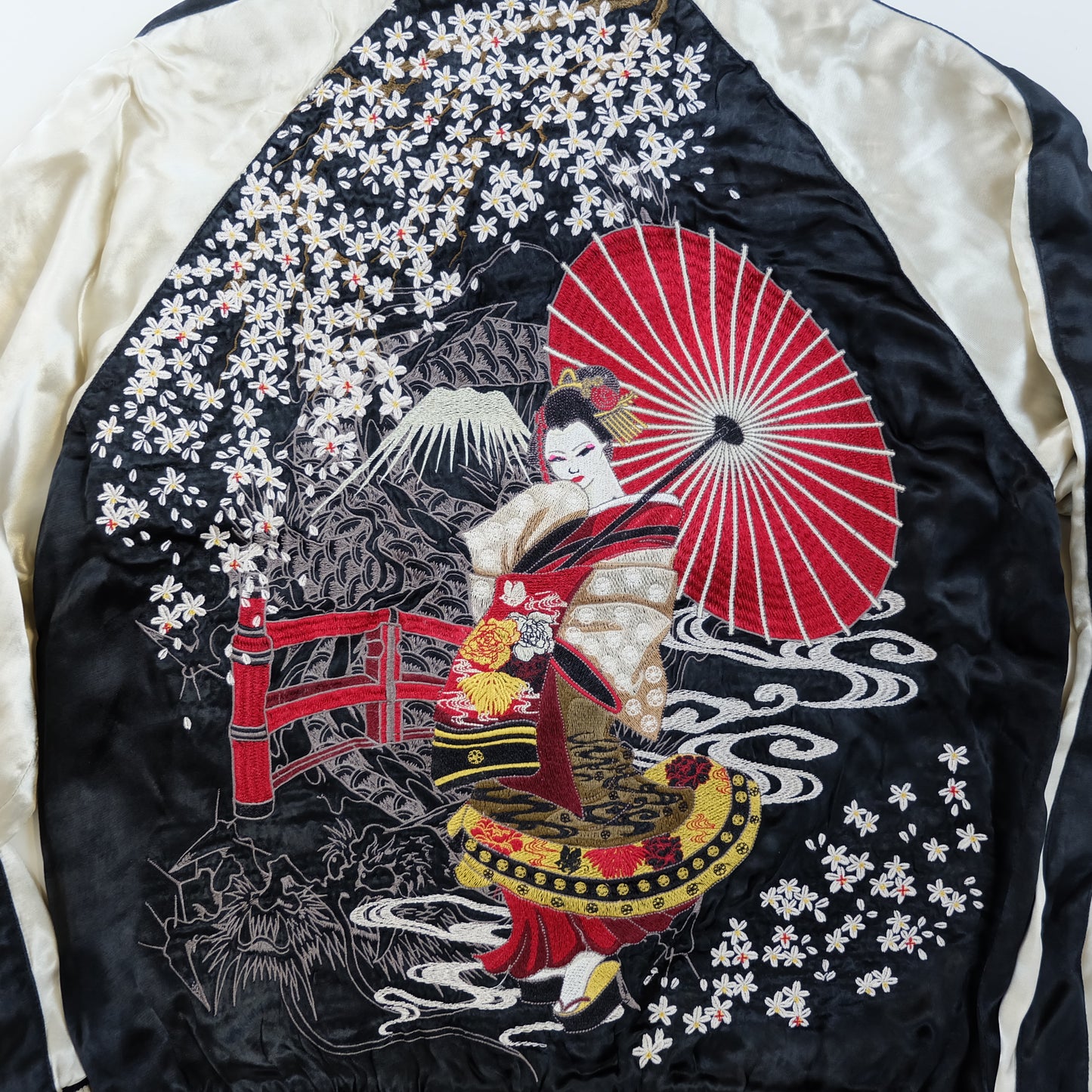
Oiran-Inspired Yokosuka Souvenir Jacket with Wagasa Parasol, Sakura, Dragon, Red Bridge, Mount Fuji, and Two-Tone Reversible Construction
COLLECTOR’S OVERVIEW
A richly embroidered Japanese sukajan built around an atmospheric nocturnal scene of an elaborately dressed oiran-inspired woman standing beneath cascading cherry blossoms with a crimson wagasa parasol, Mount Fuji, a vermilion bridge, curling clouds, and a monumental dragon emerging through the landscape.
The composition reads almost like a dramatic woodblock print translated into thread. Against the deep black satin ground, the pale blossoms appear to fall across the shoulders, the red umbrella opens like a radiant sun, and the woman’s layered kimono glows in cream, gold, crimson, and black. Behind her, the dragon coils through dark mountain forms and mist before its head reappears near the lower hem, giving the scene a hidden, mythic presence that rewards close viewing.
The jacket’s second wearable face is considerably more restrained, presenting a black satin body with blush-pink sleeves, matching pink pocket accents, and striped ribbed trim. This contrast creates two distinct styling identities within one garment: an intensely pictorial embroidered sukajan on one face and a quieter black-and-pink bomber on the other.
The jacket is especially compelling for collectors of Japanese souvenir jackets, oiran and ukiyo-e-inspired fashion, dragon imagery, sakura embroidery, wagara textiles, Y2K Japanese streetwear, and wearable narrative art.
IDENTIFICATION
Object Type
Vintage reversible Japanese sukajan, also known as a Yokosuka jumper, embroidered souvenir jacket, or Japanese-style tour bomber.
Garment Form
Short bomber silhouette with satin-finish shell, raglan-style sleeve construction, striped ribbed collar, cuffs, and waistband, central metal zipper, and welt pockets.
Primary Face
Black satin body with ivory satin sleeves and a large embroidered back composition.
Secondary Face
Black satin body with blush-pink sleeves, black sleeve inserts, pale pocket welts, and black, ivory, and pink striped ribbing.
Primary Subject
An elaborately dressed Japanese woman beneath a red paper parasol, surrounded by cherry blossoms, Mount Fuji, a red bridge, stylized clouds, water, and a large dragon.
Figure Identification
The central woman is most convincingly read as an oiran-inspired or tayū-inspired courtesan figure rather than a conventional geisha or apprentice maiko.
Her elaborate coiffure, ornamental hair arrangement, richly layered kimono, formal presentation, and prominently displayed obi-like front ornament belong to the theatrical visual language commonly used to portray high-ranking courtesans in Japanese decorative and popular art.
Maker
No maker label or branded embroidery is visible in the supplied photographs.
The precise manufacturer is therefore not confirmed.
Origin
Japan.
Period Character
The construction and embroidery appear consistent with Japanese Y2K-era to early 2010s sukajan production.
THE SUKAJAN TRADITION
Yokosuka Jumper Origins
The sukajan developed from souvenir jackets associated with Yokosuka and other Japanese port communities after the Second World War.
American-style bomber and varsity silhouettes were combined with Japanese embroidery traditions, producing garments decorated with dragons, tigers, eagles, maps, cherry blossoms, Mount Fuji, military insignia, and place names.
The Japanese term sukajan is generally understood as an abbreviation of Yokosuka jumper. Although the earliest garments were closely connected with souvenir culture, the jacket later entered Japanese youth fashion, biker culture, rockabilly, punk, visual-kei styling, luxury fashion, and global streetwear.
From Souvenir to Wearable Picture
The most ambitious sukajan use the entire back as a pictorial surface.
Rather than placing a small crest or isolated emblem on the garment, they create complete scenes with atmosphere, depth, symbolic meaning, and dramatic movement.
This jacket belongs to that narrative tradition. Its embroidery is not simply decorative ornament. It creates an imagined Japanese night landscape populated by beauty, seasonal change, architecture, sacred geography, and supernatural power.
Japanese-American Hybrid Design
The bomber silhouette and striped knit trim reflect American military and athletic clothing.
The oiran-inspired figure, sakura, Fuji, bridge, dragon, parasol, clouds, and kimono patterning belong to Japanese visual culture.
The garment therefore embodies the cultural hybridity that defines the sukajan: American outerwear architecture carrying a Japanese embroidered world.
CENTRAL FIGURE
Oiran-Inspired Woman
The woman stands at the heart of the composition, positioned slightly right of center beneath the broad red parasol.
Her posture is composed and ceremonial. Her face is rendered in pale thread with delicate red lips and dark brows, while the elaborate hair arrangement is accented by gold, red, and ivory ornament.
The visual presentation is closely aligned with stylized oiran imagery found in modern Japanese fashion, tattoo art, souvenir textiles, and reinterpretations of Edo-period pleasure-quarter culture.
Oiran and Geisha Distinction
Oiran were high-ranking courtesans of the licensed pleasure quarters during the Edo period. They were celebrated for elaborate dress, ceremonial processions, cultivated accomplishments, and highly codified public presentation.
Geisha developed as professional entertainers trained in music, dance, conversation, and performance. Maiko are apprentice geisha, particularly associated today with Kyoto.
Modern fashion imagery frequently merges these identities under the broad Western search term “geisha.” The more ornate clothing, theatrical coiffure, and front-emphasized obi treatment seen here are more consistent with an oiran-inspired fantasy than with the comparatively restrained professional dress of a geisha.
Kimono and Outer Robe
The embroidered costume is built from multiple layers of cream, ivory, red, black, brown, and gold thread.
A pale outer robe falls from the shoulders with broad sleeves and circular floral or medallion-like patterns. Beneath it, darker red and black layers create sharp diagonal bands across the torso.
The lower robe expands dramatically around the figure, displaying gold-edged black panels, red lining, flower forms, and small circular motifs. The density of the lower garment gives the woman a grounded, monumental presence despite the fluid movement of blossoms and clouds around her.
Obi-Like Front Ornament
A richly embroidered front section in red, gold, white, and black forms the visual center of the costume.
Its highly decorative placement evokes the forward-facing obi associated in popular imagery with oiran dress. Floral embroidery, tassel-like forms, and horizontal bands add texture and visual hierarchy.
This feature contributes strongly to the identification of the woman as a courtesan-inspired figure rather than a simple generic kimono wearer.
Footwear
A pale sandal or geta-like shoe is visible beneath the hem.
The small exposed foot provides a human scale against the oversized kimono and sweeping embroidery surrounding the figure.
WAGASA PARASOL
Crimson Paper Umbrella
A large red wagasa dominates the upper right portion of the back.
Its circular form is divided by evenly spaced pale ribs that converge at a dark central hub. The geometry is precise and radiant, creating an effect that recalls a sun disk, theatrical fan, or halo.
The intense red provides the strongest single field of color in the composition and balances the red bridge on the opposite side.
Symbolism of the Wagasa
Traditional Japanese paper parasols are associated with elegance, ceremony, seasonal atmosphere, performance, and classical femininity.
Within oiran and geisha-inspired imagery, the parasol often serves as both practical object and theatrical framing device. It creates privacy while simultaneously drawing attention to the figure beneath it.
The umbrella also contributes circular stability to a composition otherwise filled with diagonal branches, flowing clouds, coiling dragon forms, and the vertical figure.
Visual Relationship to the Figure
The parasol rises behind the woman rather than obscuring her.
Its pale ribs radiate outward from near her shoulder, visually framing her head and emphasizing her central role. The red canopy echoes the crimson kimono layers, bridge rails, blossoms, and scattered accents throughout the jacket.
SAKURA AND FALLING BLOSSOMS
Flowering Canopy
The upper left and central back are covered with hundreds of small embroidered flowers and petals.
The branches appear to arc from the upper left across the shoulders, creating a canopy above the woman and dragon. Individual flowers are formed in white and ivory thread with pale yellow centers and occasional red accents.
The blossoms are not arranged as a flat decorative repeat. Their density varies, with tightly clustered areas giving way to scattered petals that descend toward the center and lower hem.
Cherry Blossom Interpretation
The flowers appear consistent with stylized sakura or related spring blossoms.
Their five-petaled structure, pale coloration, and association with a Japanese scenic composition support a cherry-blossom reading, although the embroidery is decorative rather than botanically exact.
Sakura Symbolism
Cherry blossoms are among the most recognizable motifs in Japanese art and material culture.
Their brief flowering season connects them with beauty, renewal, celebration, seasonal transition, impermanence, and the awareness that precious moments cannot be held indefinitely.
Within this jacket, the blossoms introduce tenderness and ephemerality beside the enduring mountain and powerful dragon.
Falling Petals
Loose petals drift across the black ground, around the umbrella, bridge, and lower landscape.
These small embroidered fragments create a sense of movement and time. The scene does not appear frozen. It captures a moment during active blossom fall, as if a spring wind is moving through the night landscape.
THE DRAGON
Hidden Monumental Presence
A large dragon is woven through the scene in dark gray and black embroidery.
Its scaled body rises behind the woman and curves across the mountains. Because the dragon is rendered in subdued tones close to the black background, it first appears almost concealed within the landscape.
Closer examination reveals layered scales, claw-like forms, sweeping contours, and an expressive dragon head near the lower left.
This restrained treatment is one of the jacket’s most sophisticated features. The dragon does not compete with the woman and umbrella through bright color. Instead, it emerges gradually from shadow.
Dragon Head
The dragon’s head appears near the lower left edge beneath the red bridge.
Its horns, mane, open mouth, curling whiskers, teeth, and facial structure are defined through fine gray linework.
The head seems to rise from water or cloud-like currents, connecting the creature to both the landscape and the embroidered mist flowing around the woman’s feet.
Coiling Body
The dragon’s body extends upward behind the bridge and Mount Fuji.
Repeated scale patterns and overlapping curves create the impression of a creature winding through mountains rather than occupying a single flat plane.
This serpentine movement helps unite the upper blossom canopy, central mountain, lower water, and bridge into one continuous composition.
Japanese Dragon Symbolism
Japanese dragons are generally associated with water, rain, rivers, oceans, protective force, transformation, wisdom, and command over natural energy.
Unlike purely destructive monsters, dragons in Japanese and broader East Asian traditions may function as guardians, deities, ancestral powers, or forces that regulate weather and water.
Their ability to move between sky, cloud, mountain, and sea makes them ideal symbols for a scene combining Fuji, mist, bridge, blossoms, and flowing water.
Dragon and Oiran Juxtaposition
The pairing of an elegant courtesan figure with a hidden dragon creates dramatic tension.
The woman embodies cultivated beauty, ritualized appearance, and human artistry. The dragon embodies wild power, mystery, transformation, and the unseen forces beneath the visible world.
Together they turn the jacket into more than a romantic spring scene. Beauty and danger occupy the same landscape.
MOUNT FUJI
Snow-Capped Mountain
Mount Fuji rises behind the woman near the center of the composition.
Its pale snow-covered summit is embroidered against darker mountains and dragon scales, making the mountain immediately recognizable despite its relatively compact scale.
Symbolic Meaning
Mount Fuji represents endurance, aspiration, spiritual elevation, national identity, pilgrimage, and the disciplined beauty of a near-perfect form.
Its inclusion anchors the imagined scene geographically and culturally within Japan.
Fuji as Compositional Anchor
The mountain sits between the cascading blossoms and the red parasol.
This placement creates a visual bridge between the natural canopy on the left and the woman on the right. The pale summit also echoes the ivory sleeves and white blossom embroidery.
VERMILION BRIDGE
Curved Red Bridge
A red arched bridge crosses the lower left portion of the composition.
Its railings and posts are embroidered in saturated crimson with pale highlights and dark outlines. The bridge leads visually toward the woman and helps establish the layered depth of the scene.
Japanese Bridge Symbolism
Bridges signify passage, transition, connection, pilgrimage, and movement from one state or world to another.
In Japanese garden and temple imagery, red bridges often appear in carefully composed landscapes where architecture mediates between the human and natural realms.
Relationship to the Oiran Figure
The woman appears positioned near or just beyond the bridge.
This placement evokes the ceremonial procession associated in popular imagination with oiran imagery, particularly the highly stylized oiran dōchū parade in which a courtesan was publicly presented in elaborate clothing and distinctive footwear.
The jacket does not portray a documentary historical scene, but it draws on the atmosphere of ceremonial passage and theatrical arrival.
CLOUDS, MIST, AND WATER
White Cloud Scrolls
Pale curling forms sweep behind the umbrella and around the lower body.
These may be read as stylized clouds, mist, water currents, or a deliberate fusion of all three. Their elongated curves resemble traditional Japanese decorative scrollwork rather than naturalistic weather.
Movement Through the Landscape
The cloud and water forms pull the eye horizontally across the jacket.
They create contrast against the vertical figure and circular umbrella while linking the hidden dragon with its traditional association with water and rain.
Lower Currents
Near the woman’s feet and the dragon’s head, the pale embroidery becomes more fluid and wave-like.
This gives the lower scene a floating, dreamlike quality. The figure appears to stand within a shifting environment of bridge, mist, water, and supernatural presence.
COLOR ARCHITECTURE
Black Ground
The embroidered face is dominated by deep black satin.
This dark field gives the scene a nocturnal character and allows the ivory blossoms, red parasol, crimson bridge, pale Fuji, and metallic kimono details to remain highly legible.
The black also permits the gray dragon to remain partially hidden, producing depth through subtle tonal contrast.
Ivory Sleeves
The sleeves on the embroidered face are executed in warm ivory or aged cream satin.
They create a dramatic frame around the black pictorial center and visually echo the falling blossoms and pale kimono.
The contrast broadens the shoulders and reinforces the classic two-tone sukajan silhouette.
Blush-Pink Reverse
The second face introduces pale blush-pink sleeves against a black body.
The pink is soft and muted rather than bright, giving the reverse a more understated, contemporary appearance. It also creates a visual relationship with the cherry-blossom theme of the embroidered face.
Red Accents
Crimson appears in the parasol, bridge, kimono, hair ornament, floral details, and lower garment.
These repeated red elements create a visual path through the composition, moving from the upper right umbrella across the woman and toward the bridge on the lower left.
Gold and Bronze Thread
Gold, ochre, beige, and bronze threads enrich the robe, obi-like front section, hair ornament, and lower hem.
These warmer tones create the impression of brocade and ceremonial textile without relying on actual metallic foil.
White and Silver Thread
White and silver-gray define the blossoms, parasol ribs, Fuji, mist, dragon details, and garment highlights.
They create a moonlit effect against the black ground and give the scene its highly graphic readability.
EMBROIDERY WORK
Scale and Density
The back embroidery covers most of the central panel from the upper shoulders to the waistband.
The scale is unusually ambitious, incorporating a full human figure, umbrella, bridge, mountain, dragon, flowering branches, cloud forms, and scattered petals within one unified scene.
Figurative Detail
The woman’s face, hair, robe layers, hand position, footwear, and garment patterns are all differentiated through changes in thread direction, density, and color.
The face remains delicate despite the surrounding visual complexity.
Floral Stitching
The sakura canopy is built from many individually embroidered flowers and petals.
This creates a textured, almost beaded surface across the upper back. The repeated flowers catch light differently from the smoother satin around them, increasing dimensionality.
Dragon Linework
The dragon is rendered primarily through outline and scale pattern rather than solid blocks of bright thread.
This technique allows the creature to occupy a large area without overwhelming the main figure.
Parasol Geometry
The wagasa is formed from a dense red field crossed by precisely radiating pale ribs.
The strong geometry contrasts with the irregular organic forms of blossoms, mountains, clouds, and dragon scales.
Kimono Patterning
The robe incorporates circular motifs, flowers, bands, borders, and layered color fields.
These details suggest the visual richness of brocade, obi weaving, and ceremonial dress within the limits of machine embroidery.
Surface Puckering
Localized rippling is visible around dense embroidered areas.
This is common when substantial machine embroidery is applied to lightweight satin. The dense threadwork and softer shell fabric respond differently to tension, producing natural dimensional movement around the design.
REVERSIBLE CONSTRUCTION
Two Wearable Faces
The photographs show a reversible garment with contrasting treatments.
The embroidered face features the full oiran, dragon, sakura, Fuji, bridge, and umbrella composition with ivory sleeves.
The opposite face is a restrained black-and-blush satin bomber with minimal visible decoration from the front.
Contrasting Moods
The ornate face is narrative, theatrical, and explicitly Japanese in imagery.
The black-and-pink face is quieter, cleaner, and easier to style as an everyday bomber.
This duality gives the jacket unusually broad use. It can function as collector statement wear or as a subtler color-blocked outer layer.
Reversible Zipper
The central metal zipper appears configured for reversible wear.
The lower hardware and zipper pull are visible between the two faces, allowing the garment to close when either side is worn outward.
Shared Ribbing
The collar, cuffs, and waistband serve both sides.
The ribbing combines black, ivory, and blush-pink bands, coordinating with the color palette of both wearable faces.
Pocket Construction
Welt pockets are incorporated into the black-and-pink face, finished with pale pink edging.
The embroidered face’s pocket openings are not fully shown, but the garment construction is consistent with reversible sukajan design.
GARMENT CONSTRUCTION
Bomber Silhouette
The jacket has the characteristic short, gathered shape of a sukajan.
The ribbed waistband draws the body inward at the hem, while the full sleeves create volume through the arms.
Raglan-Style Sleeves
The sleeves extend diagonally from the collar toward the underarm rather than using a sharply defined conventional shoulder seam.
This construction supports freedom of movement and provides a smooth visual frame around the large embroidered back panel.
Satin Shell
Both faces appear constructed from smooth satin-finish textile.
The surface responds strongly to light, creating highlights, shadow, and tonal variation across folds and seams.
Ribbed Trim
The collar, cuffs, and waistband are finished in striped ribbed knit.
The trim provides elasticity and structural definition while introducing a sporty varsity influence to the otherwise pictorial garment.
Metal Hardware
A central metal zipper forms the closure.
The visible hardware contributes to the utilitarian bomber-jacket character and contrasts with the softness of the satin and embroidery.
PERIOD AND STYLE ASSESSMENT
Likely Era
The jacket appears consistent with 2000s to early 2010s Japanese streetwear and the Y2K-era revival of elaborate embroidered sukajan.
Its large scenic back, multicolored machine embroidery, black-and-pink reverse, stylized oiran imagery, and dragon composition align with collector-oriented souvenir jackets produced during this period.
Contemporary Wagara Influence
The design belongs to a modern wagara or Japanese-pattern revival rather than to early postwar souvenir production.
Wagara refers broadly to traditional or tradition-inspired Japanese motifs used across textiles, fashion, interiors, and decorative arts.
Here, sakura, Fuji, dragon, kimono, bridge, parasol, and clouds are combined within a contemporary streetwear garment.
Ukiyo-e and Tattoo-Art Character
The composition carries echoes of ukiyo-e print design through its flattened pictorial space, dramatic figure placement, bridge, seasonal blossoms, and carefully staged landscape.
It also shares visual language with Japanese tattoo art, particularly in the interaction of dragon, flowers, water, courtesan imagery, and full-surface narrative composition.
Production Date
The precise year of manufacture is not indicated in the photographed areas.
The jacket is therefore offered as a vintage or vintage-era Japanese sukajan whose exact production date and maker remain unspecified.
CONDITION
Overall Condition
Vintage pre-owned condition with visible wear, discoloration, creasing, textile variation, and storage character consistent with age and prior use.
The jacket remains visually striking, and the central embroidery retains substantial color, definition, and narrative impact.
Ivory Sleeve Discoloration
The ivory sleeves show visible uneven coloration, grayish marking, yellowing, and darker areas.
The most noticeable discoloration appears around the upper left sleeve and shoulder area in the back photograph, with additional tonal variation extending through the sleeves.
These marks are clearly part of the garment’s present vintage condition and should be considered when purchasing.
Blush-Pink Sleeve Variation
The pale pink sleeves on the second face show creasing, uneven sheen, and subtle tonal variation.
Because light-colored satin reflects strongly, some differences shift with viewing angle, but age-related surface character is also visible.
Black Satin Surface
The black body shows natural wrinkling, fold lines, pressure marks, and areas of uneven sheen.
Satin often displays handling and storage impressions more readily than matte textiles. The reflective surface may appear charcoal, deep black, blue-black, or slightly lighter depending on light direction.
Embroidery Condition
The large back embroidery remains strongly legible.
The woman, red parasol, cherry blossoms, dragon, bridge, Mount Fuji, clouds, kimono, and lower landscape retain their principal forms and color divisions.
No major missing section of the central composition is visible in the supplied photographs.
Minor thread movement, raised fibers, embroidery-edge wear, or isolated loose threads may be present within the densely worked surface.
Embroidery Puckering
Rippling and puckering are visible around the blossoms, dragon, parasol, and figure.
This is partly related to the density of the embroidery and the tension placed on the lightweight satin ground.
Collar and Ribbing
The striped collar, cuffs, and waistband remain present and visually coherent.
The pale bands show age toning, while the ribbing displays gentle relaxation, waviness, and wear consistent with prior use.
Zipper
The central metal zipper and lower fastening components are present.
Vintage zipper hardware may operate with more resistance or variation than modern factory-new components and should be handled patiently.
Seams and Structure
The primary body panels, sleeves, neckline, waistband, and embroidery field appear structurally present.
No catastrophic tearing, extensive open seam, or widespread loss of the embroidered design is visible in the supplied photographs.
Vintage Character
This is not a factory-new garment.
Its discoloration, satin creasing, uneven sheen, ribbing relaxation, embroidery tension, and age-related textile variation form part of its genuine history.
The visible wear gives the jacket an authentic lived character while preserving its strength as collectible wearable art.
DIMENSIONS AND SIZING
Manufacturer’s Tag Size
No manufacturer size label is visible in the supplied photographs.
Exact Measurements
Exact flat garment measurements are not shown.
No numerical chest width, back length, sleeve span, hem width, or cuff width is stated without direct ruler evidence.
Recommended Measurement Points
A: Pit-to-pit chest width
B: Back length from the base of the collar to the lower hem
C: Sleeve length from the collar seam along the upper sleeve to the cuff
D: Relaxed waistband width
E: Cuff width or another relevant fit point
Japanese Vintage Sizing
Japanese vintage sizing does not consistently correspond to contemporary Western sizing.
Fit varies according to production period, intended silhouette, body length, sleeve fullness, reversible construction, and ribbing tension.
The jacket should be assessed through actual flat garment measurements rather than assumed size conversion.
Unisex Wear
The garment is suitable for masculine, feminine, and gender-neutral styling.
The short bomber body and full sleeves can be worn fitted, traditionally compact, or slightly oversized depending on the wearer’s measurements and styling preference.
COLLECTOR DESIRABILITY
Large Narrative Back
The embroidery creates a complete scene rather than a collection of disconnected motifs.
The oiran-inspired woman, dragon, Fuji, bridge, sakura, umbrella, and clouds all belong to the same imagined landscape.
Oiran-Inspired Subject
Courtesan imagery is less common than tiger, eagle, or simple dragon designs within the sukajan market.
The elaborate female figure gives the jacket strong appeal for collectors drawn to ukiyo-e-inspired fashion, Japanese femininity, pleasure-quarter iconography, and theatrical kimono imagery.
Hidden Dragon Design
The dragon is integrated subtly into the dark background.
Its partially concealed form makes the composition more complex and sophisticated than a conventional brightly colored dragon placed directly in the center.
Dramatic Wagasa Parasol
The large red umbrella creates an immediate focal point and photographs exceptionally well.
Its circular geometry brings clarity and graphic force to the dense pictorial scene.
Sakura Canopy
The upper back is filled with extensive individually embroidered blossoms.
This creates both visual richness and tactile depth, especially against the smooth black satin.
Reversible Styling
The black-and-pink second face gives the jacket practical versatility.
A collector can wear the pictorial side when maximum impact is desired and turn to the simpler face for a more restrained streetwear presentation.
Strong Seasonal Narrative
Sakura and drifting petals place the scene within spring, while Fuji, dragon, water, and bridge give it broader timelessness.
The result is romantic without becoming delicate and powerful without losing elegance.
Display Potential
The embroidered back functions as a large textile picture.
Displayed on a broad padded hanger, the jacket becomes an atmospheric Japanese art object suitable for a fashion archive, studio, gallery wall, dressing room, or collector interior.
STYLING
Japanese Streetwear
Wear the embroidered face with black trousers, washed denim, or a minimal skirt and boots.
The surrounding outfit can remain simple, allowing the red umbrella and dense back embroidery to command attention.
Y2K Styling
Pair with low-rise or wide-leg denim, platform footwear, fitted black layers, silver accessories, or a compact shoulder bag.
The black-and-pink reverse works particularly well with Y2K color palettes and silhouette play.
Rockabilly and Biker Influence
The bomber shape can be styled with cuffed denim, boots, a white T-shirt, leather trousers, or an open-collar shirt.
The dragon and oiran imagery adds a distinct Japanese dimension to classic subcultural outerwear.
Feminine Styling
The blush sleeves, sakura imagery, and kimono figure pair naturally with flowing black dresses, pleated skirts, lace-up boots, or monochrome tailoring.
The jacket’s feminine imagery does not require a traditionally feminine outfit. Its strongest styling comes from contrast.
Gender-Neutral Styling
The bold back composition and athletic bomber construction allow the jacket to move comfortably across gendered wardrobes.
It can be worn over plain layers without relying on conventional men’s or women’s styling codes.
Editorial and Stagewear
The satin surface and large red parasol respond strongly to directional light.
The jacket is particularly suitable for editorial photography, performance wardrobes, music shoots, fashion-film styling, and Japanese-inspired visual storytelling.
CULTURAL AND ARTISTIC VALUE
Wearable Storytelling
The jacket uses clothing as a narrative field.
The wearer carries an entire imagined environment across the back: spring blossoms, sacred mountain, bridge, mysterious dragon, ceremonial woman, and drifting mist.
Beauty and Power
The composition balances two contrasting forces.
The oiran-inspired woman and sakura express cultivated beauty, human artistry, and impermanence.
The dragon and Fuji express supernatural power, endurance, and forces larger than the individual.
Traditional Motifs in Modern Fashion
The jacket does not reproduce a historical artwork literally.
Instead, it gathers recognizable Japanese motifs and reshapes them through contemporary machine embroidery and streetwear construction.
This process is central to modern wagara fashion, where historical visual language is continuously adapted for new materials and audiences.
Textile as Image
The different embroidery methods create distinct surfaces.
Blossoms are small and repetitive.
The umbrella is geometric and dense.
The dragon is linear and shadowed.
The kimono is layered and ornamental.
Clouds and water are fluid.
These varied treatments make the back more than a printed picture. It is a built textile surface with depth, weight, and changing reflectivity.
WHY THIS PIECE STANDS OUT
Oiran-Inspired Central Figure
The subject offers greater narrative specificity than a generic “geisha jacket.”
Dragon Integrated into the Landscape
The creature appears gradually through dark embroidered scales and linework, creating discovery and depth.
Extensive Sakura Embroidery
The flowering canopy covers a large portion of the upper back and shoulders.
Monumental Red Parasol
The wagasa creates a highly recognizable and visually balanced focal point.
Mount Fuji and Red Bridge
These secondary motifs strengthen the sense of place and connect the scene to Japanese landscape imagery.
Reversible Black-and-Pink Face
The understated second side extends the jacket’s practical wearability.
Strong Color Control
Black, ivory, blush, crimson, gold, and silver create drama without the chaotic effect of an unrestricted palette.
Authentic Vintage Wear
The discoloration and textile variation clearly communicate age and prior life rather than artificial distressing.
CARE AND PRESERVATION
Professional Cleaning
Professional dry cleaning by a specialist experienced with embroidered vintage satin and reversible garments is recommended.
Do not machine wash, soak, bleach, wring, or tumble dry.
Stain Treatment
The ivory sleeves show visible discoloration and should not be aggressively spot-cleaned at home.
Uncontrolled stain treatment may alter the satin sheen, create water rings, weaken fibers, or spread discoloration.
Any conservation cleaning should be undertaken by an experienced textile professional.
Embroidery Care
Do not iron directly over the woman, dragon, blossoms, umbrella, bridge, Fuji, clouds, or kimono details.
Direct pressure may flatten threads or distort densely embroidered sections.
Satin Care
Avoid friction from rough bags, hook-and-loop fasteners, jewelry, sharp accessories, and textured walls.
Satin can snag, pull, or develop permanent shine through repeated abrasion.
Steaming
Light steaming may help relax gentle folds, but the steamer should be kept at a safe distance.
Do not saturate the fabric or apply concentrated heat to embroidery, ribbing, or previously discolored areas.
Ribbing Care
Do not carry or hang the jacket by the collar, cuffs, or waistband.
The ribbing should be handled evenly to avoid additional stretching.
Zipper Care
Align the lower zipper components carefully and avoid forcing the slider.
Vintage reversible zippers benefit from patient, straight handling.
Storage
Store on a broad padded hanger capable of supporting the jacket without creating sharp shoulder points.
Use a breathable garment cover rather than sealed plastic.
Keep the jacket away from direct sunlight, humidity, smoke, perfume, and prolonged compression.
Long-Term Display
When displayed, avoid strong daylight and rotate the garment periodically.
This helps reduce uneven fading between the black body, pale sleeves, red umbrella, and embroidered thread colors.
SHIPPING, OFFERS, AND FINAL-SALE POLICIES
Shipping
Worldwide tracked shipping is available from Japan, generally through Japan Post EMS or another suitable tracked international service.
The jacket will be carefully folded with protective material placed between the embroidery, satin surfaces, zipper, and ribbed trim.
Tracking information is normally provided approximately 3–5 business days after dispatch.
Delivery times depend on destination, customs processing, postal conditions, and the international service available at the time of shipment.
Packaging
Special care will be taken to avoid unnecessary pressure on the embroidered blossoms, parasol, figure, dragon, and raised threadwork.
The jacket may retain gentle transit folds upon arrival. These should be allowed to relax naturally rather than treated with direct high heat.
Additional Photographs
Additional photographs may be available upon request.
Please contact us before purchase should you wish to examine the sleeve discoloration, embroidery edges, zipper, pockets, ribbing, cuffs, waistband, reverse face, or any other area more closely.
Offers
Reasonable offers may be considered on selected items.
Some collector pieces have limited flexibility, while others may allow greater room for negotiation. Serious and respectful proposals are welcome and considered individually.
Product Representation
Every effort has been made to represent the jacket accurately through the photographs and description.
Color may vary slightly according to lighting, screen calibration, camera exposure, and the reflective behavior of satin.
The sleeves may appear ivory, cream, pale champagne, or blush depending on the face shown and viewing conditions.
Vintage Condition
This jacket is pre-owned and is not presented as factory-new.
Visible discoloration, creasing, uneven sheen, thread variation, ribbing relaxation, embroidery puckering, and other age-related characteristics are part of its condition.
Please review the photographs carefully and purchase with appreciation for genuine vintage textiles.
Final Sale
The jacket is sold in its present condition as photographed and described.
All sales are final. No returns, claims, cancellations, or exchanges are accepted for accurately disclosed vintage wear, sizing, discoloration, patina, textile variation, color variation, satin creasing, embroidery tension, or age-related characteristics, subject to applicable Etsy rules and consumer law.
Please review all photographs, condition details, sizing information, and policies carefully before completing your purchase.
#VintageSukajan #OiranJacket #GeishaJacket #JapaneseSouvenirJacket #DragonSukajan #SakuraJacket #MountFujiJacket #WagasaParasol #JapaneseStreetwear #JapaneseEmbroidery #ReversibleSukajan #Y2KJapaneseFashion #WagaraFashion #UkiyoeInspired #WearableArt #YokosukaJumper #KimonoJacket #OiranFashion #DragonEmbroidery #SakuraEmbroidery #BlackPinkJacket #VintageBomber #JapaneseVintage #CollectorJacket #ArchiveStreetwear #JapanStyle #UnisexVintage #StatementOuterwear #SouvenirBomber #Japonista
MATERIAL TAGS
rayon satin, cotton ribbing, embroidery thread, metal zipper, reversible textile