Rare Vintage, Antiques and Art Collector / Curator / Personal Shopper From Japan
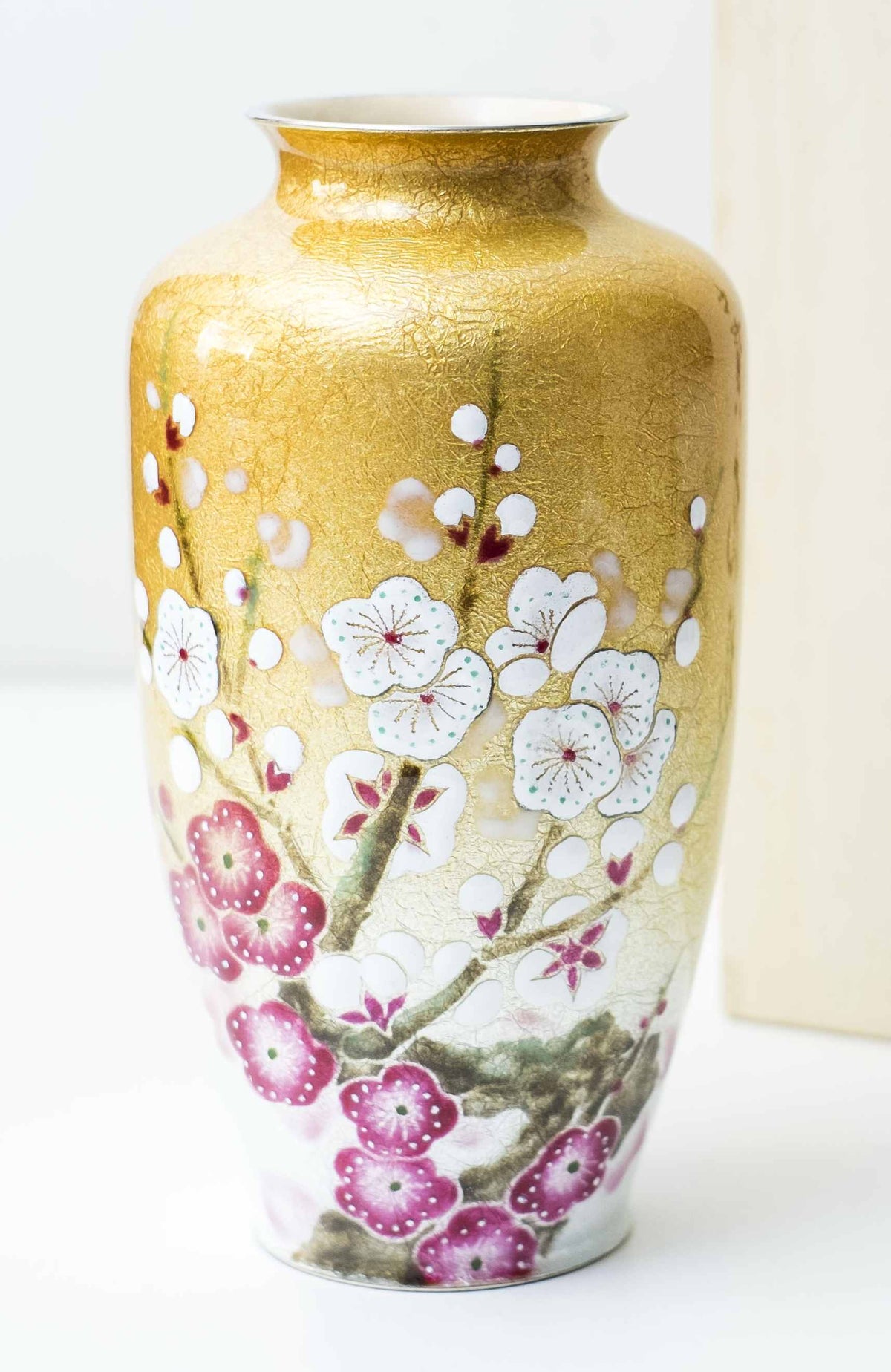
Vintage Japanese Shippo Cloisonné Vase Gold Ume Plum Blossom Enamel with Inscribed Wooden Box Showa Era
Vintage Japanese Shippo Cloisonné Vase Gold Ume Plum Blossom Enamel with Inscribed Wooden Box Showa Era
Couldn't load pickup availability
Have a reasonable price in mind? Submit your best offer and our concierge will review it personally.
Radiant Gold Japanese Enamel Flower Vase with White and Crimson Ume Blossoms, Textured Foil-Like Ground, Silver-Tone Rim and Original Shippo Kabin Presentation Box
Introduction
A field of gold becomes the sky for a flowering plum tree in this luminous vintage Japanese shippo enamel vase, a beautifully decorative work of mid-century Japanese craft presented with its original inscribed wooden storage box.
The vase immediately draws the eye through its extraordinary golden surface. Rather than a flat metallic color, the ground is richly textured beneath the glossy enamel, creating a delicate web of crinkles, folds and irregular reflections. In strong light it becomes brilliant and almost jewel-like; in softer surroundings it deepens into warm amber gold.
Across this glowing background grows a branching ume plum blossom composition, rendered in white, soft blush, crimson-pink, green and muted brown. Some blossoms open completely, revealing fine radiating stamens. Others remain tiny rounded buds, while deeper pink flowers cluster toward the lower portion of the vase. The arrangement becomes increasingly abundant toward the base, giving the impression of a flowering branch rising naturally through a golden atmosphere.
A narrow polished metal rim provides a cool visual counterpoint to the warm gold enamel.
The accompanying light wooden box bears the traditional inscription Shippo Kabin, identifying the object simply and appropriately as a Japanese cloisonné enamel flower vase.
At approximately 21 cm high and 11 cm wide, the proportions are substantial enough to create presence without overwhelming a shelf, cabinet or tokonoma-inspired display.
It is decorative Japanese craft at its most immediately enchanting: flowers emerging from gold, framed by clear lacquer-like gloss and preserved with its original presentation box.
A Gold Landscape in Enamel
The strongest visual characteristic of this vase is unquestionably its gold ground.
From a distance, the body appears covered in a uniform field of warm metallic color.
Move closer and the surface changes completely.
The gold possesses an intricate irregular texture beneath the glossy transparent finish, creating tiny ridges, folds and fractured-looking patterns that catch the light differently across every part of the vessel.
It resembles finely crumpled metallic foil sealed beneath glass.
This texture gives the gold extraordinary depth.
It does not behave like paint.
It seems to sit beneath the enamel surface, allowing light to penetrate the glossy exterior before bouncing back from the textured metallic layer below.
The result is particularly beautiful on the curved shoulder of the vase, where highlights travel across the surface and reveal different shades of yellow, honey, bronze and pale champagne gold.
Even without the floral decoration, the surface would be compelling.
With the blossoms layered over it, the vase becomes considerably richer.
Ume Plum Blossoms
The flowers appear to represent ume, the Japanese plum blossom, one of the most enduring seasonal motifs in Japanese visual culture.
Ume blossoms arrive unusually early, often opening while winter has not completely released its hold.
For this reason, they have long been associated with perseverance, renewal, resilience and the promise of spring.
That symbolism makes the flower especially appropriate against this glowing gold background.
The blossoms seem to emerge out of winter darkness into light.
White flowers dominate the upper section, creating a quiet and refined atmosphere.
Lower down, deeper crimson and pink blossoms gather more densely, warming the composition and preventing the gold from becoming visually overwhelming.
Small unopened buds connect the larger flowers and provide a sense of movement through the branches.
This is not a rigid botanical diagram.
It is a decorative interpretation of flowering plum, composed to work harmoniously around a curved vessel.
White Blossoms Against Gold
The white flowers are among the most elegant elements of the design.
Their pale enamel petals create a sharp yet gentle contrast against the metallic ground.
Inside many of the flowers, extremely fine lines radiate outward from a central crimson point.
Tiny green dots appear around the petals of several blossoms, adding another layer of delicate color.
Some petals are pure white.
Others carry a faint blush.
This subtle variation prevents the flower clusters from becoming visually repetitive.
Because the blossoms sit against gold rather than a naturalistic sky or landscape, the composition feels almost ceremonial.
The flowers are not merely growing on branches.
They are being presented.
Crimson Blossoms
Near the lower body, the palette becomes richer.
Deep pink and crimson flowers anchor the composition near the base.
The petals carry pale dotted accents and softly graduated interiors that create dimension within relatively small shapes.
These darker blossoms serve an important compositional role.
Without them, the white flowers might disappear against the powerful luminosity of the gold.
The crimson provides visual gravity.
It pulls the eye downward before the branching stems lead attention back upward toward the shoulder.
The combination of white and red plum blossoms also has a particularly celebratory quality in Japanese decorative art.
Branches and Natural Movement
The floral arrangement grows across the vase rather than sitting in a single isolated medallion.
Dark branching forms move diagonally through the lower half.
They divide, taper and reconnect with the flower clusters.
Soft green coloration appears within some branch sections, while darker brown and black tones define their structure.
The movement is organic without becoming chaotic.
This is important on a tall cylindrical vase.
Vertical forms can sometimes feel static.
The branching diagonal introduces energy.
The eye does not simply travel from top to bottom.
It wanders through the flowers.
The Vessel Form
The body itself is beautifully restrained.
The silhouette begins with a narrow foot before rising into a gently tapering cylindrical body.
The shoulders swell softly outward.
Above them sits a short neck that opens into a subtly flared mouth.
This modest flare is enough to give the vase a graceful termination without competing with the elaborate surface.
The balance is particularly successful.
The decoration is rich.
The form is simple.
One supports the other.
A more complicated body shape might have made the composition feel excessive.
Instead, the vase functions almost like a three-dimensional canvas.
Silver-Tone Rim
The mouth is finished with a narrow polished metal rim.
Against the intensely warm gold exterior, this cooler silver-colored line provides a small but important contrast.
It sharpens the profile.
It frames the opening.
And it gives the vase a slightly more formal presentation.
Viewed from above, the rim creates a precise circular border around the pale interior.
This detail is understated in the full view but particularly attractive when examined closely.
The Interior
The supplied overhead photograph reveals a pale cream-colored interior beneath the flared rim.
The interior is intentionally quieter than the exterior, allowing the decorative treatment to remain concentrated on the visible surface.
This contrast is aesthetically effective.
Outside, gold and plum blossom.
Inside, simplicity.
The dark depth visible through the opening gives the vase additional dimensional presence in display.
Shippo
The wooden box identifies the piece as shippo, the Japanese tradition of vitreous enamel decoration on metal.
Shippo enamel is created through repeated firing of glass-based enamel onto a metal foundation.
Different shippo techniques can employ wires, foil, metallic foundations, translucent enamels, opaque enamels or combinations of those methods.
The supplied photographs strongly support the shippo identification, while the box inscription provides useful documentary confirmation.
What should not be overstated is the precise internal construction method.
The underlying metal body is not visible in the supplied photographs, and no bottom image identifying the base metal has been provided.
For that reason, the safest collector description is Japanese shippo enamel over a metal body, rather than asserting copper or brass without direct confirmation.
That distinction matters.
Good listings become stronger when certainty and uncertainty are separated rather than blended together.
A Foil-Like Gold Ground
The gold surface deserves its own collector terminology.
The visual texture strongly resembles a thin metallic foil layer beneath transparent or translucent enamel.
This type of treatment can create extraordinary luminosity because the metallic surface reflects through the glassy enamel above.
However, without direct workshop documentation or microscopic examination, it would be inappropriate to promise a particular precious-metal foil composition.
For public presentation, gold-toned foil-textured enamel ground is both accurate and visually descriptive.
It communicates what the buyer can actually see.
And what the buyer can see is beautiful.
Japanese Gold and Seasonal Flowers
Gold has long functioned differently in Japanese decorative art than in many purely Western luxury traditions.
It can signal prestige, certainly.
But it also serves as atmosphere.
Gold screens transform rooms into fields of light.
Gold lacquer makes darkness luminous.
Gold leaf turns ordinary surfaces into symbolic environments.
Here, the same visual logic operates on a small scale.
The plum branches are not depicted against blue sky.
They exist within gold.
The background therefore feels timeless rather than geographically specific.
It suggests neither day nor night.
The flowers simply emerge from radiance.
The Wooden Presentation Box
The original-style light wood storage box contributes considerably to the completeness of the piece.
Its central calligraphy identifies the object as:
Shippo Kabin
or essentially:
Cloisonné Enamel Flower Vase
That inscription is valuable because it confirms the traditional Japanese category of the object without requiring speculation based solely on visual appearance.
The pale wood also provides a beautiful contrast with the vase.
Gold enamel in front.
Natural blond wood behind.
Black calligraphy connecting the two.
Displayed together, they create an immediately recognizable Japanese collector presentation.
Why the Box Matters
Traditional Japanese storage boxes are more than shipping containers.
They belong to a preservation culture in which craft objects are protected, documented and passed onward with their associated packaging.
A box may identify:
the object type,
the title,
the material,
the technique,
the artist,
the kiln,
the workshop,
or occasionally the occasion for which a piece was made.
In this instance, the inscription clearly supports the shippo vase identification.
No maker attribution is confidently visible from the photographs supplied, so the box should be described as inscribed rather than automatically called an artist-signed tomobako.
That is a more responsible presentation and leaves room for future research if additional inscriptions are discovered elsewhere on the box or object.
A Vase That Changes with Light
This piece responds dramatically to different lighting.
Under bright daylight, the gold becomes almost electric.
The white blossoms appear crisp and cool.
The pinks become vivid.
Under softer ambient lighting, the gold grows warmer and more subdued.
The textured ground becomes more apparent.
The deeper blossoms begin to dominate.
This gives the vase unusual versatility.
It can look brilliant and festive in a bright room.
Or quiet and sophisticated in lower light.
Placed beneath a warm gallery lamp, the metallic background should take on an especially rich amber character.
Japanese Seasonal Symbolism
Ume is one of the most important floral motifs in Japanese art.
Unlike cherry blossoms, which are often associated with the fleeting beauty of spring at its height, plum blossoms carry the atmosphere of spring approaching.
They flower earlier.
They endure cold.
They announce transition.
That gives them a slightly different emotional character.
Resilience.
Promise.
Endurance.
Renewal.
The gold ground strengthens those associations.
The flowers appear not merely alive, but illuminated.
A Celebration Piece Without Being Loud
Despite the abundance of gold, this vase avoids becoming garish.
Much of that restraint comes from the composition.
There are no excessively complicated borders.
No competing geometric panels.
No large figurative scene.
No multicolored background.
Instead, the decorative vocabulary remains disciplined:
gold,
white,
pink,
green,
branches,
flowers.
That limited palette allows the vase to remain elegant even though the surface is luxurious.
Showa-Era Character
The style is consistent with vintage twentieth-century Japanese decorative shippo, particularly the broader Showa period rather than the extremely fine wire-intensive cloisonné associated with many celebrated late Meiji export works.
The floral forms are bold and readable.
The gold field has strong decorative impact.
The colors are clean.
The overall form is modern and uncluttered.
Without a dated inscription or maker documentation, a precise decade should not be claimed as certainty.
A mid-to-late Showa vintage attribution is more responsible than presenting an exact 1950s, 1960s or 1970s date as established fact.
Mid-Century Japanese Decorative Arts
One of the pleasures of collecting Showa-period Japanese decorative art is seeing traditional techniques interpreted through cleaner, more modern compositions.
Earlier cloisonné often dazzles through technical density.
Later works may instead emphasize color, contrast and graphic simplicity.
This vase sits comfortably within that later decorative sensibility.
The gold background provides immediate impact.
The floral motif is traditional.
The silhouette is understated.
The result bridges classical Japanese symbolism and mid-century interior design remarkably well.
Tokonoma Display
The vase would be particularly attractive in a tokonoma-inspired setting.
Allow generous negative space around it.
Place it slightly off center.
Pair it with a restrained seasonal branch, a small lacquer object or a simple calligraphic work.
Because the vase already carries a substantial floral composition, it does not require an elaborate arrangement.
Even displayed empty, it reads as a complete work.
Its surface already contains its own garden.
Contemporary Interior Styling
The piece also works surprisingly well outside explicitly Japanese interiors.
Against white walls, the gold becomes graphic.
Against dark walnut, the metallic tones become warmer.
Against black shelving, the white blossoms become especially prominent.
Against stone or concrete, the vase introduces softness and warmth.
It could comfortably enter:
a Japandi interior,
a contemporary minimalist home,
a maximalist collector cabinet,
an Art Deco influenced space,
or a modern floral arrangement.
The traditional technique does not trap the object within a traditional room.
That is one of its greatest strengths.
A Collector's Vase
For the Japanese decorative-art collector, this vase touches several attractive categories at once.
Shippo enamel.
Ume plum blossom imagery.
Metal-bodied decorative craft.
Gold-ground finish.
Vintage Showa-era aesthetics.
Original inscribed wooden storage box.
Japanese floral symbolism.
Mid-century decorative art.
Together these elements give the piece considerably more interest than an unboxed generic floral vase.
Floral Arrangement Potential
Although compelling enough to stand alone, the vase could also support carefully selected floral material.
Because the body already contains a dense flowering-plum composition, a restrained arrangement would be best.
A single branch.
A few winter berries.
A slender flowering stem.
Or perhaps nothing at all.
The object should remain visible.
The purpose of flowers would be conversation with the vase rather than concealment of it.
The Gold Surface as Texture
One detail that photographs particularly well is the interaction between the crackled or crinkled metallic ground and the highly polished transparent enamel surface.
At first glance, the vase looks smooth.
And physically, the outer surface appears glossy.
But visually, the gold below is intensely textured.
That creates an interesting contradiction.
Smooth touch.
Rough-looking depth.
Gloss above.
Foil texture below.
It is one of those surfaces that can never be fully understood in a single photograph.
The object changes as it rotates.
White, Crimson and Green
The color balance is unusually successful.
White gives freshness.
Crimson creates warmth.
Green introduces life.
Brown anchors the branches.
Gold unifies everything.
None of the secondary colors overwhelms the overall composition.
The gold remains dominant.
This is important because it preserves the vase's luxurious identity while preventing the floral decoration from becoming visually chaotic.
Condition
The supplied photographs show the vase presenting with strong overall gloss and intact floral decoration.
The gold-toned field remains visually rich and reflective.
The blossoms retain clear color definition.
The mouth and metal rim appear present and continuous in the supplied views.
Normal vintage surface variation, tiny marks, small irregularities and signs of age should be expected from a pre-owned Japanese decorative object.
The wooden box shows light age-related variation consistent with storage and handling.
No bottom photograph has been supplied in this set, so the underside, any maker mark, exact base metal and any additional inscriptions cannot be independently confirmed from the present images.
Please examine all supplied photographs carefully, as they form an essential part of the condition description.
Dimensions
Approximate vase dimensions:
Height: 21 cm
Width: 11 cm
Because the vessel is essentially round in section, width provides the most useful available diameter reference.
Wooden box dimensions were not supplied and are therefore not estimated.
Care
Dust gently with a clean, dry and very soft cloth.
Avoid abrasive cleaners, polishing compounds or aggressive metal cleaners.
Do not attempt to polish the gold surface.
Avoid prolonged soaking.
When placing flowers inside, take care when adding or removing water so that the exterior enamel and wooden box remain dry.
Store the wooden box away from excessive humidity, strong sunlight and large temperature fluctuations.
Enamel objects are highly durable but can chip when struck against hard surfaces, so always lift the vase rather than sliding it across stone, ceramic or metal shelves.
Why This Piece Stands Out
A great decorative object does not need to shout.
This vase does something more interesting.
It glows.
The gold ground creates the first impression.
Then the eye begins noticing the white plum blossoms.
Then the crimson.
Then the tiny green dots.
Then the branches.
Then the texture underneath everything.
And finally the wooden box quietly confirms what the vase already suggested:
this is traditional Japanese shippo craft interpreted through the warm decorative vocabulary of vintage Showa design.
Brand Heritage
Japanese decorative arts have long understood that material and symbolism can carry equal weight.
A flower can represent a season.
A season can represent an emotional state.
A metal surface can become light.
A storage box can become provenance.
A useful flower vessel can become a collectible artwork.
This vase brings all of those ideas together.
Its ume blossoms speak of endurance and renewal.
Its gold ground transforms reflected light into atmosphere.
Its enamel preserves color permanently beneath glass-like gloss.
Its box records the object in the traditional language of Japanese craft.
The result is more than a floral vase.
It is an unusually luminous meeting point between material, season and symbolism.
Closing
There is a particular pleasure in objects that reveal themselves gradually.
At first this is simply a gold Japanese vase.
Then the floral detail appears.
Then the metallic texture.
Then the delicate stamens.
Then the subtle blush within the white blossoms.
Then the small buds between branches.
Then the inscription on the wooden box.
Each layer adds context without diminishing the visual immediacy of the first impression.
Displayed empty, it is sculptural.
Filled with a restrained branch, it becomes seasonal.
Placed beside its wooden box, it becomes archival.
And under changing light, the gold surface ensures that it never looks exactly the same twice.
For collectors of Japanese shippo, Showa decorative arts, floral symbolism or simply objects that carry warmth and quiet brilliance, this is a particularly graceful piece.
Purchase, Shipping and Vintage Policy
This is a vintage Japanese collectible offered in its present condition as photographed. Vintage and pre-owned objects naturally may show age-related marks, surface variation, storage wear, minor oxidation to metal fittings, small scratches, tiny enamel irregularities and other evidence of previous ownership. These characteristics form part of the history and individuality of the piece.
Some items in our collection have a little room for negotiation while others are more firmly priced. Respectful offers are always welcome and will be considered individually.
Preparation, shipping and handling normally takes 5–10 business days or earlier whenever possible. The vase and its wooden storage box will be individually protected and carefully packed for international transportation.
Tracking information will be provided once the parcel has been prepared and dispatched.
International customs duties, import taxes or destination-country charges, where applicable, remain the responsibility of the buyer.
If you are looking for this design or model in another size, please feel free to message us. Although availability cannot be guaranteed, we may be able to locate the same or a closely matching piece in a different size through our sourcing network.
#JapaneseCloisonne #JapaneseShippo #ShippoYaki #JapaneseEnamel #CloisonneVase #JapaneseVase #Ume #UmeBlossom #PlumBlossom #PlumBlossomVase #GoldVase #GoldEnamel #JapaneseFloralArt #JapaneseDecorativeArt #ShowaEra #VintageShowa #VintageJapanese #JapaneseVintage #JapaneseCollectible #JapaneseArt #JapaneseCraft #TraditionalJapaneseCraft #EnamelArt #JapaneseMetalwork #JapaneseFlowerVase #JapaneseInterior #Tokonoma #Japandi #WabiSabi #JapaneseHomeDecor #AsianArt #AsianAntiques #AsianDecor #MidCenturyJapan #MidCenturyDecor #FloralVase #FlowerVase #GoldDecor #LuxuryDecor #CollectorVase #DecorativeVase #VintageEnamel #JapaneseGift #JapaneseHeritage #JapaneseDesign #OriginalBox #WoodenBox #KiriBox #JapaneseCalligraphy #HeirloomDecor
japanese cloisonne, shippo yaki vase, japanese vase, plum blossom vase, gold enamel vase, vintage shippo, showa era vase, japanese enamel, ume blossom, floral vase, japanese decor, cloisonne art, boxed japanese vase
Material Tags
vitreous enamel, Japanese shippo enamel, cloisonné enamel, enamel over metal, metal body, gold-tone metallic ground, foil-textured gold ground, glossy enamel, opaque white enamel, translucent blush enamel, crimson enamel, green enamel accents, floral enamel decoration, polished silver-tone rim, wood storage box, kiri-style wood, ink calligraphy, traditional Japanese enamelwork