Rare Vintage, Antiques and Art Collector / Curator / Personal Shopper From Japan
Vintage Japanese Miroku Bosatsu Bust Resin Ceramic Composite Buddha Head Zen Sculpture on Wood Base
Vintage Japanese Miroku Bosatsu Bust Resin Ceramic Composite Buddha Head Zen Sculpture on Wood Base
Couldn't load pickup availability
Have a reasonable price in mind? Submit your best offer and our concierge will review it personally.
A quiet, sculptural presence with the visual gravity of an old temple fragment, this vintage Japanese Buddhist-style head bust depicts a serene Miroku Bosatsu, the bodhisattva associated with the future Buddha, contemplation, hope, and the eventual renewal of Buddhist teaching.
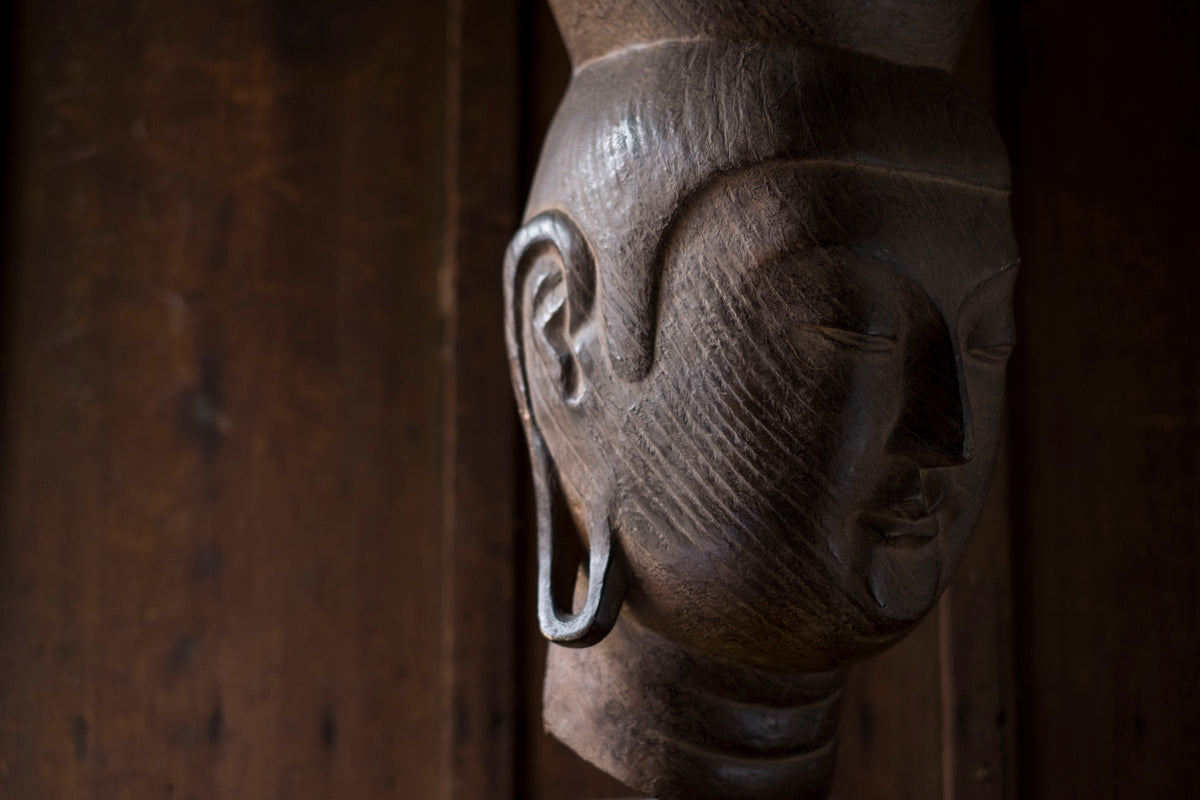
The sculpture is modeled with closed, meditative eyes, elongated earlobes, a gently composed mouth, and an elevated crown-like coiffure. Its expression is restrained rather than theatrical. From different angles, the face shifts subtly between solemnity and calm, giving the piece the kind of contemplative presence that works beautifully in a study, meditation room, library, tokonoma-inspired display, or carefully curated interior.
Unlike a conventional brightly finished devotional statue, this work has been given a dark brown, wood-like surface treatment. Fine linear striations travel across the forehead, cheeks, hair, neck, and crown, creating the visual suggestion of carved timber while preserving the clean symmetry and controlled geometry associated with a molded sculptural form.
The body appears to be made from a resin and ceramic or mineral-filled composite rather than carved from a single block of wood. This type of material allows surprisingly crisp modeling while retaining substantial visual depth and weight. The result is a sculpture that carries the atmosphere of an older carved Buddhist head without requiring the piece itself to be described as solid wood.
Mounted on a simple black wooden pedestal, the sculpture takes on a gallery-like presentation. The contrast is especially effective: the warm brown figure seems to hover above the nearly architectural black plinth, allowing the facial modeling and crown to become the visual focus.
Miroku Bosatsu and the Future Buddha
Miroku Bosatsu, known internationally as Maitreya, occupies a distinctive place within Buddhist tradition. Rather than representing the historical Buddha of the past, Miroku is associated with the Buddha yet to come.
This symbolism gives Miroku imagery an unusually hopeful quality. The figure is connected with the idea that wisdom and compassion continue beyond the present age, and that enlightenment remains something humanity may continually move toward.
Japanese representations of Miroku vary considerably. Some are seated in the celebrated contemplative pose, while others appear as standing bodhisattvas, devotional figures, or simplified sculptural heads intended to emphasize expression rather than narrative detail.
This bust belongs to that quieter tradition of representation. There is no elaborate narrative composition surrounding the figure. Instead, the face becomes the entire subject.
The downcast eyes suggest inward attention. The long ears recall the iconographic language of Buddhist sculpture. The slightly compressed lips and softly rounded cheeks create a meditative expression that changes with the direction of light.
It is an object designed to be looked at slowly.
Sculptural Character
One of the most compelling qualities of this piece is the deliberate simplicity of the modeling.
The eyebrows are formed as broad planes rather than sharply incised lines. The nose is long and architectural. The eyelids sit heavily over the closed eyes, helping create the sense of inward contemplation.
Across the face and hair, the sculptor introduced numerous fine linear marks. These marks imitate the visual rhythm of chisel-cut wood grain and give the otherwise smooth cast surface an aged, hand-worked appearance.
The crown or elevated coiffure is especially distinctive. Its broad, slightly flared upper silhouette gives the head a strong vertical profile and introduces an almost architectural quality to the composition.
Viewed in profile, the sculpture becomes particularly dramatic. The long ear, projecting crown, elongated neck, and angular nose create a strong silhouette that feels equally at home in a traditional Japanese-inspired interior or a more contemporary gallery setting.
Resin and Ceramic Composite Construction
The material is best understood as a resin and ceramic, mineral, or similar composite sculptural medium with a hand-finished surface.
Rather than displaying exposed timber fibers, knots, end grain, or conventional carving transitions, the sculpture has the comparatively controlled surface and symmetry expected from a cast or molded object.
The linear markings should therefore be appreciated as part of the artistic surface treatment rather than literal wood grain.
This distinction is important because it allows the piece to be appreciated for what it actually is: a carefully modeled decorative Buddhist sculpture whose surface was intentionally finished to evoke the warmth and character of traditional carved statuary.
Composite sculpture also has its own advantages. It allows fine facial contours, thin ear forms, and repeated surface textures to remain sharply defined while providing enough mass for the object to feel visually substantial.
The brown finish ranges from deeper chocolate tones to softer warm highlights where light catches the raised modeling. In subdued lighting the sculpture can appear almost black-brown, while stronger natural light reveals considerably more tonal variation.
A Powerful Display Piece
The black pedestal transforms the sculpture from a decorative figurine into something closer to a small gallery object.
Displayed alone, it works beautifully on:
a console table
a bookshelf
a study desk
a pedestal
a tokonoma-inspired alcove
a meditation room shelf
a gallery wall cabinet
a minimalist sideboard
a library display
a Buddhist or contemplative art collection
The piece also pairs naturally with antique Japanese ceramics, bronze okimono, incense vessels, suiseki, lacquerware, scrolls, or other subdued natural materials.
Against plaster, wood, stone, linen, or dark shelving, the sculpture has remarkable visual presence without needing bright color.
Its strongest quality is restraint.
Wabi-Sabi and Japanese Interior Appeal
Part of the appeal comes from the way the surface interacts with age, texture, and shadow.
The dark finish is not completely uniform. Areas of rubbing, subtle tonal variation, and irregular surface character help prevent the sculpture from feeling newly manufactured or overly polished.
This makes the piece particularly suitable for interiors influenced by wabi-sabi, Japandi, Japanese modernism, primitive sculpture, monastic design, or collected global antiques.
Rather than functioning as a bright decorative accent, it acts as a visual anchor.
Its form is quiet.
Its palette is quiet.
Its expression is quiet.
That restraint gives the object unusual strength.
Buddhist Art Without Visual Excess
Many Buddhist decorative objects rely upon gold, elaborate robes, bright enamel, or complex iconography. This sculpture takes the opposite approach.
Almost everything has been reduced to the head.
The viewer is invited to focus on expression, proportion, line, and surface.
That reduction gives the sculpture a surprisingly modern quality. Even buyers who are not specifically collecting Buddhist art may appreciate it simply as a strong sculptural portrait with an unmistakably East Asian visual language.
For a dedicated Buddhist collector, the piece offers another type of appeal: an accessible representation of contemplative imagery that can be displayed respectfully without requiring a large altar arrangement.
Vintage Character
The sculpture presents as a vintage decorative Buddhist work rather than a newly produced contemporary ornament.
Its darkened finish, restrained modeling, surface variation, and simple mounted presentation give it the atmosphere of an older collected object.
Exact dating is not established from the sculpture alone, so it is best appreciated as a vintage 20th-century Japanese Buddhist-style decorative sculpture rather than attributed to a specific historical period without further documentation.
The pedestal appears to be a separate black wooden display base selected to complement the sculpture.
Condition
Vintage condition with surface character consistent with age and display.
Please carefully review all photographs, as they form an important part of the condition description.
The dark brown finish naturally shows tonal variation, texture, rubbing, and minor irregularities that contribute to the sculptural character of the piece.
No claim is made that the sculpture is carved solid wood. The figure appears to be made from a resin and ceramic, mineral, or similar composite material with a wood-look hand-finished surface.
The black display pedestal is included as shown.
Material
Resin and ceramic composite
Mineral-filled resin or similar sculptural composite
Pigmented surface finish
Wood-look brown patina
Black wooden display pedestal
Style and Subject
Japanese Buddhist art
Miroku Bosatsu
Maitreya
Bodhisattva head
Buddhist sculpture
Meditation sculpture
Japanese devotional-inspired art
Vintage Asian sculpture
Zen interior object
Gallery display bust
Display Suggestions
This piece works especially well when given breathing room.
Rather than surrounding it with many small objects, allow the vertical silhouette to stand against a relatively plain background. Warm directional light will bring out the surface striations around the cheeks, forehead, crown, ears, and neck.
For a darker interior, a narrow spotlight creates a striking temple-like mood.
For a brighter Japandi space, the brown sculpture and black pedestal provide a strong counterpoint to cream walls, pale timber, linen, stone, and neutral ceramics.
Collectors may also enjoy displaying it alongside Japanese bronze, lacquer, celadon, Buddhist figures, suiseki, or antique vessels to create a layered but restrained cultural collection.
Why This Piece Stands Out
Its appeal lies in the combination of spiritual imagery and sculptural understatement.
The Miroku-inspired subject gives the work cultural depth.
The composite construction allows detailed modeling.
The brown wood-look treatment gives warmth and age.
The black pedestal creates a gallery presentation.
And the restrained expression allows the sculpture to work equally well as Buddhist art, vintage Japanese decor, or simply an evocative contemplative object.
Rather than demanding attention, it slowly gathers it.
That is precisely what makes it such a compelling piece.
Purchase, Shipping and Vintage Policy
This is a vintage or previously owned collectible and should not be expected to present as factory-new. Natural signs of age, storage, handling, surface variation, and previous display are part of the character of vintage objects.
Please review all photographs carefully before purchase. We photograph our pieces from multiple angles so that buyers can assess the form, finish, texture, and visible condition as completely as possible.
We welcome thoughtful questions before purchase and are happy to clarify any visible detail shown in the photographs.
Preparation, shipping and handling normally takes approximately 5 to 10 business days or earlier whenever possible. Each object is carefully prepared for international transport with particular attention given to vulnerable projecting details and the display pedestal.
Availability of vintage Japanese decorative arts is naturally limited. Once sold, an identical replacement cannot normally be guaranteed.
If you are looking for a similar Buddhist sculpture, Japanese decorative object, or related collectible, please feel free to message us. Although availability cannot be guaranteed, we may be able to locate the same or a closely related piece through our sourcing network.
Reasonable offers may be considered on selected pieces. Some objects have greater flexibility than others, but respectful proposals are always welcome.
#JapaneseBuddhistArt #MirokuBosatsu #Maitreya #BuddhaBust #Bodhisattva #JapaneseSculpture #BuddhistSculpture #VintageJapaneseArt #ZenDecor #MeditationDecor #WabiSabiDecor #JapandiInterior #JapaneseInterior #AsianArt #BuddhistDecor #SpiritualArt #ContemplativeArt #JapaneseCollectible #VintageSculpture #BuddhaHead #BodhisattvaHead #MaitreyaBuddha #JapaneseDecor #ZenInterior #MeditationRoom #SacredArt #AsianSculpture #GalleryDecor #StudyDecor #LibraryDecor #Tokonoma #JapaneseAesthetic #WabiSabi #MinimalistDecor #VintageJapan #BuddhistCollectible #SpiritualDecor #MindfulnessDecor #ResinSculpture #CeramicComposite #CompositeSculpture #WoodLookSculpture #BrownSculpture #ArtObject #JapaneseArtCollector #AsianAntiquesStyle #VintageBuddha #ZenArt #SculpturalDecor #JapaneseHomeDecor
Miroku Bosatsu, Maitreya Buddha, Japanese Buddha, Buddha head bust, Buddhist decor, Japanese sculpture, Zen home decor, vintage Japan art, Bodhisattva bust, meditation decor, wabi sabi decor, Japandi sculpture, Asian art decor
Materials
resin, ceramic composite, mineral resin, sculptural composite, pigmented finish, brown patina finish, wood look finish, black wood pedestal, molded sculpture, cast sculpture, hand finished surface