Rare Vintage, Antiques and Art Collector / Curator / Personal Shopper From Japan
Vintage Japanese Kutani Shishi Guardian Lion Pair with Pierced Brocade Balls | Red Gold Moriage Ceramic Foo Dogs
Vintage Japanese Kutani Shishi Guardian Lion Pair with Pierced Brocade Balls | Red Gold Moriage Ceramic Foo Dogs
Couldn't load pickup availability
Have a reasonable price in mind? Submit your best offer and our concierge will review it personally.
Matched Japanese Shishi Temple Guardian Lions with Crimson Textured Bodies, Cream Flame Manes, Cobalt Brocade Orbs, Polychrome Enamels and Extensive Gilt Decoration
Introduction
A pair of objects can command a room in a way that a single sculpture rarely can.
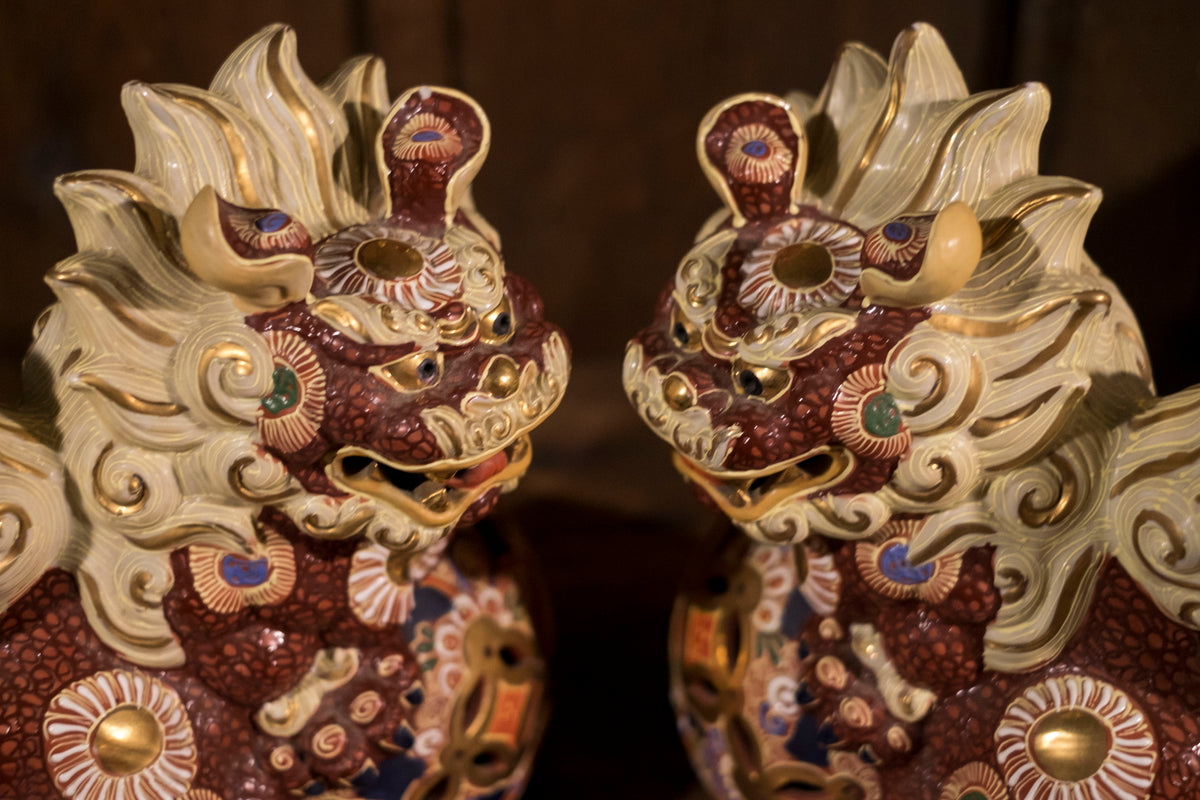
These exuberant Japanese Kutani shishi guardian lions were created to be encountered together, two powerful ceramic creatures crouching behind richly decorated pierced brocade balls, their enormous flame-like manes and tails rising around them in curling waves of cream and gold.
The visual language is unmistakably Japanese. Ferocious faces meet joyful color. Teeth and claws meet flowers. Heavy bodies are wrapped in delicate decorative pattern. Deep iron-red surfaces are interrupted by chrysanthemums, scrolling motifs, cobalt blue, green enamel and lustrous gilding.
The result is wonderfully theatrical.
Each shishi leans forward with a paw resting confidently upon a large pierced decorative orb. Their mouths open into expressive snarls, revealing individually modeled teeth, fangs and tongues. The eyes are alert and slightly playful rather than purely frightening. Around the face, an enormous cream-colored mane spirals outward in curls before rising into sculptural flames.
Behind each animal, the tail becomes almost architectural, sweeping upward in broad curling forms that transform the guardian lion into something halfway between animal, flame and cloud.
Placed together, they create a remarkable mirrored composition.
They are protective figures, decorative sculpture and unapologetically maximal Japanese ceramic art all at once.
A Pair With Presence
What distinguishes this set immediately is scale of visual effect.
The bodies are low and muscular.
The heads rise dramatically above the shoulders.
The tails climb vertically behind them.
Then the large circular brocade balls establish another layer of form directly in front of each guardian.
Nothing about the composition feels accidental.
Viewed straight on, the two lions create a highly symmetrical architectural arrangement. Their bodies spread outward while the balls anchor the center. Their tails rise like flames behind the outer edges, framing the entire pair.
Viewed from an angle, the sculptures become much more animated.
The depth of the shoulders appears.
The massive curling manes begin to overlap.
The paws reach forward over the decorative balls.
The tails reveal their deeply modeled ridges.
And the faces suddenly seem to turn toward one another, creating the wonderful impression that the guardians are engaged in an eternal conversation.
This is one of those pairs that benefits tremendously from being displayed with breathing room.
They do not merely occupy a shelf.
They establish a territory.
The Shishi Guardian Lion
Shishi are stylized guardian lions that became deeply embedded in Japanese religious, architectural and decorative culture.
Their ancestry ultimately reaches back through East Asian interpretations of the lion, an animal that was historically exotic to Japan. Over centuries, artists transformed the real lion into something more imaginative.
The Japanese shishi developed curling hair, exaggerated jaws, large eyes, powerful paws and flame-like ornament.
It is less zoological lion than supernatural guardian.
Their appearance is deliberately contradictory.
They are fierce, yet playful.
Protective, yet decorative.
Muscular, yet surrounded by flowers and scrollwork.
That combination is beautifully expressed in this pair.
The faces possess tremendous personality. Broad noses, raised brows, prominent eyes, curling moustache-like forms and sharply modeled teeth are arranged into expressions that are intimidating without losing charm.
Their open mouths give the sculptures a tremendous sense of life.
Rather than presenting a strict temple-gate A-Un arrangement with one open and one closed mouth, the supplied views show both figures animated with open jaws. They therefore read as a deliberately matched decorative pair united through posture, color and ornament.
The Pierced Brocade Balls
Each lion places a paw against a large spherical ornament.
These are among the most visually elaborate elements of the sculptures.
The balls are predominantly deep cobalt or midnight blue, providing an extraordinary color contrast against the crimson bodies and cream manes.
Across their surfaces runs an almost textile-like composition of floral forms, scrolling arabesques, petal shapes and repeated ornamental lines.
The decoration resembles the visual richness of Japanese brocade.
Large metallic gold openwork elements puncture the surface of each ball, forming stylized flower or leaf-shaped apertures around geometric central forms.
These openings are not merely decorative painting.
They create genuine negative space.
Light passes through the ball and produces changing shadows as the figure is viewed from different angles.
That use of openwork gives the sculptures another dimension of craftsmanship and prevents the large spherical elements from appearing visually heavy.
Against the densely patterned enamel, the pierced gold-colored forms become almost jewel-like.
Crimson Bodies and Raised Surface
The bodies are covered in a remarkable deep reddish-brown field.
Look closely and the surface is not flat.
It is densely textured with thousands of small irregular marks, creating the impression of scales, pebbled hide or raised enamel granulation.
This tactile-looking ground provides an important counterpoint to the glossy smoothness of the mane and gilded medallions.
The shishi appear almost armored.
The dense pattern follows the shoulders, forelegs, flanks and haunches, emphasizing the physical mass of the animals.
Across this crimson field are circular decorative medallions outlined in white, blue and gold.
These roundels interrupt the red body in rhythmic intervals and make the lions feel almost dressed in ceremonial textiles.
It is an extraordinary collision between animal anatomy and textile design, one of the qualities that makes highly decorated Kutani sculptural work so distinctive.
Moriage-Style Decoration
Much of the visual richness comes from raised overglaze decoration commonly associated with elaborate Kutani work.
Fine lines and ornamental details stand slightly proud of the ceramic surface, giving the designs physical texture as well as color.
This moriage-style treatment is particularly effective around the floral patterns, mane details, facial ornament and brocade balls.
Rather than simply painting an image onto porcelain, the decoration becomes part of the sculpture.
Light catches raised ridges.
Gold gleams differently from the underlying enamel.
Small shadows form around floral outlines.
The result becomes especially beautiful under directional lighting.
A photograph can reproduce the colors.
It cannot entirely reproduce the dimensionality.
The Cream Flame Manes
The manes are among the finest sculptural elements of the pair.
Cream-colored locks emerge from the head and neck in great curling spirals, each ridge emphasized by fine brown or gold-toned lines.
Some locks curl inward like clouds.
Others climb vertically.
Around the cheeks, they wrap tightly into classical shishi curls.
Behind the head, they explode outward into larger flame-shaped masses.
The mane softens the transition between the crimson body and the pale tails while making the face appear even more dramatic.
The restrained cream palette is also important.
Had the mane been painted in another intense color, the sculpture could easily have become overwhelming.
Instead, the cream functions almost as visual light.
It separates the red body from the darker background and gives the shishi their unmistakable silhouette.
Monumental Flame Tails
Turn the pair slightly and another extraordinary feature appears.
Each tail rises upward behind the body as a vast curling flame.
The forms are broad, almost architectural.
Deeply modeled grooves run through the cream glaze, following the curvature of each flame-like section.
Gold accents emphasize individual ridges and catch the light.
The tail therefore works on several levels.
From the front it creates a dramatic silhouette.
From the side it gives the sculpture verticality.
From behind it reveals a separate piece of ceramic modeling that could almost function as an abstract sculpture by itself.
This is an excellent example of how Japanese decorative animals often transform natural anatomy into ornamental pattern.
The tail no longer behaves like an ordinary animal tail.
It becomes fire.
Cloud.
Energy.
Movement.
Expressive Faces
Despite all the decorative richness, the faces remain the emotional center of the sculptures.
Large rounded eyes stare outward.
The brows curl.
The noses project in polished gold-toned relief.
The mouths open broadly.
Sharp triangular teeth line the jaws.
A tongue appears inside each mouth, adding an unexpectedly playful touch.
The faces are fierce without becoming grim.
There is humor in them.
That combination of threat and personality is an important part of the visual appeal of shishi imagery.
A guardian should be intimidating to whatever it is meant to repel.
But it should also be a welcome presence for those it protects.
These figures achieve exactly that balance.
Gold Throughout the Composition
Gold-colored decoration appears across almost every major element.
It defines the noses.
It catches the teeth and facial ornament.
It fills flower centers.
It outlines curls.
It frames pierced sections of the brocade balls.
It runs through the mane and tail.
Rather than covering the sculptures uniformly, the gilding is distributed as highlights.
That matters.
The metallic surfaces punctuate the composition instead of flattening it.
Under warm lighting, the effect can be particularly rich.
The gold seems to ignite against the crimson ground.
Under cooler daylight, the blue and cream elements become stronger and the pair acquires an entirely different personality.
These sculptures reward changes in lighting.
Kutani Color Language
Kutani ceramics are celebrated for saturated overglaze color and fearless ornament.
This pair embraces that visual tradition without restraint.
Iron red dominates the bodies.
Cobalt establishes depth.
Cream provides relief.
Green appears as jewel-like accents.
White creates fine linework.
Gold supplies brilliance.
Small touches of orange, pink and purple add additional complexity.
From across a room, the palette reads primarily as red, ivory, blue and gold.
From close range, dozens of smaller color decisions emerge.
This is precisely the kind of object that becomes richer rather than simpler the closer one looks.
Floral Ornament
Flowers appear everywhere.
Large circular blossoms decorate the shoulders and limbs.
Petal structures radiate from metallic centers.
Smaller flowers fill the brocade balls.
Curled leaves and arabesques weave between them.
This floral vocabulary is important because it moderates the ferocity of the guardian lions.
Claws, teeth and muscles are surrounded by flowers.
Power is clothed in beauty.
The visual contradiction gives the sculptures sophistication.
Without the floral work, these could be imposing animal figures.
With it, they become unmistakably decorative art.
Ceramic Sculpture in the Round
These are not flat-front decorative figures designed only to face one direction.
The sculptural treatment continues around the sides and backs.
From the three-quarter view, the mane projects dramatically.
The shoulders become powerful rounded masses.
The forelegs extend downward into broad paws.
The enormous tails reveal layered construction.
The brocade balls remain visually active from multiple angles.
The pair therefore works particularly well on furniture where viewers can move around them.
A console table.
Large sideboard.
Low cabinet.
Library shelf.
Gallery plinth.
Traditional Japanese-inspired alcove.
They deserve to be seen from more than one direction.
A Matched Pair
The visual value of the set comes not simply from owning two similar objects, but from the way the two figures interact.
Displayed facing slightly inward, the guardians create a ceremonial composition.
Placed parallel, they become architectural sentinels.
Separated across a doorway or large cabinet, they define the space between them.
Placed closely together, their balls and bodies form a nearly continuous wall of ornament.
The photographs demonstrate this beautifully.
When the pair faces one another, their expressions suddenly become conversational.
When viewed frontally, they become protective.
When staggered in depth, they become sculptural.
Few decorative objects offer that amount of flexibility.
The Guardian Tradition
Guardian lions were historically associated with important thresholds.
Temple entrances.
Shrine approaches.
Palaces.
Gates.
Later, their symbolism entered domestic and decorative culture.
The fundamental idea remains consistent.
A guardian occupies the boundary between protected space and whatever lies beyond it.
For contemporary interiors, one does not need to approach the pair literally as religious objects.
Their symbolic vocabulary remains compelling even in purely decorative settings.
Protection.
Strength.
Courage.
Authority.
Balance.
Prosperity.
Watchfulness.
They make particularly meaningful objects for an entrance, office, study or important living space.
The Ball as Symbol
The decorative sphere beneath the paw of a guardian lion is frequently interpreted as a jewel, pearl, sacred ball or brocade ball.
It can suggest authority, knowledge, completeness and mastery.
In Japanese decorative ceramics, the sphere also provides artists with a wonderful opportunity for elaborate surface decoration.
This pair uses that opportunity exuberantly.
The balls are almost sculptures within the sculptures.
Their intricate painted flowers contrast with the animal bodies.
Their perfect geometry contrasts with the organic movement of the mane.
Their pierced openings contrast with the dense ceramic mass of the lions.
The result is exceptionally effective.
Kutani and the Art of Excess
There is a particular kind of Japanese beauty that comes from restraint.
There is another that comes from abundance.
These lions belong unapologetically to the second tradition.
More pattern.
More curl.
More color.
More gold.
More flowers.
More movement.
Yet the composition remains coherent because the same motifs repeat across both animals.
Crimson connects the bodies.
Cream connects mane and tail.
Blue connects claws and balls.
Gold passes through almost everything.
Repetition transforms abundance into rhythm.
That is the secret of the pair.
They are visually rich without becoming random.
Display in a Contemporary Interior
Despite their traditional imagery, these figures can work brilliantly within contemporary interiors.
Against dark wood, their cream manes and gold accents become warm and atmospheric.
Against white walls, the crimson and cobalt become extremely graphic.
Against black shelving, the gold acquires almost theatrical intensity.
In a minimalist room, they can function as the single deliberately maximal element.
In an eclectic collection, they can sit comfortably beside ceramics, bronzes, books and textiles.
For Japandi interiors, they provide a useful counterpoint to the otherwise restrained aesthetic.
A room sometimes benefits from one object that refuses to whisper.
These lions certainly qualify.
A Strong Collector Display
Collectors of Japanese ceramics will appreciate the pair because the appeal operates across several collecting categories.
They are sculptural Kutani.
They are shishi imagery.
They are decorative guardian figures.
They employ raised polychrome enamel.
They carry extensive gilt decoration.
They incorporate pierced ceramic work.
And most importantly, they survive as a matched pair.
Pairs are always particularly desirable because one separated figure can be relatively easy to encounter while an original visually compatible set can be considerably more difficult to replace once divided.
That completeness matters.
Condition
The pair presents with strong visual impact in the supplied photographs.
The polychrome decoration remains vivid, the cream manes and tails retain attractive gloss, the cobalt and floral ornament remains clearly legible, and the metallic gilt accents continue to give the sculptures considerable brilliance.
As vintage ceramic pieces, minor age-related surface wear, rubbing to gilding, glaze irregularities, tiny firing marks and signs of previous display should be expected.
No major structural breakage is immediately apparent in the supplied views.
Because no clear underside photographs or maker marks are included in the present image set, specific kiln, workshop or artist attribution should not be inferred beyond the Kutani identification and stylistic context supplied with the piece.
Please review the photographs carefully, as they form an important part of the condition description.
Care and Display
Handle each lion from the solid body rather than lifting by the mane, tail, ears, ball ornament or projecting ceramic details.
Avoid abrasive cleaners or polishing compounds.
Gilded and overglaze surfaces should be dusted gently with a very soft dry brush or microfiber cloth.
If deeper cleaning is ever required, avoid soaking and prolonged moisture around textured decoration.
Ceramic tails, teeth, ears and projecting curls are naturally vulnerable to impact.
For long-term display, place each sculpture on a stable level surface away from shelf edges and areas where bags, curtains or sleeves may catch the projecting ornament.
A museum-style wax or anti-slip display pad beneath each figure can provide additional security without permanently altering the ceramic.
Brand Heritage
Japanese decorative ceramics often achieve their greatest magic when symbolism and craftsmanship become inseparable.
The guardian lion is already a creature of transformation.
An animal known through distant cultural memory becomes a supernatural protector.
Its mane becomes cloud.
Its tail becomes flame.
Its paw rests on a jewel-like world.
Kutani decoration adds another transformation.
Ceramic becomes textile.
Body becomes brocade.
Flowers grow across muscle.
Gold turns glaze into light.
This pair captures that layered Japanese visual imagination beautifully.
They are fierce without darkness.
Luxurious without sterility.
Traditional without feeling static.
Viewed individually, each lion is an elaborate sculptural object.
Viewed together, they become an environment.
Two guardians.
Two spheres.
Two towers of curling flame.
And between them, the protected space.
Purchase, Shipping and Vintage Policy
This is a vintage Japanese collectible pair offered in the condition represented by the photographs. Vintage objects naturally may show small marks, glaze variation, rubbing, gilt wear, firing irregularities, surface scratches or other traces of age and previous display. These characteristics are part of the individuality of vintage decorative art.
Some objects in our collection have a little room for negotiation while others are more firmly priced. Respectful best offers are welcome and are considered individually.
Preparation, shipping and handling normally takes approximately 5 to 10 business days or earlier whenever possible. Because these are dimensional ceramic sculptures with multiple projecting elements, each guardian will be extensively protected and packed independently within the shipment to reduce movement and contact during transportation.
Tracking information will be supplied after dispatch.
International duties, import taxes and destination-country charges, where applicable, remain the responsibility of the buyer.
If you are looking for this design or model in another size, please feel free to message us. Although availability cannot be guaranteed, we may be able to locate the same or a closely matching piece in a different size through our sourcing network.
Material Tags
Japanese ceramic, porcelain-style ceramic body, Kutani ware, polychrome overglaze enamel, iron-red enamel, crimson textured glaze, cobalt blue enamel, cream glaze, white enamel linework, green enamel accents, purple enamel accents, raised moriage-style decoration, gilt decoration, gold-tone accents, pierced ceramic openwork, sculpted ceramic mane, sculpted flame tail, floral overglaze decoration, brocade-pattern ornament, glossy glaze, hand-painted decoration, molded and hand-finished ceramic
#Kutani #KutaniWare #KutaniShishi #JapaneseShishi #ShishiLion #Karajishi #FooDog #FooDogs #GuardianLion #GuardianLions #JapaneseCeramics #JapanesePorcelain #JapaneseArt #JapaneseDecor #JapaneseVintage #VintageJapan #JapaneseCollectible #JapaneseOkimono #Okimono #KutaniOkimono #Moriage #MoriagePottery #MoriageCeramic #HandPaintedCeramic #JapaneseEnamel #PolychromeCeramic #GiltCeramic #GoldDecor #RedGoldDecor #TempleGuardian #TempleLion #ProtectiveSymbol #JapaneseGuardian #AsianDecor #AsianAntiques #AsianArt #OrientalDecor #InteriorStatement #StatementDecor #MaximalistDecor #CollectorDecor #VintageCeramic #CeramicSculpture #LionSculpture #JapaneseSculpture #SacredGuardian #BrocadeBall #PiercedCeramic #FloralCeramic #JapaneseCraft #JapaneseCraftsmanship #ShowaDecor #ShowaEra #JapaneseHomeDecor #LuxuryDecor #WabiSabiCollecting #JapandiAccent #JapaneseMythology #GuardianStatue #PairOfLions
kutani shishi pair, foo dog pair, guardian lions, kutani ware, japanese ceramic, shishi statue, karajishi decor, japanese vintage, moriage pottery, gold gilt ceramic, temple lion decor, asian guardian art, japan collectible