Rare Vintage, Antiques and Art Collector / Curator / Personal Shopper From Japan
Kitamura Seibō Bronze Samurai Horse Sculpture Kumagai Naozane Signed Japanese Showa Statue with Original Box
Kitamura Seibō Bronze Samurai Horse Sculpture Kumagai Naozane Signed Japanese Showa Statue with Original Box
Couldn't load pickup availability
Have a reasonable price in mind? Submit your best offer and our concierge will review it personally.
Dynamic Japanese Equestrian Bronze of the Legendary Warrior Raising His Battle Fan
Description
A commanding signed Japanese bronze sculpture associated with Kitamura Seibō 北村西望, depicting the celebrated warrior Kumagai Jirō Naozane 熊谷次郎直実 mounted on horseback at a pivotal moment from The Tale of the Heike.
The armored samurai sits upright in the saddle while raising an open folding fan above the horse. Beneath him, the animal advances with concentrated physical energy, its body, harness and muscular movement carefully integrated into the composition. The contrast between the warrior’s controlled gesture and the horse’s forward momentum gives the sculpture an unusually vivid narrative presence.
This is not a generic image of a mounted samurai. The raised fan identifies a specific episode associated with Kumagai Naozane at the Battle of Ichi-no-Tani. Kitamura’s monumental version, installed outside Kumagaya Station in 1974, was based on an earlier depiction by Watanabe Kazan and shows Naozane raising his fan to call the young Taira warrior Atsumori back from the shore.
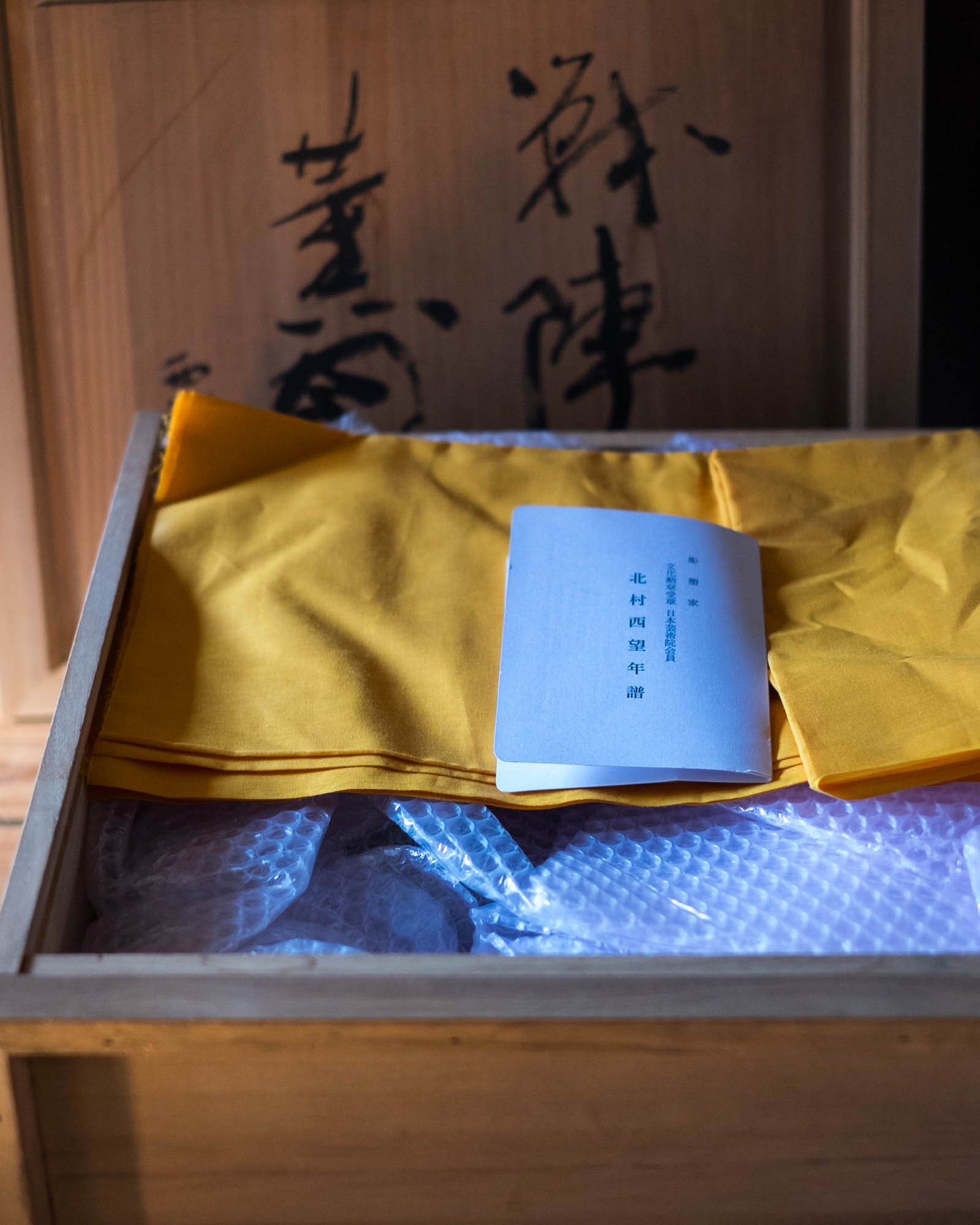
The sculpture is accompanied by its original signed or inscribed wooden storage box, strengthening its presentation as a complete Japanese collector’s object. With its powerful equestrian silhouette, historically grounded subject and connection to one of modern Japan’s most important sculptors, the work brings together samurai history, literary memory and twentieth-century bronze artistry.
Historical Presence
The sculpture captures a moment poised between heroic action and moral consequence.
Naozane appears at the height of martial authority, fully armored and mounted, yet the story surrounding him is not a simple celebration of victory. His encounter with Atsumori became one of the most emotionally resonant episodes in Japanese warrior literature, remembered for its confrontation between military duty and human compassion.
The raised fan functions as both signal and narrative hinge. It stops the fleeing warrior, arrests the movement of the scene and leads toward an encounter that ultimately changes Naozane’s spiritual life.
That tension gives the bronze unusual depth. It can be appreciated as a dynamic samurai sculpture, but it also carries themes of impermanence, remorse, duty and transformation.
Identification
Artist attribution: Kitamura Seibō / 北村西望
Subject: Kumagai Jirō Naozane / 熊谷次郎直実
Object type: Japanese bronze equestrian sculpture
Composition: Armored samurai mounted on horseback and raising a fan
Material: Cast bronze with patinated or gold-toned finish
Period: Vintage Japanese work, likely later Shōwa-era production
Presentation: Original signed or inscribed wooden storage box
Country of origin: Japan
Artistic category: Modern Japanese sculpture, samurai art and decorative bronze
Display type: Freestanding sculpture / okimono
The work is best understood as a signed reduced bronze cast derived from Kitamura Seibō’s larger equestrian composition rather than the unique monumental original installed at Kumagaya Station.
Kumagai Naozane and the Raised Fan
Kumagai Naozane was a warrior from Musashi Province whose life crossed the turbulent transition between the late Heian and early Kamakura periods.
He is most closely associated with the death of the young aristocratic warrior Taira no Atsumori during the Battle of Ichi-no-Tani in 1184. According to the literary tradition, Naozane saw Atsumori attempting to escape toward the Taira ships and called him back for combat.
The fan raised above the horse refers to this charged instant.
The official Kumagai Naozane digital archive identifies Kitamura’s equestrian monument as a representation of Naozane raising his fan to summon Atsumori during the battle. The monumental bronze was commissioned for Kumagaya and installed in 1974.
The gesture therefore communicates more than military command. It marks the threshold between action and regret, worldly reputation and spiritual awakening.
The Atsumori Narrative
The confrontation between Naozane and Atsumori became one of the defining episodes of The Tale of the Heike.
After overpowering the younger warrior, Naozane reportedly discovered that Atsumori was close in age to his own son. Surrounded by approaching allies and unable to release him safely, Naozane carried out his duty but was deeply affected by the encounter.
The episode contributed to his eventual withdrawal from military life and his embrace of Buddhist practice under the name Renshō or Rensei.
Seen within this context, the sculpture’s heroic form contains a quieter meditation on the cost of warfare. The horse, armor and fan establish Naozane’s worldly power, while the story behind them points toward renunciation and compassion.
Kitamura Seibō
Kitamura Seibō was born in Nagasaki Prefecture in 1884 and died in 1987 after a career extending across the Meiji, Taishō and Shōwa eras.
He is most internationally recognized as the sculptor of the monumental Peace Statue in Nagasaki Peace Park. Official Japanese institutional sources also note his particular strength in heroic male figures and equestrian military subjects, making the Naozane composition highly characteristic of his broader sculptural language.
His work frequently balances physical strength with symbolic purpose. Muscular bodies, warriors, animals and historical figures are rendered with monumentality, but the subjects often carry wider messages concerning courage, remembrance, peace or moral responsibility.
That duality is especially compelling here. The same sculptor associated with one of Japan’s most important postwar peace monuments also created this image of a warrior whose battlefield experience led toward spiritual transformation.
Sculptural Composition
The figure is arranged as a unified equestrian group rather than as a rider simply placed upon a horse.
The horse provides the sculpture’s physical rhythm. Its torso, legs and harness establish forward movement, while the warrior rises vertically above the saddle. The lifted fan extends the composition upward and outward, creating an emphatic silhouette visible even from across a room.
Important visual elements include:
- The upright armored warrior
- The raised open fan
- Layered samurai armor
- Helmet and warrior regalia
- Reins and saddle equipment
- Articulated horse anatomy
- Forward equestrian movement
- Contrasting vertical and horizontal gestures
- Textured bronze surface
- Integrated sculptural base
The fan prevents the upper body from appearing static. It draws the eye above the warrior’s head and transforms the gesture into a visual command.
The Horse
The horse is central to the emotional and physical energy of the work.
In samurai culture, the mounted warrior embodied mobility, rank and battlefield authority. The horse was not merely transportation but an extension of the warrior’s presence and training.
Here, the animal gives substance to the moment. Its posture suggests movement interrupted by command, matching the narrative in which Naozane calls Atsumori back from the water.
The horse may be read as symbolizing:
Momentum: the forward force of history and action
Discipline: controlled strength under an experienced rider
Loyalty: the bond between mounted warrior and animal
Status: the social authority of the equestrian samurai
Transition: movement from battlefield glory toward spiritual reckoning
The Folding Fan
The fan is the most important narrative attribute in the sculpture.
Folding fans could carry ceremonial, social and military significance in Japan. In this composition, however, the fan is not merely an emblem of rank. It is an active signal directed toward Atsumori.
Its open form creates a sharp visual contrast with the dense armor and muscular horse. The fan is light, broad and immediately legible, becoming the focal point around which the entire story turns.
The gesture can evoke:
- Authority
- Challenge
- Recognition
- The interruption of flight
- The decisive instant before combat
- The power of a single action to redirect a life
Armor and Warrior Identity
The sculpted armor places Naozane within the elite mounted-warrior culture of the late Heian period.
Layered plates, protective elements, helmet forms and riding equipment create a richly textured surface. These details reward close inspection while contributing to the larger silhouette of the mounted figure.
The armor communicates protection and social position, but it also creates distance between the viewer and the person beneath it. The historical narrative gradually strips away that distance, revealing the emotional consequences experienced by the warrior after the encounter.
This dialogue between armored exterior and inward transformation gives the sculpture more psychological weight than a conventional triumphal equestrian figure.
Bronze and Surface Character
Bronze is particularly suited to this composition because it allows strength, movement and detail to coexist.
The material preserves the projecting fan, horse anatomy, layered armor and smaller harness elements while giving the sculpture a substantial physical presence. A darker patina or smoky gold-toned finish can emphasize the recesses between armor plates and the contours of the horse.
Depending on the lighting, raised areas may appear warmer and more luminous while recessed details deepen into shadow. This creates a changing surface that becomes especially effective under directional illumination.
The bronze may exhibit natural tonal variation, patina, small casting characteristics or surface changes associated with age. These qualities contribute to the work’s material depth.
Original Wooden Box
The accompanying wooden box is an important part of the sculpture’s collector presentation.
In Japanese art and craft traditions, a fitted or associated box may serve as storage, identification and documentation. Inscriptions can preserve the title, artist’s name, workshop or presentation history.
The survival of the box adds several important qualities:
- It maintains the relationship between sculpture and attribution
- It supports careful long-term storage
- It preserves Japanese calligraphic or written information
- It enhances the completeness of the collector presentation
- It provides additional protection during transport
- It distinguishes the sculpture from an unboxed decorative cast
Natural variation, marks, fading or storage wear to the wood should be understood as part of the box’s history.
Period Assessment
This sculpture appears consistent with a vintage Japanese reduced bronze cast produced during the later Shōwa period or in connection with Kitamura Seibō’s established sculptural models.
The monumental Kumagai Naozane equestrian statue was installed in 1974, providing a firm historical reference for the composition.
Reduced casts based on prominent sculptural models were produced in multiple sizes and editions within modern Japanese bronze culture. The presence of a signature and original box supports the attribution and collector presentation, while the work is not represented as the unique monumental original or as a one-off lifetime casting unless further documentation establishes that status.
Condition
Vintage pre-owned condition with age-related character appropriate to a Japanese bronze sculpture and its wooden box.
The bronze may show:
- Natural patina and tonal variation
- Light surface rubbing
- Small marks from handling or display
- Dust within recessed details
- Minor casting irregularities
- Gentle wear to raised areas
- Age-related changes to the base or finish
The original wooden box may display:
- Storage marks
- Natural wood variation
- Small scratches
- Tonal changes
- Softened corners or edges
- Calligraphic fading or surface wear
These characteristics form part of the object’s history and should not be evaluated according to the standards of newly manufactured decorative merchandise.
Please inspect all photographs carefully, as they form an essential part of the condition description.
Display and Interior Placement
The sculpture has sufficient historical and visual presence to function as a central display object.
It would be especially effective in:
- A Japanese art collection
- A private library or study
- An executive office
- A martial arts dojo
- A samurai or armor collection
- A traditional tokonoma-inspired arrangement
- A museum-style display cabinet
- A reception room
- A history-themed interior
- A room incorporating dark wood, bronze or stone
- A collector’s gallery of Asian metalwork
- A Zen or contemplative study space
For a restrained presentation, display the bronze alone on a dark wood or stone surface.
Directional lighting from one side will strengthen the outline of the fan, deepen the shadows within the armor and emphasize the muscular modeling of the horse.
Cultural and Collecting Appeal
This sculpture brings together several areas of international collector interest:
- Kitamura Seibō sculpture
- Modern Japanese bronze
- Samurai and warrior history
- Equestrian art
- Kumagai Naozane
- The Tale of the Heike
- Battle of Ichi-no-Tani imagery
- Shōwa-period decorative art
- Signed Japanese metalwork
- Original-box presentation
- Japanese military history
- Buddhist themes of impermanence and transformation
The subject has greater narrative depth than a generalized samurai ornament. It represents a recognizable historical warrior, a famous literary encounter and a composition connected to a major public monument.
The original box further strengthens the work’s appeal as a complete Japanese art object rather than an isolated decorative figure.
Why This Sculpture Stands Out
This piece is distinguished by:
- Attribution to one of modern Japan’s major sculptors
- A historically identifiable samurai subject
- Direct correspondence with Kitamura’s Kumagaya monument
- Dynamic mounted composition
- The rare raised-fan gesture
- Richly modeled armor and horse anatomy
- Substantial bronze construction
- Original signed or inscribed wooden box
- Strong Shōwa-era character
- Cross-cultural appeal to Japanese art and equestrian collectors
- A narrative balancing valor, sorrow and spiritual change
Its atmosphere is heroic without being uncomplicated. The sculpture shows a warrior in command, yet the viewer familiar with the story knows that this apparent moment of triumph leads toward remorse and renunciation.
That tension gives the bronze its lasting emotional force.
Offers, Shipping and Store Policies
Respectful and reasonable offers may be considered. Some pieces have room for negotiation, while others are offered at firmer prices according to rarity, condition, attribution and international collector demand.
This is a vintage collectible sculpture offered in its existing condition. Please review the photographs, description, signature, box and condition details carefully before purchasing.
We make every effort to represent our objects accurately. Please contact us before purchase with questions regarding condition, material, inscriptions, dimensions, weight, patina or presentation.
All sales are final. Returns, exchanges, cancellations and condition-related claims are not accepted.
Worldwide shipping is available through Japan Post EMS wherever service is available. The sculpture and original box will be packed carefully for international transit, with particular attention given to the raised fan, horse legs and other projecting details.
Orders are normally prepared for dispatch within approximately 3–5 business days. Delivery times may vary according to destination, customs processing and local postal conditions.
Customs duties, import taxes, brokerage charges and local handling fees remain the responsibility of the buyer where applicable.
#KitamuraSeibo #JapaneseBronze #SamuraiSculpture #KumagaiNaozane #EquestrianSculpture #SamuraiStatue #BronzeHorse #JapaneseArt #ShowaArt #ShowaEra #JapaneseSculpture #SignedBronze #OriginalWoodenBox #JapaneseMetalwork #TaleOfTheHeike #Atsumori #WarriorArt #EquestrianArt #JapaneseHistory #SamuraiCollector #AsianFineArt #BronzeStatue #VintageJapaneseArt #JapaneseWarrior #HorseSculpture #CollectorBronze #ModernJapaneseArt #Japonista
kitamura seibo, samurai bronze, kumagai naozane, equestrian statue, japanese bronze, samurai sculpture, horse statue, showa era art, signed japanese art, original wood box, warrior on horse, asian fine art, japanese metalwork
Material Tags
Cast bronze, patinated bronze, gold-toned bronze finish, natural wood, Japanese wooden storage box, metal signature plaque, traditional casting materials