Rare Vintage, Antiques and Art Collector / Curator / Personal Shopper From Japan
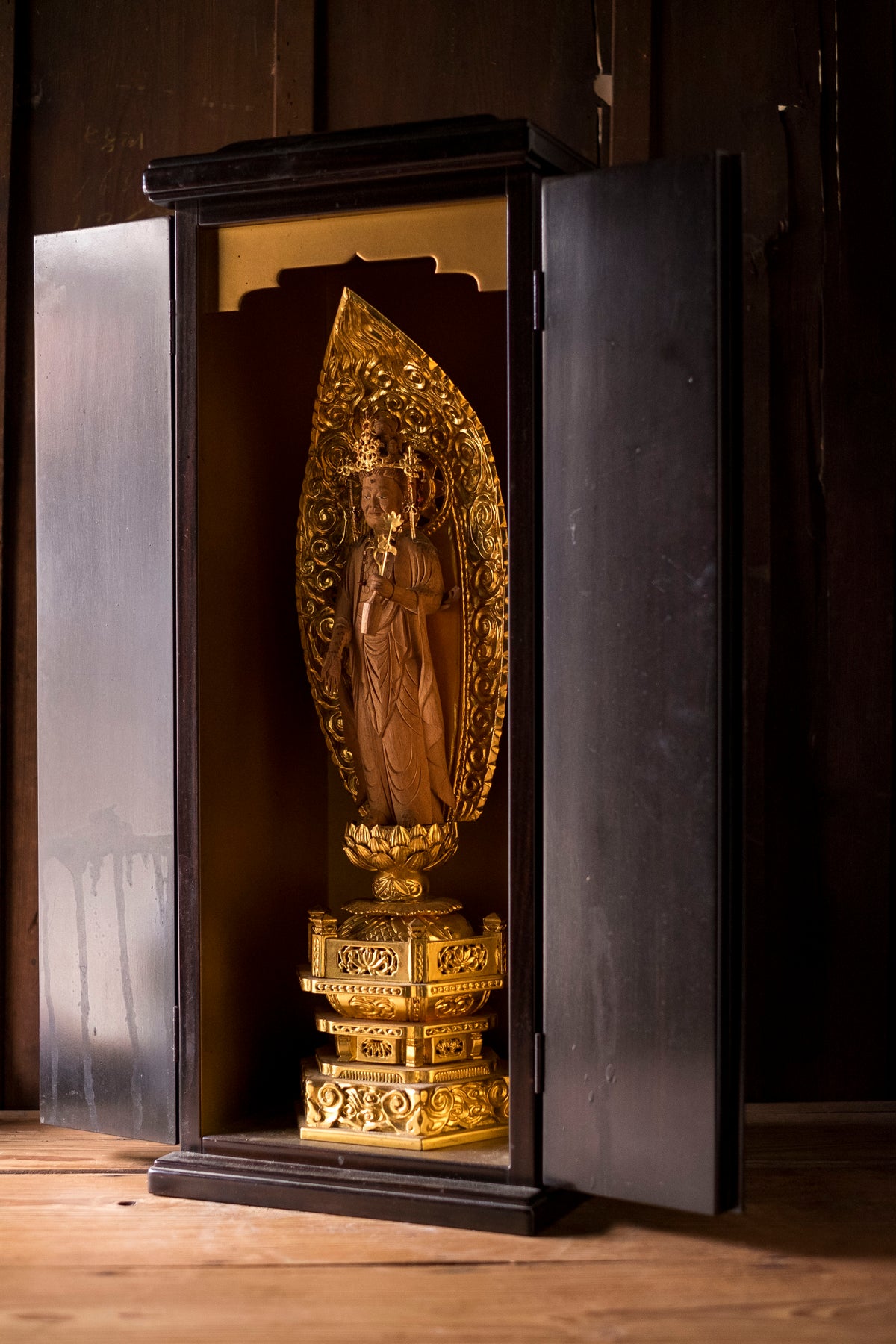
Vintage Japanese Kannon Zushi Shrine Large Gilt Wood Buddhist Altar Cabinet Kannon Bosatsu Lotus Mandorla Statue
Vintage Japanese Kannon Zushi Shrine Large Gilt Wood Buddhist Altar Cabinet Kannon Bosatsu Lotus Mandorla Statue
Couldn't load pickup availability
Have a reasonable price in mind? Submit your best offer and our concierge will review it personally.
Introduction
Hidden behind a pair of dark lacquered doors is an entirely different world.
This impressive Japanese zushi shrine opens from an understated, architectural cabinet into a luminous devotional interior centered upon a standing Kannon Bosatsu figure. The contrast is part of its beauty: restrained black-brown wood on the outside, then an explosion of gold, carved lotus forms, celestial ornament and intricate metalwork within.
The standing Bodhisattva is carved in wood and presented before a tall flame-shaped mandorla filled with deeply modeled swirling cloud and flame motifs. Below, the figure rises from an elaborate lotus throne supported by a highly architectural, multi-tiered pedestal richly finished in gold. When the shrine is closed, the sacred image disappears behind the cabinet doors; when opened, the entire composition becomes a striking vertical altar.
Rather than functioning merely as a statue placed inside a box, the cabinet, figure, mandorla, lotus throne and pedestal operate together as a single devotional composition. It is this layered construction that gives Japanese zushi their extraordinary presence.
The Figure of Kannon Bosatsu
Kannon Bosatsu is one of the most beloved figures within Japanese Buddhism, traditionally associated with compassion, mercy and the willingness to hear the suffering of living beings.
This representation has a calm, frontal stance with long cascading robes falling in carefully carved folds toward the feet. The face has a gentle, introspective expression, while the elaborate crown and hanging ornaments introduce a degree of ceremonial richness without overwhelming the quiet character of the carved wooden body.
The contrast between materials is particularly beautiful.
Much of the central figure retains the warm natural brown appearance of carved wood, while the crown, jewelry, attributes, lotus pedestal, mandorla and architectural foundation introduce layers of brilliant gold. Small red and neutral-toned decorative beads suspended from the crown and chest add another delicate dimension when viewed closely.
The result feels neither completely gilded nor completely natural. Instead, the artisan has allowed the warmth of the wood to remain visible against a radiant devotional setting.
Elaborate Crown and Devotional Ornament
One of the most captivating areas is the head and crown.
The Bodhisattva wears a remarkably intricate openwork crown constructed with gold-toned metal ornament, small suspended elements and bead accents. Slender hanging ornaments frame either side of the face, while additional decorative elements continue across the chest.
These delicate components bring movement to an otherwise still sculpture. Viewed close-up, they reveal a level of detail that is easy to miss from across a room.
The serene wooden face emerging from this ornate ceremonial framework creates a wonderful visual balance: restrained expression surrounded by elaborate sacred ornament.
Flame-Shaped Mandorla
Behind the figure rises a large pointed mandorla, or devotional aureole, dramatically framing the entire body.
Its surface is filled with repeated curling forms resembling flames, clouds and sacred vegetal scrollwork. The relief catches light differently throughout the day, turning the background from dark bronze-gold in shadow to brilliant gold when struck directly by light.
This tall aureole gives the composition much of its visual authority. Rather than appearing as a small religious figurine, the Kannon becomes a complete sculptural presence enclosed within an almost architectural field of gold.
Seen from slightly off-center, the depth between the figure and mandorla becomes especially apparent.
Lotus Throne and Architectural Pedestal
The figure stands upon a full lotus blossom, a traditional Buddhist symbol associated with spiritual awakening and purity.
Below the lotus is an unusually elaborate tiered base composed of multiple geometric and floral stages. Openwork panels, raised borders, small projecting corner elements, scrolling ornament and repeated lotus motifs create the appearance of a miniature sacred structure.
The pedestal is not a secondary element. Its sculptural complexity is one of the strongest features of the entire shrine.
From the broad lower plinth, the eye travels upward through several increasingly delicate levels, then through the lotus blossom, the standing Bodhisattva and finally the pointed mandorla. The entire object therefore has a carefully considered upward rhythm.
The Zushi Cabinet
The shrine is housed within a tall dark wooden zushi cabinet fitted with double doors.
Closed, the cabinet has a dignified and almost austere appearance. The dark finish is accented by decorative gilt-metal fittings positioned at the upper, central and lower sections of the doors. These ornamental fittings provide just enough detail to hint at what lies within.
Opened, the dark cabinet becomes a frame around the golden interior.
This dramatic transition between closed and open states is fundamental to the visual appeal of the piece. The exterior protects and conceals; the interior reveals and illuminates.
For display, the shrine can therefore create two completely different impressions. With the doors open it becomes a commanding Buddhist altar centerpiece. With the doors closed it reads as an elegant piece of traditional Japanese devotional furniture.
Japanese Devotional Craftsmanship
Japanese zushi were created to house sacred Buddhist images, protecting them physically while also defining a dedicated devotional space around them.
The cabinet itself therefore forms part of the religious object rather than merely functioning as storage.
This example incorporates several traditional techniques and materials within one composition:
Carved wooden Buddhist figure
Dark finished or lacquered wooden shrine cabinet
Gilded and gold-finished architectural pedestal
Lotus throne
Large carved and gilt mandorla
Decorative metal crown and jewelry elements
Gilt-metal cabinet fittings
Small suspended bead ornaments
Layered openwork and relief carving
The richness comes from the accumulation of all these details rather than from any single decorative device.
A Powerful Interior Statement
Even outside a formal devotional setting, the shrine has extraordinary sculptural presence.
Displayed in a quiet alcove, meditation room, study, collector's cabinet, Japanese-inspired interior or gallery-like space, it naturally becomes the visual center of the room.
Against darker wood the gold becomes warm and almost candlelit. Against a lighter contemporary interior the shrine becomes more graphic, with the black cabinet acting as a frame around the luminous figure.
It can work equally well within traditional Japanese interiors, wabi-sabi environments, contemplative spaces and carefully curated eclectic homes.
Collectors of Japanese Buddhist art will appreciate the completeness of the composition: shrine cabinet, standing figure, elaborate mandorla, lotus throne, architectural pedestal and original devotional ornament remain together as one ensemble.
Period and Attribution
This piece appears consistent with traditional Japanese Buddhist workshop production of the Showa period or later 20th century, employing forms and iconography rooted in much earlier Buddhist sculptural traditions.
The precise workshop, carver and date have not been documented, so the shrine is presented conservatively as a vintage Japanese devotional work rather than assigned an unsupported early period.
That distinction is important. Its appeal rests on the actual craftsmanship, scale, completeness and visual presence of the shrine rather than on an exaggerated age attribution.
Condition
Vintage condition with age-related patina and wear visible throughout.
The wooden figure, gilded surfaces, cabinet, metal fittings, crown ornaments and other delicate devotional elements should be examined carefully in the photographs, which form an important part of the description.
Natural variations, minor surface wear, rubbing to gilded areas, small marks and signs of previous devotional or display use are part of the character expected in a vintage shrine of this type.
Because the crown, hanging ornaments and mandorla contain delicate projecting elements, careful handling is strongly recommended.
Please feel free to contact us before purchase if you would like additional close-up photographs or specific condition details.
Dimensions
Exact measurements can be provided upon request and may be added to the listing shortly.
Because this is a substantial shrine with a cabinet, pedestal and delicate internal components, please also contact us if you require detailed packed dimensions for a particular display location or international shipment.
Display Suggestions
The shrine is particularly suited for:
Japanese Buddhist art collections
Private meditation or contemplation rooms
Butsudan and altar-inspired displays
Tokonoma or alcove presentation
Japanese antique and vintage interiors
Wabi-sabi and contemplative interior design
Gallery-style sculpture display
Asian art collections
Spiritual and devotional collections
Interior design projects seeking a dramatic Japanese centerpiece
It is equally compelling photographed with the doors fully opened, partially opened, or completely closed.
Offers
Some pieces in our collection have a little room for negotiation while others have relatively firm prices. Respectful offers are always welcome and will be considered individually.
If you have a particular figure in mind, please feel free to contact us. We are happy to discuss the piece and see whether we can accommodate your budget.
Product Representation and Questions
We make every effort to represent our vintage and collectible pieces accurately through detailed photography and written descriptions.
Because handmade, vintage and devotional objects may contain age-related variations that are difficult to communicate entirely through photographs, we warmly encourage questions before purchase. Additional images and detail views can be provided when available.
Purchase, Shipping and Vintage Policy
This is a vintage/pre-owned collectible and is offered in the condition shown in the photographs. Please inspect all images carefully before purchase.
Preparation, packing, shipping and handling normally require 5–10 business days or earlier, depending on the complexity of protecting the shrine and its delicate internal components for transport.
Particular attention will be given to protecting the mandorla, crown ornaments, lotus pedestal, cabinet fittings and other projecting elements.
Worldwide shipping is available to many destinations. Tracking information will be provided after dispatch.
Vintage objects may show patina, surface variation, age wear, handling marks, minor imperfections and other evidence of their history. These characteristics form part of the individuality of each piece and should not be expected to resemble factory-new merchandise.
Please review our current shop policies before purchase for complete transaction, cancellation, return and shipping terms.
If you are looking for this design or model in another size, please feel free to message us. Although availability cannot be guaranteed, we may be able to locate the same or a closely matching piece in a different size through our sourcing network.
#JapaneseZushi #KannonShrine #KannonBosatsu #JapaneseBuddhism #BuddhistShrine #BuddhistArt #JapaneseBuddha #JapaneseDevotionalArt #JapaneseTempleArt #JapaneseVintage #JapaneseCollectibles #JapaneseSculpture #JapaneseWoodCarving #GiltWood #GildedShrine #Butsudan #Zushi #LotusPedestal #Mandorla #BuddhistAltar #MeditationAltar #SacredArt #SpiritualDecor #ZenDecor #JapaneseInterior #WabiSabiDecor #AsianAntiques #AsianArt #Bodhisattva #Avalokitesvara #KannonStatue #BuddhistStatue #TempleSculpture #WoodBuddha #GoldBuddha #JapaneseCraftsmanship #DevotionalArt #SacredSpace #MeditationDecor #JapaneseHeritage #JapaneseArtCollector #VintageBuddhistArt #BuddhistCollectible #JapaneseAltar #TempleDecor #JapaneseHomeDecor #TraditionalJapaneseArt #CollectorInterior #ZenInterior #CuratedJapaneseArt
japanese zushi, kannon shrine, buddhist altar, kannon bosatsu, gilt wood statue, japanese buddha, lotus pedestal, buddhist shrine, vintage japan art, zen altar decor, wood buddha statue, temple art japan, spiritual decor
Material Tags
Carved wood, lacquered wood, gilt wood, gold leaf finish, painted wood, dark wood cabinet, carved mandorla, carved lotus pedestal, gilt metal fittings, metal crown ornament, decorative beads, metal devotional ornaments, traditional Japanese woodcraft