Rare Vintage, Antiques and Art Collector / Curator / Personal Shopper From Japan
Vintage Japanese Japan Metallic Green Butterfly Chocho Flowers Tattoo Art Design Embroidered Yokosuka Jumper Bomber Sukajan Souvenir Jacket
Vintage Japanese Japan Metallic Green Butterfly Chocho Flowers Tattoo Art Design Embroidered Yokosuka Jumper Bomber Sukajan Souvenir Jacket
Couldn't load pickup availability
Have a reasonable price in mind? Submit your best offer and our concierge will review it personally.
Embroidered Chōchō and Kiku Yokosuka Jumper with Petrol-Teal Satin, Champagne Sleeves, Metallic Brocade Trim, and Tonal Lavender Jacquard Reverse
COLLECTOR’S OVERVIEW
A richly detailed reversible Japanese sukajan built around a graceful garden of oversized butterflies, chrysanthemums, scrolling flight trails, and layered metallic textile work.
The principal face combines a deep petrol-teal satin body with soft champagne-silver sleeves. Two large butterflies sweep across the front and back, their wings embroidered in lavender, coral, orange, white, pink, and crimson. Long ivory trails flow behind them in broad curling lines, giving the composition the sensation of movement through air rather than the stillness of a conventional floral arrangement.
Large kiku-inspired chrysanthemums surround the butterflies, their radiating petals worked in ivory, pale lavender, coral, muted red, and soft gray. Olive and antique-gold leaves spread across the shoulders and upper back, while additional flower heads anchor the lower composition. The embroidery continues over the front panels, allowing the jacket to read as a complete botanical environment from every principal viewing angle.
Dark brocade-like bands run from the shoulders down the sleeves, patterned with metallic-looking waves and dense ornamental linework. These panels introduce a second level of texture beside the smooth satin and raised embroidery.
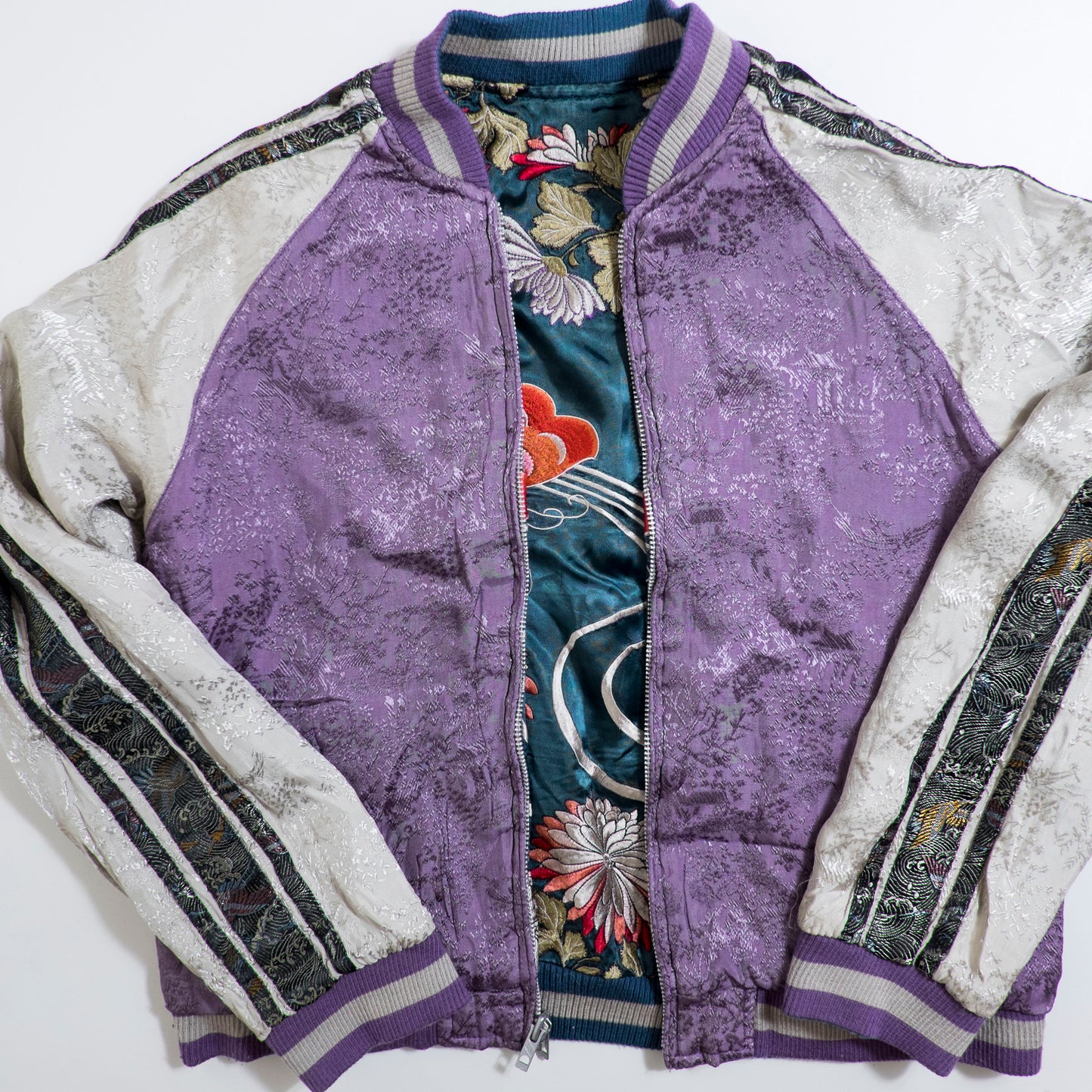
The reverse transforms the jacket into a more restrained lavender-and-ivory bomber. Tonal jacquard imagery moves subtly across the purple body and pale sleeves, suggesting trees, architecture, landscape, and decorative foliage revealed only when the textile catches the light. The same dark ornamental sleeve bands remain visible, linking the quiet reverse with the elaborate butterfly face.
One side is pictorial, colorful, and exuberant. The other is understated, monochromatic, and textile-led. Together they create a highly versatile example of Japanese reversible streetwear and wearable decorative art.
IDENTIFICATION
Object Type
Vintage reversible Japanese sukajan, also known as a Yokosuka jumper, embroidered souvenir bomber, Japanese tour jacket, or reversible wagara streetwear jacket.
Principal Face
Petrol-teal satin-finish body with champagne-silver sleeves, extensive butterfly and chrysanthemum embroidery, dark metallic-patterned sleeve panels, and blue-gray striped ribbing.
Reverse Face
Lavender jacquard body with ivory jacquard sleeves, dark patterned shoulder and sleeve bands, tonal woven landscape imagery, and coordinating purple-gray striped ribbing.
Principal Motifs
Butterflies, chrysanthemums, curling flight trails, flowering branches, leaves, ornamental textile bands, and tonal Japanese-inspired landscape patterns.
Japanese Motif Names
Chō / Chōchō
Butterfly.
Kiku
Chrysanthemum.
Construction
Fully reversible bomber construction with raglan-style sleeves, central metal zipper, welt pockets, striped rib-knit collar, cuffs, and waistband, and two complete wearable textile faces.
Color Architecture
Petrol teal, blue-green, champagne silver, lavender, violet, ivory, coral, orange, crimson, pink, pale blue, olive, antique gold, charcoal, and metallic gray.
THE SUKAJAN TRADITION
Yokosuka Jumper Heritage
The sukajan developed from embroidered souvenir jackets associated with Yokosuka and other Japanese port communities during the postwar era.
American bomber and athletic-jacket construction was combined with Japanese embroidery craftsmanship, producing garments decorated with dragons, tigers, eagles, maps, Mount Fuji, flowers, birds, military emblems, and place names.
Over time, the sukajan moved beyond its original souvenir role and entered Japanese rockabilly, motorcycle fashion, punk, visual-kei wardrobes, luxury design, anime fashion, and international streetwear.
This jacket belongs to the more lyrical botanical branch of the tradition. Rather than emphasizing martial animals or overtly aggressive imagery, it builds its identity around transformation, seasonal beauty, movement, and textile richness.
Wagara-Inspired Design
Wagara refers broadly to traditional and tradition-inspired Japanese decorative patterns.
The butterflies, chrysanthemums, scrolling lines, radiating petals, ornamental brocade, and tonal landscape reverse draw from that visual vocabulary without reproducing one specific historical textile.
The motifs have been enlarged and reorganized for modern outerwear, transforming classical decorative imagery into a dynamic all-over streetwear composition.
PETROL-TEAL BUTTERFLY FACE
Deep Blue-Green Satin Ground
The central body is constructed from a reflective satin-finish textile in a rich petrol-teal or peacock blue-green.
The color changes significantly according to lighting and fabric direction, moving between teal, blue-green, smoky turquoise, dark cyan, and muted slate.
This cool ground gives the pale chrysanthemums and multicolored butterflies exceptional visibility while maintaining a sophisticated alternative to conventional black sukajan.
Champagne-Silver Sleeves
The sleeves are formed from pale champagne, silver-beige, or warm gray satin.
Their softer neutral tone frames the saturated teal body and prevents the floral embroidery from becoming overly sweet or theatrical.
Natural creasing and directional sheen cause the sleeves to shift between pearl gray, antique silver, warm ivory, and pale taupe.
Blue, Gray, and Lavender Ribbing
The collar, cuffs, and waistband use striped rib-knit in muted blue, gray, ivory, and lavender tones.
The ribbing gathers the lightweight shell into the rounded silhouette associated with classic souvenir bombers while connecting the colors of both reversible faces.
THE BUTTERFLIES
Monumental Back Pair
Two large butterflies dominate the back composition.
The upper-left butterfly spreads broad scalloped wings across the teal field. Its embroidery combines pale blue, lavender, purple, ivory, orange, coral, crimson, and soft pink.
The lower-right butterfly turns in the opposite direction, creating a balanced diagonal movement through the jacket. Its wings are worked in lavender, white, orange-red, rose, and deep violet, with clearly divided ornamental sections.
The butterflies are not placed as small decorative accents. They function as the principal figures of the composition, comparable in scale and visual importance to the dragons, tigers, or eagles found on more traditional sukajan.
Front Butterfly Composition
The front repeats the butterfly imagery across both sides of the zipper.
One large butterfly spreads across the left chest while another occupies the lower-right front. Their arrangement is deliberately asymmetrical, giving the front a natural sense of movement rather than a rigid heraldic layout.
The jacket remains visually complete whether viewed open or closed. When fastened, the curling trails and floral clusters move across the central line, visually connecting both front panels.
Wing Construction
Each wing is divided into layered embroidered fields.
Scalloped outer edges create softness.
White dots add rhythm.
Lavender and violet sections establish depth.
Coral and orange introduce warmth.
Crimson accents sharpen the design.
Pale pink details soften the transitions between the stronger colors.
Directional stitching follows the curves of the wings, helping the butterflies appear light and mobile despite the density of the embroidery.
Chōchō Symbolism
Butterflies are associated with transformation, renewal, freedom, joy, beauty, and the soul’s passage from one state into another.
Their development from caterpillar to chrysalis and finally winged form makes them natural emblems of personal change and emergence.
In Japanese decorative art, paired butterflies may also suggest companionship, marital happiness, or two lives moving together.
Movement and Release
The butterflies appear in active flight rather than resting on the flowers.
Their long trails cross the body in sweeping curves, reinforcing the ideas of departure, freedom, and continuous movement.
The composition therefore presents transformation not as a finished condition, but as an unfolding journey.
CURLING FLIGHT TRAILS
Long Ivory Lines
Extended ivory and pale-gray embroidered lines emerge behind the butterflies.
Some travel horizontally before turning into large loops. Others descend in narrow ribbons across the torso and lower back.
These lines may be interpreted as:
Air currents.
Ribbon streamers.
Movement trails.
Wind.
Decorative mizuhiki-like cords.
Abstract paths through the floral landscape.
Visual Rhythm
The trails create necessary breathing space between the dense chrysanthemums and butterfly wings.
Their open construction allows the teal satin to remain visible and prevents the jacket from becoming a continuous block of embroidery.
The lines also connect distant parts of the composition. The upper butterfly, lower butterfly, flowers, and front panels all appear to belong to the same flowing environment.
Symbolic Reading
The winding paths suggest that transformation is rarely linear.
The butterflies move through curves, returns, loops, and changing directions, giving the jacket an unexpectedly thoughtful visual rhythm.
CHRYSANTHEMUM GARDEN
Large Radiating Blooms
The back is surrounded by large chrysanthemum-like flowers.
Several blossoms occupy the upper-right shoulder and neckline, while additional flowers appear along the lower-left and lower-center areas.
The blooms use long, narrow petals radiating from concentrated centers. Their color combinations include:
Ivory and pale lavender.
White and coral.
Lavender and muted gray.
Soft pink and red.
Cream and pale violet.
Front Floral Field
The chrysanthemum composition continues across the front.
Large blooms spread along the neckline, upper chest, shoulders, and lower body, creating continuity between the jacket’s front and back rather than isolating the main artwork on one panel.
Olive and Gold Leaves
The flowers are connected by branching leaves embroidered in olive, beige, taupe, and antique-gold thread.
The leaf veins are individually articulated, providing botanical structure beneath the softer flower heads.
These muted earth tones stabilize the brighter butterfly palette and give the jacket a slightly aged, autumnal atmosphere.
Kiku Symbolism
The chrysanthemum, or kiku, is associated with longevity, endurance, refinement, rejuvenation, autumn, and dignified beauty.
Its many petals unfold from an ordered center, creating a natural emblem of life extending outward through time.
The flower carries significant cultural importance in Japan, but here it functions primarily as a decorative and symbolic botanical motif rather than as a formal political or institutional emblem.
Butterflies and Chrysanthemums
The pairing creates a dialogue between movement and endurance.
The butterfly is light, temporary, and transformed.
The chrysanthemum is structured, recurring, and associated with long life.
Together they suggest beauty that can be both fleeting and enduring.
DARK ORNAMENTAL SLEEVE BANDS
Brocade-Like Surface
Dark patterned bands run from the shoulders along the outer sleeves.
Their surface contains densely layered metallic-looking linework in charcoal, silver, gray, muted gold, and occasional colored accents.
The pattern appears to include wave-like curls, foliage, fine geometric lines, and tightly woven ornamental forms.
Textile Contrast
These bands introduce a third major texture beside the satin shell and raised embroidery.
The teal body is smooth and reflective.
The floral imagery is dimensional and stitched.
The sleeve bands are dense, dark, and brocade-like.
This combination gives the jacket greater textile complexity than a standard two-tone satin bomber.
Framing Function
The dark bands create clear borders between the champagne sleeves and floral center.
They visually lengthen the arms and guide the eye from the collar toward the cuffs.
Their metallic quality also connects with the silver-gray chrysanthemums and pale ribbon trails.
FRONT CONSTRUCTION
Asymmetrical Botanical Layout
The teal front is treated as a continuous picture rather than two identical chest badges.
Butterflies, chrysanthemums, leaves, and curling lines cross the upper and lower sections in different densities.
This asymmetry makes the garment feel closer to a Japanese textile panel than a conventional sports jacket.
Central Metal Zipper
A metal zipper closes the jacket through the center.
The dark zipper tape integrates with the teal body, while the silver-toned teeth provide a narrow vertical accent through the floral composition.
Welt Pockets
Angled welt pockets are incorporated near the lower front.
Their openings are edged discreetly so they do not interrupt the embroidered butterflies and flowers.
Raglan-Style Sleeves
The sleeves extend diagonally from the collar toward the underarm.
This construction produces a smooth shoulder line and allows the ornamental bands to travel continuously from neckline to cuff.
TONAL LAVENDER REVERSE
A Quieter Second Identity
The reverse changes the jacket from a multicolored embroidered garden into a subdued lavender-and-ivory textile composition.
Rather than repeating the bold butterflies, the second face depends upon tonal weaving, changing sheen, soft contrast, and landscape-like jacquard imagery.
This makes the reverse highly wearable while preserving substantial textile interest.
Lavender Jacquard Body
The central body is made from a lavender or mauve jacquard-finish textile.
Within the purple surface, darker and lighter woven imagery appears according to the angle of the light.
The patterns suggest a layered Japanese landscape with trees, foliage, architectural forms, bridges or pavilions, and distant scenic elements.
The precise scene remains intentionally subtle. It emerges as the wearer moves rather than presenting itself as a flat graphic.
Ivory Jacquard Sleeves
The sleeves shift to pale ivory, pearl, or warm silver.
Their tonal woven pattern appears to continue the landscape character of the lavender body, with foliage, architectural silhouettes, and delicate scenic detail woven into the reflective surface.
Because the imagery is nearly monochromatic, it creates depth without making the reverse visually crowded.
Dark Brocade Shoulder Bands
The patterned sleeve bands remain visible on the reverse.
They frame the pale sleeves and lavender body with charcoal metallic detail, connecting the second face to the richer ornament of the butterfly side.
Reverse Color Movement
The lavender may appear:
Lilac.
Mauve.
Orchid.
Dusty violet.
Silver-purple.
Muted plum.
The sleeves may shift between:
Ivory.
Pearl gray.
Pale champagne.
Warm silver.
Cream.
These changes are inherent to the reflective jacquard textile and give the reverse a softly animated surface.
TONAL JAPANESE LANDSCAPE IMAGERY
Woven Scenic Character
The reverse appears to contain tonal woven scenes rather than printed surface decoration.
Dark purple lines move through the lavender body, suggesting branches, trees, structures, and distant landscape forms.
Paler imagery is visible within the ivory sleeves.
Hidden Detail
The scenic pattern becomes most visible under directional light.
From one angle, the reverse appears almost plain.
From another, the woven landscape emerges across the body and sleeves.
This hidden quality gives the reverse a restrained luxury and rewards closer viewing.
Landscape Symbolism
Japanese landscape imagery often brings together cultivated nature and human architecture.
Trees, water, pathways, pavilions, bridges, and distant buildings can suggest retreat, contemplation, travel, and harmony between the human and natural worlds.
The subtle reverse offers a quieter counterpoint to the airborne butterflies of the embroidered face.
One side represents movement through a flowering garden.
The other evokes a landscape held in memory.
REVERSIBLE CONSTRUCTION
Two Complete Wearable Faces
The garment has been designed as a true reversible sukajan.
The teal face offers extensive raised embroidery, pictorial butterflies, chrysanthemums, and strong color contrast.
The lavender face offers tonal jacquard scenery, pale sleeves, and a more restrained visual identity.
Neither face functions as an ordinary hidden lining.
Reversible Hardware
The central metal zipper is arranged for use from either side.
As with many reversible vintage jackets, the lower components should be aligned carefully before closing and should never be forced if resistance is encountered.
Shared Ribbing
The striped collar, cuffs, and waistband serve both wearable faces.
Their blue, gray, ivory, and lavender colors harmonize naturally with the teal body, silver sleeves, purple reverse, and pale jacquard panels.
Integrated Sleeve Structure
The raglan construction allows the sleeve textiles and patterned bands to remain visually continuous on both faces.
This creates a more finished transition between the body, shoulders, and cuffs than a simple set-in sleeve construction.
EMBROIDERY AND TEXTILE EXECUTION
Butterfly Wing Density
The butterfly wings use dense machine embroidery arranged in scalloped color fields.
Each wing contains several different stitch directions, allowing adjacent sections to reflect light differently.
The white dots, colored borders, and interior divisions remain clearly legible against the teal ground.
Chrysanthemum Petals
The flowers use long radiating stitches.
Ivory and lavender thread forms the principal petals, while coral, red, and gray accents add depth and distinguish one bloom from another.
Leaf Structure
The leaves use compact satin stitches with darker vein lines.
Their olive and antique-gold tones produce a softer, more botanical surface than the vivid butterfly wings.
Ribbon and Wind Lines
The pale trails are constructed from long, narrow embroidered bands.
Their smooth open curves provide contrast against the densely filled flowers and insects.
Brocade Panels
The dark sleeve bands appear woven with metallic-effect thread or a similarly reflective textile treatment.
Their intricate surface remains visible without relying upon high-contrast color.
Jacquard Reverse
The lavender and ivory textiles appear woven with tonal scenic motifs.
The designs are integrated into the fabric structure, producing an image that changes according to light rather than sitting flat upon the surface.
Embroidery Puckering
Localized rippling is visible around heavily embroidered flowers, butterflies, and long curved lines.
This is characteristic of dense machine embroidery applied to lightweight satin and contributes to the jacket’s dimensional surface.
SYMBOLIC DUALITY
Transformation and Longevity
The butterflies represent change, emergence, and movement.
The chrysanthemums represent endurance, rejuvenation, and long life.
The two motifs create a balanced symbolic system in which transformation does not erase continuity.
Flight and Landscape
The embroidered face is defined by movement through open air.
The jacquard reverse is defined by a landscape that appears still and contemplative.
One side travels.
The other observes.
Color and Restraint
The teal face uses coral, violet, red, white, gold, and olive in an exuberant embroidered composition.
The reverse reduces the palette to lavender, ivory, charcoal, and muted metallic tones.
Reversing the jacket therefore changes its emotional temperature as well as its appearance.
Visible and Hidden Beauty
The butterfly face reveals its imagery immediately.
The jacquard face hides its scenery until light strikes the woven surface.
Together they present two forms of decorative beauty: one openly displayed and one gradually discovered.
PERIOD AND STYLE ASSESSMENT
Likely Era
The jacket appears consistent with Japanese sukajan and decorative streetwear produced during the 2000s to early 2010s.
Its oversized botanical embroidery, petrol-teal palette, reversible jacquard construction, metallic brocade bands, lavender reverse, and all-over pictorial treatment align strongly with Y2K and post-Y2K Japanese fashion.
Heisei-Era Character
The garment reflects the eclecticism of Heisei-era Japanese streetwear, when traditional motifs were frequently enlarged, recolored, and combined with contemporary bomber construction.
Butterflies and chrysanthemums are treated neither as strict historical patterns nor as generic floral decoration. They have been transformed into a dramatic, wearable composition suited to modern fashion.
Archive Streetwear Appeal
The unusual blue-green and lavender palette, complex reversible textiles, and extensive embroidery give the jacket particular relevance for collectors of Japanese archive, visual-kei, art-fashion, and alternative Y2K outerwear.
CONDITION
Overall Condition
Vintage pre-owned condition with visible creasing, satin rippling, tonal variation, embroidery-related puckering, ribbing wear, and age-appropriate handling or storage character.
The butterfly and chrysanthemum imagery remains visually strong, and the lavender reverse retains substantial woven detail.
Petrol-Teal Body
The teal satin displays natural folds, pressure lines, and directional sheen.
Its color changes between blue-green, smoky teal, dark cyan, and slate depending on lighting.
Localized rippling appears around the dense butterflies, flowers, and long embroidered trails.
Champagne-Silver Sleeves
The pale sleeves show visible creasing, uneven sheen, gentle age toning, and areas of darker or warmer surface variation.
Pale satin naturally reveals handling, storage impressions, and changes in reflectivity more readily than darker textiles.
Butterfly Embroidery
The principal butterflies remain clearly defined.
Their wing divisions, scalloped edges, colored fields, white dots, bodies, and long flight trails retain substantial detail.
Minor raised fibers, isolated loose thread ends, soft edge wear, or small embroidery irregularities may be present within the densely worked areas.
Chrysanthemum Embroidery
The flower heads, petals, leaves, and branches remain substantially intact and legible.
The ivory, lavender, coral, red, and olive threads continue to contrast strongly with the teal ground.
Dark Sleeve Bands
The metallic-patterned panels remain visually coherent.
Natural creasing, surface variation, and light wear may be visible within the densely woven ornament.
Lavender Reverse
The purple jacquard body displays creasing, changes in sheen, and areas of tonal darkening.
The scenic woven imagery remains visible across the back and becomes more pronounced under directional light.
Ivory Jacquard Sleeves
The pale reverse sleeves show natural wrinkling, gentle discoloration, and reflective variation consistent with vintage wear and storage.
The tonal woven pattern remains visible across the surface.
Ribbing
The striped collar, cuffs, and waistband remain present and structurally cohesive.
The knit shows normal softening, waviness, light pilling, mild stretching, and age-related tonal variation.
Zipper and Structure
The metal zipper and lower fastening components are present.
The principal body panels, raglan seams, sleeve panels, cuffs, waistband, pocket openings, embroidery fields, and reverse jacquard sections appear structurally complete.
No catastrophic tear, major missing textile panel, or extensive embroidery loss is visible in the photographed areas.
Vintage Character
This garment is not presented as factory-new.
Natural satin creasing, embroidery tension, tonal shifts, small thread irregularities, jacquard wear, and ribbing relaxation form part of its authentic vintage character.
COLLECTOR DESIRABILITY
Oversized Chōchō Motifs
The large butterflies give the jacket a distinctive identity within a category more commonly dominated by dragons, tigers, eagles, and koi.
Extensive Kiku Embroidery
The chrysanthemums cover the back, front, neckline, shoulders, and lower body, creating a complete floral environment rather than isolated decoration.
Petrol-Teal Color
The blue-green ground is unusual, sophisticated, and highly effective with lavender, coral, orange, ivory, and antique-gold embroidery.
Metallic Brocade Panels
The dark patterned sleeve bands introduce additional textile complexity and long-distance visual structure.
Tonal Jacquard Reverse
The lavender-and-ivory side provides a genuinely different wearable identity and rewards close inspection through its hidden landscape imagery.
Fully Developed Front and Back
The elaborate front composition makes the garment visually compelling even when the back is not visible.
Symbolic Balance
Butterflies and chrysanthemums unite transformation with longevity, giving the design greater cultural and emotional depth than a purely decorative floral bomber.
Display Potential
Either face may be displayed as textile art.
The embroidered side offers color, movement, and dimensional threadwork.
The jacquard side offers subtle scenic detail and changing woven light.
DISPLAY, STYLING, AND CULTURAL VALUE
Teal-Face Styling
Wear the embroidered face with black trousers, charcoal denim, ivory knitwear, muted lavender, or deep blue.
The colorful threadwork already carries substantial visual information, so restrained accompanying garments allow the butterflies and chrysanthemums to remain dominant.
Lavender-Reverse Styling
The reverse pairs naturally with cream, gray, purple, faded blue, black, dusty pink, or silver-toned accessories.
Its quieter surface makes it suitable for everyday wear while retaining collector-level textile interest.
Japanese Streetwear
Combine with wide-leg trousers, washed denim, cargo pants, sneakers, or minimal layered tops.
The bomber silhouette provides structure while the oversized botanical imagery creates the statement.
Visual-Kei and Art Fashion
The metallic bands, lavender reverse, unusual insect imagery, and cool jewel-tone palette work naturally within visual-kei, alternative, romantic, and theatrical Japanese styling.
Feminine Styling
The butterfly-and-flower imagery can be paired with long skirts, dresses, pleated silhouettes, platform footwear, or soft tailoring.
The athletic bomber construction creates a compelling contrast with flowing garments.
Gender-Neutral Styling
The raglan bomber form and symbolic nature imagery move comfortably across masculine, feminine, and gender-neutral wardrobes.
Editorial and Stagewear
The satin, metallic panels, raised embroidery, and tonal jacquard each react differently under directional lighting.
The teal face creates jewel-like color and luminous threadwork.
The lavender reverse reveals its scenic pattern gradually as the garment moves.
This makes the jacket highly suitable for editorial photography, music styling, performance wardrobe, fashion film, and visual merchandising.
Wearable Transformation
The garment’s central butterfly motif is echoed by its reversible construction.
Just as the butterfly changes form, the jacket itself changes from an embroidered garden into a quiet woven landscape.
This relationship between subject and construction gives the piece unusual conceptual unity.
CARE AND PRESERVATION
Professional Cleaning
Professional dry cleaning by a specialist experienced with embroidered satin, jacquard textiles, metallic brocade, ribbed knit, and reversible garments is recommended.
Do not machine wash, soak, bleach, scrub, wring, or tumble dry.
Embroidery Care
Do not iron directly over the butterflies, chrysanthemums, leaves, ribbon trails, or other raised threadwork.
Direct pressure may flatten the embroidery, distort long curved lines, or alter the satin sheen.
Satin Care
Protect the garment from hook-and-loop fasteners, sharp jewelry, rough bags, textured straps, abrasive walls, and exposed hardware.
Satin may snag, pull, or develop permanent changes in reflectivity through friction.
Jacquard Care
Avoid aggressive spot cleaning on the lavender and ivory reverse.
Uncontrolled moisture or cleaning agents may leave tide marks, alter the tonal landscape pattern, or change the textile’s sheen.
Metallic-Panel Care
Do not rub or brush the dark ornamental sleeve bands aggressively.
Metallic-effect threads and densely woven surfaces may catch or fray under repeated abrasion.
Ribbing Care
Do not carry the jacket by the collar, cuffs, or waistband.
Handle the knit evenly and avoid unnecessary stretching.
Zipper Care
Align the zipper carefully before fastening.
Keep satin, jacquard, embroidery, and ribbing clear of the teeth. Do not force the slider if resistance is encountered.
Reversing the Jacket
Turn the garment slowly while supporting the body and sleeves.
Avoid pulling one cuff sharply through the opposite sleeve, as this may stress the ribbing, seam joins, jacquard, and embroidered panels.
Storage
Store on a broad padded hanger capable of supporting the reversible construction and dense embroidery.
Use a breathable garment cover rather than sealed plastic.
Keep the jacket away from direct sunlight, high humidity, smoke, perfume, dust, and prolonged compression.
Display
Alternate the visible face periodically when displaying the jacket for extended periods.
This helps reduce uneven light exposure and allows both the butterfly garden and lavender landscape to be appreciated.
SHIPPING, OFFERS, AND FINAL-SALE POLICIES
Shipping
Worldwide tracked shipping is available from Japan, generally through Japan Post EMS or another suitable tracked international service.
The jacket will be carefully folded with protective material placed between the embroidery, satin surfaces, jacquard reverse, metallic sleeve bands, ribbed trim, zipper, and hardware.
Tracking information is normally provided approximately 3–5 business days after dispatch.
Delivery times depend on destination, customs processing, postal conditions, and the international service available at the time of shipment.
Protective Packaging
Special care will be taken to reduce pressure on the butterfly wings, chrysanthemum petals, leaves, long flight trails, metallic-patterned panels, and tonal jacquard surfaces.
Gentle transit folds may remain upon arrival and should be allowed to relax naturally rather than treated with direct high heat.
Additional Photographs
Additional photographs may be available upon request.
Detailed views can be useful for examining the butterfly embroidery, flower edges, sleeve panels, jacquard reverse, ribbing, zipper, pocket openings, cuffs, and waistband.
Offers
Reasonable offers may be considered on selected items.
Because of the extensive embroidery, reversible jacquard construction, unusual color palette, and complex sleeve textiles, flexibility may be limited. Serious and respectful proposals are nevertheless welcome and considered individually.
Product Representation
Every effort has been made to represent the jacket accurately through the photographs and description.
Satin, jacquard, and metallic textiles change considerably according to lighting, camera exposure, viewing angle, and screen calibration.
The body may appear teal, blue-green, or smoky turquoise. The sleeves may appear champagne, gray, or warm silver. The reverse may shift between lavender, mauve, silver-purple, ivory, and pearl.
Final Sale
The jacket is sold in its present condition as photographed and described.
All sales are final. No returns, claims, cancellations, or exchanges are accepted for accurately disclosed vintage wear, satin variation, jacquard variation, color changes, creasing, embroidery tension, ribbing relaxation, textile patina, or other age-related characteristics, subject to applicable Etsy rules and consumer law.
Please review all photographs, condition information, care guidance, and policies carefully before completing your purchase.
#VintageSukajan #ReversibleSukajan #ButterflyJacket #ChochoJacket #ChrysanthemumJacket #KikuEmbroidery #JapaneseSouvenirJacket #WagaraJacket #JapaneseStreetwear #Y2KJapaneseFashion #TealSatinJacket #LavenderJacket #ButterflyEmbroidery #FloralSukajan #JapaneseBomber #YokosukaJumper #JapaneseEmbroidery #JacquardJacket #WearableArt #ArchiveStreetwear #VisualKeiFashion #UnisexVintage #CollectorJacket #SouvenirBomber #JapaneseTextileArt #FloralBomber #ReversibleBomber #StatementOuterwear #JapanVintage #Japonista
butterfly sukajan, floral sukajan, reversible bomber, chrysanthemum coat, japanese streetwear, teal satin jacket, lavender jacket, wagara jacket, y2k japan fashion, embroidered bomber, yokosuka jumper, wearable art coat, vintage sukajan
MATERIAL TAGS
satin-finish textile, jacquard textile, embroidery thread, metallic brocade, ribbed knit, metal zipper