Rare Vintage, Antiques and Art Collector / Curator / Personal Shopper From Japan
Vintage Japanese Japan Koi Carp Fish Sakura Cherry Blossoms Tattoo Art Design Embroidered Yokosuka Jumper Bomber Sukajan Souvenir Jacket M
Vintage Japanese Japan Koi Carp Fish Sakura Cherry Blossoms Tattoo Art Design Embroidered Yokosuka Jumper Bomber Sukajan Souvenir Jacket M
Couldn't load pickup availability
Have a reasonable price in mind? Submit your best offer and our concierge will review it personally.
Fully Embroidered Scarlet Satin Yokosuka Jumper with Twin Koi, Flowing Water, Bamboo, Mountain Landscape, and Dark Wagara Jacquard Reverse
COLLECTOR’S OVERVIEW
A richly composed reversible Japanese sukajan built around one of the most enduring motifs in Japanese decorative culture: koi moving through water beneath bamboo and flowering branches.
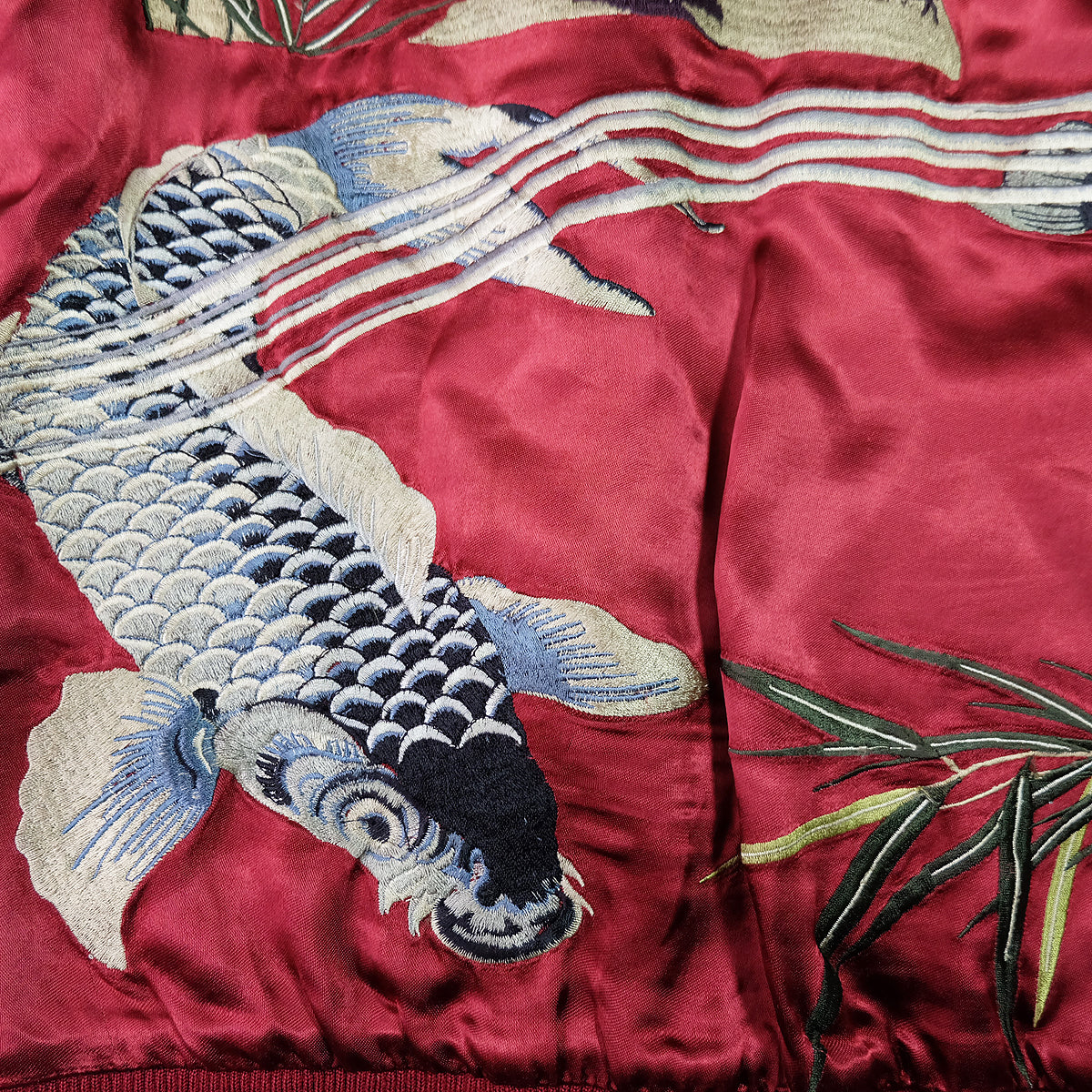
The principal face is executed in deep scarlet satin with extensive embroidery across both the front and back. Two large koi swim in opposing directions through layered ivory currents, their bodies worked in silver, cream, slate blue, charcoal, and pale gray. Slender bamboo leaves cross the upper and lower fields, while a distant mountain form introduces depth behind the moving water.
Rather than restricting the principal artwork to the back, the design continues across the front panels. The koi, bamboo, mountain, and flowing currents cross the central zipper, producing a near-continuous landscape when the jacket is fastened. Pale patterned sleeve panels carry additional koi, flowering branches, red water ribbons, and chrysanthemum-like floral forms, allowing the composition to travel from the torso across the full width of the garment.
The reverse transforms the jacket into a darker and more restrained wagara bomber. Its charcoal-black body is covered with koi, curling crimson currents, blossom-laden branches, radiating flowers, pale foliage, and shadowed landscape forms. Soft pink and silver-gray sleeve fields extend the pattern outward, while black and lavender-striped ribbing gives the reverse a cooler, more nocturnal identity.
One side is vivid, sculptural, and embroidery-led. The other is atmospheric, patterned, and textile-led.
Together they create an unusually complete example of reversible Japanese streetwear in which neither face is secondary. Every major view presents koi, water, flowers, or landscape imagery, making the jacket equally compelling as wearable fashion and displayed textile art.
IDENTIFICATION
Object Type
Vintage reversible Japanese sukajan.
Also known as a Yokosuka jumper, embroidered souvenir jacket, Japanese tour bomber, wagara jacket, or reversible satin streetwear jacket.
Tagged Size
M.
Approximate Western Fit
A Japanese or Asian tagged M generally fits closest to a contemporary Western XS-S, or a trim S-M depending on chest width, shoulder proportions, arm length, desired ease, and the thickness of garments worn underneath.
The rounded bomber construction, gathered ribbed waistband, and raglan-style sleeves create the compact silhouette traditionally associated with Japanese souvenir jackets.
Principal Face
Scarlet-red satin-finish body with large embroidered koi, ivory flowing-water lines, bamboo leaves, a distant mountain form, patterned pale sleeves, red racing panels, and red-and-pink striped ribbing.
Reverse Face
Charcoal-black patterned body with pale pink and silver-gray sleeves, all-over koi and floral landscape imagery, crimson water ribbons, dark branches, radiating flowers, and black-and-lavender striped ribbing.
Principal Motifs
Koi carp.
Flowing water.
Bamboo.
Mountain landscape.
Cherry-blossom-like branches.
Chrysanthemum-like flowers.
Rock and tree forms.
Red stream or cloud ribbons.
Japanese wagara textile ornament.
Construction
Fully reversible bomber construction with:
Raglan-style sleeves.
Central reversible metal zipper.
Two complete wearable faces.
Angled welt pockets.
Striped rib-knit collar.
Striped rib-knit cuffs.
Striped rib-knit waistband.
Contrasting sleeve panels.
Decorative racing stripes.
Extensive front and back pictorial treatment.
Color Architecture
Scarlet red, deep crimson, charcoal black, pale pink, silver-gray, ivory, cream, slate blue, navy, olive green, muted gold, lilac, soft coral, and smoky gray.
THE SUKAJAN TRADITION
Yokosuka Jumper Heritage
The sukajan emerged from the embroidered souvenir jackets associated with Yokosuka and other Japanese port communities during the postwar period.
American bomber and athletic-jacket construction was combined with Japanese embroidery craftsmanship, producing garments decorated with dragons, tigers, eagles, koi, maps, Mount Fuji, flowers, military emblems, and regional place names.
Over time, the sukajan moved beyond its original souvenir role and became part of Japanese rockabilly, motorcycle fashion, punk, visual-kei wardrobes, luxury design, tattoo-influenced streetwear, and international archive fashion.
This jacket belongs to a later, highly decorative branch of that tradition.
Instead of relying on one isolated back emblem, it treats the entire garment as a textile landscape. The embroidery continues over the chest and back, while the reverse uses a coordinated all-over wagara composition.
Japanese Landscape as Streetwear
The jacket translates the visual language of folding screens, decorative textiles, embroidered panels, tattoo compositions, and painted landscapes into a contemporary bomber silhouette.
Koi occupy the principal visual field.
Water creates movement.
Bamboo establishes vertical rhythm.
Flowers introduce seasonality.
The mountain anchors the distant horizon.
The resulting composition feels less like a logo-based jacket and more like a mobile Japanese landscape.
THE SCARLET EMBROIDERED FACE
Deep Red Satin Ground
The primary face uses a saturated scarlet or crimson satin-finish textile.
Its reflective surface shifts according to lighting and fabric direction, moving between ruby red, deep crimson, wine red, coral-red, and dark burgundy shadow.
This luminous ground provides dramatic contrast for the pale koi, silver-blue scales, cream currents, green bamboo, and subdued mountain embroidery.
Unlike black sukajan, where pale embroidery may feel stark and graphic, the scarlet field creates warmth and theatrical depth. The koi appear almost suspended within red lacquer, sunset light, or a richly dyed textile panel.
Full Front-and-Back Composition
The most distinctive feature is the extent of the pictorial embroidery.
The back carries a complete koi-and-water landscape.
The front repeats and reorganizes the scene across both sides of the zipper.
This means the jacket remains visually elaborate from every principal angle. The front is not merely decorated with small chest emblems. It becomes another full landscape, with large koi, flowing currents, bamboo, and the mountain form continuing across the fastening line.
When worn open, the front panels frame the darker reverse beneath.
When fastened, the embroidered lines move across the center and visually reconnect the two halves.
THE TWIN KOI
Opposing Movement
Two large koi dominate the red face.
One rises diagonally through the upper portion of the composition.
The second moves across the lower field in the opposite direction.
Their contrasting orientations create a circular visual rhythm rather than a simple procession. The viewer’s eye travels from one fish through the pale water currents, around the bamboo, and back toward the second fish.
Embroidered Bodies
The koi are worked in ivory, silver-gray, slate blue, charcoal, navy, and pale cream thread.
Each body contains individually articulated scales arranged in repeated overlapping rows.
The fins are built from longer directional stitches, creating a lighter and more fluid surface than the compact scale fields.
The eyes are enlarged and strongly outlined, giving each fish an expressive, almost theatrical presence.
The mouths are slightly open, emphasizing motion through the water rather than passive floating.
Scale Pattern
The alternating pale and dark scales produce depth without relying upon bright multicolored thread.
The bodies appear blue-black along their upper surfaces and lighter along the sides and bellies, suggesting reflected light moving over wet scales.
This restrained palette keeps the koi visually forceful against the red ground while preserving a sophisticated, almost monochrome character.
Curving Anatomy
The fish are shown with bodies bending through the current.
Their tails and fins extend into the surrounding water lines, preventing them from appearing pasted onto the satin.
The upper koi curves downward while the lower koi rises toward the center, creating the impression of two creatures circulating through a shared stream.
KOI ICONOGRAPHY AND SYMBOLISM
Perseverance
Koi are celebrated for their ability to move against strong currents.
They therefore represent perseverance, resilience, determination, courage, and the willingness to continue through adversity.
The fish is not admired because its journey is effortless.
Its meaning comes from resistance.
Advancement and Success
Koi imagery is also associated with advancement through sustained effort.
In decorative art, clothing, tattooing, and festival culture, the fish can express the hope that discipline and persistence will eventually produce growth, recognition, or success.
Transformation
The koi is frequently connected with the Dragon Gate legend, in which a carp that successfully ascends a difficult waterfall is transformed into a dragon.
The fish therefore exists between two identities:
What it is now.
What it may become.
This makes koi imagery especially resonant for periods of personal change, reinvention, recovery, ambition, or movement toward a larger life.
Paired Koi
Two koi can suggest balance, companionship, complementary energy, partnership, and shared movement.
Because the fish on this jacket travel in opposing directions, they may also be read as a visual expression of duality:
Action and reflection.
Struggle and release.
Beginning and completion.
Movement outward and return.
Water and Adaptability
A koi cannot be separated from water.
Its strength is expressed through its ability to navigate changing currents rather than by remaining fixed.
The fish therefore carries not only the symbolism of endurance, but also adaptability, timing, and intelligent movement.
FLOWING WATER
Ivory Current Lines
Long pale embroidered lines travel across the red body.
They pass in front of and behind the koi, widening and narrowing as they cross the jacket.
Some move in parallel bands.
Others curve sharply around the fish.
Several continue toward the central zipper, helping unify the two front panels.
Stylized Rather Than Naturalistic
The water is not embroidered as literal blue waves.
Instead, it is reduced to elegant cream, ivory, pale gray, and silver lines.
This stylization recalls the graphic representation of water in Japanese woodblock prints, screen painting, textile design, and tattoo backgrounds.
The red satin itself becomes the river field, while the pale currents define motion within it.
Visual Continuity
The flowing lines connect the separate motifs.
They guide the eye from bamboo to koi, from mountain to fish, and from one side of the jacket to the other.
Without these currents, the composition would feel like a collection of separate decorative elements. With them, the entire surface becomes one continuous environment.
Water Symbolism
Water represents movement, purification, adaptability, continuity, emotional depth, and the ability to assume new forms without losing its essential nature.
Its interaction with koi intensifies the jacket’s central message: strength is revealed through movement within changing conditions.
BAMBOO
Upper and Lower Clusters
Slender bamboo leaves appear across the upper-left and lower-right areas of the red composition.
Their narrow forms are embroidered in olive, dark green, muted gold, cream, and charcoal thread.
The stems intersect with the flowing-water lines and extend toward the koi, introducing sharper linear geometry against the broad curves of the fish.
Bamboo Symbolism
Bamboo bends in wind and rain without easily breaking.
For this reason, it represents resilience, flexibility, integrity, endurance, renewal, and the ability to survive pressure without surrendering one’s structure.
Koi and Bamboo
The pairing of koi and bamboo creates a layered expression of perseverance.
The koi advances through resistance.
The bamboo survives by yielding.
One demonstrates forceful movement.
The other demonstrates flexible strength.
Together they present two different strategies for endurance.
Seasonal Rhythm
The bamboo also introduces a living landscape around the koi.
Rather than floating in abstract space, the fish appear within a cultivated natural world of leaves, water, flowers, rock, and distant land.
THE DISTANT MOUNTAIN
Low Horizon Form
A pale, dark-edged mountain or island form appears behind the central currents.
Its summit is softly rounded rather than sharply volcanic, suggesting a generalized Japanese mountain landscape rather than a definitive identification with one specific peak.
Visual Anchor
The mountain introduces distance into the composition.
The koi occupy the foreground.
The currents move through the middle plane.
The mountain sits behind them.
This layered arrangement gives the embroidered field greater spatial depth than a purely ornamental pattern.
Mountain Symbolism
Mountains can represent permanence, endurance, spiritual elevation, stability, retreat, and the long view beyond immediate difficulty.
Within the koi composition, the mountain becomes a still counterpoint to the moving water.
The fish travel.
The currents shift.
The mountain remains.
THE PALE PATTERNED SLEEVES
Soft Pink and Silver Ground
The sleeves are constructed from a pale pink, silver-gray, and cream patterned textile.
This lighter surface frames the dense red body and prevents the garment from becoming visually heavy.
The sleeve color shifts between blush pink, pearl gray, soft lilac, warm silver, and pale rose according to the direction of the light.
Wagara Imagery
The sleeve textile contains:
Koi.
Red flowing-water ribbons.
Dark flowering branches.
Small blossoms.
Radiating chrysanthemum-like flowers.
Pale foliage.
Rock or tree forms.
Scattered decorative textures.
This imagery connects directly with the central embroidered composition while presenting it in a flatter, more textile-oriented form.
Red Racing Panels
Narrow red panels and dark piping travel from the shoulders down the outer sleeves.
These bands give the jacket a sporting structure and emphasize the elongated raglan line.
They also connect the pale sleeves back to the scarlet body.
Sleeve Narrative
The sleeves are not blank framing devices.
Koi bodies, branches, currents, and flowers remain visible from shoulder to cuff, allowing the imagery to move around the wearer’s arms.
This creates a broader visual field when the jacket is displayed flat or worn with the arms relaxed.
THE DARK WAGARA REVERSE
A Nocturnal Second Identity
The reverse shifts the jacket into charcoal black, smoky green-gray, pale pink, lilac, silver, and crimson.
Where the red face is bold and sculptural, the dark face is atmospheric and densely patterned.
The imagery appears submerged within the textile rather than raised dramatically above it.
This gives the reverse a quieter but equally elaborate character.
Charcoal Landscape Field
The central body uses a dark charcoal or blue-black ground.
Within it, koi, blossoms, radiating flowers, red currents, pale branches, and large shadowed tree or rock forms overlap in an all-over composition.
The dark surface may appear:
Black.
Charcoal.
Blue-gray.
Deep green-gray.
Graphite.
Smoky navy.
Its changing tone makes the reverse especially effective under directional light.
Koi in Shadow
Several koi are distributed across the front and back.
Unlike the monumental pale koi of the red face, these fish are partly absorbed into the surrounding pattern.
Their scales, eyes, fins, and curved bodies emerge gradually from the charcoal field.
This creates the impression of fish moving beneath dark water, visible only where light reaches the surface.
Crimson Water Ribbons
Bright red and coral currents weave horizontally across the reverse.
These narrow, repeated ribbons provide the strongest color accent and establish movement through the dark landscape.
They travel around the koi, across the floral clusters, and between the larger shadowed forms.
Blossom-Laden Branches
Dense clusters of small pink, coral, white, and pale-gray flowers spread across the reverse.
Dark branches weave beneath the petals, creating a spring landscape that appears layered over the water.
The flowers may be read as cherry-blossom-inspired imagery, particularly where they gather densely along black branching forms.
Radiating Flowers
Larger pale floral heads appear throughout the dark textile.
Their long petals radiate from greenish or muted-gold centers, producing a chrysanthemum-like form.
These flowers create larger points of visual emphasis among the many smaller blossoms.
SAKURA AND SEASONAL BEAUTY
Cherry-Blossom Character
The pale pink branches and scattered petals evoke sakura, one of the most recognizable seasonal motifs in Japanese art.
Sakura represents beauty, renewal, spring, celebration, impermanence, and the awareness that luminous moments are temporary.
Koi and Sakura
The koi represents persistence through difficulty.
Sakura represents acceptance of change.
The fish struggles forward.
The blossom opens, falls, and disappears.
Together they create a balance between determination and impermanence.
Movement Through the Seasons
The combination of koi, bamboo, blossoms, chrysanthemums, water, and mountain imagery allows the jacket to move across several seasonal associations rather than belonging to one narrow moment.
Bamboo remains evergreen.
Sakura evokes spring.
Chrysanthemum suggests autumn and longevity.
Water continues through every season.
The composition therefore feels cyclical rather than fixed.
CHRYSANTHEMUM-LIKE FLOWERS
Radiating Petal Forms
The reverse includes repeated flowers with long narrow petals extending from concentrated centers.
Their pale gray, ivory, muted green, and soft pink tones remain visible without overwhelming the koi and red currents.
Kiku Symbolism
The chrysanthemum, or kiku, is associated with longevity, rejuvenation, endurance, refinement, and the ordered unfolding of life.
Its many petals radiate from a stable center, creating a natural symbol of expansion through time.
Koi and Kiku
The koi expresses effort and movement.
The chrysanthemum expresses duration and renewal.
Their combination suggests not only achievement, but the ability to sustain what has been achieved.
REVERSIBLE CONSTRUCTION
Two Complete Wearable Faces
The jacket is constructed as a true reversible sukajan.
The scarlet face offers:
Raised pictorial embroidery.
Large silver-blue koi.
Bamboo.
Flowing water.
Mountain scenery.
A dramatic red ground.
The dark face offers:
All-over wagara patterning.
Koi.
Crimson currents.
Blossoming branches.
Radiating flowers.
Charcoal and pink color blocking.
Neither face functions as an ordinary hidden lining.
Reversible Hardware
A central metal zipper is configured for use from either side.
The zipper should be aligned carefully at the lower box and pin before fastening.
It should never be forced if resistance is encountered.
Shared Ribbing
The collar, cuffs, and waistband serve both wearable faces.
Their red, black, pale pink, and lilac striping connects the scarlet embroidered face with the charcoal patterned reverse.
Raglan-Style Sleeves
The sleeves extend diagonally from the neckline toward the underarms.
This construction creates a smooth shoulder line and allows the racing stripes and patterned textile to flow continuously from collar to cuff.
Welt Pockets
Angled welt pockets are integrated into the lower front on both wearable faces.
Their narrow trim keeps them visually discreet within the dense textile composition.
EMBROIDERY AND TEXTILE EXECUTION
Dense Koi Embroidery
The large koi use compact scale stitching, dark contour lines, directional fin work, and broader satin-like thread fields.
The repeated scales create a tactile surface and allow the fish to remain legible from a distance.
Directional Stitching
Thread direction changes across:
Scales.
Fins.
Faces.
Water currents.
Bamboo leaves.
Mountain forms.
This produces subtle shifts in reflectivity and prevents the pale embroidery from appearing flat.
Water-Line Construction
The current lines are built from long parallel embroidered bands.
Their smooth curves contrast with the compact texture of the koi scales and the pointed structure of the bamboo leaves.
Bamboo Leaves
The leaves use narrow directional stitches with darker central veins.
Their fine linear construction gives the composition sharpness and detail.
Patterned Reverse
The dark face appears to use a satin-jacquard or similarly patterned woven textile in which the koi, currents, flowers, branches, and scenic elements are integrated into the surface.
The precise method is secondary to its visual effect: the pattern changes with light and appears to emerge from within the fabric rather than resting heavily above it.
Surface Movement
The lightweight satin shows natural rippling around the embroidery and seams.
This is characteristic of dense threadwork applied to a fluid textile and contributes to the dimensional character of the jacket.
SYMBOLIC DUALITY
Red and Black
The two faces offer opposing atmospheres.
The scarlet side is warm, open, and immediately visible.
The charcoal side is cool, layered, and gradually revealed.
Red suggests vitality, passion, celebration, courage, and life force.
Black suggests depth, restraint, night, mystery, and contemplation.
Raised and Woven Imagery
The red face presents its koi through dimensional embroidery.
The dark face allows the koi to dissolve into a continuous textile pattern.
One side brings the fish forward.
The other lets them disappear into the current.
Struggle and Flow
Koi are often celebrated for swimming against the current.
Yet the reverse also emphasizes water moving freely around the fish.
The jacket therefore presents strength as both resistance and adaptation.
Movement and Permanence
The koi move.
The water flows.
The blossoms fall.
The bamboo bends.
The mountain remains.
This interaction gives the garment greater symbolic richness than a straightforward decorative fish jacket.
PERIOD AND STYLE ASSESSMENT
Likely Era
The jacket appears consistent with Japanese sukajan and embroidered streetwear produced during the 2000s to early 2010s.
Its saturated red satin, extensive front-and-back embroidery, all-over patterned reverse, slim athletic sleeve panels, complex wagara imagery, and reversible construction align strongly with Y2K and post-Y2K Japanese fashion.
Heisei-Era Character
The garment reflects the visual eclecticism associated with Heisei-era streetwear.
Traditional motifs were enlarged, recolored, layered, and reorganized across contemporary bomber silhouettes.
Rather than reproducing one historical textile, this jacket combines koi, bamboo, blossoms, chrysanthemums, water, and mountain imagery into a modern wearable panorama.
Archive Streetwear Appeal
The complete reversible design, dense koi embroidery, scarlet colorway, dark all-over reverse, and extensive front treatment give the jacket particular relevance for collectors of Japanese archive fashion, visual-kei, tattoo-inspired garments, sukajan, and Y2K streetwear.
CONDITION
Overall Presentation
Vintage pre-owned condition with visible satin creasing, directional sheen, embroidery-related rippling, light textile variation, and age-appropriate character associated with wear, handling, and storage.
Both wearable faces retain strong visual impact.
The principal koi, bamboo, currents, mountain, flowers, and reverse landscape remain clearly legible.
Scarlet Satin
The red satin displays natural folds, pressure lines, and changes in reflectivity.
Its color may shift between scarlet, crimson, ruby, burgundy, and coral-red according to lighting and fabric direction.
Localized rippling appears around the densely embroidered koi, bamboo, water, and mountain forms.
Koi Embroidery
The scale fields, eyes, mouths, fins, and body contours remain strongly defined.
Minor raised fibers, isolated loose thread ends, gentle edge wear, or small irregularities may be present within the extensively worked embroidery.
Water and Bamboo Embroidery
The pale current lines remain clearly articulated across the red ground.
The bamboo leaves and stems retain strong color separation in olive, cream, gold, and dark green.
Patterned Sleeves
The pale pink and silver-gray sleeve textile shows natural creasing, changes in sheen, and gentle surface variation.
The koi, blossom, current, and floral patterns remain visible throughout the photographed areas.
Dark Reverse
The charcoal patterned face retains substantial decorative detail.
Natural folds, tonal movement, and variations in reflectivity appear across the body and sleeves.
The koi, red currents, floral branches, and radiating flowers remain visually cohesive.
Ribbing
The striped collar, cuffs, and waistband remain present and structurally unified.
The knit shows normal softening, waviness, light pilling, mild stretching, and tonal variation consistent with vintage wear.
Zipper and Structure
The central metal zipper and lower fastening components are present.
The principal body panels, raglan seams, sleeves, pocket openings, cuffs, waistband, embroidery fields, and reversible sections appear structurally complete in the photographed areas.
The jacket presents without an obvious major missing panel or extensive embroidery loss.
Vintage Character
This garment is not presented as factory-new.
Natural satin creasing, embroidery tension, textile movement, ribbing relaxation, tonal shifts, and small thread irregularities form part of its vintage character.
SIZING AND FIT
Tagged Size
M.
Approximate Western Conversion
Generally comparable to a contemporary Western XS-S, or a close-fitting S-M depending on chest width, shoulder proportions, arm length, preferred layering, and desired bomber silhouette.
Fit Character
The jacket appears to follow a traditional Japanese sukajan profile with:
Raglan-style shoulders.
A compact body.
Full sleeves.
A gathered ribbed waistband.
Flexible knit cuffs.
Additional textile weight from the reversible construction.
Layering
The jacket is best suited to a T-shirt, fitted knit, lightweight shirt, or similarly thin base layer unless the wearer prefers a very close fit.
Unisex Wear
The garment is suitable for masculine, feminine, and gender-neutral styling.
Fit should be evaluated through body measurements and preferred silhouette rather than gendered size assumptions.
Additional flat measurements may be requested when confirming fit.
COLLECTOR DESIRABILITY
Extensive Front-and-Back Embroidery
The principal face is fully developed from both directions, making the jacket visually complete whether displayed or worn.
Monumental Koi
The large pale koi remain immediately recognizable and create strong long-distance impact.
Flowing-Water Composition
The ivory currents connect the motifs and give the embroidery genuine movement rather than static placement.
Bamboo Symbolism
The bamboo adds resilience, flexibility, and natural structure to the koi narrative.
Scarlet Colorway
The saturated red ground is dramatic, collectible, and especially effective with silver-blue embroidery.
Dark Wagara Reverse
The reverse provides a genuinely different identity rather than a simplified alternate color.
All-Over Textile Pattern
Koi, flowers, streams, and branches continue across the body and sleeves, creating exceptional visual density.
Balanced Symbolism
Perseverance, transformation, adaptability, resilience, longevity, beauty, and impermanence are woven into one coherent motif system.
Display Potential
The red side functions as embroidered textile art.
The dark side functions as an all-over Japanese landscape textile.
Either face may be displayed independently on a broad padded hanger.
DISPLAY, STYLING, AND CULTURAL VALUE
Scarlet-Face Styling
Pair the embroidered face with black trousers, charcoal denim, ivory knitwear, dark skirts, or restrained monochrome layers.
The silver koi and pale currents already carry strong visual detail, so simple supporting garments allow the embroidery to dominate.
Dark-Reverse Styling
The charcoal reverse works naturally with black, gray, burgundy, dusty pink, cream, plum, or faded indigo.
Its all-over pattern makes it suitable for buyers who prefer complex textile surfaces without the raised monumentality of the red face.
Japanese Streetwear
Wear with wide-leg trousers, cargo pants, washed denim, platform shoes, sneakers, or minimal layered tops.
The compact bomber silhouette balances especially well with fuller lower-body proportions.
Visual-Kei and Alternative Fashion
The red satin, black reverse, koi imagery, floral branches, and dramatic reversible construction work naturally within visual-kei, gothic streetwear, punk, rock, romantic, and theatrical styling.
Tattoo-Inspired Styling
Koi, bamboo, flowing water, flowers, and mountains are deeply compatible with Japanese tattoo composition.
The jacket may be worn with black denim, leather trousers, boots, silver accessories, or a plain fitted base layer to emphasize the imagery.
Feminine Styling
The scarlet satin and floral reverse can be paired with long skirts, dresses, pleated silhouettes, platform footwear, or soft tailoring.
The athletic bomber form creates a compelling contrast with flowing garments.
Gender-Neutral Styling
The raglan construction, koi symbolism, and balanced red-black palette move comfortably across masculine, feminine, and gender-neutral wardrobes.
Editorial and Stagewear
The red satin, pale embroidery, dark reverse, crimson currents, and patterned sleeves each respond differently under directional lighting.
The scarlet face produces luminous highlights and sculptural threadwork.
The charcoal reverse reveals its koi and flowers gradually as the garment moves.
This makes the jacket especially effective for editorial photography, music styling, performance wardrobe, fashion film, and visual merchandising.
Wearable Landscape
The garment does not merely place Japanese symbols on a bomber jacket.
It constructs an entire environment around the wearer.
The koi move across the torso.
Water crosses the zipper.
Bamboo climbs the shoulders.
Flowers spread through the sleeves.
The mountain waits in the distance.
The jacket becomes a landscape carried on the body.
CARE AND PRESERVATION
Professional Cleaning
Professional dry cleaning by a specialist experienced with embroidered satin, patterned jacquard, rib-knit trim, metal hardware, and reversible garments is recommended.
Do not machine wash, soak, bleach, scrub, wring, or tumble dry.
Embroidery Care
Do not iron directly over the koi, scales, fins, bamboo, mountain, or flowing-water lines.
Direct pressure may flatten the embroidery, distort the long currents, or alter the satin sheen.
Satin Care
Protect the garment from rough bags, hook-and-loop fasteners, sharp jewelry, textured walls, abrasive straps, and exposed hardware.
Satin may snag, pull, or develop permanent changes in reflectivity through friction.
Patterned Textile Care
Avoid aggressive spot cleaning on the dark reverse and pale patterned sleeves.
Uncontrolled moisture or cleaning agents may leave rings, affect the sheen, or alter the relationship between the dark ground and lighter motifs.
Ribbing Care
Do not carry the jacket by the collar, cuffs, or waistband.
Handle the knit evenly and avoid unnecessary stretching.
Zipper Care
Align the reversible zipper carefully before fastening.
Keep satin, patterned textile, ribbing, and embroidery clear of the teeth.
Do not force the slider if resistance is encountered.
Reversing the Jacket
Turn the garment slowly while supporting the body and sleeves.
Avoid sharply pulling one cuff through the opposite sleeve, as this may place unnecessary pressure on the ribbing, seams, patterned panels, and embroidery.
Steaming
Gentle steaming from a safe distance may help relax light creasing.
Do not saturate the textile or apply concentrated heat directly to the embroidery, ribbing, zipper tape, or metal hardware.
Storage
Store on a broad padded hanger capable of supporting the reversible construction and extensive embroidery.
Use a breathable garment cover rather than sealed plastic.
Keep away from direct sunlight, high humidity, smoke, perfume, dust, and prolonged compression.
Display
Alternate the visible face periodically during extended display.
This helps reduce uneven light exposure and allows both the scarlet embroidered landscape and dark wagara reverse to be appreciated.
SHIPPING, OFFERS, AND FINAL-SALE POLICIES
Shipping
Worldwide tracked shipping is available from Japan, generally through Japan Post EMS or another suitable tracked international service.
The jacket will be carefully folded with protective material placed between the koi embroidery, flowing-water lines, bamboo leaves, patterned sleeves, dark reverse, ribbed trim, zipper, and hardware.
Tracking information is normally provided approximately 3–5 business days after dispatch.
Delivery times depend on destination, customs processing, postal conditions, and the international service available at the time of shipment.
Protective Packaging
Special care will be taken to reduce friction and pressure across the koi scales, fins, embroidered currents, bamboo, mountain, floral patterns, collar, cuffs, and reversible zipper.
Gentle transit folds may remain upon arrival and should be allowed to relax naturally rather than treated with direct high heat.
Additional Photographs
Additional photographs may be available upon request.
Detailed views can be useful for examining the embroidery edges, patterned reverse, satin surfaces, ribbing, zipper, pocket openings, cuffs, waistband, and fit proportions.
Offers
Reasonable offers may be considered on selected items.
Because of the extensive front-and-back embroidery, fully reversible construction, elaborate patterned alternate face, and desirable koi subject, price flexibility may be limited. Serious and respectful proposals are nevertheless welcome and considered individually.
Product Representation
Every effort has been made to represent the jacket accurately through the photographs and description.
Satin and patterned textiles change considerably according to lighting, camera exposure, viewing angle, fabric direction, and screen calibration.
The primary face may appear scarlet, ruby, crimson, or burgundy. The reverse may shift between charcoal, blue-black, smoky green-gray, pink, lilac, and silver.
Final Sale
The jacket is sold in its present condition as photographed and described.
All sales are final. No returns, claims, cancellations, or exchanges are accepted for accurately disclosed vintage wear, approximate sizing, satin variation, color variation, creasing, embroidery tension, ribbing relaxation, textile patina, or other age-related characteristics, subject to applicable Etsy rules and consumer law.
Please review all photographs, condition information, sizing guidance, care instructions, and policies carefully before completing your purchase.
#VintageSukajan #ReversibleSukajan #KoiJacket #KoiCarpJacket #RedSukajan #JapaneseSouvenirJacket #YokosukaJumper #JapaneseBomber #SakuraJacket #BambooEmbroidery #WagaraJacket #JapaneseStreetwear #Y2KJapaneseFashion #TattooArtJacket #JapaneseEmbroidery #FloralSukajan #ReversibleBomber #SouvenirBomber #WearableArt #ArchiveStreetwear #VisualKeiFashion #UnisexVintage #CollectorJacket #JapaneseTextileArt #CarpEmbroidery #JapanVintage #StatementOuterwear #JapaneseFolklore #KoiNoTakinobori #EmbroideredJacket
MATERIAL TAGS
satin-finish textile, embroidery thread, patterned jacquard textile, ribbed knit, metal zipper