Rare Vintage, Antiques and Art Collector / Curator / Personal Shopper From Japan
Vintage Japanese Giltwood Kannon Bosatsu Statue | Carved Lotus Pedestal, Openwork Mandorla, Buddhist Altar Sculpture
Vintage Japanese Giltwood Kannon Bosatsu Statue | Carved Lotus Pedestal, Openwork Mandorla, Buddhist Altar Sculpture
Couldn't load pickup availability
Have a reasonable price in mind? Submit your best offer and our concierge will review it personally.
Standing Japanese Kannon Bodhisattva in aged gold lacquer, richly carved robes, lotus throne, pierced floral kohai mandorla and tiered altar base
Introduction
There are Japanese Buddhist sculptures that decorate a room, and there are others that seem to quietly reorganize the atmosphere around them.
This standing Kannon Bosatsu belongs to the second kind.
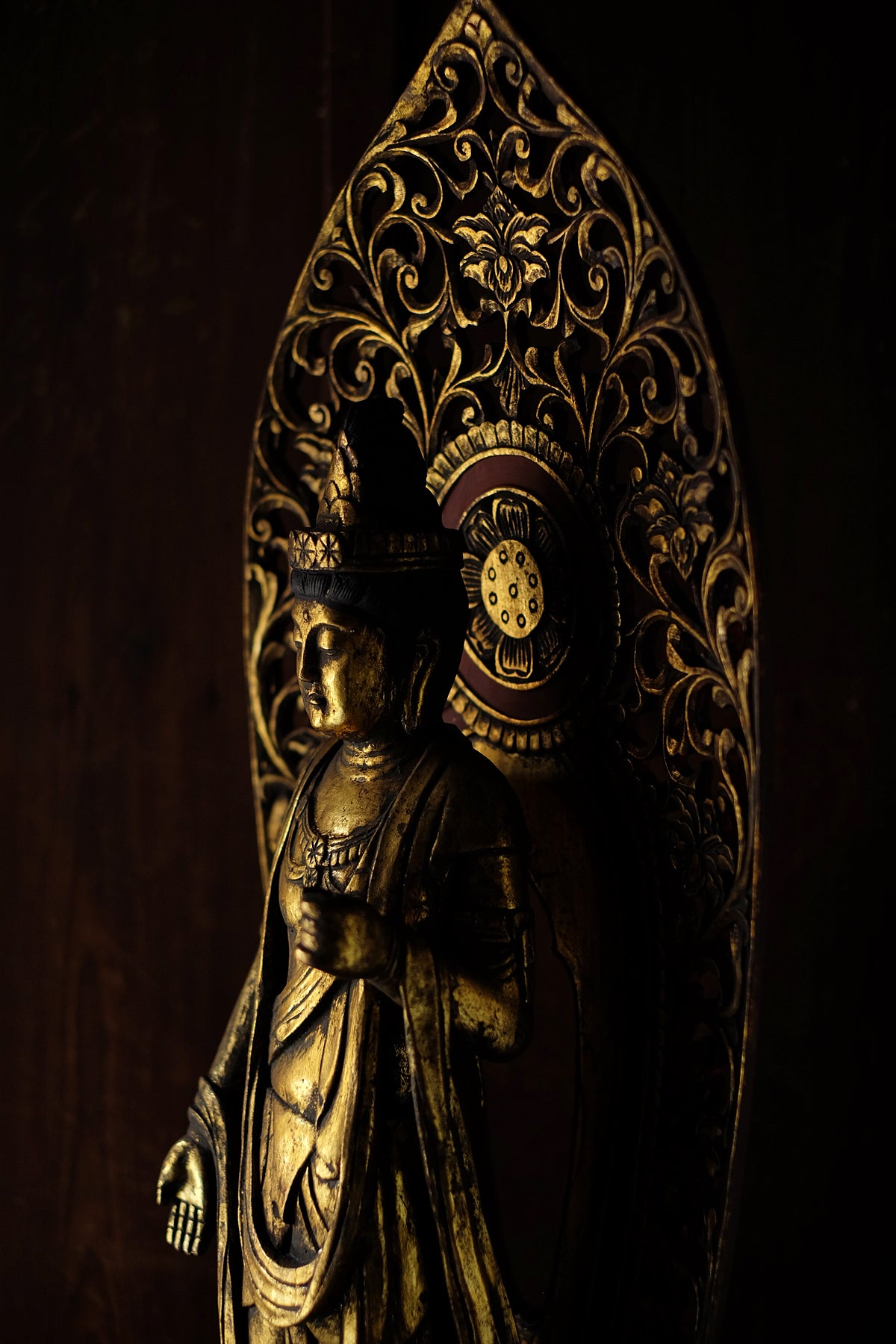
Carved in wood and finished with richly aged gilt lacquer, the figure rises from an elaborate lotus pedestal before a tall, pointed openwork mandorla filled with curling foliage and floral ornament. The composition is beautifully vertical, almost architectural, with the serene Bodhisattva held at the center of an intricate framework of petals, vines, gold and shadow.
The surface has matured beautifully. Bright gold survives across the face, garments, lotus petals and surrounding ornament, while darker areas reveal the passage of time and lend the sculpture remarkable visual depth. Rather than appearing newly decorative, the figure carries the quiet gravity expected of an object conceived for a Buddhist devotional setting.
Kannon, known throughout Japanese Buddhism as the Bodhisattva of Compassion, represents the compassionate impulse to hear suffering and respond to it. This figure captures that ideal without theatrical excess. The face is composed and introspective, the body upright and balanced, the robes descend in graceful folds, and one hand extends downward in a gesture of benevolence while the other is raised beside the body.
From the finely modeled face to the layered lotus throne and pierced halo-like mandorla, the sculpture reveals itself gradually. It rewards both distant viewing and close inspection.
As Buddhist art, devotional sculpture and Japanese woodcarving, it has exceptional presence.
As an interior object, it is equally compelling.
Kannon Bosatsu, the Bodhisattva of Compassion
Kannon occupies one of the most beloved positions in Japanese Buddhism.
Known in Sanskrit as Avalokiteshvara and elsewhere in Asia as Guanyin, Kannon embodies mercy, compassion and the willingness to respond to those in distress.
Japanese Buddhist art developed numerous manifestations of Kannon, ranging from quiet standing figures to complex multi-armed forms. What unites them is the idea of attentive compassion.
The face of this sculpture communicates that character beautifully.
The eyes are lowered rather than confronting the viewer directly.
The mouth is restrained.
The shoulders are relaxed.
Even the elongated standing posture contributes to the sense of composure.
There is no dramatic movement required. The power of the image lies in stillness.
For a devotional object, that stillness is central.
For a collector, it is also what allows the sculpture to remain visually compelling outside its original religious environment.
The Standing Bodhisattva Form
The figure stands frontally upon a lotus support, framed symmetrically by the tall mandorla.
The body is slender and elongated, giving the sculpture a graceful vertical rhythm.
Layered garments fall from the shoulders and cross the torso before descending into long overlapping folds around the legs. The sculptor has used these folds not simply as costume detail but as a way of directing the eye downward toward the feet and lotus pedestal.
One hand is lowered with the palm presented outward, while the opposite hand rises beside the chest.
The exact attributes associated with individual Bodhisattva forms can vary across workshops and periods, and this sculpture is best appreciated conservatively as a Japanese Kannon Bosatsu-type devotional image rather than forcing an overly narrow iconographic attribution without an inscription or temple record.
That restraint strengthens the listing rather than diminishing the piece.
Its Buddhist identity, Japanese character and Bodhisattva iconography are already exceptionally clear.
A Face Designed for Contemplation
The face is one of the strongest features of the sculpture.
Gold remains luminous across the forehead, cheeks, eyelids and lips, while deeper patination gathers around the contours.
The result is almost cinematic.
Light catches the brow and nose.
The eyes remain in shadow.
The cheeks glow softly.
Then the neck and robes fall back into darker gold and brown.
The expression is not sentimental.
It is calm.
That emotional neutrality is part of the sophistication of traditional Buddhist sculpture. The figure does not dictate a feeling to the viewer. Instead, it creates a visual environment in which contemplation becomes possible.
Depending on illumination, the face can appear almost radiant or deeply meditative.
Placed beside a low lamp or natural side light, the effect becomes particularly striking.
The Crown and Sacred Ornament
The head is crowned by a tall pointed headdress, further distinguishing the figure from images of the historical Buddha.
Its vertical shape extends the silhouette upward toward the mandorla and creates a visual bridge between the figure and the pointed frame behind it.
The headdress retains traces of gold and darkened finish, with ornamental carving that becomes increasingly visible at closer range.
Around the neck and upper chest, carved jewelry and layered ornamental elements reinforce the Bodhisattva identity.
These details are important.
In Buddhist sculpture, Bodhisattvas are often represented with princely ornaments because they remain engaged with the world while pursuing the liberation of all beings.
The jewelry, crown and flowing garments therefore communicate both beauty and spiritual meaning.
The Openwork Mandorla
Behind the figure rises perhaps the most dramatic element of the entire composition.
The mandorla, or kohai, is carved into a tall pointed leaf-like silhouette surrounding the Bodhisattva.
Its interior is pierced with scrolling foliage, curling vines and floral forms.
Because so much material has been removed, the background becomes almost lace-like.
Light passes through it.
Darkness fills the openings.
Gold catches on projecting edges.
The visual effect changes according to the wall or environment behind the sculpture.
Against a pale wall, the pierced carving becomes highly graphic.
Against dark timber, as shown in the photographs, it becomes mysterious and architectural, revealing itself through highlights rather than contrast.
This openwork construction also creates a beautiful tension between delicacy and scale.
The mandorla appears fragile and intricate, yet its pointed outline gives the entire sculpture monumentality.
Floral Ornament and the Sacred Frame
The floral carving surrounding the central figure should not be read merely as decoration.
Lotus, foliage and scrolling plant imagery have long occupied important positions within Buddhist art.
Plants emerge, bloom, disappear and return.
They offer a natural visual language for transformation.
Within this mandorla, curling forms spread outward from the figure and fill the pointed frame with controlled movement.
The Bodhisattva remains completely still.
The surrounding carving seems alive.
That contrast is extremely effective.
It creates the feeling that calm exists at the center of movement.
The Halo
Immediately behind the head sits a smaller circular halo.
Its layered construction forms a visual crown around the face and separates the head from the more complicated openwork behind it.
The circular element also softens the strong vertical geometry of the mandorla.
From the side view, the layered nature of the sculpture becomes much clearer.
The figure is not simply attached to a flat decorative backboard.
Instead, multiple depths interact:
the standing body,
the circular halo,
the openwork mandorla,
the lotus throne,
and the lower architectural base.
This makes the piece particularly engaging when viewed slightly off-center.
The Lotus Pedestal
The Bodhisattva stands upon a lotus blossom, one of Buddhism's most enduring visual symbols.
The lotus grows from muddy water yet produces a clean flower above the surface.
For centuries, this natural transformation has provided Buddhist artists with an ideal metaphor for awakening.
Here, the lotus throne is broad and sculptural.
Individual petals are layered around the central platform, creating both visual weight and symbolic elevation.
The darker recesses between petals intensify the gilded edges.
Because the standing figure is slender, the broad lotus also performs an important structural role in the overall composition.
It gives the sculpture a strong visual foundation before transitioning into the lower tiered base.
The Lower Lotus Base
Beneath the upper blossom sits another deeply modeled lotus structure.
Its petals radiate outward across the lower pedestal, forming a broad visual platform beneath the Bodhisattva.
The repetition of the lotus motif creates a rhythm:
figure,
flower,
flower,
architectural base.
It is almost temple-like in construction.
Each successive layer widens as the eye moves downward.
This gives the sculpture stability without making it appear heavy.
The pedestal itself is an important work of carving and should be considered part of the sculpture rather than merely a support.
The Tiered Architectural Plinth
The entire composition rests on a polygonal, tiered plinth.
The base has a formal geometry that contrasts beautifully with the organic petals above it.
This transition from flower to architecture is typical of Buddhist altar sculpture.
The lotus provides the sacred support.
The plinth anchors that sacred form within the physical world.
The result is visually satisfying from both frontal and three-quarter angles.
It also allows the statue to stand independently without requiring an additional display base.
Gold, Shadow and Aged Surface
One of the most attractive aspects of this statue is its surviving finish.
The gold is not uniform.
Nor should it be.
Areas that were protected retain richer gilding.
Raised edges have softened.
Darkened lacquer appears through portions of the surface.
Recesses have accumulated deeper coloration.
This creates extraordinary tonal complexity.
At first glance, the sculpture appears gold.
Look longer and the palette expands:
warm ochre,
burnished bronze,
deep brown,
blackened recesses,
muted red,
and brighter flashes of surviving gilding.
Age has transformed what may once have been a much more brilliant religious image into something quieter and more atmospheric.
For many collectors, this matured surface is significantly more appealing than modern uniform gilding.
Gilt Lacquer and Japanese Buddhist Woodcarving
Japanese Buddhist sculpture frequently combines carved wood with lacquer and gilding.
The relationship between these materials is important.
Wood allows the sculptor to create fine facial modeling, layered robes, delicate fingers and elaborate openwork.
Lacquer seals and refines the surface.
Gold introduces sacred luminosity.
When newly completed, such images could be visually radiant within the low light of an altar.
Over decades, the material changes.
Gold becomes warmer.
Lacquer darkens.
Tiny variations emerge.
The underlying carving becomes increasingly important as brilliant surfaces soften.
This sculpture exists beautifully within that later stage of life.
Its surface does not feel sterile or newly manufactured.
It carries texture, age and atmosphere.
Designed for an Altar Environment
The tall, frontal format strongly reflects the visual logic of Buddhist altar sculpture.
Within a butsudan or temple space, the figure would be viewed primarily from the front.
Vertical framing would emphasize sacred hierarchy.
Gold would respond dramatically to candle or lamp light.
Openwork behind the figure would deepen the shadows.
The lotus would provide symbolic elevation.
Even outside a formal Buddhist altar, those same design principles remain powerful.
A narrow console, alcove, study shelf or dedicated meditation space can reproduce some of the intimacy originally intended by the sculptor.
The piece does not require a large room.
It requires visual breathing space.
The Power of Low Light
The photographs reveal one of the most beautiful characteristics of this sculpture.
It thrives in low light.
Bright illumination reveals carving and condition.
Side light reveals form.
But subdued light creates presence.
The face becomes a small point of gold.
The openwork mandorla retreats almost completely into darkness.
Edges of lotus petals catch light one by one.
The robes become bands of muted bronze.
The effect is quietly dramatic.
For interior presentation, a single warm side lamp can produce a far more evocative display than strong overhead lighting.
A Sculptural Silhouette
From a distance, the sculpture reads as a single elongated silhouette.
The pointed mandorla gives the entire work a flame or leaf-like outline.
The head sits near the upper third.
The body establishes the vertical center.
The lotus widens below.
The polygonal base closes the composition.
This silhouette is one reason the piece works so well as interior art.
Even without understanding Buddhist iconography, the proportions are immediately compelling.
For collectors who do understand the religious language, the work offers an additional layer of meaning.
Japanese Spiritual Art Without Visual Excess
Although richly carved, the overall composition remains disciplined.
The figure is centered.
The facial expression is restrained.
The robes are organized into long vertical folds.
The lotus remains symmetrical.
The mandorla fills the background without overpowering the Bodhisattva.
This balance is crucial.
The sculpture is elaborate, but not chaotic.
The eye always returns to the face.
That hierarchy is the mark of successful devotional design.
A Meaningful Presence for Contemporary Interiors
The sculpture is particularly effective in interiors combining old and new.
Within a minimalist setting, the aged gold surface provides warmth without introducing excessive color.
In a Japanese-inspired room, it naturally complements dark wood, ceramics, lacquerware, bamboo and textile.
Within a more eclectic collection, it becomes an architectural anchor among smaller objects.
It can also stand beautifully alone.
A narrow shelf.
A dark wall.
A soft light.
Nothing else is necessary.
The sculpture already contains enough complexity to reward long viewing.
Collecting Japanese Buddhist Sculpture
Japanese Buddhist figures occupy a fascinating space between religion, sculpture, craftsmanship and history.
Some pieces remain active devotional objects.
Others enter collections because of their carving, age, surface and cultural significance.
This sculpture can comfortably inhabit both worlds.
For a Buddhist practitioner, it can function as a contemplative image.
For an art collector, the combination of standing Bodhisattva, lotus throne, complete architectural base and large openwork mandorla makes the work particularly attractive.
For an interior collector, its extraordinary silhouette and aged gold finish provide immediate visual impact.
The most successful pieces often operate across all three categories.
This is one of them.
Period and Attribution
The sculpture has been represented as a Japanese Kannon Bosatsu from the Showa period.
Its construction, gilded devotional finish, altar format and carving style are consistent with Japanese Buddhist sculpture made for domestic or temple-related devotional use during the twentieth century.
Without a visible inscription, dated interior record or documented temple provenance, an exact workshop and year should not be stated as fact.
The surface is clearly aged, however, and the workmanship is consistent with traditional Japanese carved Buddhist altar sculpture rather than contemporary decorative resin production.
For public presentation, vintage Japanese giltwood Kannon Bosatsu is the strongest and most defensible identification.
Condition and Age Character
The sculpture displays a compelling aged surface with visible rubbing, darkening and localized loss to the gilt and lacquer finish.
The face, robes, pedestal and mandorla retain substantial decorative presence.
Small abrasions, finish variation and handling marks are consistent with age and previous display.
The openwork mandorla appears impressively preserved in the supplied photographs considering its delicacy, although buyers should examine all images carefully for small losses, old repairs or fragile areas that may not be obvious under low lighting.
The lotus pedestal and lower base show age-related surface wear and darkening.
No major structural break is immediately apparent from the photographs provided.
The patina and irregularity of the finish are integral to the character of this vintage devotional sculpture and should not be interpreted as the appearance of a factory-new object.
Brand Heritage
Japanese Buddhist carving developed around an extraordinary partnership between material and belief.
A block of wood was never merely shaped into a body.
It was transformed through layers.
Carving established the form.
Lacquer refined the surface.
Gold gave the image light.
The pedestal placed the figure above ordinary space.
The mandorla surrounded it with another realm.
The result was an object designed to exist between architecture and sculpture.
That tradition is beautifully visible here.
The Bodhisattva stands quietly at the center.
The robes descend.
The lotus blooms beneath.
The openwork mandorla rises around the body like a carved garden.
Gold appears and disappears with the light.
Nothing needs to move.
The sculpture changes because the room changes around it.
Morning light reveals the surface.
Afternoon shadow deepens the carving.
Evening illumination catches only the face and edges.
That quality makes Japanese Buddhist sculpture so compelling beyond its original religious setting.
It does not simply occupy space.
It changes it.
Purchase, Shipping and Vintage Policy
This is a vintage Japanese devotional sculpture and is offered in the condition represented by the photographs. Older carved and gilt surfaces naturally may show rubbing, oxidation, darkening, small losses, scratches, previous restoration, minor separations, dust within recessed carving and other traces of long-term use or storage.
Some pieces in our collection have a little room for negotiation while others are more firmly priced. Respectful best offers are welcome and considered individually.
Preparation, shipping and handling normally takes approximately 5 to 10 business days or earlier whenever possible. Due to the delicate openwork mandorla and layered pedestal construction, this piece will require careful protective packing and appropriate internal support.
International customs duties, taxes and import charges, where applicable, remain the responsibility of the buyer.
If you are looking for this design or model in another size, please feel free to message us. Although availability cannot be guaranteed, we may be able to locate the same or a closely matching piece in a different size through our sourcing network.
Material Tags
carved wood, Japanese wood carving, giltwood, gilded wood, gold lacquer, gilt lacquer, urushi-style lacquer finish, carved Buddhist sculpture, Kannon Bosatsu figure, Bodhisattva sculpture, lotus pedestal, carved lotus petals, openwork mandorla, pierced wood carving, kohai halo, circular halo, carved robes, carved crown, altar sculpture, butsudan figure, temple-style sculpture, devotional wood carving, religious art, Japanese Buddhist art, hand-carved wood, aged gilding, patinated gold surface, lacquered wood, tiered wooden base, polygonal plinth, floral openwork, scrolling foliage carving, vintage Japanese woodcraft
#Kannon #KannonBosatsu #JapaneseBuddhistArt #JapaneseBuddha #BuddhistSculpture #Giltwood #GiltwoodStatue #JapaneseWoodCarving #JapaneseSculpture #Bodhisattva #Avalokiteshvara #Guanyin #Compassion #SacredArt #TempleArt #JapaneseTempleArt #BuddhistAltar #Butsudan #LotusPedestal #Mandorla #Kohai #GoldLacquer #GildedWood #VintageJapan #JapaneseVintage #JapaneseAntiqueStyle #JapaneseArt #AsianArt #AsianAntiques #BuddhistDecor #ZenDecor #MeditationDecor #SpiritualDecor #SacredSculpture #JapaneseInterior #WabiSabi #WabiSabiDecor #JapaneseCraft #JapaneseCraftsmanship #WoodenBuddha #BuddhistCollectible #JapaneseCollectible #TempleSculpture #LotusThrone #BuddhistIconography #JapaneseSpiritualArt #GoldBuddha #HomeAltar #MeditationSpace #OrientalArt #AsianDecor #JapaneseCulture #BuddhistTradition #ArtCollector #SpiritualArt #DevotionalArt #CarvedMandorla #OpenworkCarving #JapaneseWoodwork #HeirloomDecor
kannon statue, gilt wood buddha, japanese altar, buddhist art, lotus pedestal, wooden kannon, mandorla statue, zen decor, butsudan figure, guanyin statue, japanese vintage, sacred sculpture, giltwood statue