Rare Vintage, Antiques and Art Collector / Curator / Personal Shopper From Japan
Vintage Japanese Bronze Rat on Rice Bale Okimono Koro Incense Vessel with Tomobako Nezumi Zodiac Art
Vintage Japanese Bronze Rat on Rice Bale Okimono Koro Incense Vessel with Tomobako Nezumi Zodiac Art
Couldn't load pickup availability
Have a reasonable price in mind? Submit your best offer and our concierge will review it personally.
Sculptural Japanese Nezumi on Tawara Rice Bale in Patinated Bronze / Copper Alloy with Inscribed Wooden Storage Box, Auspicious Symbol of Prosperity, Harvest and Abundance
Introduction
A wonderfully charming marriage of Japanese metalwork, zodiac symbolism, agricultural prosperity, and playful naturalism, this vintage Japanese bronze work depicts a remarkably lifelike rat perched atop a traditional bundled rice bale.
At first glance, the subject is delightfully simple: a small rat has discovered the ultimate treasure, an entire bale of rice.
Within Japanese visual culture, however, the composition carries layers of auspicious meaning.
The rat, or nezumi, is the first animal of the Japanese zodiac cycle and has long been associated with cleverness, adaptability, fertility, multiplication, and the ability to discover opportunity where others may not. The traditional rice bale, or tawara, represents stored harvest, nourishment, agricultural success, wealth, and the security that comes from abundance.
Together, the two motifs form one of Japan's enduring auspicious images: nezumi on tawara, the rat upon the rice bale.
The subject is rendered here not as a flat emblem but as a fully dimensional metal sculpture. The rat sits alertly above the rounded bale, its front paws drawn close to its chest, ears raised, body compact, and long tail sweeping naturally across the curve of the form. Beneath it, the bale has been meticulously modeled with parallel straw lines, twisted rope bindings, and raised seams that imitate the woven construction of a traditional rice container.
The passage of time has given the metal an especially attractive surface, with dark bronze tones, softened golden highlights, and areas of blue-green oxidation gathering naturally within the deeply modeled bale texture. The resulting patina gives the piece enormous character and makes the tiny animal appear almost alive against the weathered surface beneath it.
Presented with its original-style inscribed wooden tomobako storage box, this is an engaging Japanese object that works simultaneously as symbolic art, metal sculpture, zodiac collectible, incense-related vessel or covered decorative object, and a sophisticated accent for a Japanese interior.
The Rat on the Rice Bale
The imagery of a rat seated upon or beside a rice bale may appear humorous to the modern eye, but historically it belongs to a much richer vocabulary of Japanese auspicious design.
Rice was never merely food.
For centuries it functioned as a measure of agricultural wealth, a store of value, a symbol of sustenance, and an essential foundation of Japanese life. A full rice store represented security. An abundance of rice suggested successful harvest, prosperity, and continuity from one season to the next.
The rat, meanwhile, possesses an interesting double identity.
In ordinary life it could certainly be regarded as a creature capable of consuming precious grain. Yet within Japanese auspicious imagery, its extraordinary fertility and ability to thrive made it a natural symbol of multiplication and abundance.
A storehouse so plentiful that rats gather around it can therefore be transformed visually into a sign of overflowing wealth.
That paradox is exactly what gives the motif its charm.
What might seem like a small agricultural nuisance becomes a messenger of plenty.
Nezumi and the Japanese Zodiac
Nezumi occupies the opening position in the twelve-animal zodiac cycle.
The rat's position as the first zodiac animal gives it associations with beginnings, initiative, intelligence, resourcefulness, and new cycles.
Its quickness and adaptability have made it a particularly lively zodiac subject in Japanese decorative arts.
Rat imagery appears across an extraordinary range of Japanese objects, including netsuke, metalwork, lacquer, ceramics, textile decoration, tea utensils, seasonal ornaments, wood carvings, prints, and small auspicious sculptures.
Collectors born in a Year of the Rat may find such works especially meaningful, but the symbolism reaches well beyond personal zodiac identity.
The rat can represent:
resourcefulness,
renewal,
fertility,
prosperity,
multiplication,
new opportunities,
household abundance,
and successful beginnings.
Placed atop a rice bale, those associations become even stronger.
The Connection with Daikokuten
The rat also holds a traditional association with Daikokuten, one of Japan's celebrated deities of good fortune.
Daikokuten is frequently linked with wealth, agriculture, plentiful food stores, successful commerce, and household prosperity. His imagery commonly includes rice bales, and rats became closely associated with his abundance.
That relationship transformed the animal from a mere grain-eating creature into an auspicious companion of stored wealth.
The combination of rat and rice bale therefore creates a particularly dense visual shorthand for prosperity.
It is not simply “a rat sitting on rice.”
It evokes the world of granaries, harvests, household security, fortunate accumulation, and the hope that resources will continue to multiply.
For a traditional Japanese viewer, this compact sculpture could therefore carry a surprisingly large symbolic vocabulary.
Sculptural Character of the Rat
The rat itself is beautifully observed.
Rather than presenting the animal as a cartoonish zodiac emblem, the maker has paid careful attention to anatomy and texture.
The body swells naturally toward the hindquarters.
The shoulders narrow toward the head.
The paws are gathered beneath the chest.
The ears rise sharply from the skull.
The eyes are carefully indicated.
The long tail continues down the curvature of the bale rather than ending abruptly, creating an elegant visual line through the composition.
Most impressive is the treatment of the fur.
Fine incised lines move across the surface in directional patterns that follow the volume of the body. Around the flanks, chest, shoulders, and face, these lines create the illusion of dense short fur without overwhelming the sculpture.
This texturing also allows light to break across the metal unevenly.
Polished ridges catch brighter highlights.
Recessed grooves remain dark.
From different viewing angles, the rat can therefore shift from golden bronze to deep charcoal and muted silver-gray.
The effect is remarkably lively for such a restrained object.
The Rice Bale
The tawara beneath the rat is more than a base.
It is approximately half the story.
Traditional straw rice bales were bound by ropes that compressed and strengthened the cylindrical bundle. Here, those structural features have been carefully translated into cast metal.
The surface is covered with parallel linear grooves suggesting tightly packed woven straw.
Raised rope bands wrap around the bale.
A stronger horizontal binding divides the upper and lower halves.
The rounded ends curve softly inward.
The whole body has the tactile appearance of something woven, compressed, tied, and handled rather than something mechanically smooth.
It is a clever transformation of material.
Metal pretends to be straw.
Solid bronze imitates fibrous rice packaging.
The visual tension between those materials gives the piece much of its artistic appeal.
Patina and Surface
One of the most attractive qualities of this example is its aged surface.
The metal has developed a complex combination of brown, dark gray, muted gold, and blue-green tones.
The recesses between the modeled straw lines retain darker oxidation.
Raised rope sections catch warmer bronze color.
Blue-green verdigris-like oxidation is particularly visible across the rice bale, gathering naturally in recessed areas and around the bindings.
The rat itself appears darker and comparatively smoother, which helps distinguish its compact body from the textured bale below.
This difference creates visual depth without relying on applied color.
The object therefore changes considerably under different lighting.
In soft ambient light, it reads as quiet dark bronze.
Under stronger directional illumination, the gold-brown ridges emerge and the green patina becomes far more evident.
That surface complexity is precisely what gives older Japanese metalwork its quiet visual richness.
Object Form and Possible Function
The rice-bale body appears constructed as a covered vessel, with a clear division between upper and lower sections.
The sculptural rat functions as the natural visual finial of the upper section.
Objects of this type are commonly encountered in Japanese decorative and incense-related contexts as small covered vessels, kogo-style containers, koro-related objects, or auspicious okimono.
The accompanying box identifies the subject and metalwork but does not, from the visible inscription alone, establish a more specific ritual function.
For that reason, this listing presents it conservatively as a covered bronze okimono / incense-related vessel, allowing the object itself to remain the authority rather than assigning an undocumented function.
Whether displayed closed as sculpture or appreciated for its covered construction, it remains a beautifully resolved object.
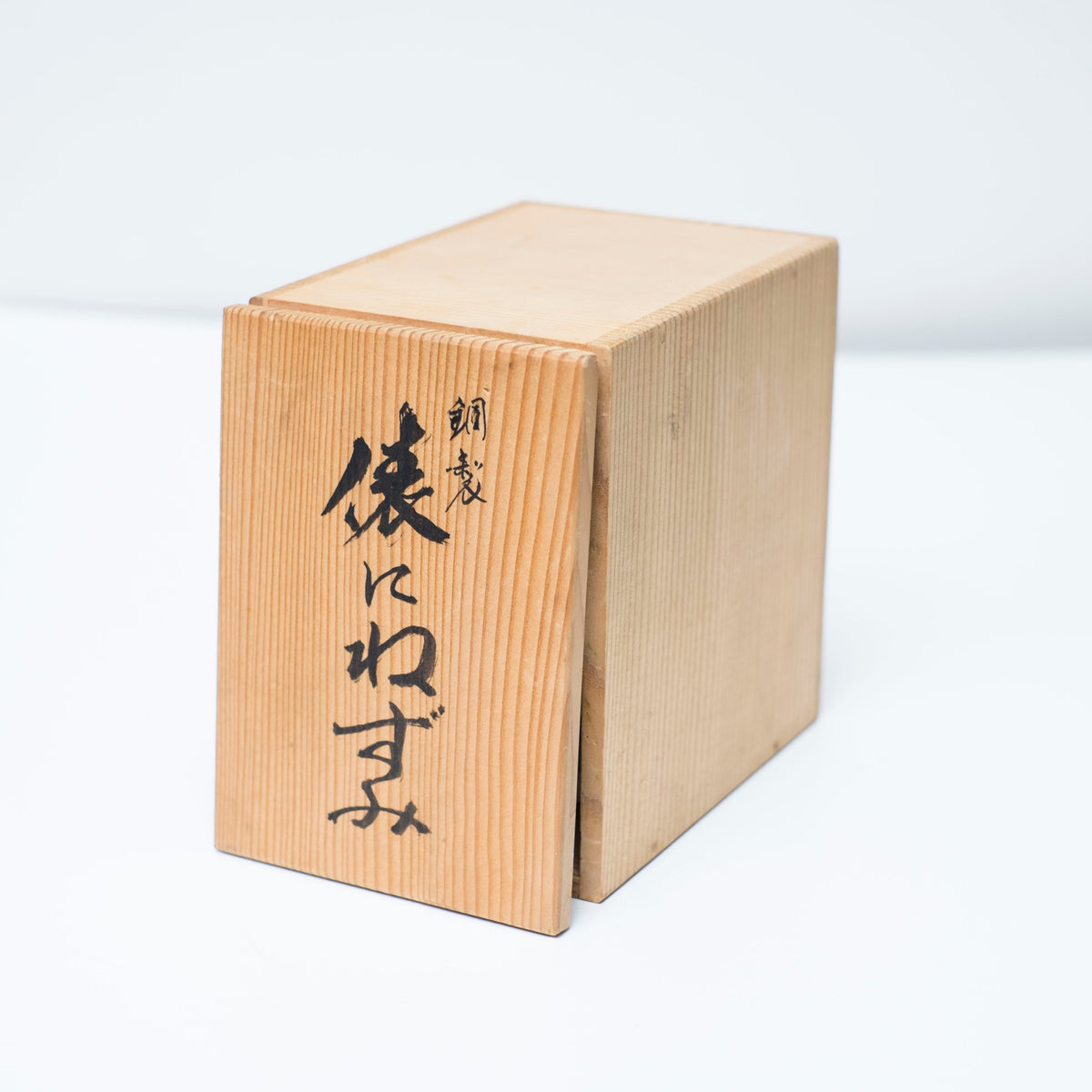
Tomobako Inscription
The wooden storage box is especially useful in understanding the piece.
The visible inscription identifies it in romaji as:
Dousei Tawara ni Nezumi
which may be understood as:
Copper / bronze work, rat on rice bale.
In Japanese decorative-metal terminology, references to copper can encompass copper-based alloys, including bronze-like materials, so the safest English material description is bronze or copper alloy unless formal metallurgical analysis is undertaken.
Importantly, the box confirms the intended subject.
The image is not simply interpreted as a generic mouse-like animal on an abstract bundle.
It is specifically understood as nezumi on tawara.
The tomobako also strengthens the object as a coherent collectible ensemble and provides a traditional method of storage and presentation.
Brand Heritage
No securely identifiable individual artist or workshop signature is visible in the photographs supplied, so the piece is intentionally not assigned to a famous maker without evidence.
Its value lies instead in the strength of the traditional subject, the quality of the modeled metalwork, the expressive rat, convincing rice-bale texture, layered patina, and survival of the inscribed wooden storage box.
This approach is particularly important with Japanese decorative metalwork.
A beautiful piece does not need an invented attribution to become desirable.
Anonymous and workshop-produced objects can still preserve excellent craftsmanship, regional visual traditions, seasonal symbolism, and a strong sense of Japanese material culture.
Here, the maker understood how to make a compact object carry considerable narrative weight.
Auspicious Meaning
The symbolism of the composition is unusually concentrated.
The rat suggests fertility and multiplication.
The rice bale suggests harvest and stored nourishment.
Their relationship recalls Daikokuten and the imagery of abundance.
The zodiac adds themes of beginnings and cyclical renewal.
The container form suggests something protected or stored.
The original wooden box reinforces preservation and continuity.
Together, these qualities make the piece especially appropriate for display where themes of prosperity, business fortune, household abundance, successful harvest, family continuity, or new beginnings carry meaning.
It can therefore be appreciated not only as decorative sculpture but also as a traditional auspicious object.
A Small Object with Narrative Presence
The charm of this piece comes partly from scale.
Large sculptures announce themselves.
Small Japanese objects often invite discovery.
The rat appears almost to have climbed onto the bale while nobody was watching.
Its paws are held closely together.
Its ears remain alert.
Its long tail extends behind it.
There is something intimate and observant about the pose, almost as though the animal has paused briefly before continuing across the storeroom.
That little moment turns an auspicious emblem into a scene.
It is not simply symbolic.
It has personality.
That distinction can make an object far more memorable in a collection.
Japanese Naturalism in Miniature
Japanese decorative arts repeatedly demonstrate a fascination with small creatures.
Mice, frogs, rabbits, insects, fish, crabs, turtles, birds, and other animals were treated with extraordinary attentiveness across netsuke, metalwork, lacquer, ceramics, and carved objects.
The maker often needed only a few centimeters of surface to communicate posture, species, movement, and personality.
This rat belongs comfortably within that tradition.
The slightly lowered head, compact body, upright ears, carefully modeled feet, and extended tail all suggest direct observation rather than merely schematic zodiac design.
The sculptor has retained enough naturalism to make the animal convincing while simplifying the form enough to remain decorative.
Wabi-Sabi Surface Character
The bale's oxidation adds another dimension to the work.
Rather than remaining uniformly polished, the bronze has accumulated the marks of time.
Softening.
Darkening.
Oxidation.
Uneven coloration.
Deposits within crevices.
Changes in the surface where the object has been exposed differently to air, moisture, storage, and handling.
These changes form part of the object's visual history.
For collectors who appreciate wabi-sabi sensibilities, the appeal lies precisely in that refusal to remain pristine and anonymous.
Time has painted a second surface over the original craftsmanship.
Display Possibilities
This piece would display beautifully in a surprisingly broad variety of settings.
A Japanese antique cabinet.
A tokonoma-inspired alcove.
A tea room.
A study.
A library.
A business reception space.
A meditation room.
A zodiac collection.
A shelf of Japanese metalwork.
A seasonal New Year arrangement.
A display focused on Daikokuten and the Seven Lucky Gods.
A minimalist interior where a single richly patinated object provides contrast.
Because the silhouette is relatively low and horizontally weighted, it also works particularly well on a low shelf or wooden platform.
Warm woods enhance the bronze.
Dark lacquer creates stronger drama.
Natural stone emphasizes the green oxidation.
Pale linen or plaster backgrounds make the silhouette particularly readable.
Displayed alongside the tomobako, the piece acquires an immediate collector's context.
Displayed by itself, it becomes almost sculptural and contemporary.
For Year of the Rat Collectors
For someone born in a Year of the Rat, this object carries an additional personal dimension.
Unlike mass-produced zodiac ornaments that may be displayed briefly and stored away after a season, this work possesses enough craftsmanship and historical character to remain on display permanently.
It can therefore function as:
a birthday gift,
a New Year gift,
a housewarming gift,
a business-opening gift,
an anniversary gift,
a personal zodiac talisman,
or simply a quiet symbol of prosperous beginnings.
Its meaning is positive without being overly literal.
Why the Tomobako Matters
The wooden storage box is not merely packaging.
In Japanese art collecting, boxes frequently become part of the history of the object itself.
They protect.
Identify.
Record.
Organize.
And preserve the relationship between object and owner.
In this case, the inscription preserves the intended subject in words, confirming the rat-and-rice-bale composition.
Even when a box does not identify a famous artist, its survival adds context that a loose unboxed object simply cannot provide.
Collectors often value this relationship between object and box because it helps preserve the work as an ensemble rather than as an isolated decorative item.
Condition
This is an older Japanese metal object and displays visible surface aging consistent with age, storage, handling, and the natural oxidation of copper-based metal.
The bronze / copper-alloy surface shows substantial patination, including dark brown and charcoal coloration, muted golden highlights, and areas of blue-green oxidation across the rice bale.
The surface is intentionally described rather than polished away because this aged character forms an important part of the visual appearance of the piece.
There may be minor scratches, small casting irregularities, oxidation, deposits in recesses, rubbing to raised areas, and other age-related characteristics visible in the photographs.
The rat and its extended tail appear delicate and should be handled carefully.
The wooden tomobako also shows natural age and handling characteristics.
Please study the supplied photographs carefully, as they form an essential part of the condition description.
The piece is offered in its existing vintage condition and has not been represented as newly manufactured or professionally restored.
Material & Construction
The box inscription identifies the work as dousei, indicating copper-based metalwork.
For international listing purposes, bronze / copper alloy is the most appropriate conservative description.
The object appears cast and finished with incised and modeled surface detailing.
The bale includes finely worked linear texture and raised rope bindings.
The rat features incised fur detail, sculptural paws, ears, facial features, and a long extended tail.
The surface carries naturally developed oxidation and patina.
The accompanying storage box is wood with brushed calligraphic inscription.
Collector Appeal
This work crosses several collecting categories particularly well.
Japanese bronze and metalwork.
Zodiac art.
Animal sculpture.
Okimono.
Incense culture.
Daikokuten symbolism.
Auspicious Japanese objects.
New Year decoration.
Traditional agricultural imagery.
Tomobako-preserved works.
Miniature naturalistic sculpture.
Wabi-sabi interiors.
Japanese decorative arts.
Unlike a generic zodiac figurine, it has enough sculptural character and surface complexity to stand comfortably within a serious Japanese collection.
Unlike a purely formal bronze object, it possesses a wonderfully approachable personality.
That combination is one of its greatest strengths.
Purchase, Shipping & Vintage Policy
This is a vintage collectible offered in its existing condition as photographed.
Please review all photographs and descriptive information carefully before purchase. Older metalwork may naturally show patination, oxidation, rubbing, surface deposits, casting characteristics, small marks, tonal variation, and other evidence of age and handling. These qualities should be considered part of the individual history and appearance of the object.
We make every reasonable effort to represent each piece accurately. If a specific structural, material, or condition detail is important to your purchase decision, please feel free to contact us before ordering.
Some pieces in our collection have a little room for negotiation while others are more firmly priced according to rarity, condition, acquisition cost, and replacement difficulty. Respectful offers are always welcome and will be considered seriously.
Preparation, shipping and handling normally takes 5–10 business days or earlier whenever possible.
International orders are packed carefully for safe transit and shipped with tracking whenever available. Import duties, taxes, customs charges, brokerage fees, or other destination-country costs may apply according to local regulations and remain the responsibility of the recipient unless otherwise specified.
All vintage and antique items are sold as shown and described.
If you are looking for this design or model in another size, please feel free to message us. Although availability cannot be guaranteed, we may be able to locate the same or a closely matching piece in a different size through our sourcing network.
Closing
There is something wonderfully Japanese about the way this object turns a tiny everyday animal into a complete meditation on abundance.
A rat pauses.
A bale of rice waits beneath it.
The sculpture quietly speaks of harvest, stored wealth, fertility, cleverness, beginnings, and the old connection between nature and human prosperity.
Then time adds its own contribution.
Bronze darkens.
Green oxidation settles into the straw.
Highlights remain on the animal's fur.
The wooden box protects the story.
What begins as a charming zodiac object becomes something considerably richer: a compact piece of Japanese symbolism and metalwork carrying both humor and blessing.
For the collector who appreciates objects that reward close looking, this is a particularly appealing little world in bronze.
#JapaneseBronze #JapaneseMetalwork #Nezumi #RatZodiac #YearOfTheRat #Tawara #RiceBale #RatOnRiceBale #JapaneseOkimono #BronzeOkimono #JapaneseKoro #IncenseVessel #JapaneseIncense #JapaneseAntique #VintageJapanese #JapaneseArt #JapaneseCollectible #AsianAntiques #AsianArt #JapaneseZodiac #ZodiacArt #ZodiacCollectible #Daikokuten #ProsperitySymbol #AbundanceSymbol #HarvestSymbol #GoodLuckDecor #JapaneseGoodLuck #AuspiciousArt #BronzeRat #RatFigurine #AnimalSculpture #JapaneseAnimalArt #JapaneseCraftsmanship #TraditionalJapanese #JapaneseCulture #JapaneseHeritage #Tomobako #WoodenStorageBox #PatinatedBronze #BronzePatina #CopperAlloy #Verdigris #WabiSabi #WabiSabiDecor #JapaneseInterior #TokonomaDecor #NewYearDecor #JapaneseNewYear #FineJapaneseArt
japanese bronze, bronze rat, rat rice bale, nezumi zodiac, year of rat, japanese okimono, bronze okimono, japanese koro, zodiac sculpture, tomobako box, japanese antique, prosperity decor, japanese metalwork
Material Tags
bronze, copper alloy, patinated bronze, cast metal, Japanese metalwork, dark patina, verdigris oxidation, naturally aged metal, incised metalwork, sculpted bronze, modeled copper alloy, wooden tomobako, paulownia style wood box, ink inscription