Rare Vintage, Antiques and Art Collector / Curator / Personal Shopper From Japan
Vintage Early Wool A-1 Style Aviation Jacket Olive Button Front Knit Collar Military Flight Jacket Rare
Vintage Early Wool A-1 Style Aviation Jacket Olive Button Front Knit Collar Military Flight Jacket Rare
Couldn't load pickup availability
Have a reasonable price in mind? Submit your best offer and our concierge will review it personally.
Early Wool Aviation-Style Jacket
A-1 family orbit, olive wool with knit collar and waistband
circa early 20th century / military-sportswear transition period
A rare and visually persuasive early wool aviation-style jacket whose construction places it within the orbit of the Type A-1 and related pre-zip flightwear forms, though without sufficient evidence at present to support an unqualified regulation attribution. The jacket is executed in olive-toned wool and defined by its exceptionally strong knit architecture, including a substantial collar, elongated cuffs, and broad striped waistband, all of which contribute to a silhouette of unusual early authority.
Its importance lies in what it preserves of a transitional moment in flightwear history, when military and aviation garments still shared structural language with sportswear and outfitting traditions not yet hardened into later standard issue. The button front and flap pockets reinforce this impression, while the overall softness of the body distinguishes it from the more familiar leather iconography that would come to dominate collector culture.
Condition is consistent with age and use, yet the garment retains a striking compositional integrity. Whether ultimately classified as true military aviation wear or as a closely related early specialist jacket, it remains a highly evocative textile object from a difficult and increasingly scarce category.
A serious piece for the collector who values early form as much as confirmed nomenclature.
Object
Early wool aviation-style / military sportswear-style jacket in the A-1 family orbit
Seller Attribution
“Wool Type A-1 flight jacket”
Curatorial Reading
This should be treated as an A-1-adjacent early wool flight / sports jacket, not as an unquestioned regulation Type A-1, unless further label, contract, or archival evidence is produced
Category
Early aviation clothing / military sportswear crossover
Button-front wool jacket with knit collar, cuffs, and waistband
Material
Wool body
Heavy knit shawl-style or roll-knit collar
Heavy knit cuffs
Heavy striped waistband knit
Color
Olive / khaki-olive body with brown-toned knit contrast
Construction Traits Visible
- button front closure
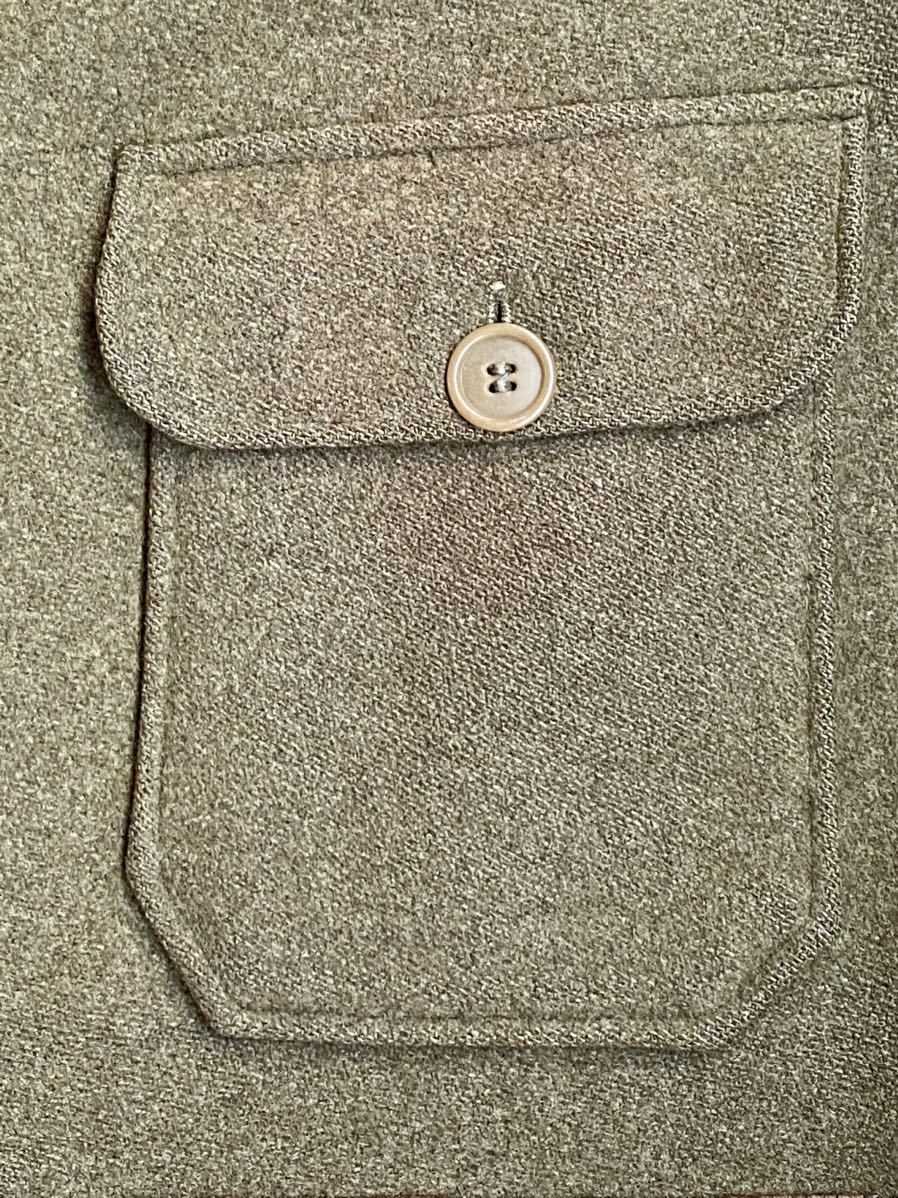
- two front patch pockets with button flaps
- long rib-knit cuff treatment
- very substantial lower knit waistband
- soft early silhouette closer to pre-zip aviation / sportswear garments than later militarized leather flight jackets
Measurements
Shoulder: approx. 41 cm
Chest: approx. 55 cm
Sleeve: approx. 66 cm
Length: approx. 67 cm
Fit Reading
Despite narrow shoulder, the chest measurement suggests a slightly fuller body than one might expect, likely due to the relaxed prewar cut and soft wool structure
Condition Summary
General vintage wear, fade, abrasion, dirt, and age acknowledged by seller
Photographically, the piece appears to retain highly attractive overall form
This is more likely a display-plus-occasional-careful-wear object than a hard-use garment
Object Classification
A rare and visually important early wool aviation-style jacket, potentially collectible as a pre-leather or parallel-track aviation / military garment, but requiring attribution discipline
COLLECTOR RELEVANCE
Tier: Advanced Early Textile / Aviation-Adjacency Piece
Best for:
- collectors of pre-leather flightwear
- early military textile specialists
- buyers interested in aviation-sportswear crossover garments
- museum-minded collectors who can tolerate attribution nuance
Not ideal for:
- buyers who need hard contract proof
- leather-flightwear-only purists
- anyone pricing purely by seller label language without independent scrutiny
This is a garment for someone who understands that rarity sometimes arrives dressed in ambiguity.
CURATORIAL ANALYSIS
Before Leather, There Was Soft Authority
One of the reasons this garment is so compelling is that it reminds us that aviation clothing did not begin and end in leather. Before the iconic zip-front horsehide jacket became the fixed image of military flightwear, there existed a softer, stranger, more transitional world of wool, knit, buttoning, and garments that sat somewhere between sportswear, uniform, and technical necessity.
This piece seems to belong to that world.
And that is why it feels unusual. It does not project the later hard-edged martial glamour of the A-2. Instead it suggests an earlier language, one in which aviation clothing still shared blood with collegiate outerwear, sporting garments, and officer-purchased specialty wear.
That earlier language is rarer, and in some ways more haunting.
The Problem and Power of “Type A-1”
The seller’s use of “Type A-1” needs to be handled carefully. In the vintage market, “A-1” is often used too loosely, sometimes to mean:
- actual regulation lineage
- visual resemblance
- pre-A-2 style wool or leather aviation jacket
- simply “old military-looking button jacket”
This piece absolutely has A-1 energy. The button front, the knit collar, the pocket logic, and the short aviation-ready body all point in that direction. But without a confirming label or contract evidence, the right approach is not to flatten it into certainty.
And yet, the lack of certainty does not reduce the garment’s fascination.
In fact, it may increase it.
Because objects like this occupy the unstable, fertile territory where early aviation clothing, military outfitting, and civilian sportswear still bleed into one another. That is often where the most interesting garments live.
The Knit Architecture Is the Star
The best thing about this jacket may not be the wool body. It may be the knit architecture.
The collar is not incidental. It is thick, expressive, and almost sculptural. The cuffs extend long and practical. The waistband is broad, striped, and anchoring. Altogether they give the garment a powerful silhouette without relying on hardware or graphic noise. The whole body feels gathered and held by knit, which is exactly the sort of engineering one expects from an early cold-weather flight or motoring-adjacent garment.
This makes the jacket visually rich in a very quiet way.
No paint.
No patches.
No spectacle.
Just form, textile, and proportion.
That is often more sophisticated.
Why Wool Matters Here
Leather dominates flight-jacket collecting because leather photographs dramatically and ages mythically. But wool can be more revealing historically. It reminds us that early aviation was not always dressed in the cinematic uniform later generations prefer. Wool garments often speak to a more improvised or transitional period, where function had not yet fully hardened into the iconography we now associate with military air service.
This jacket captures that sensation beautifully. It feels closer to experiment than standardization. Closer to the frontier of category than to its settled center.
That is collector gold when the garment is right.
This Could Be Military, It Could Be Adjacent, and Both Possibilities Matter
There are really three value scenarios here:
First, it is a true aviation-related early military garment in the A-1 family orbit.
That would make it highly significant and justify serious pricing.
Second, it is a private-purchase or military-adjacent aviation sports jacket from the same period vocabulary.
That would still make it very interesting and collectible.
Third, it is a non-aviation early wool sportswear piece that strongly resembles flightwear.
That would lower the military significance, but not erase the garment’s visual importance.
What is striking is that in all three scenarios, the jacket remains attractive. The question is not whether it matters. The question is how much of its value should be assigned to aviation specificity versus broader early-textile rarity.
A Jacket of Atmosphere Rather Than Documentary Force
Unlike a labeled contract A-2, this jacket does not force itself forward with bureaucracy. It works through atmosphere. It asks the eye to read age, shape, and material logic. Some collectors hate that ambiguity. Others spend their whole lives chasing it.
Because there is a special pleasure in a garment that does not hand over all its secrets at once. This piece has that quality. It feels like something recovered from the edge of a known history, not from its polished center.
That makes it harder to price, but often harder to forget.
MATERIAL FORENSICS
Wool Body
The key questions:
- does the wool still have tensile life or has it thinned in stress zones?
- are there moth tracks not visible in broad photos?
- is fading uniform and age-natural?
- how strong are shoulder seams and pocket edges?
A jacket like this depends heavily on body cloth integrity. If the wool remains structurally sound, much of the piece’s value stays intact.
Knits
The collar, cuffs, and waistband are critical. They are not secondary details. They are the garment’s architecture. They should be checked for:
- hidden moth loss
- elasticity
- prior repairs
- weak seam joins into body cloth
- whether the striped waistband is original to the garment or period-consistent replacement
If the knits are strong, the entire silhouette survives.
Buttons
Button integrity matters more here than on later zip jackets. Originality, stitch age, and button consistency should be studied carefully. One wrong later replacement can subtly alter how the whole garment reads.
Authenticity & Stewardship
Evaluated under the Japonista Aviation & Military Garment Authentication Framework™
Each work is examined through a structured, multi-layered assessment:
• Model classification and military typology verification (A-2, B-3, MA-1, G-1, L-2, etc.)
• Material evaluation across leather, shearling, nylon, wool, and mixed components
• Hardware inspection including zippers, snaps, and period-correct fastenings
• Graphic and nose art analysis, including paint method, iconography, and historical alignment
• Condition and structural integrity review, including wear patterns consistent with age and use
Where applicable, contract labels, manufacturer markings, and period construction details are reviewed to confirm authenticity and era alignment.
Guaranteed 100% Authentic.
All garments are curated and backed by the Japonista Lifetime Authenticity Warranty™, with emphasis on both material truth and historical accuracy.
A Note on Flight Jackets, Service & Visual Identity
Military flight jackets were engineered as functional equipment—designed for temperature regulation, durability, and survival in demanding conditions. Over time, they evolved into carriers of identity, memory, and personal expression.
Nose art and painted jackets—originally applied to aircraft and later to garments—represent a distinct form of visual folklore. Pin-up figures, squadron insignia, mascots, and symbolic imagery transformed standard-issue equipment into individualized statements of presence and morale.
At Japonista, these jackets are approached as wearable military artifacts. Surface wear, leather creasing, paint aging, and textile fatigue are evaluated as evidence of lived history rather than imperfection.
We preserve these works with restraint—allowing their material narrative to remain visible and intact.
Our role is to connect these garments with collectors who recognize their dual nature as both functional objects and historical documents.
Inquiries, Availability, and Private Consideration
Many flight jackets are singular in character due to condition, paintwork, contract variation, or production era. Certain pieces are held firmly due to rarity, historical resonance, or preservation status.
All inquiries are handled discreetly, and we welcome thoughtful discussion regarding provenance, contract details, nose art interpretation, and long-term wear or display considerations.
Collectors building focused archives—by model type, era, or graphic style—may consult with us for deeper guidance.
Concierge Support & Collector Guidance
Japonista Concierge™ provides tailored assistance for collectors seeking deeper engagement with aviation garments:
• Model and contract identification (A-2 variants, G-1 lineage, MA-1 evolution)
• Leather and textile preservation guidance
• Paint conservation and display considerations
• Wearability versus archival preservation assessment
• Strategic acquisition planning for aviation-focused collections
For select rare or historically significant works, private reservation or structured acquisition arrangements may be available on a case-by-case basis.
Before Proceeding
We encourage collectors to review our shop policies and house guidelines, available through the links in our website footer. These outline shipping protocols, handling considerations, and condition standards specific to vintage leather, painted garments, and military-issued clothing.
Understanding these guidelines supports responsible stewardship of each piece.
A Closing Note
Flight jackets occupy a distinct place within material history. They are objects of function shaped by environment, and over time, transformed into records of identity, service, and expression.
Nose art—whether applied to aircraft or garments—extends this narrative, capturing moments of humor, defiance, and individuality within structured military life.
At Japonista, we steward these works as aviation artifacts in wearable form—ensuring they continue their journey with collectors who understand both their construction and their story.
If you have questions or wish to explore related items, please feel free to contact Japonista Concierge™ at any time.