Rare Vintage, Antiques and Art Collector / Curator / Personal Shopper From Japan
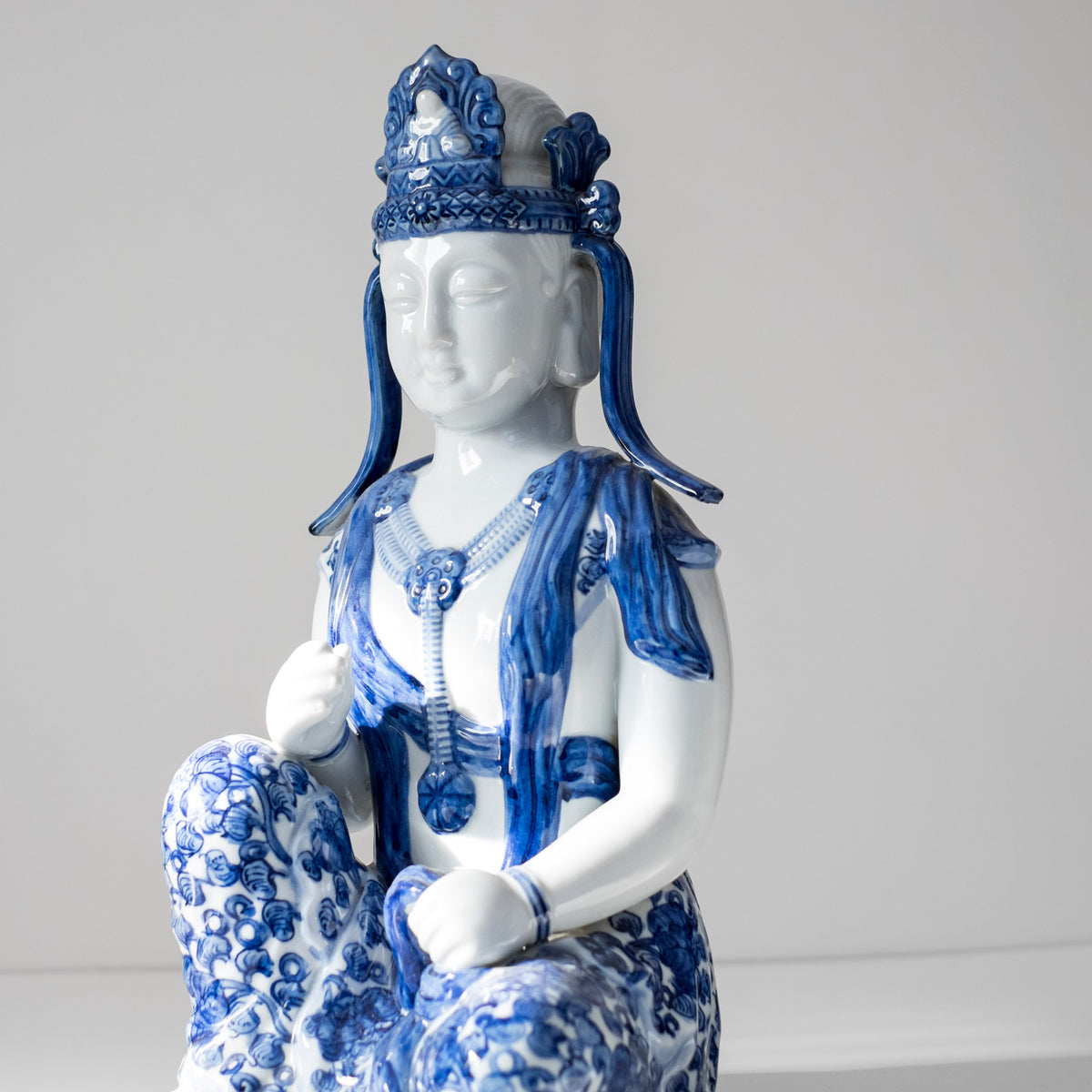
Vintage Blue White Porcelain Kannon Guanyin Statue, Seated Bodhisattva Buddhist Sculpture, Sometsuke Style Asian Art
Vintage Blue White Porcelain Kannon Guanyin Statue, Seated Bodhisattva Buddhist Sculpture, Sometsuke Style Asian Art
Couldn't load pickup availability
Have a reasonable price in mind? Submit your best offer and our concierge will review it personally.
Large Cobalt-and-White Porcelain Bodhisattva in Royal-Ease Pose with Floral Robes, Ornamental Crown and Serene Sculptural Presence
Introduction
Serene, architectural and richly detailed, this substantial blue-and-white porcelain Kannon / Guanyin figure transforms the familiar language of cobalt decoration into a fully sculptural Buddhist image.
The Bodhisattva is shown seated in an elegant relaxed posture, one knee raised while the opposite leg folds beneath the body. The pose gives the figure an unusual sense of life. Rather than appearing rigidly frontal or formally enthroned, Kannon seems quietly present, composed yet approachable, with one hand raised near the chest and the other resting naturally beside the knee.
The face is deliberately restrained. Downcast eyes, softly modeled lips, elongated ears and an almost weightless expression create the calm visual center of the sculpture. Around that pale porcelain face, progressively richer layers of cobalt ornament unfold: an elaborate crown, long hanging ribbons, draped garments, jewelry and densely painted floral trousers.
The result is beautifully balanced.
From across a room, the figure reads as a strong blue-and-white silhouette.
At closer distance, it becomes an intricate study in porcelain modeling, brushwork, Buddhist iconography and decorative pattern.
This is the kind of object capable of anchoring an entire cabinet, console, tokonoma-inspired display or meditation space without becoming visually loud. Its power comes from stillness.
The Figure of Kannon and Guanyin
Kannon is the Japanese name associated with Avalokiteshvara, the Bodhisattva of compassion, known widely in Chinese tradition as Guanyin.
Across East Asian Buddhist art, this figure became one of the most beloved embodiments of mercy and compassionate response.
Rather than representing power through aggression or command, Kannon represents the ability to recognize suffering and answer it.
That philosophy helps explain why Kannon imagery feels so different from many other sacred figures.
The expression is rarely confrontational.
The posture is rarely tense.
The figure does not dominate the viewer.
It receives them.
The sculpture offered here captures that quality especially effectively. Its gently lowered eyes and near-smile create an unusually peaceful presence, while the broad seated form gives the figure visual stability.
It feels grounded without appearing heavy.
A Relaxed Royal-Ease Pose
One of the most appealing features is the asymmetrical seated posture.
Instead of being seated in a strict cross-legged meditation position, the Bodhisattva raises one knee and allows the body to settle into a more relaxed configuration traditionally associated with forms of royal ease.
This pose has a long history in Buddhist imagery.
It communicates contemplation rather than withdrawal.
The figure remains alert to the world.
That distinction matters.
The raised knee introduces movement to the lower half of the composition, allowing the painted floral decoration to cascade across large curved porcelain surfaces.
It also gives the sculpture considerably greater three-dimensional interest than a conventional frontal devotional figure.
Viewed from the front, the body creates a triangular composition.
Viewed from either side, the raised leg projects forward and the drapery forms layers of changing depth.
From the back, the densely painted lower garment becomes an almost continuous field of cobalt flowers.
This is truly a sculpture meant to be viewed from more than one direction.
The Crown and Sacred Identity
The elaborate crown provides one of the strongest iconographic clues to the figure's identity.
At its center is a small modeled sacred figure framed within an ornamental crest.
Representations of Avalokiteshvara and Guanyin frequently incorporate an image associated with Amitabha Buddha within the crown or headdress, reinforcing the Bodhisattva's devotional connection.
Here, that small central image is surrounded by curling flame- or cloud-like forms painted in deep cobalt.
Below it runs a patterned diadem with repeating geometric decoration and a central floral medallion.
The crown is not treated simply as jewelry.
It functions almost like miniature architecture.
Vertical elements rise behind it, while long ribbon-like ornaments descend beside both ears.
Those elongated blue elements are especially elegant because they visually connect the elaborate crown to the shoulders and garments below.
They frame the pale face with cobalt on both sides, making the expression appear even more luminous.
The Face
The face is among the most successful parts of the sculpture.
Much of the surface has intentionally been left in luminous white glaze.
This restraint gives the figure an almost porcelain-like radiance in the purest sense.
Rather than outlining every facial feature in blue, the maker relied on modeling and reflected light.
The eyebrows are subtle.
The eyelids are gently lowered.
The nose is softly defined.
The mouth forms the slightest suggestion of a smile.
Large elongated ears reinforce the sacred visual vocabulary.
Because the surrounding crown and garments are densely decorated, this undecorated white face becomes even more powerful.
The eye naturally returns to it.
The composition is therefore not merely blue-and-white decoration applied everywhere indiscriminately.
There is hierarchy.
Pattern surrounds stillness.
Ornament surrounds calm.
Blue and White Porcelain Tradition
Blue-and-white porcelain is one of the most influential decorative traditions in East Asian ceramic history.
In Japan, cobalt-painted porcelain became strongly associated with traditions generally described through terms such as sometsuke, particularly within major porcelain centers producing blue-under-white decoration.
Chinese blue-and-white porcelain developed its own enormous artistic lineage, traditionally described as qinghua.
Because workshops in China and Japan influenced international ceramic taste for centuries, individual later works can sometimes blend visual conventions associated with both traditions.
That is particularly relevant here.
The statue has previously been described using Japanese Arita and Imari terminology as well as Chinese Guanyin references. Without a visible kiln or maker mark establishing a specific workshop, the more responsible presentation is as a vintage East Asian blue-and-white porcelain Kannon / Guanyin sculpture, rather than forcing an unsupported attribution to one famous production center.
That conservative description allows the quality of the object itself to remain the focus.
Cobalt Decoration
The cobalt work changes dramatically across different areas of the figure.
The shoulder robe is painted with broad flowing strokes.
The jewelry uses tighter repeating bands.
The crown combines geometric ornament and sculptural relief.
The trousers carry dense floral decoration.
The rear drapery employs washes of blue that create folds through tonal variation rather than hard outline alone.
This mixture gives the statue more painterly sophistication than a simple transfer-decorated object.
Some passages are deep navy.
Others soften into cloudy blue.
Elsewhere the pigment thins sufficiently for the white porcelain beneath to become part of the design.
The result is not flat.
Light passes across glaze, pigment and molded surfaces differently throughout the figure.
In strong daylight, cobalt areas become vivid.
Under softer interior illumination, they deepen toward indigo.
Floral Robes
The floral decoration across the seated legs is particularly rich.
Large blossoms are surrounded by smaller buds, leaves and scrolling stems, producing an almost textile-like density.
This is an important visual effect.
The porcelain imitates the complexity of woven or embroidered ceremonial fabric.
Rather than carving every textile motif deeply into the clay, painted cobalt creates layers of visual pattern across the rounded body.
The raised knee becomes almost an independent painted panel.
On the opposite side, the design continues across the lower leg and base, visually binding the figure together.
From the rear, the floral field expands again across the broad lower garment, creating one of the most decorative views of the sculpture.
The back is not unfinished.
It was clearly intended to participate in the composition.
Drapery and Garment Modeling
The upper robe is handled quite differently from the floral lower garment.
Large sweeping blue bands fall from the shoulders.
The cloth crosses the torso, turns across the back and gathers around the body.
This gives the figure a sculptural rhythm.
The painter followed the modeled folds rather than treating the body as a flat surface.
Dark cobalt accumulates in recessed areas.
Lighter blue follows raised edges.
The technique enhances the three-dimensional illusion.
The robe appears heavier where color becomes dense and lighter where porcelain remains visible.
At the back, one broad section crosses diagonally across the body before falling vertically.
That diagonal movement prevents the sculpture from becoming stiff.
Bodhisattva Jewelry
The chest carries an elaborate necklace or pectoral ornament modeled and painted directly into the porcelain.
Bands run down toward a central floral element and continue into a long pendant.
The pendant terminates around the center of the torso, creating a strong vertical axis beneath the face.
This is a small but very effective compositional decision.
The entire upper body is organized around that axis.
Crown.
Face.
Necklace.
Pendant.
Together they create a calm central line while the raised knee and flowing robes create movement around it.
The combination of symmetry and asymmetry is one of the sculpture's strongest features.
Hands and Gesture
The hands have been modeled separately from the surrounding blue garments through their pure white finish.
One hand is raised toward the chest in a composed gesture.
The other rests lower beside the body.
Their restrained positioning complements the peaceful expression.
Nothing about the sculpture feels exaggerated.
There is no dramatic gesture demanding interpretation.
Instead, the hands function as quiet extensions of the figure's meditative presence.
The fingers are simplified but gracefully modeled, consistent with the overall decorative rather than hyper-naturalistic approach.
Front, Profile and Rear Views
This figure rewards rotation.
From the front, Kannon appears formal and symmetrical above the dramatically raised knee.
From the three-quarter angle, the depth of the leg and torso becomes much more apparent.
The profile reveals the projecting crown, hanging ribbons and layered shoulder cloth.
From the back, a surprisingly elegant composition emerges.
The hair or coiffure is modeled in fine vertical ribs and gathered into a high rounded form.
The long crown ribbons descend independently on either side.
A blue floral textile panel crosses the shoulders.
One robe section sweeps diagonally across the back.
Below it, the densely painted lower garment forms an uninterrupted cobalt garden.
The rear view is therefore not simply utilitarian.
It is beautifully finished.
That makes the statue particularly effective on open shelving, central consoles or furniture where it can be viewed from several sides.
Light and Porcelain
Porcelain has a visual quality metal and stone cannot imitate.
Glaze captures light.
The white areas appear brighter than the surrounding environment.
Cobalt seems to float beneath the glossy surface.
Curved passages create moving highlights as the viewer changes position.
This object is especially responsive to directional daylight.
The forehead, cheeks, shoulders and forearms develop bright reflections.
The floral areas remain darker and more textured.
The glazed crown produces small points of reflected light.
The contrast gives the statue a subtle sense of animation even though the figure itself remains perfectly still.
Sometsuke Aesthetic
Collectors of Japanese blue-and-white ceramics will immediately recognize why the term sometsuke style is useful in describing the visual effect.
The power of sometsuke does not depend on multiple colors.
Its sophistication comes from the relationship between cobalt and empty porcelain.
Blue does not simply decorate white.
White actively shapes the composition.
That principle is particularly visible here.
The face remains white.
The arms remain largely white.
The torso retains large undecorated areas.
Cobalt is concentrated strategically across clothing, crown and ornament.
The sculpture therefore retains remarkable visual clarity despite the density of decoration.
Japanese and Chinese Visual Interchange
Kannon and Guanyin imagery traveled through Buddhist networks for centuries.
So did ceramic technology.
So did blue-and-white decoration.
Later porcelain figures can therefore contain visual elements that resist simple national categorization.
The present work is an excellent example of why that matters.
Its subject is equally legible as Kannon within Japanese Buddhist vocabulary and Guanyin within Chinese Buddhist vocabulary.
Its cobalt decoration belongs to the enormous East Asian blue-and-white ceramic tradition shared across cultural borders.
Its form can be appreciated without forcing it into an attribution that has not been independently verified.
That ambiguity can actually make it more interesting.
It exists at an artistic crossroads.
A Sculpture of Compassion
Beyond ceramic history, the emotional center of the piece remains the figure itself.
Kannon is associated with compassion.
Not abstract compassion.
Responsive compassion.
The willingness to perceive suffering and answer it.
That makes Kannon imagery unusually adaptable.
For a Buddhist practitioner, the figure can function devotionally.
For a collector, it may represent East Asian religious art.
For an interior designer, it becomes a powerful blue-and-white sculptural centerpiece.
For someone drawn to the symbolism rather than formal practice, it can represent mercy, patience and calm.
The object does not need a single mode of appreciation.
Display Possibilities
This piece would be especially compelling against dark wood, where the porcelain body can glow against the background.
A black or dark lacquer platform would intensify the cobalt.
Natural oak would create a quieter Japanese-inspired presentation.
A neutral plaster or stone wall would bring the silhouette forward.
It could anchor a blue-and-white porcelain collection while still remaining visually distinct from ordinary bowls, chargers and vases.
It would also work beautifully alone.
A single sculptural object often has greater power than an overcrowded display.
The figure already contains enough line, color, symbolism and ornament to fill a visual field by itself.
Tokonoma-Inspired Presentation
For a Japanese-influenced display, the statue can be treated much like a singular seasonal or contemplative object.
Leave space around it.
Avoid competing patterns immediately behind it.
Allow the profile of the crown ribbons and raised knee to remain visible.
A restrained textile, small flower arrangement, low bronze object or simple scroll can complement the sculpture without competing with it.
Its cobalt color also works particularly well with indigo textiles, warm timber and muted natural materials.
Collector Positioning
This figure sits naturally at the intersection of several collecting categories.
It appeals to collectors of Buddhist sculpture.
It appeals to blue-and-white porcelain collectors.
It fits Asian decorative arts collections.
It complements Japanese-inspired interiors.
It belongs comfortably beside other Kannon and Guanyin imagery.
Its three-dimensional scale gives it substantially greater visual impact than a small porcelain figurine.
The dense hand-painted appearance of the lower robes also means it functions as ceramic painting as much as ceramic sculpture.
For a collector who normally buys blue-and-white jars, dishes and vases, this is an especially attractive way to add figurative form to the collection.
Attribution and Period
The exact kiln and date have not been established from the currently available photographic evidence.
For that reason, this listing intentionally avoids presenting the figure as definitively Arita, Imari or Jingdezhen manufacture.
Its materials, modeling and decoration are consistent with 20th-century East Asian porcelain production, and it is best offered conservatively as a vintage blue-and-white porcelain Kannon / Guanyin figure unless additional maker marks, box inscriptions or provenance allow a more precise attribution.
This approach protects the integrity of the object.
The sculpture has enough visual merit that it does not require an unsupported famous-kiln attribution.
Condition
The figure presents beautifully in the supplied photographs, with a glossy white porcelain body and richly preserved cobalt decoration.
The sculptural details of the crown, long side ribbons, hands, jewelry, floral garments and modeled facial features remain visually strong.
As with any vintage ceramic object, buyers should review the photographs carefully for glaze variation, firing irregularities, light rubbing, minor surface marks, age-related wear or other small characteristics associated with older porcelain.
The crown projections, long hanging ornaments and hands are naturally among the more delicate areas and should be handled carefully.
No specific kiln mark or underside image has been incorporated into the present identification, so attribution remains intentionally broad.
The photographs form an important part of the condition description.
Purchase, Shipping and Vintage Policy
This is a vintage collectible and is offered in its existing condition as photographed. Older porcelain can naturally show slight glaze variation, firing marks, surface rubbing, crazing, tiny production irregularities or age-related traces that distinguish vintage ceramic work from newly manufactured factory-perfect décor.
We make every reasonable effort to represent the object accurately through detailed photographs and description. Buyers are warmly encouraged to review all photographs before purchase and contact us if a specific condition point is important.
Some items in our collection have a little room for negotiation while others are more firmly priced. Respectful offers are always welcome and considered individually.
Preparation, shipping and handling normally takes 5–10 business days or earlier whenever possible. Fragile ceramic sculptures are packed with particular attention to projecting details and double-boxed when appropriate for international transit.
International buyers are responsible for any customs duties, taxes, brokerage fees or other destination-country charges unless otherwise stated.
If you are looking for this design or model in another size, please feel free to message us. Although availability cannot be guaranteed, we may be able to locate the same or a closely matching piece in a different size through our sourcing network.
Closing
Blue-and-white porcelain is often associated with vessels.
Bowls.
Vases.
Jars.
Plates.
Here, that familiar visual language becomes a person.
Cobalt flowers become clothing.
Brushstrokes become folds.
White porcelain becomes skin.
The silhouette of a jar is replaced by the quiet presence of a Bodhisattva.
That transformation is what makes this sculpture so compelling.
It carries the visual refinement of blue-and-white ceramics, yet it also possesses the emotional gravity of sacred imagery.
The result is simultaneously decorative and contemplative.
A richly painted object from a distance.
A serene Kannon up close.
A sculpture that becomes quieter the longer one looks at it.
#Kannon #Guanyin #KannonBosatsu #Avalokiteshvara #BlueWhitePorcelain #BlueAndWhitePorcelain #PorcelainKannon #PorcelainGuanyin #BuddhistArt #BuddhistStatue #Bodhisattva #AsianBuddhistArt #AsianPorcelain #JapaneseInspired #JapaneseDecor #JapaneseArt #JapaneseCeramics #Sometsuke #SometsukeStyle #CobaltPorcelain #CobaltBlue #PorcelainSculpture #PorcelainFigurine #VintagePorcelain #VintageAsianArt #AsianAntiques #AsianCollectibles #SacredArt #SpiritualDecor #MeditationDecor #MeditationSpace #HomeAltar #BuddhistAltar #ZenInterior #ZenDecor #Compassion #GoddessOfMercy #BlueWhiteDecor #PorcelainCollector #CeramicCollector #CeramicArt #AsianDecor #EastAsianArt #OrientalArt #CollectorDecor #StatementSculpture #FloralPorcelain #CobaltArt #ReligiousArt #ContemplativeArt
blue white kannon, guanyin statue, porcelain kannon, buddhist statue, cobalt porcelain, sometsuke style, bodhisattva art, asian porcelain, vintage guanyin, buddhist decor, porcelain statue, meditation decor, blue white decor
Material Tags
porcelain, glazed porcelain, white porcelain, cobalt pigment, cobalt blue underglaze style, ceramic, fired ceramic, glossy glaze, hand-painted style decoration, molded porcelain, sculpted ceramic, blue and white porcelain, painted ceramic, glazed ceramic sculpture, decorative porcelain