Rare Vintage, Antiques and Art Collector / Curator / Personal Shopper From Japan
Vintage AJOP “Japan The 23th State / Last Frontier” Eagle Embroidered Sukajan Souvenir Jacket | Blue Silver Japanese Yokosuka Bomber | Tag Size 150
Vintage AJOP “Japan The 23th State / Last Frontier” Eagle Embroidered Sukajan Souvenir Jacket | Blue Silver Japanese Yokosuka Bomber | Tag Size 150
Couldn't load pickup availability
Rare Blue & Silver Japanese Souvenir Jacket with Eagle, Cloud & “Japan The 23th State / Last Frontier” Embroidery
Description
A wonderfully unusual piece of vintage Japanese souvenir-jacket culture, this AJOP sukajan / Yokosuka-style bomber jacket combines a classic glossy satin appearance with an eccentric embroidered interpretation of Japan imagined through American frontier imagery.
Finished primarily in a rich deep navy-to-steel blue satin with contrasting silver-gray / ivory side and sleeve panels, the jacket carries embroidered eagle imagery to the chest and a much more elaborate narrative composition across the back.
The central rear embroidery reads:
Japan
THE 23TH STATE
LAST FRONTIER
The original embroidery uses the unusual wording “23TH” exactly as shown on the garment, an idiosyncratic detail that gives the piece considerable charm and individuality.
Around the lettering appear fantastical embroidered creatures and stylized cloud forms, including an eagle-like bird perched dramatically across a branch or ground line and a second mythic creature emerging through clouds. The imagery blends American eagle symbolism, Japanese souvenir culture, frontier mythology and East-West visual crossover into a jacket that feels unmistakably connected to the history of Japanese Americana.
Rather than being a conventional tiger, dragon or Mt. Fuji sukajan, this example tells a much stranger story.
It imagines Japan almost as an exotic frontier territory, filtered through the same postwar cultural exchange that made the sukajan itself possible.
That makes it particularly appealing for collectors looking for something outside the familiar mainstream motifs.
A Distinctive Piece of Japanese Americana
The sukajan developed from the extraordinary cultural encounter between postwar Japan and American military personnel stationed in the country.
Japanese embroidery workshops began decorating satin bomber-style garments with motifs that foreign servicemen could take home as souvenirs:
- dragons
- tigers
- eagles
- Mt. Fuji
- maps of Japan
- cherry blossoms
- geisha
- military insignia
- regional names
- oriental landscapes
Over the decades, this hybrid garment evolved far beyond souvenir clothing and became a major pillar of Japanese streetwear, rockabilly fashion, biker culture, punk styling and modern Japanese Americana.
This jacket embraces that cross-cultural identity quite literally.
An American-style eagle and “Last Frontier” language coexist with Japan proudly written across the back, creating a piece that feels both American and Japanese without belonging completely to either visual tradition.
That cultural tension is precisely what makes a good sukajan interesting.
Identification
Brand: AJOP / label reads “AJOP”
Garment Type: Japanese souvenir jacket / sukajan / Yokosuka-style bomber
Tag Size: 150
Primary Color: Deep blue / navy blue
Contrast Color: Silver-gray / light ivory
Closure: Full front zipper
Collar: Rib-knit varsity / bomber collar
Cuffs: Rib-knit
Hem: Rib-knit
Pocket Style: Angled front welt pockets
Chest Decoration: Embroidered eagle / bird motif with “Japan” lettering
Back Decoration: Multi-element embroidered composition
Rear Text: “Japan / THE 23TH STATE / LAST FRONTIER”
Visual Themes: Japan, eagle, clouds, frontier, Americana, souvenir culture
Style: Sukajan / souvenir jacket / Yokosuka bomber / Japanese Americana
Era: Vintage / older Japanese fashion piece, exact production year not confirmed
The Back Artwork
The rear panel is unquestionably the centerpiece.
The embroidered word:
Japan
sits prominently at the top in red-accented lettering.
Below it appears:
THE 23TH STATE
followed by:
LAST FRONTIER
The original grammatical irregularity, “23TH” rather than “23rd,” has been preserved exactly as embroidered.
For collectors of vintage Japanese clothing, details like this can be fascinating because they capture the imperfect but highly creative way Western language and imagery were sometimes absorbed into Japanese fashion.
Rather than correcting the phrase, the embroidery becomes a cultural artifact in itself.
Surrounding the typography are expressive embroidered creatures rendered in green, red, gold and cream against the blue satin ground.
The lower-right motif resembles an eagle or stylized predatory bird with bright red and green wings, while the upper-left imagery incorporates a more fantastical creature among stylized cloud formations.
Together they give the back the feeling of a fictional heraldic landscape.
Eagle Symbolism
The eagle became one of the defining motifs of Japanese souvenir jackets precisely because it translated so naturally between cultures.
Within American imagery, the eagle represents:
- strength
- freedom
- military power
- independence
- national identity
- aviation
Within Japanese sukajan culture, however, the eagle became something slightly different.
It became part of the vocabulary of American-style rebellion as interpreted through Japanese craftsmanship.
Placed against satin and surrounded by Japanese embroidery techniques, the eagle stops being merely an American emblem and becomes part of a uniquely Japanese street-fashion language.
This jacket makes that cultural crossover particularly visible.
“The Last Frontier”
The phrase “Last Frontier” gives the jacket another fascinating layer.
Rather than presenting Japan only through temples, dragons or Mt. Fuji, the embroidery borrows language associated with exploration, wilderness and faraway territories.
This suggests an imagined Japan seen through romanticized American eyes:
distant, exotic, untamed and adventurous.
The result resembles the fantasy geography often found on vintage souvenir pieces, where historical accuracy matters less than atmosphere.
It is not documentary imagery.
It is storytelling through clothing.
Color & Visual Character
The combination of deep blue and silvery white gives this jacket a particularly clean vintage sporting appearance.
Blue Body
The body has a rich satin sheen that shifts from navy to steel blue depending upon lighting.
Silver / Ivory Panels
The side and sleeve inserts provide strong contrast without overwhelming the jacket.
Ribbing
Blue and light gray striped ribbing reinforces the vintage varsity / bomber influence.
Embroidery
Red, green, gold, cream and muted earth tones add restrained color across the back.
The palette feels considerably calmer than many heavily multicolored sukajan jackets, making this example surprisingly wearable despite its unusual rear artwork.
Front Design
The front remains relatively restrained.
A small embroidered eagle / bird appears over the chest together with the word:
Japan
This smaller emblem creates visual continuity with the larger imagery across the rear.
The front also uses contrasting silver-gray side panels that travel from shoulder through the sleeves, producing an elongated athletic silhouette reminiscent of both vintage track jackets and classic souvenir bombers.
Angled pockets keep the design practical while preserving the clean front composition.
Construction
The jacket displays many of the details associated with traditional sukajan and Japanese souvenir-jacket styling:
- glossy satin-style body
- raglan-inspired shoulder treatment
- contrast sleeves / side stripes
- ribbed striped collar
- ribbed striped cuffs
- ribbed striped waistband
- full front zipper
- embroidered chest emblem
- large embroidered back composition
- short bomber-jacket silhouette
- relaxed vintage proportions
The light-catching surface gives the jacket a different character depending on illumination.
Under stronger light, the blue becomes vivid and almost electric.
Under subdued light, it settles into a darker naval tone.
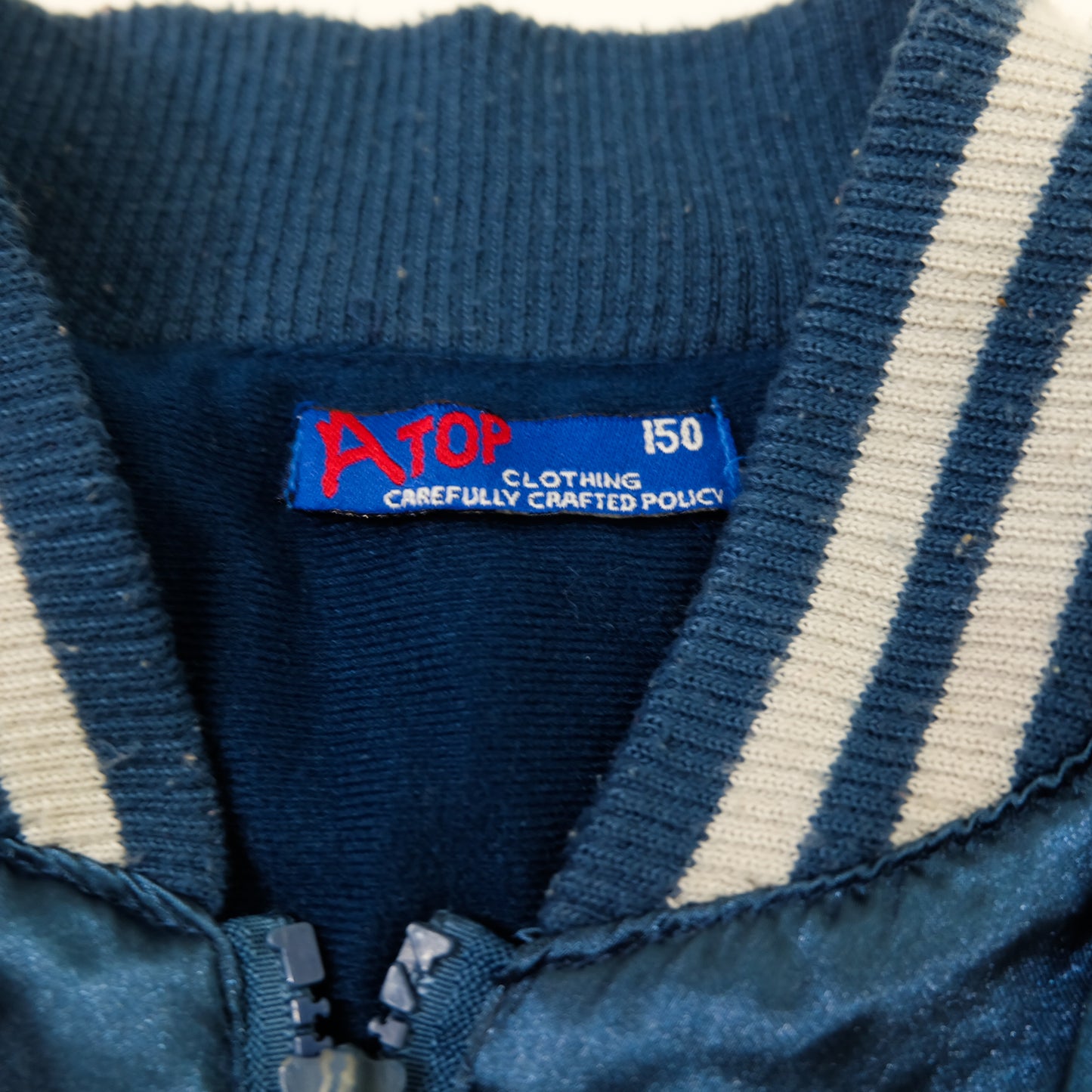
Brand Label
The internal woven label reads approximately:
AJOP
CLOTHING
CAREFULLY CRAFTED POLICY
with:
150
shown as the manufacturer's size.
The brand itself appears to be a comparatively obscure Japanese fashion label, which adds another layer of interest for collectors drawn to lesser-seen vintage Japanese manufacturers rather than only the major modern reproduction houses.
Size
Manufacturer’s Tag Size: 150
Japanese size 150 is generally associated with garments intended around the 150 cm height range and is commonly encountered in youth sizing.
However, vintage Japanese sizing varies significantly by brand, era and garment pattern.
For that reason, the numerical tag should not be treated as an exact modern international equivalent.
Depending on the buyer's body dimensions and preferred silhouette, this could potentially also appeal to smaller adult wearers seeking a cropped or fitted vintage bomber look.
Please prioritize actual garment measurements whenever available.
If additional flat measurements are supplied, compare them against a jacket you already own for the most reliable fit assessment.
Approximate Measurements
Detailed flat measurements are not presently supplied in the available information.
When measurements are added, they should be treated as the primary sizing reference.
Suggested points to compare:
A: Overall length
B: Chest / pit-to-pit
C: Sleeve / center-back sleeve measurement
D: Shoulder or relevant guide measurement
E: Hem / lower width
Please refer to the corresponding measurement diagram used with the listing photographs.
Condition
Vintage Pre-Owned Condition
This is a vintage garment and naturally displays characteristics consistent with previous ownership, use and storage.
From the photographs, the jacket presents with attractive overall vintage character while retaining:
- strong blue coloration
- highly readable rear embroidery
- good visual definition to the eagle motifs
- intact ribbed collar
- intact cuffs and waistband
- functional-looking front zipper
- recognizable satin sheen
- well-preserved overall design integrity
Natural vintage characteristics may include:
- light creasing
- age-related wrinkling
- minor surface wear
- slight color variation
- minor marks
- textile aging
- gentle wear around ribbing
- small imperfections associated with a previously worn vintage satin jacket
These characteristics contribute to the garment's vintage identity rather than detract from its appeal as an older collectible piece.
Please examine all photographs carefully as they form an important part of the condition description.
Period & Cultural Context
The exact production year is not confirmed from the available label alone.
Stylistically, however, the jacket belongs firmly within the broad Japanese souvenir-jacket tradition that developed from postwar Yokosuka embroidery culture and continued through later Japanese Americana fashion.
Its relatively straightforward satin construction, unusual English phrasing and less-commercialized imagery give it the feel of an older domestic Japanese piece rather than a contemporary high-fashion interpretation.
It carries precisely the slightly eccentric visual vocabulary that makes vintage Japanese clothing so enjoyable to collect.
Sukajan, Yokosuka Jumper & Souvenir Jacket
The term sukajan derives from the Japanese contraction historically associated with Yokosuka jumper, referring to the satin souvenir jackets that became closely linked with the naval port city of Yokosuka.
Over time, the category expanded to include jackets decorated with virtually every imaginable combination of Japanese and American imagery.
Today, sukajan are collected internationally as:
- vintage military-adjacent fashion
- Japanese streetwear
- rockabilly clothing
- biker fashion
- punk fashion
- Americana
- embroidery art
- souvenir culture
- wearable art
This example is particularly appealing because its imagery returns directly to the cultural collision that created the genre.
Japanese Americana
Few garments embody Japanese Americana more perfectly than the sukajan.
The jacket takes a Western bomber silhouette and transforms it through Japanese textile craft.
American symbols enter Japan, are reinterpreted, stylized and embroidered, and then return to international fashion in a completely new form.
The process is circular.
American military clothing inspires Japanese souvenir makers.
Japanese embroidery transforms the clothing.
Japanese street culture adopts the result.
Western collectors later rediscover the Japanese interpretation.
This AJOP jacket captures that cultural loop beautifully.
Why This Piece Stands Out
Many modern sukajan rely on familiar motifs:
- tiger
- dragon
- koi
- Hannya
- Mt. Fuji
Those are beautiful, but increasingly common.
This jacket is different.
Its fascination lies in the strange proclamation:
JAPAN THE 23TH STATE
combined with:
LAST FRONTIER
and distinctly American eagle imagery.
It is exactly the type of unusual graphic concept that becomes more interesting with age because it documents a particular form of cultural imagination.
Wearable Art
Seen purely as fashion, this is an excellent lightweight statement jacket.
Seen as design history, it becomes more interesting.
The satin surface functions as a canvas.
Typography, animal imagery and symbolism interact across the back while the front remains comparatively restrained.
That balance allows the wearer to appear relatively understated from the front before revealing the full composition from behind.
It is classic souvenir-jacket theater. 🎴
Styling Potential
This jacket works particularly well with:
- dark indigo denim
- faded Japanese denim
- black jeans
- wide-leg trousers
- military chinos
- white T-shirt
- vintage sneakers
- Converse-style canvas shoes
- engineer boots
- loafers
- rockabilly styling
- streetwear layering
Because of the blue and silver palette, it is also easier to coordinate than many brighter red or gold sukajan pieces.
Display & Collection Value
Beyond wearability, the jacket has strong display potential.
The unusual back typography means it immediately sparks conversation when displayed on:
- a mannequin
- a vintage clothing rack
- a collector wall
- a boutique display
- a Japanese Americana room
- a rockabilly interior
- a streetwear archive
Collectors increasingly appreciate not only famous brands but also unusual surviving pieces that document the broader ecosystem of Japanese fashion.
This jacket fits that category beautifully.
Why Collect This Jacket?
Because it possesses qualities that cannot easily be reproduced through modern mass-market clothing.
It offers:
- an unusual vintage Japanese brand
- rare “Japan The 23th State” embroidery
- “Last Frontier” wording
- eagle imagery
- strong souvenir-jacket identity
- classic satin bomber construction
- blue and silver color combination
- vintage Japanese sizing
- distinctive East-West cultural crossover
- excellent wearable-art potential
- unusually memorable typography
- strong Japanese Americana character
For a collector who already owns the predictable dragon, tiger and koi designs, this is exactly the sort of eccentric piece that adds personality to a collection.
Purchase, Shipping and Vintage Policy
This is a pre-owned vintage collectible garment and is offered in its present condition.
Please carefully inspect all photographs before purchasing. Vintage garments naturally may show signs of previous wear, storage, textile aging, minor marks, fading, creasing, surface variation or other age-related characteristics.
These are not modern factory-new garments and should be appreciated accordingly.
Sizing on vintage Japanese clothing often differs substantially from contemporary Western sizing. Please use actual garment measurements whenever available rather than relying exclusively on the manufacturer’s numerical size.
No returns, exchanges or claims can be accepted on the basis of normal vintage characteristics, subjective fit preference, age-related wear or condition details clearly represented in the photographs and description.
Worldwide tracked international shipping is available, including EMS where appropriate.
Preparation, shipping and handling normally takes 5–10 business days or earlier.
Respectful offers may be considered.
If you are looking for this design or model in another size, please feel free to message us. Although availability cannot be guaranteed, we may be able to locate the same or a closely matching piece in a different size through our sourcing network.
#Sukajan #VintageSukajan #YokosukaJacket #SouvenirJacket #JapaneseJacket #JapaneseVintage #JapanJacket #EagleJacket #VintageBomber #SatinJacket #JapaneseAmericana #AmericanaStyle #YokosukaJumper #JapanSouvenir #EmbroideredJacket #VintageJapan #RockabillyJacket #BikerFashion #JapaneseStreetwear #VintageStreetwear #JapanFashion #SouvenirBomber #EagleEmbroidery #LastFrontier #WearableArt #VintageJapanese #CollectorJacket #BomberJacket #JapanEmbroidery #RareSukajan
vintage sukajan, sukajan jacket, eagle sukajan, japan souvenir, yokosuka jacket, satin bomber, japanese jacket, vintage japan, eagle jacket, souvenir jacket, japan americana, embroidered jacket, vintage bomber
Material Tags
Satin Style Fabric, Embroidery Thread, Rib Knit, Metal and Resin Zipper Components, Polyester Textile, Vintage Japanese Textile