Rare Vintage, Antiques and Art Collector / Curator / Personal Shopper From Japan
Vintage 1982 Johnsons La Rocka Sky Bandit Leather Flying Jacket King’s Road London Rare
Vintage 1982 Johnsons La Rocka Sky Bandit Leather Flying Jacket King’s Road London Rare
Couldn't load pickup availability
Have a reasonable price in mind? Submit your best offer and our concierge will review it personally.
A JOHNSONS LA ROCKA BLACK LEATHER FLYING JACKET, LONDON, 1982
King’s Road subculture piece with “Sky Bandit” reverse, large-scale graphic appliqué, and exceptional preservation
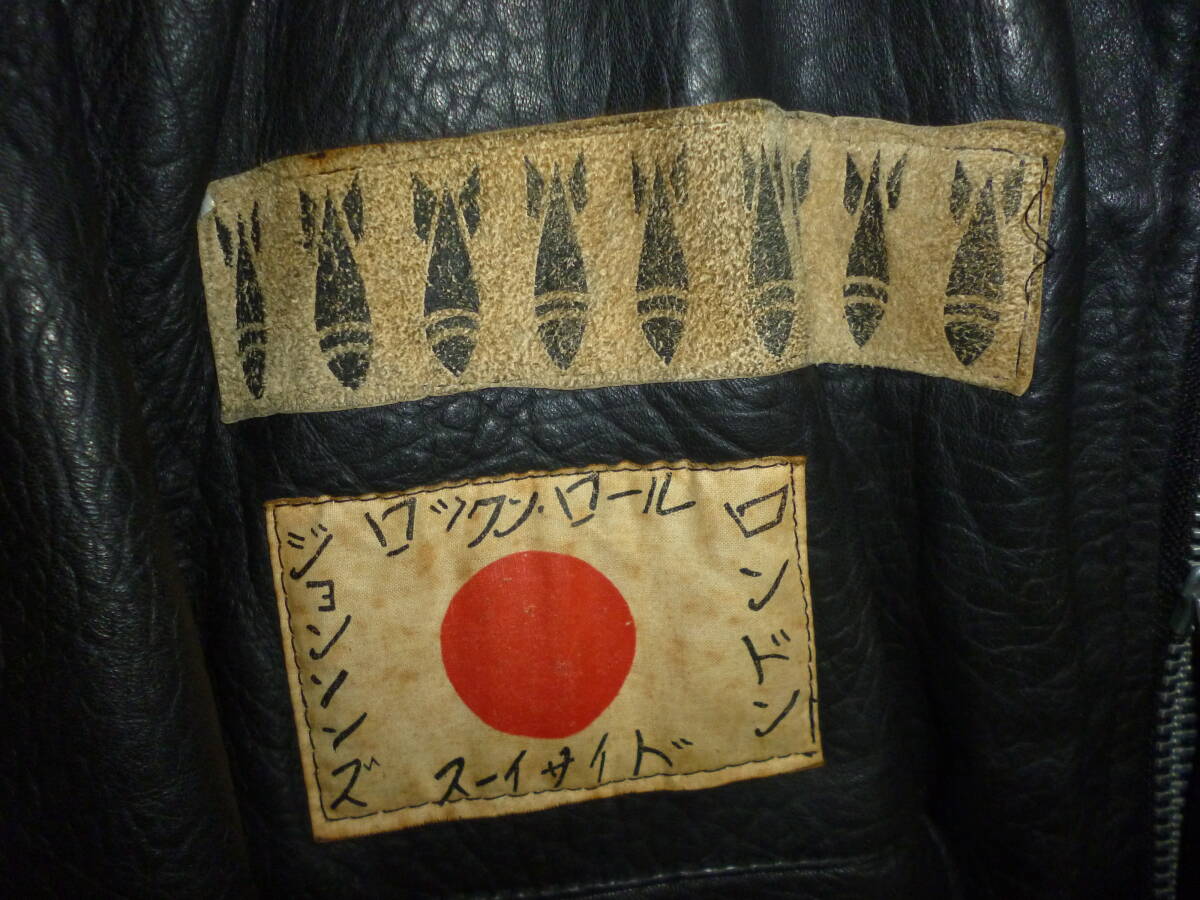
A black leather flying jacket by Johnsons La Rocka, acquired on London’s King’s Road in 1982 and distinguished by a large-scale reverse composition reading “Sky Bandit,” incorporating aviator-skull imagery, Gothic script, and bold red-and-cream panel work. The front carries additional insignia and flag-derived motifs, extending the jacket’s subcultural graphic language while preserving the structural clarity of the bomber silhouette. Unlike many surviving examples of comparable date and scene origin, the present jacket remains in near-unused condition, with unusually strong surface integrity and preserved visual force. It stands as a compelling artifact of early 1980s British style culture, where leather outerwear functioned not merely as clothing but as a form of coded allegiance and public identity.
Object
Johnsons La Rocka black leather flying jacket
Brand / Maker
Johnsons La Rocka
King’s Road, London
Production Era
1982 purchase-era example
Early 1980s British subcultural leather
Category
Graphic subculture leather jacket / rockabilly-punk flying jacket
Material
Black leather shell
Ribbed waistband and cuffs
Zip-front flying-jacket body
Large-scale multi-piece appliqué / graphic panel work
Style Basis
Flying-jacket / bomber-jacket silhouette reworked through London subculture design language
Graphic / Surface Context
Back:
- oversized “Sky Bandit” composition
- aviator skull / helmet iconography
- rising-sun / roundel-like red and cream field
- large Gothic lettering
- heavy theatrical patch / panel construction
Front:
- additional chest insignia and panel work
- Japanese flag-derived motif
- graphic patch language consistent with La Rocka’s hybrid Americana / militaria / biker / rock’n’roll vocabulary
Size
No tag size present
Measured Fit
Length: approx. 61 cm
Sleeve: approx. 63 cm
Chest: approx. 57 cm
Shoulder: approx. 48 cm
Condition Summary
Stated as try-on only / deadstock-level preservation
Exceptionally clean for period
Overall presentation reads near-unused and highly collector favorable
Object Classification
Not ordinary vintage fashion
Not generic biker leather
A first-order British subculture artifact from the King’s Road ecosystem
COLLECTOR RELEVANCE
Tier: Major British Subculture Leather / High Collector Category
This piece is for:
- Johnsons / La Rocka collectors
- King’s Road fashion historians
- punk / psychobilly / rockabilly archive buyers
- subculture garment collectors
- leather-jacket collectors who understand scene provenance
This piece is not for:
- ordinary fashion buyers comparing it to generic leather bombers
- minimalist wardrobes
- buyers who want anonymous luxury rather than explicit identity
This is for the collector who understands that the best subculture garments are not just worn. They are witnesses.
CONFIDENCE & VERIFICATION NOTES
Strong positives
- purchase provenance anchored to Johnsons, King’s Road, 1982
- condition appears exceptionally strong
- back graphic is major and memorable
- silhouette remains clean and wearable
- maker and period combination is culturally serious
Not Just a Jacket, but a Piece of King’s Road Language
The first and most important thing is that this is not simply “vintage leather.” That phrase is far too small for what Johnsons La Rocka represents. La Rocka garments belong to a very specific ecosystem: King’s Road, post-punk London, rockabilly revival, fetish-informed tailoring, biker attitude, and a graphic confidence that refused ordinary fashion restraint.
This jacket comes directly from that world.
That matters because provenance here is not background detail. It is the object’s bloodstream. “Bought in 1982 at Johnsons on King’s Road” is not a casual anecdote. It is the kind of provenance that transforms a good jacket into a real cultural artifact.
Why Johnsons La Rocka Matters
Johnsons and La Rocka sit in a rare zone where retail history, music history, and style mythology overlap. These are not garments that simply reflected a trend. They helped define the visual grammar of a tribe. That is why the label continues to matter across punk, psychobilly, rockabilly, underground fashion, and collector circles.
A La Rocka piece is never just about:
- leather
- fit
- condition
It is also about:
- scene
- attitude
- location
- symbolic aggression
- street-authored glamour
That is what gives the jacket its weight.
The “Sky Bandit” Back Is the Whole Theater
The back is the event. And it should be.
The large “Sky Bandit” composition operates like a stage poster stitched into leather. Skull-aviator imagery, rising-sun structure, cream-and-red panel field, and Gothic lettering all collide in a way that is too loud for mainstream fashion and exactly right for La Rocka.
This is critical:
the back does not read as merely decorative. It reads as identity declaration.
That is the difference between vintage graphic leather and subcultural armor.
The wearer is not dressing.
The wearer is announcing alignment.
Flying-Jacket Form, Subculture Soul
The flying-jacket silhouette is an intelligent choice because it gives the jacket authority before the graphics even begin. A weak body could never carry this much imagery. But the bomber / flying-jacket base gives the piece:
- masculine structure
- shoulder command
- visual compression at the waist
- enough military-adjacent force to support theatrical embellishment
In other words, the jacket has bones strong enough for the graphics.
That is why it works.
The Japanese Flag Motif and Why It Fits
In ordinary design terms, the mix of aviator, skull, Japanese-flag language, and Gothic script could feel confused. In La Rocka terms, it feels correct. Johnsons often worked by collaging symbolic power rather than obeying neat historical boundaries. The point was not documentary coherence. The point was charge.
That charge is present here.
The front insignia and Japanese flag field contribute to the jacket’s total symbolic aggression. They widen the object’s visual vocabulary without weakening the back. This is difficult to do well. Here, it lands.
Why Condition Changes Everything
Condition is the other great threshold. If this were heavily worn, cracked, or scene-battered, it would still matter, but in a different way. It would be a relic. What makes this example more dangerous in the market is that it remains near deadstock. That changes the whole buyer experience.
A clean early La Rocka example offers:
- purity of form
- clarity of color
- integrity of appliqué
- minimal compromise
- display power without restoration anxiety
That is extraordinarily important, because subcultural garments often survive through use, sweat, nightlife, smoke, alteration, and attrition. To find one this clean with direct-era provenance is a different collector proposition altogether.
Why This Is Better Than Generic “Rock’n’Roll Leather”
Because it is anchored.
There are many jackets that try to look rebellious. Very few actually come from one of the real streets where these visual languages were built and sold. This one does. And that gives it a density that reproduction, tribute, or later imitation cannot fake.
The difference is subtle to outsiders and enormous to collectors.
This jacket does not borrow the mood.
It belongs to the source.
The Size and Wearability Factor
The measured dimensions place it in a healthy zone. It is not trapped in tiny archive-only sizing, nor does it become oversized enough to distort the body language. That matters because La Rocka garments depend on silhouette. If the fit goes wrong, the whole spell weakens.
Here, the dimensions suggest a jacket that can still function:
- on a collector’s body
- on a mannequin
- in a fashion archive
- in editorial or exhibition use
That flexibility strengthens liquidity.
MATERIAL FORENSICS
Leather Shell
The shell appears extremely well preserved, and this matters more here than in many military jackets. The leather is supposed to remain a crisp stage for the graphic work. Once the shell collapses, the appliqué loses power. Here, the shell still reads clean, stable, and structurally sharp.
Points that matter:
- body line remains disciplined
- waistband still controls the silhouette
- leather has not drifted into tired softness
- presentation supports collector confidence immediately
Graphic Back Panel
The back panel is the premium driver. It appears bright, whole, and compositionally intact. That is central to valuation. If the back were damaged, the jacket’s identity would drop sharply. Here, it remains commanding.
Front Panels and Insignia
The front continues the narrative without overloading the body. This balance is often where loud subculture jackets fail. Here, the front still functions as a jacket, not merely a preview of the back.
Interior and Preservation
The interior appears remarkably calm for the period and category. On early 1980s underground or scene-adjacent garments, this kind of preservation is a true premium indicator.
Authenticity & Stewardship
Evaluated under the Japonista Aviation & Military Garment Authentication Framework™
Each work is examined through a structured, multi-layered assessment:
• Model classification and military typology verification (A-2, B-3, MA-1, G-1, L-2, etc.)
• Material evaluation across leather, shearling, nylon, wool, and mixed components
• Hardware inspection including zippers, snaps, and period-correct fastenings
• Graphic and nose art analysis, including paint method, iconography, and historical alignment
• Condition and structural integrity review, including wear patterns consistent with age and use
Where applicable, contract labels, manufacturer markings, and period construction details are reviewed to confirm authenticity and era alignment.
Guaranteed 100% Authentic.
All garments are curated and backed by the Japonista Lifetime Authenticity Warranty™, with emphasis on both material truth and historical accuracy.
A Note on Flight Jackets, Service & Visual Identity
Military flight jackets were engineered as functional equipment—designed for temperature regulation, durability, and survival in demanding conditions. Over time, they evolved into carriers of identity, memory, and personal expression.
Nose art and painted jackets—originally applied to aircraft and later to garments—represent a distinct form of visual folklore. Pin-up figures, squadron insignia, mascots, and symbolic imagery transformed standard-issue equipment into individualized statements of presence and morale.
At Japonista, these jackets are approached as wearable military artifacts. Surface wear, leather creasing, paint aging, and textile fatigue are evaluated as evidence of lived history rather than imperfection.
We preserve these works with restraint—allowing their material narrative to remain visible and intact.
Our role is to connect these garments with collectors who recognize their dual nature as both functional objects and historical documents.
Inquiries, Availability, and Private Consideration
Many flight jackets are singular in character due to condition, paintwork, contract variation, or production era. Certain pieces are held firmly due to rarity, historical resonance, or preservation status.
All inquiries are handled discreetly, and we welcome thoughtful discussion regarding provenance, contract details, nose art interpretation, and long-term wear or display considerations.
Collectors building focused archives—by model type, era, or graphic style—may consult with us for deeper guidance.
Concierge Support & Collector Guidance
Japonista Concierge™ provides tailored assistance for collectors seeking deeper engagement with aviation garments:
• Model and contract identification (A-2 variants, G-1 lineage, MA-1 evolution)
• Leather and textile preservation guidance
• Paint conservation and display considerations
• Wearability versus archival preservation assessment
• Strategic acquisition planning for aviation-focused collections
For select rare or historically significant works, private reservation or structured acquisition arrangements may be available on a case-by-case basis.
Before Proceeding
We encourage collectors to review our shop policies and house guidelines, available through the links in our website footer. These outline shipping protocols, handling considerations, and condition standards specific to vintage leather, painted garments, and military-issued clothing.
Understanding these guidelines supports responsible stewardship of each piece.
A Closing Note
Flight jackets occupy a distinct place within material history. They are objects of function shaped by environment, and over time, transformed into records of identity, service, and expression.
Nose art—whether applied to aircraft or garments—extends this narrative, capturing moments of humor, defiance, and individuality within structured military life.
At Japonista, we steward these works as aviation artifacts in wearable form—ensuring they continue their journey with collectors who understand both their construction and their story.
If you have questions or wish to explore related items, please feel free to contact Japonista Concierge™ at any time.