


US Navy WEP Winter Flying Jacket, Aviators Clothing Co. MIL-S-18342B, VMFP-3 RF-4B Phantom Iwakuni Patches, 42 Long
US Navy WEP Winter Flying Jacket, Aviators Clothing Co. MIL-S-18342B, VMFP-3 RF-4B Phantom Iwakuni Patches, 42 Long
- Dispatch
- Prepared and sent from Tokyo within 7–14 days, often sooner, or as arranged
- Arrival
- United States · usually 4–7 days after dispatch, insured and tracked
- Import
Duties and customs · View the estimate
A guide for this piece: about $165, based on the 10% US charge on the declared value of goods made in Japan.
The final figure is set by US Customs and depends on where the piece was made and the kind of object it is. Many antiques over a century old carry no ordinary duty; most jewellery and leather goods add a single-digit rate.
With EMS, any charge is collected by your postal service on delivery. For pieces of significant value we can often arrange duties prepaid before dispatch.
How the estimate is reached · Ask for a figure on this piece
- Sizing
- Measured flat by hand, pit to pit and length, in centimetres · Find your size · Ask before you buy
- Replies
- Within one Tokyo business day · Ask the curator team
- Guarantee
- Authenticity guaranteed · How we grade
Couldn't load pickup availability
All sales are final. Please read our refund policy before purchase.
Considered offers only. The Desk replies personally to figures made in good faith; those set far below the asking price receive no reply.
Examined in Tokyo, one price, insured to your door. How buying from Japonista works · Join the Circle, free
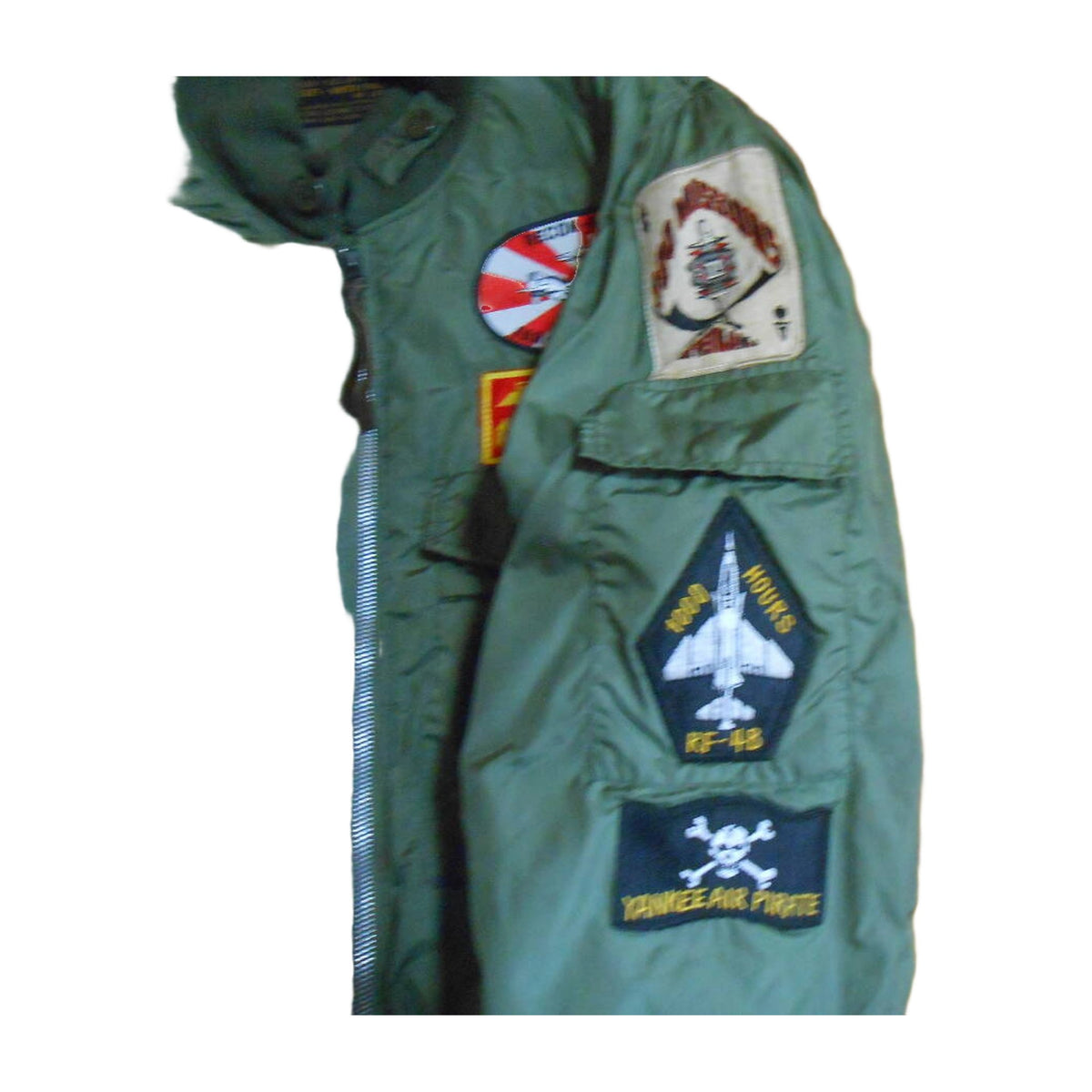
A black-label BuAer winter flying jacket by Aviators Clothing Co., later dressed in more than twenty patches of VMFP-3, the Marine RF-4B reconnaissance Phantom squadron whose Det C flew from Iwakuni in Japan.
The Jacket Collectors Call WEP
Few naval garments have as many names as this one. Officially it was the Jacket, Winter Flying Suit, and later the Jacket, Suits, Flying, Winter; collectors call it the WEP, after the Bureau of Naval Weapons that appeared on later labels, and the fashion world often sells it as the G-8. Whatever the name, it was the cold-weather companion to the leather G-1: a sage-green nylon shell over a quilted lining, with a knitted collar and cuffs, a smocked elastic waist, flapped chest pockets and a pen pocket on the sleeve.
Its specification passed through a series of revisions, MIL-S-18342 in 1955, 18342A in 1956, 18342B in 1958 and 18342C in 1964, and the WEP remained in Navy and Marine Corps service for decades. Because it was worn in ready rooms, on flight decks and on liberty, it became the natural canvas for squadron patches, and a fully patched WEP is one of the most recognisable images of Cold War naval aviation.
Unlike leather, nylon did not age into a heirloom, and many WEPs were worn until the linings gave out. Surviving early examples with their original labels, Conmar zips and a full complement of period patches are therefore much harder to find than the later, plainer jackets that turn up in surplus stores.
Aviators Clothing Co. and the B Revision
The label of this jacket reads BUAER, U.S. NAVY, JACKET, WINTER FLYING SUIT, SIZE 42 LONG, SPECIFICATION MIL-S-18342B, AVIATORS CLOTHING CO. INC., CONTRACT N383-53185A. Aviators Clothing Co. was a long-standing government contractor that supplied a wide range of flight jackets, including the B-15. The B revision of the specification dates from 1958, and the BuAer heading is consistent with Bureau of Aeronautics labelling before the bureau was merged into the Bureau of Naval Weapons in 1959 and 1960. That places the jacket around 1958 to the early 1960s; the exact year is not confirmed.
Black-label BuAer WEPs of this early generation are noticeably scarcer than the later green-label and Alpha examples, and collectors searching for an original Navy winter flying jacket to MIL-S-18342 tend to prize them for their earlier detailing and the Conmar zips fitted on many contracts, including this one.
VMFP-3, Eyes of the Corps
The patches tell a later story than the label. Marine Tactical Reconnaissance Squadron 3, VMFP-3, was activated on 1 July 1975 at MCAS El Toro, California, and flew the RF-4B Phantom II, the Marine Corps' unarmed reconnaissance variant, equipped for photographic, infrared and side-looking radar work. Its tail code was RF and its nickname 'Eyes of the Corps'. The squadron took over the reconnaissance mission previously flown by VMCJ-1, and its RF-4Bs deployed aboard USS Midway with Carrier Air Wing Five between 1975 and 1984.
VMFP-3 was deactivated in 1990, when the F/A-18D with the ATARS reconnaissance system took over Marine tactical reconnaissance. Its RF-4Bs, among the last Phantoms in Marine service, are remembered with great affection by enthusiasts, and the squadron's patches, with their camera-wielding cartoon figures and Phantom 'Spook' mascots, are among the liveliest of the era.
Det C at Iwakuni
VMFP-3 maintained detachments at Marine Corps Air Station Iwakuni in Yamaguchi Prefecture, the base of the 1st Marine Aircraft Wing's Marine Aircraft Group 15, and patches marked Det C denote that Japanese detachment. This jacket carries a whole family of them: the Rhino Warriors VMFP-3 Det C patches in red and blue, a rhino-shaped RF-4 badge, the Super Phantom Det C patch with the Spook dressed as Superman, the VMFP-3 Suspects Det C patch with its plea 'Honest, we didn't do it', and a Recon-Radar 'Far-East-Detention' patch that puns on the word detachment.
Alongside them are the base and wing insignia that frame the story: the 1st Marine Air Wing Iwakuni patch with its torii and eagle, globe and anchor, an MCAS Iwakuni triangle and a Marine Aircraft Group 15 triangle, together with the round VMFP 3 Spook, a Spook-shaped RF-4B patch, a rising-sun RF-4B pentagon, a 1000 Hours RF-4B patch and a Mach 2 Club Phantom II patch.
Iwakuni sits on the Seto Inland Sea, and for American aircrew of the 1970s and 1980s it was the gateway to the Western Pacific: a forward base from which detachments flew training and reconnaissance sorties across the region and from which Marines rotated back to California. A jacket dressed in Det C patches is, in effect, a memento of a tour in Japan.
Patch Culture on Japan's Air Bases
Many of these patches have the bright colours and dense embroidery of the Japanese base-shop work for which Iwakuni and other American stations in Japan were famous. Local embroiderers produced squadron, detachment and humour patches to order, and aircrew assembled them on their flight jackets as a running record of where they had served and what they had flown. The tradition is one reason Japanese collectors feel such a connection to these jackets: the patches were, in many cases, made in Japan.
The Yankee Air Pirate skull patch belongs to the same culture. It began as aircrew humour during the Vietnam War and was worn for years afterwards. Here it is part of a post-1975 ensemble, not evidence of Vietnam service. Base-shop patches were also produced for collectors, so while the grouping is coherent, each patch has not been individually verified.
A Name Tape and a Legend
The Marine aviator name tape on the chest reads JOHN H. GLENN, JR. John Glenn was a Marine fighter pilot in the Second World War and Korea, set a transcontinental speed record in 1957 under Project Bullet and became the first American to orbit the Earth. He retired from the Marine Corps in 1965 and never served with VMFP-3. The tape is a tribute or novelty tape, of a kind Marine aviators sometimes wore in jest, and it is not evidence that this jacket belonged to Glenn. We mention it because it is there, and because it is part of the humour of the piece.
The Piece
This is an original black-label WEP to specification MIL-S-18342B, made by Aviators Clothing Co. on contract N383-53185A, in size 42 Long, with its original Conmar zip in working order. The sage nylon shell is in good order. The quilted lining shows the wear typical of these jackets at the collar and armpits, and the knits have small damage and minor repairs.
Its real distinction is the decoration: more than twenty patches assembled around VMFP-3 and its Iwakuni detachment, together with US flag, 1st Marine Air Wing, MAG-15 and Phantom achievement patches. The jacket itself predates the squadron, so it is best understood as a long-serving garment re-patched by an RF-4B crewman between 1975 and 1990, a period after the Vietnam War when the Phantom still flew reconnaissance from Japan.
For anyone who collects the Phantom, Marine aviation or the American air presence in Japan, it is a remarkably complete visual record of one squadron's life at Iwakuni.
Details
- Type: US Navy WEP (Jacket, Winter Flying Suit), often called G-8
- Maker: Aviators Clothing Co. Inc.
- Contract / label: BuAer black label, MIL-S-18342B, contract N383-53185A
- Era: Jacket c.1958 to early 1960s; patches 1975 to 1990
- Leather / shell: Sage nylon shell
- Hardware: Conmar zip, flapped chest pockets, sleeve pen pocket
- Lining & knits: Quilted lining; knit collar and cuffs; smocked elastic waist
- Decoration: VMFP-3 and Det C patches, RF-4B, 1000 Hours RF-4B and Mach 2 Club patches, 1st MAW Iwakuni, MCAS Iwakuni and MAG-15 patches, Yankee Air Pirate, US flag; JOHN H. GLENN, JR. tribute name tape
- Tagged size: 42 Long
- Measurements: Shoulder 51 cm · Chest (pit to pit) 56 cm · Sleeve 68 cm · Length 60 cm
Condition
- Shell and patches in good order
- Lining wear at the collar and under the arms, typical of the type
- Small damage and minor repairs to the knits
- Patches post-1975; no Vietnam service implied
- Glenn name tape is a tribute or novelty tape
- Original Conmar zip works properly
Condition grade AB on the Japanese scale; see Japanese condition ranks, explained.
Authenticity & Care
The label, contract and size tags, leather, stitching, zip and hardware, paint and insignia are examined together and documented in Japan before dispatch; anything that cannot be confirmed is stated plainly in the description. Every piece carries the Japonista authenticity guarantee. Spot-clean the nylon shell only, never machine wash, and store flat or on a broad hanger so the patch-laden front does not drag the shoulders.
Delivery from Japan
Packed by hand in Japan and shipped insured and tracked by EMS or an equivalent express service. Import duties and taxes, where applicable, are payable on arrival. Every sale is final; please ask anything before you buy, and see our published policy.
Every figure above is taken by hand with the garment laid flat, in centimetres. Lay a shirt or jacket you already love beside them and allow a centimetre or two of margin, the quiet safeguard on a final sale. Our size guide to tops and jackets turns pit-to-pit figures into US, UK, EU and Japanese sizes, and for anything it leaves open the curator team replies within one Tokyo business day.
Considered offers are welcome through Send an Offer, and each one is reviewed personally. Pieces over $1,000 may be reserved over several payments with Layaway Privilege™.
Continue browsing: Military Flight Jacket & Nose Art · Designer Leather Jackets · Japan Luxury Archive
Eyes of the Corps
Collecting a particular squadron, or looking for a WEP or G-1 from one of the Japan air stations? Our Hunting Salon™ locates a specific reference across Japan’s private collector circles, then inspects, documents and delivers it to you. Begin a Hunting Salon™ request →
Collectors also search: US Navy WEP jacket · WEP flight jacket original · G-8 WEP jacket vintage · Navy winter flying jacket MIL-S-18342 · BuAer flight jacket black label · Aviators Clothing Co jacket · VMFP-3 patch jacket · RF-4B Phantom jacket · MCAS Iwakuni patch jacket · 1st Marine Air Wing Iwakuni patch · Phantom II Mach 2 Club patch · WEP jacket VMFP-3 Det C Iwakuni patches


Chosen for you