Rare Vintage, Antiques and Art Collector / Curator / Personal Shopper From Japan
Toys McCoy B-10 Bugs Bunny Flight Jacket Custom WWII Style Alpaca Lined Military Cartoon Jacket Size 36
Toys McCoy B-10 Bugs Bunny Flight Jacket Custom WWII Style Alpaca Lined Military Cartoon Jacket Size 36
Couldn't load pickup availability
Have a reasonable price in mind? Submit your best offer and our concierge will review it personally.
TOYS McCOY
A LICENSED B-10 FLIGHT JACKET, ‘STRENGTH AND PRECISION’ BUGS BUNNY CUSTOM
OLIVE SHELL WITH ALPACA-STYLE PILE COLLAR, GRAPHIC BACK PANEL, INSIGNIA PATCHING AND NAME STRIP
The present jacket is a noteworthy example of Japanese reproduction culture at its most playful and most self-aware, combining the utilitarian authority of the WWII-era B-10 flight jacket with the enduring iconography of Bugs Bunny in a composition that consciously echoes wartime nose-art and morale graphics. Executed by Toys McCoy, the piece benefits from a properly convincing military base, complete with olive shell, deep pile collar, and period-style proportions, allowing the graphic program to register as integrated rather than superficial.
What distinguishes the jacket is the unusual effectiveness of its pictorial language. The bold rear-panel slogan, bomb-riding Bugs Bunny figure, explosive accents, and mission-tally motif all invoke the visual grammar of combat-era personalization, yet are filtered through the lens of twentieth-century American animation and high-end Japanese collector manufacturing. The result is a jacket that functions simultaneously as outerwear, display object, and cultural crossover artifact.
Examples of this type appeal to a notably broad collecting audience, encompassing military-reproduction enthusiasts, animation and Americana collectors, and buyers interested in garments that operate as statement pieces within the archive-fashion field. In this respect, the present jacket is especially persuasive, its value lying not merely in brand or license, but in the coherence with which those elements are brought together.
Object Type: B-10 flight jacket
Maker / Label: Toys McCoy
Theme / Custom Program: Bugs Bunny custom flight-jacket presentation
Character License: Warner Bros. licensed character application indicated by interior tag
Material Family: Military flight-jacket shell with alpaca/wool-style pile lining and fur collar construction
Primary Color: Olive drab / khaki green
Graphic Language: Back-panel cartoon nose-art style composition with Bugs Bunny riding a bomb, explosive bursts, and mission-style bomb tally motifs
Construction Style: WWII U.S. Army Air Forces B-10 inspired reproduction
Collar: Brown alpaca-style pile collar
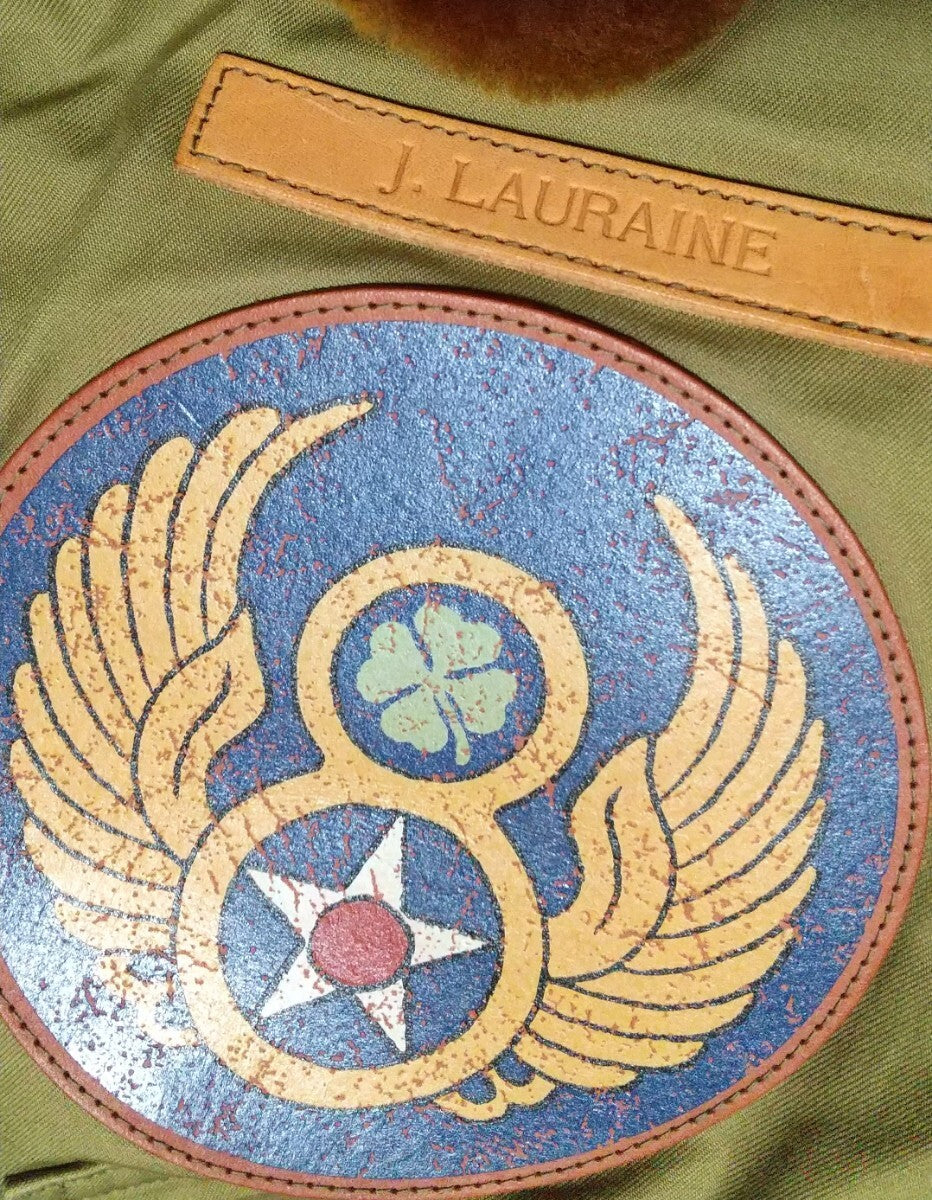
Front Details: Name strip “J. LAURAINE,” large chest insignia patch, sleeve Army Air Forces style insignia
Back Text: “STRENGTH and PRECISION”
Back Motif: Bugs Bunny seated on bomb with cartoon detonation bursts and extensive white bomb tally graphics
Tagged Size: 36
Spec Label: Type B-10 / Specification No. 3157 visible in tag photo
Condition Read: Lightly used presentation with visible overall strength; minor loose threads, small signs of handling, normal age/use character for a reproduction flight jacket
Collector Classification: Licensed Japanese collector-grade military-cartoon crossover jacket
Licensed character crossover executed on a serious reproduction flight-jacket base
Highly graphic back panel with excellent display impact
Collector-friendly military-animation fusion piece
Strong front-to-back balance between restraint and theatricality
Overview
This is the sort of piece that makes the Japanese reproduction universe so dangerous to collectors in the best possible way. On one level, it is a B-10, one of the most beloved transitional flight-jacket silhouettes to emerge from the WWII period: olive shell, pile-lined interior, fur collar, knit cuffs and waistband, practical front pocketing, and that unmistakable balance between utility and swagger. On another level, it is a fully theatrical object, a jacket that abandons anonymity and leans hard into the visual mythology of wartime custom art through one of the most unexpectedly perfect mascots possible: Bugs Bunny.
That is what gives this piece its voltage. It is not merely military style. It is military style filtered through cartoon bravado, American animation folklore, bomber-nose humor, and Japanese collector obsession. The result is not silly. It is magnetic.
The back panel does nearly all the heavy lifting and does it with unusual confidence. “STRENGTH and PRECISION” curves over Bugs Bunny riding a bomb, surrounded by stylized detonation bursts and rows of bomb tallies. This is classic flight-art grammar translated through pop iconography. The composition is loud, but not chaotic. It has exactly the right ratio of irreverence to structure. The figure reads instantly, the palette punches against the olive shell, and the bomb tally bands anchor the lower field with military rhythm.
What makes the jacket especially persuasive is that the underlying B-10 form is already one of the most wearable, handsome, and texturally satisfying military jackets ever made. That gives the cartoon treatment a grounded stage. Without a serious base, this kind of concept can become novelty. With a strong base, it becomes an object with real collector gravity.
This is not just a jacket with Bugs Bunny on it. It is a Japanese-built collector artifact operating at the crossroads of aviation history, licensed cartoon culture, and premium repro outerwear. That intersection is where the real heat lives.
Iconography
The iconography is beautifully direct and wonderfully shameless. Bugs Bunny is not treated here as a generic cartoon logo. He is recast as bomber art, a wartime mascot of cocky resilience, perched atop a red bomb with the same kind of theatrical confidence that pin-up girls, mascots, and aircraft nicknames once projected across fuselages and squadron jackets.
That translation matters. The jacket does not simply borrow a famous character. It repositions him inside the grammar of military custom art. The curved headline “STRENGTH and PRECISION” gives the scene mission-like force. The surrounding explosions act almost like visual percussion. The white bomb rows at the hem create count, repetition, and campaign language. Together, these elements turn the back into something closer to a pseudo-nose-art mural than a mere character print.
The front is more disciplined, which is exactly the right decision. The chest insignia patch provides immediate military coding. The leather name strip adds personalized cockpit energy. The sleeve marking further roots the piece in air-force symbolism. Because the front is comparatively restrained, the back gets to remain the knockout field. This front/back imbalance is crucial in jackets like this. It lets the wearer choose when the object behaves like military outerwear and when it erupts into full collector spectacle.
The use of Bugs Bunny is especially effective because he already carries a peculiar historical charge in twentieth-century visual culture. He is irreverent, impossible to intimidate, permanently unimpressed, and somehow always in command even inside chaos. Those traits map almost too well onto wartime morale-art logic. That is why the jacket works. The character is not random decoration. He fits the emotional architecture of bomber-era fantasy better than many more obvious choices would.
Material and Construction
A B-10 lives or dies by its tactile argument. This one appears to retain the proper ingredients of that argument: an olive shell with real field-jacket credibility, a deep brown pile collar that immediately warms the entire silhouette, a soft inner pile environment, and the robust front balance created by the B-10’s pocketing and knit finish.
The color palette is excellent. Olive shell, brown collar, brown knit, cream-white bomb tallies, yellow lettering, bright Bugs Bunny blues and reds. It sounds almost too busy on paper, yet visually it resolves with surprising elegance because the olive field absorbs and organizes the louder notes. The jacket never loses its military body. It remains grounded.
The collar is especially important. B-10 collars do more than keep the neck warm. They frame the entire jacket. Here the deep brown pile collar gives the piece a softness and a richness that prevent the graphic program from feeling flat or poster-like. The collar tells the eye that this object has volume, seasonality, and real garment authority. It is not just image. It is habitat.
The shell itself appears to present cleanly, with the kind of mild use character that actually helps a piece like this. Perfectly sterile examples of cartoon military customs can sometimes feel toy-like. A little life in the fabric, a little handling in the body, can make the jacket feel more convincing as outerwear and less like prop merchandise.
The front name strip and patching also matter materially. They provide depth through stitched-on contrast elements rather than relying solely on printed graphics. That layered construction helps the piece feel assembled, not merely decorated. The same goes for the military-style sleeve insignia, which reinforces the sense that the jacket belongs to a world rather than existing as isolated fan service.
Maker Significance
Toys McCoy matters because it occupies that elevated zone in Japanese reproduction culture where military garments are treated with a kind of reverent technical obsession. The brand understands that old flight clothing is not only about silhouette. It is about aura: the way fabrics sit, the way collars frame the neck, the way knits finish the hem, the way a jacket suggests machinery, sky, and narrative even when hung motionless.
Once a maker like Toys McCoy enters licensed character territory, the danger is obvious: the result could become novelty merchandise. What separates their better pieces from novelty is that they still begin from a serious garment philosophy. The jacket must work first as a jacket. Only then can the art matter.
This example shows why that order is correct. The B-10 base gives the character program backbone. Bugs Bunny is not pasted onto a weak shell. He is embedded within an already desirable military-repro format. That dramatically raises the collectible stakes.
There is another layer here too. Japanese collectors have long understood something that global markets sometimes miss: mid-century American military culture and mid-century American animation are not separate universes. They overlap in humor, propaganda, silhouette, energy, and iconography. Brands like Toys McCoy know how to mine that overlap without flattening it. When they succeed, the result is not costume. It is a new archive object.
This jacket lands squarely in that space.
Historical and Cultural Context
The B-10 is one of the key bridge garments of twentieth-century military outerwear. It belongs to the moment when heavy leather flight jackets began to give way to textile-based systems better suited to evolving combat conditions and aircraft environments. In collector culture, however, the B-10 has always been more than a technical transition. It is one of the warmest, most attractive, and most wearable wartime silhouettes ever produced.
That makes it an especially potent base for reinterpretation.
At the same time, Bugs Bunny is not just a cartoon celebrity. He is one of the most enduring American visual personas of the twentieth century, carrying with him irony, resilience, mockery of authority, and a kind of unflappable self-possession that feels strangely close to wartime morale culture. During the WWII era, cartoon imagery and military life were not strangers. Animation, nose art, insignia culture, and barracks humor often moved through the same imaginative air.
This jacket taps that shared oxygen. It does not attempt to recreate a literal original period piece. Instead, it stages a conversation between wartime jacket culture and animated Americana through the lens of a high-end Japanese repro maker. That makes it an object of cultural crossover rather than mere reproduction.
The back slogan, the bomb-riding pose, and the tally marks all amplify this feeling. They evoke not innocence but attitude. Bugs Bunny becomes an emblem of aerial mischief, precision, audacity, and mission bravado. The military framing gives the cartoon bite. The cartoon gives the military framing charm. Each needs the other.
Collector Relevance
This piece has broad collector reach precisely because it refuses to stay in one lane.
For Toys McCoy collectors, it offers a branded crossover example with strong visual impact and recognizable collector appeal.
For flight-jacket enthusiasts, it provides one of the most attractive cloth flight-jacket silhouettes ever made, complete with the visual density of patching, custom art, and pile-collar presence.
For cartoon and licensed-character collectors, it is far more desirable than generic licensed outerwear because the character is embedded in a fully realized military-art concept rather than floating as mere branding.
For archive-fashion buyers, the jacket has immense visual utility. The back panel is theatrical enough to anchor a wardrobe, a photoshoot, or a display wall, while the front remains restrained enough to preserve styling flexibility.
For Americana and crossover collectors, the object is almost a thesis statement: animation mythology, militaria aesthetics, Japanese manufacturing seriousness, and postwar collector fetish all fused into one body.
That crossover is the key. A normal B-10 may appeal mainly to flight-jacket people. A normal Bugs Bunny item may appeal mainly to character people. This piece attracts both, and then some. That expands the demand halo around it. Expanded halos matter. They make certain objects much harder to replace because the buyer pool is no longer narrow.
Condition Positioning
The condition should be framed as strong and wearable within collector expectations, while still respecting the fact that this is a used jacket with some small signs of life. From the provided information and images, the presentation remains highly attractive. The artwork reads clearly. The shell holds shape well. The collar remains visually rich. The knits and body appear solid overall, with only ordinary minor wear language attached.
That is a very good place to be for a piece like this.
Collectors do not always want absolute sterility in a jacket that trades on military-art atmosphere. Light use can actually deepen authenticity of feel, especially when the graphics remain fresh and the structural body remains handsome. The key is that the condition does not seem to undermine the core visual experience. Here, it does not. The jacket still performs.
So the correct framing is not “mint,” but rather:
strong collector condition, visually commanding, materially persuasive, lightly used, and display-excellent.
That is the tone the piece deserves.
Summary
This is a Toys McCoy B-10 that succeeds because it understands exactly what kind of object it wants to be. It is warm, military, graphic, theatrical, collectible, and deeply legible at first glance. The B-10 silhouette gives it gravitas. The Bugs Bunny treatment gives it personality. The bomb tally field gives it wartime theater. The insignia and name-strip details complete the illusion that this belongs to a fully imagined alternate archive.
It is not subtle, and that is part of its charm.
It is not generic, and that is part of its value.
It is not just licensed outerwear, and that is why it matters.
This is the kind of jacket that can live in a collection, on a wall, on a rack, or on the body and still command attention every single time.
Authenticity & Stewardship
Evaluated under the Japonista Aviation & Military Garment Authentication Framework™
Each work is examined through a structured, multi-layered assessment:
• Model classification and military typology verification (A-2, B-3, MA-1, G-1, L-2, etc.)
• Material evaluation across leather, shearling, nylon, wool, and mixed components
• Hardware inspection including zippers, snaps, and period-correct fastenings
• Graphic and nose art analysis, including paint method, iconography, and historical alignment
• Condition and structural integrity review, including wear patterns consistent with age and use
Where applicable, contract labels, manufacturer markings, and period construction details are reviewed to confirm authenticity and era alignment.
Guaranteed 100% Authentic.
All garments are curated and backed by the Japonista Lifetime Authenticity Warranty™, with emphasis on both material truth and historical accuracy.
A Note on Flight Jackets, Service & Visual Identity
Military flight jackets were engineered as functional equipment—designed for temperature regulation, durability, and survival in demanding conditions. Over time, they evolved into carriers of identity, memory, and personal expression.
Nose art and painted jackets—originally applied to aircraft and later to garments—represent a distinct form of visual folklore. Pin-up figures, squadron insignia, mascots, and symbolic imagery transformed standard-issue equipment into individualized statements of presence and morale.
At Japonista, these jackets are approached as wearable military artifacts. Surface wear, leather creasing, paint aging, and textile fatigue are evaluated as evidence of lived history rather than imperfection.
We preserve these works with restraint—allowing their material narrative to remain visible and intact.
Our role is to connect these garments with collectors who recognize their dual nature as both functional objects and historical documents.
Inquiries, Availability, and Private Consideration
Many flight jackets are singular in character due to condition, paintwork, contract variation, or production era. Certain pieces are held firmly due to rarity, historical resonance, or preservation status.
All inquiries are handled discreetly, and we welcome thoughtful discussion regarding provenance, contract details, nose art interpretation, and long-term wear or display considerations.
Collectors building focused archives—by model type, era, or graphic style—may consult with us for deeper guidance.
Concierge Support & Collector Guidance
Japonista Concierge™ provides tailored assistance for collectors seeking deeper engagement with aviation garments:
• Model and contract identification (A-2 variants, G-1 lineage, MA-1 evolution)
• Leather and textile preservation guidance
• Paint conservation and display considerations
• Wearability versus archival preservation assessment
• Strategic acquisition planning for aviation-focused collections
For select rare or historically significant works, private reservation or structured acquisition arrangements may be available on a case-by-case basis.
Before Proceeding
We encourage collectors to review our shop policies and house guidelines, available through the links in our website footer. These outline shipping protocols, handling considerations, and condition standards specific to vintage leather, painted garments, and military-issued clothing.
Understanding these guidelines supports responsible stewardship of each piece.
A Closing Note
Flight jackets occupy a distinct place within material history. They are objects of function shaped by environment, and over time, transformed into records of identity, service, and expression.
Nose art—whether applied to aircraft or garments—extends this narrative, capturing moments of humor, defiance, and individuality within structured military life.
At Japonista, we steward these works as aviation artifacts in wearable form—ensuring they continue their journey with collectors who understand both their construction and their story.
If you have questions or wish to explore related items, please feel free to contact Japonista Concierge™ at any time.