
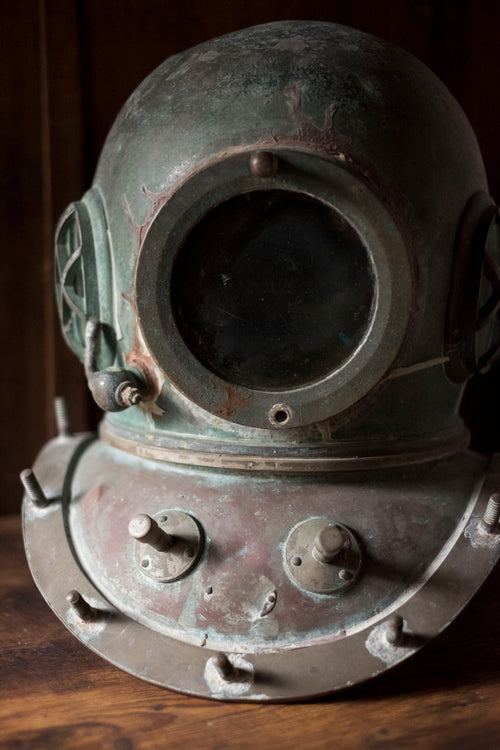


TOA Commercial Diving Helmet in Cast Bronze with Glass Viewports, Japanese Shōwa Period, c. 1930s–1950s
TOA Commercial Diving Helmet in Cast Bronze with Glass Viewports, Japanese Shōwa Period, c. 1930s–1950s
- Dispatch
- Prepared and sent from Tokyo within 7–14 days, often sooner, or as arranged
- Arrival
- United States · usually 4–7 days after dispatch, insured and tracked Check the Shipping Flowchart here
- Shipping
- Quoted for this piece before purchase ·
- Import
Duties and customs · View the estimate
A guide for this piece: about $396, based on the 10% US charge on the declared value of goods made in Japan.
The final figure is set by US Customs and depends on where the piece was made and the kind of object it is. Many antiques over a century old carry no ordinary duty; most jewellery and leather goods add a single-digit rate.
With EMS, any charge is collected by your postal service on delivery. For pieces of significant value we can often arrange duties prepaid before dispatch.
Your customs authority: U.S. Customs and Border Protection (CBP), CBP Information Center · +1 877 227 5511 within the United States; +1 202 325 8000 from abroad (Monday to Friday, 8:30 to 17:00 Eastern)
These figures are estimates for your guidance; the charge set by customs may come in over or under them.
How the estimate is reached · Ask for a figure on this piece
- Character
- Scoring underway ·
- Replies
- Within one Tokyo business day · Ask the curator team
- Guarantee
- Authenticity guaranteed · How we grade
Every piece is measured by hand, in centimetres as Japan measures. Please allow 1–2 cm (about ½ inch) for the give of the material and the hand that held the tape.
Where each figure is taken · View the plate

Object, sculpture and ceramics
Freight piece: please confirm delivery before purchase
This piece travels in a crate or by freight rather than standard mail, and may need careful dismantling before it can be packed. The shipping shown at checkout is an estimate. Japonista reserves the right to determine the final handling, crating and freight cost when your order is received, according to the piece, the destination and carrier conditions at that time.
We advise requesting a delivery quote before checkout. If the final cost is higher than the amount paid, we send the difference for your approval before dispatch. Your piece is held for you until it is settled.
Questions about delivery? Write to the curator deskCouldn't load pickup availability
All sales are final. Please read our refund policy before purchase.
Considered offers only. The Desk replies personally to figures made in good faith; those set far below the asking price receive no reply.
Examined in Tokyo, one price, insured to your door. How buying from Japonista works · Join the Circle, free
Before composites and digital instruments there was weight. This sand-cast bronze helmet, attributed to TOA of Tokyo, served Japan's Shōwa-era working divers and now carries a stable verdigris skin, its form never meant to be aesthetic, yet made so by survival.
The Piece
A substantial and visually compelling Japanese commercial diving helmet attributed to TOA, executed in cast bronze with multiple reinforced glass viewports. It retains its original structural configuration, including the rounded dome and bolted neck assembly. The helmet was one component of a surface-supplied hard-hat system: air was pumped from the surface, the helmet maintained positive pressure, and the diver worked tethered by an umbilical. There was no redundancy in such systems, only precision, and failure was immediate and unforgiving.
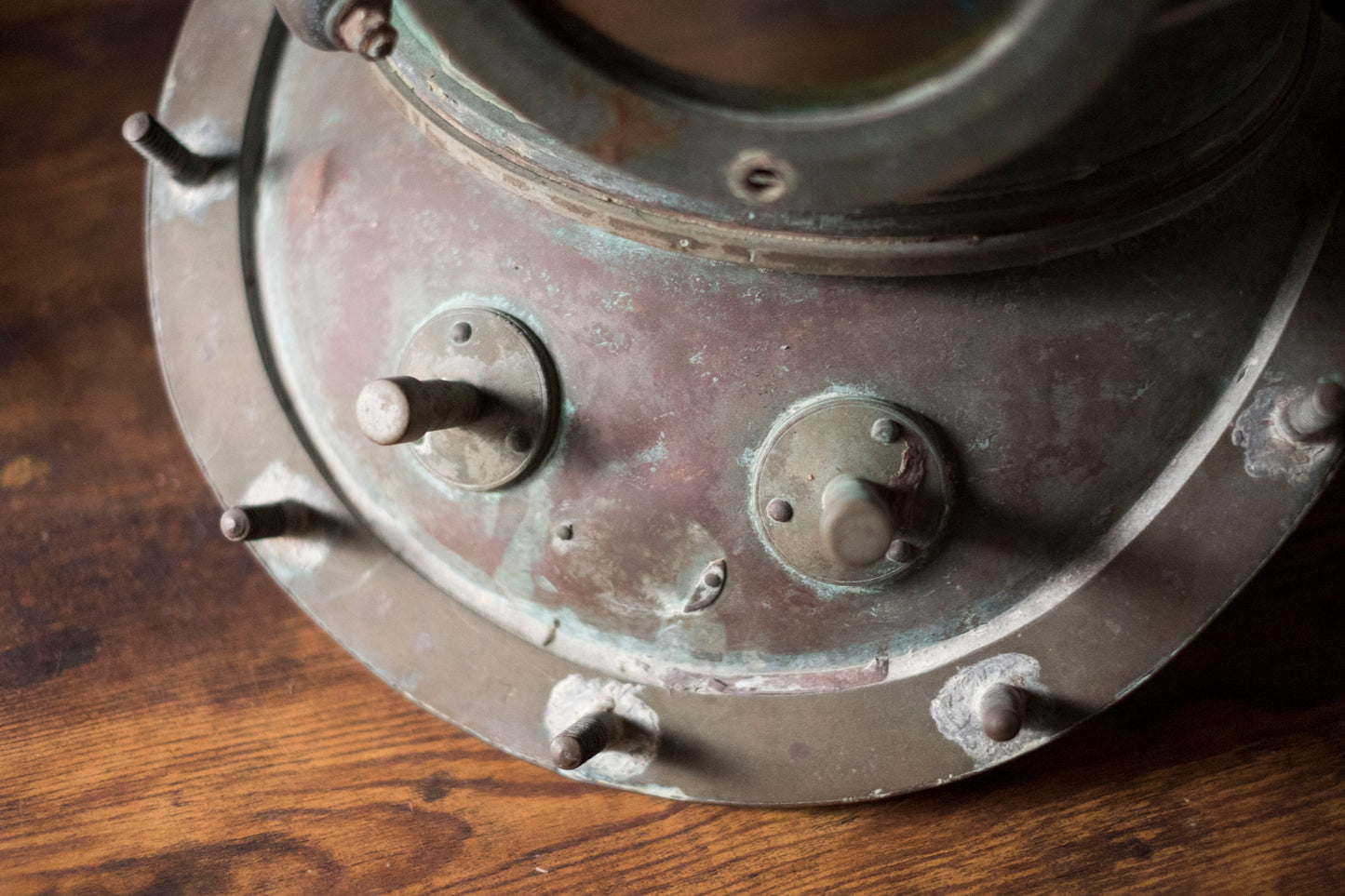
Every curve serves a purpose. The rounded dome distributes external pressure evenly, the thick glass ports act as controlled visual apertures, and the neck ring ensures a sealed interface with the diving suit; this is pre-digital engineering solved through physics rather than electronics. The dome was sand-cast, its threading surfaces and viewport housings machined after casting, and the whole finished by hand in a manner consistent with mid-20th-century industrial production.
Bronze here is a recorder of time. The green patina spreading across the surface is evidence of oxygen, salt, moisture and years of interaction with a copper-rich alloy designed to resist rather than surrender. Unlike iron, which flakes and collapses, bronze transforms slowly, stabilizing into a skin that protects what lies beneath, which is why maritime engineers favored it.
Where Western helmets often embraced polished brass and visual authority, Japanese helmets such as this TOA example embody something quieter: function-first minimalism rooted in practical necessity, material honesty and structural balance. Relative to DESCO (USA), more modular and polished, and Siebe Gorman (UK), earlier in innovation and more refined in engineering, TOA helmets show heavier casting, less ornament and greater raw industrial presence, and they are less common internationally, which makes them highly distinctive in global collections.
During the Shōwa era, Japan's coastline became a site of intense industrial activity, with expanding ports, ships in constant need of maintenance and infrastructure reaching into the sea. Helmets like this served harbor reinforcement and dredging, ship hull maintenance, salvage recovery and underwater construction in high-current coastal zones. Their divers were workers, not explorers, unseen from the surface and connected only by lifeline and trust. Today the helmet works at once as artifact, as sculpture shaped by necessity and as a presence that anchors the space around it.
Details
- Maker: TOA (TOA industrial diving equipment lineage, Tokyo), attributed
- Era: Shōwa period, c. late 1930s–1950s, with possible overlap of prewar tooling into early postwar production
- Origin: Japan
- Object: Commercial diving helmet, component of a surface-supplied hard-hat system
- Material: High-copper cast bronze alloy (likely tin bronze with trace zinc); machined brass/bronze viewport rings; thick pressure-resistant glass (pre-acrylic era); marine-grade fasteners (bronze or early steel variants)
- Construction: Sand-cast dome body; post-cast machining of threading surfaces and viewport housings; manual finishing; rounded dome with bolted neck assembly
Condition
- Structural integrity intact; original structural configuration retained.
- Naturally developed verdigris patina across the copper-rich surfaces; oxidation layers stable and visually dense.
- Minor abrasions and oxidation consistent with age and functional use.
- Wear consistent with prolonged marine exposure and storage aging.
- An early production form with dense bronze casting integrity, retaining its original patina.
Authenticity & Care
Attributed to TOA of Tokyo on form, casting and construction; alloy and fastener descriptions are qualified (likely tin bronze; bronze or early steel fasteners) pending further examination. Every piece is examined and documented in Japan before dispatch and is offered with the Japonista authenticity guarantee.
Delivery from Japan
Packed by hand in Japan and shipped insured and tracked by EMS or an equivalent express service. Import duties and taxes, where applicable, are payable on arrival. Every sale is final; please ask anything you wish to know before you buy, and see our published policy.
Considered offers are welcome through Send an Offer, and each one is reviewed personally. Pieces over $1,000 may be reserved over several payments with Layaway Privilege™.
Continue browsing: Maritime Antiques
Armory & Export
Armor, sword fittings and historical militaria travel with export paperwork, custom crating and insured freight through our Museum-Grade Logistics Suite™. Plan a museum-grade shipment →
Collectors also search: toa diving helmet · japanese bronze diving helmet · showa diving helmet · antique commercial diver helmet · vintage hard hat diving helmet · maritime antique japan · cast bronze diving helmet


Chosen for you